Kelsey Hightower spent decades shaping the cloud-native ecosystem, most notably as a driving force behind Kubernetes and a leading advocate for pragmatic engineering. Known for his ability to demystify complex systems, his "learning in public" ethos and human-centric approach to infrastructure changed how developers understand and build software. This collection distills his philosophy on technology, career longevity, and the importance of solving actual problems rather than chasing hype.
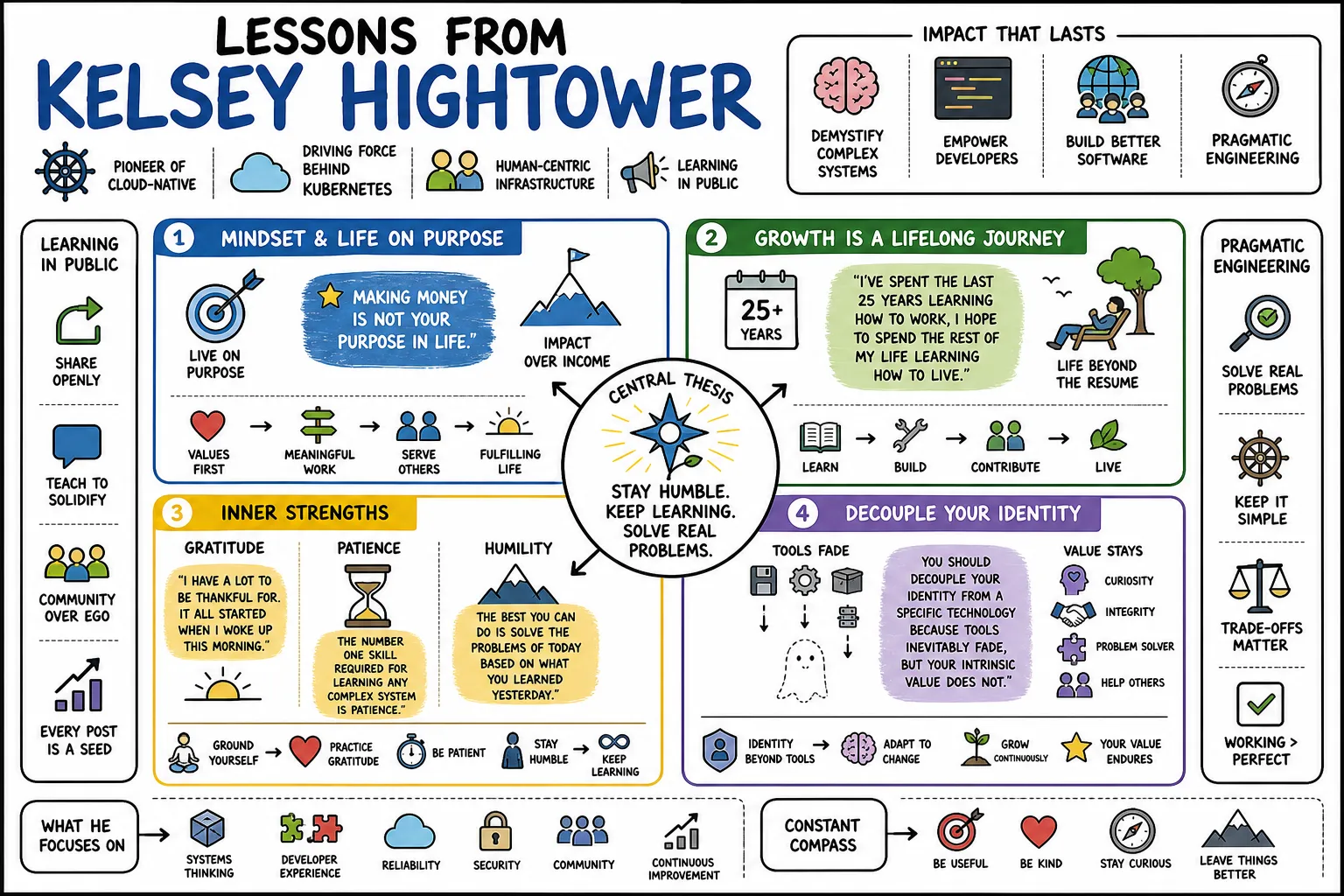
Part 1: On Mindset and Life
- On Purpose: "Making money is not your purpose in life." — Source: [GitHub]
- On Retirement: "I've spent the last 25 years learning how to work, I hope to spend the rest of my life learning how to live." — Source: [Software Misadventures]
- On Gratitude: "I have a lot to be thankful for. It all started when I woke up this morning." — Source: [Twitter / X]
- On Patience: "The number one skill required for learning any complex system is patience." — Source: [DefProgramming]
- On Humility: "The best you can do is solve the problems of today based on what you learned yesterday. Keep learning and stay humble." — Source: [GitHub]
- On Identity: You should decouple your identity from a specific technology because tools inevitably fade, but your intrinsic value as a problem solver remains. — Source: [Mentors FM]
- On Minimalism: "If you keep things as minimal as possible... then when you find that important thing, then you can go hard on it without having all this unnecessary complexity lying around that's holding you back." — Source: [Humans+Tech]
- On Success: "Once you've found success, your next goal should be helping others do the same." — Source: [GitHub]
- On Origins: "Never forget where you come from so you'll remember to help those who come after you." — Source: [GitHub]
- On Pace: "Slow down so you can speed up." — Source: [Twitter / X]
Part 2: On People and Leadership
- On Core Skills: "What skills should I invest in? People skills. No. I mean what tools and best practices should I learn? Learn what respect is. Then use it on everyone around you." — Source: [YouTube]
- On Impact: Learn the distinct difference between mere daily activities and actual business impact. — Source: [Tech Lead Journal]
- On Credit: "Don't take all the credit. Leave some for those doing the work." — Source: [Twitter / X]
- On Disagreement: "When people disagree with you, don't miss the opportunity to listen, and possibly learn from them." — Source: [Twitter / X]
- On the Senior Human: True leadership requires empathy, clarity, influence, and restraint; possessing technical excellence is only the baseline expectation. — Source: [Medium]
- On Design: "Great leaders listen before they design." — Source: [Medium]
- On Judgment: In an era of AI-generated code, the real engineering value lies in taste, intention, and knowing which system tradeoffs are acceptable. — Source: [Tech Lead Journal]
- On Multipliers: "I think a 10x engineer is the type of person who can come in and make 10 other people better than they were before." — Source: [YouTube]
- On Mentoring: Mentorship is about enabling others to work better, and success should be measured by what your mentees independently achieve. — Source: [InfoQ]
- On Learning Out Loud: Admitting you do not know something and asking questions publicly is the fastest way to level up and build trust within a team. — Source: [HashiCorp]
Part 3: On Open Source and Community
- On Collaboration: "Open source is about collaborating; not competing." — Source: [Rocket.Chat]
- On Maintenance: "Maintaining an open-source project is like being a Flight Attendant for an airline where all tickets are free and the majority of customer surveys offer suggestions on how to fly the airplane." — Source: [Kartaca]
- On Communication: "From the open source community, you have no choice but to be a communicator." — Source: [YouTube]
- On Meritocracy: "When I started committing to Kubernetes, there was no one checking for college degrees... open source allows talent to emerge regardless of background, and contributions matter more than credentials." — Source: [The New Stack]
- On Origins: "The origins of open source came from fighting against the big vendors." — Source: [The New Stack]
- On Sovereignty: "Open source is a way that you can take sovereignty over your own career." — Source: [The New Stack]
- On Community Value: Internal company headcount is no match for gaining the perspectives of hundreds of thousands of people in a global open source community. — Source: [Substack]
- On Open Licensing: "I don't think the answer is changing your license. That's not going to work folks... you're going to have to figure out how to offer value in an open ecosystem." — Source: [YouTube]
- On Empathy for Maintainers: Open source is fundamentally about people, and if a community isn't welcoming, contributors will leave regardless of the underlying technology's quality. — Source: [GitHub Blog]
- On Influence: "If I talk to 30% of my customer base and they all start asking for the same thing, you end up having a lot of sway over what happens." — Source: [YouTube]
Part 4: On Kubernetes and Cloud Native
- On The Endgame: "Kubernetes is a platform for building platforms. It's a better place to start; not the endgame." — Source: [YCombinator]
- On The Future: "The future of Kubernetes, if we're being honest, is that it has to go away. If we're still talking about Kubernetes 20 years from now, that would be a sad moment in tech because we didn't come up with any better ideas." — Source: [GitHub Blog]
- On Abstraction: "What Kubernetes does is actually, in my opinion, it's just a very thin layer on top of, for most people, virtual machines." — Source: [Tech Lead Journal]
- On Overuse: "I think Kubernetes is overused, because people just don't quite understand what it does." — Source: [The Podlets]
- On The Hard Way: To truly master a system like Kubernetes, you must bootstrap it manually at least once to understand the security and networking layers obscured by automated tools. — Source: [GitHub]
- On Custom Resource Definitions: "They're just making CRDs for everything. There are CRDs to take a shower. I'm like 'Dude, no. You just literally go take a shower. You don't need to do kubectl apply. Take a shower!'" — Source: [GitHub]
- On Edge Computing Rebrands: "If you're stuck on-prem, and starting to feel like you missed out on the cloud native movement, just start calling it 'edge' and consider your digital transformation complete." — Source: [Twitter / X]
- On Legacy Patterns: "A lot of enterprises approach technology where they say, 'Hey, can you make the new thing work the old way?'" — Source: [Stack Overflow Blog]
- On The Cloud: "It is the cloud, it is not heaven. Everything is a tradeoff... just make them intentionally." — Source: [OfBizian]
- On the Goal of Cloud: The ultimate goal of adopting cloud infrastructure is for organizations to have as little direct interaction with underlying servers as possible. — Source: [GitLab]
Part 5: On Engineering and Complexity
- On Automation: "As an industry we've been pushing: Automate. Automate. Automate. We should have been saying: Understand. Understand. Understand. Because if you understand what you're doing, you can automate if you want to." — Source: [GitHub]
- On Progress: "More code doesn't mean more progress; often it means more liability." — Source: [Medium]
- On Tool Mastery: "You haven't mastered a tool until you understand when it should not be used." — Source: [Dev.to]
- On Complexity: "As an industry we tend to build overly complex solutions and dedicate our careers justifying their existence. This typically results in technical debt and ultimately bankruptcy." — Source: [Tech Lead Journal]
- On the Magician's Trick: "The magician's power comes from being the only one that understands how something works. Learn how it works and they won't be able to trick you." — Source: [GitHub]
- On Completion: "Done is the best metric." — Source: [GitHub]
- On Infrastructure as Code: "Infrastructure as code has always been seen as this fragile black box." — Source: [Platform Engineering Podcast]
- On Feature Flags: "The reality is they are tech debt. They're ticking time bombs and they're incredibly valuable, just like regular debt." — Source: [Platform Engineering Podcast]
- On Overengineering: "If you don't end up regretting your early technology decisions, you probably overengineered." — Source: [OfBizian]
Part 6: On Career and Experience
- On Ignorance: "Pay attention because ignorance is expensive." — Source: [Twitter / X]
- On CS Degrees: "Pursuing a CS degree isn't a waste of time. Assuming those who chose not to are inferior is." — Source: [YouTube]
- On Experience Breadth: "Be careful not to go out and get 20 years of one-year experience." — Source: [GitHub]
- On Entrepreneurship: "I think starting with the entrepreneurial mindset really kind of set my career up really nice." — Source: [Tech Lead Journal]
- On Self-Taught Reality: "We used to say non-traditional background, but I think so many people in tech these days are self-taught that maybe this is the traditional approach." — Source: [Tech Lead Journal]
- On Fundamentals: "Technology doesn't move that fast. The fundamentals are roughly the same. It's the fact that we don't necessarily teach fundamentals." — Source: [Tech Lead Journal]
- On Focusing: "At some point I made the decision to focus on foundational concepts; not features of a particular implementation; my tech career took off." — Source: [Twitter / X]
- On Career Sovereignty: You should define your own definition of success, set your own goals, and turn down roles that misalign with the impact you want to have. — Source: [YouTube]
- On Opportunity: Instead of putting all your eggs in the Big Tech basket early on, go where you can get your hands dirty, learn new things, and push yourself. — Source: [Tech Lead Journal]
Part 7: On Systems and Operations
- On Culture vs. Scripts: "There is no single continuous integration and delivery setup that will work for everyone. You are essentially trying to automate your company's culture using bash scripts." — Source: [GitHub]
- On Microservices: "Microservices simplifies code. It trades code complexity for operational complexity." — Source: [Twitter / X]
- On Operations: "You can't separate the operations of a service from its development. They're intrinsically linked." — Source: [Twitter / X]
- On System Administration: "I think most people who have any system administration experience with more than a handful of machines already has about 85% of the fundamentals required to really leverage Kubernetes." — Source: [Gremlin]
- On Distributed Systems: "Distributed systems are hard. You can bootstrap one in 10 minutes, but it's going to take a real time investment to understand how it works." — Source: [GitHub]
- On Service Mesh: "Service mess: the result of spending more compute resources than your actual business logic dynamically generating and distributing Envoy proxy configs and TLS certificates." — Source: [Twitter / X]
- On Free Software: "The price for free software is your time." — Source: [OfBizian]
- On Containers: "Treating containers like a black box will eventually leave you in the dark." — Source: [GitHub]
Part 8: On Product and Business
- On Hello Revenue: The ultimate goal of enterprise technology is not reaching "Hello, World," but reaching "Hello, Revenue"—the point where it solves a real problem and generates value. — Source: [Platform Engineering Podcast]
- On Ideas: "Ideas travel faster than code." — Source: [Twitter / X]
- On Hype vs. Usage: "Usage matures products faster than hype does." — Source: [GitHub]
- On Business Context: "Technology supports business goals, so engineering teams need to first understand the customers and business they are supporting before understanding the purpose and impact of that technology." — Source: [The New Stack]
- On Breaking Things: "Move slow and fix things." — Source: [Twitter / X]
- On the Monopoly of Power: "The monopoly isn't the fact that there's only one company doing it. The monopoly is the fact that it takes almost a nation state with access to huge amounts of capital and power to even venture down this road." — Source: [Bitdrift]
- On the NoCode Movement: "No code is the best way to write secure and reliable applications. Write nothing; deploy nowhere." — Source: [GitHub]
- On Selling Complexity: "Selling complexity will eventually cost you." — Source: [Twitter / X]
- On The Value of Boring: Use reliable platforms for what they excel at, and treat "boring" technology as a competitive advantage that allows you to focus purely on the business logic. — Source: [YouTube]