Kenneth Cole spent four decades building a global shoe and apparel brand. He is best known for directing the company's advertising platform toward social causes, from early HIV/AIDS awareness to current mental health advocacy. He also kept revisiting the mechanics of the company itself: how it reached customers, where it invested, and what made the brand worth choosing again. His career shows how resourcefulness, long-term thinking, and a clear point of view can help a business survive market shifts while contributing to public life. The lessons below focus on those operating choices rather than treating purpose as a separate philanthropic chapter.
Part 1: Entrepreneurial Resourcefulness
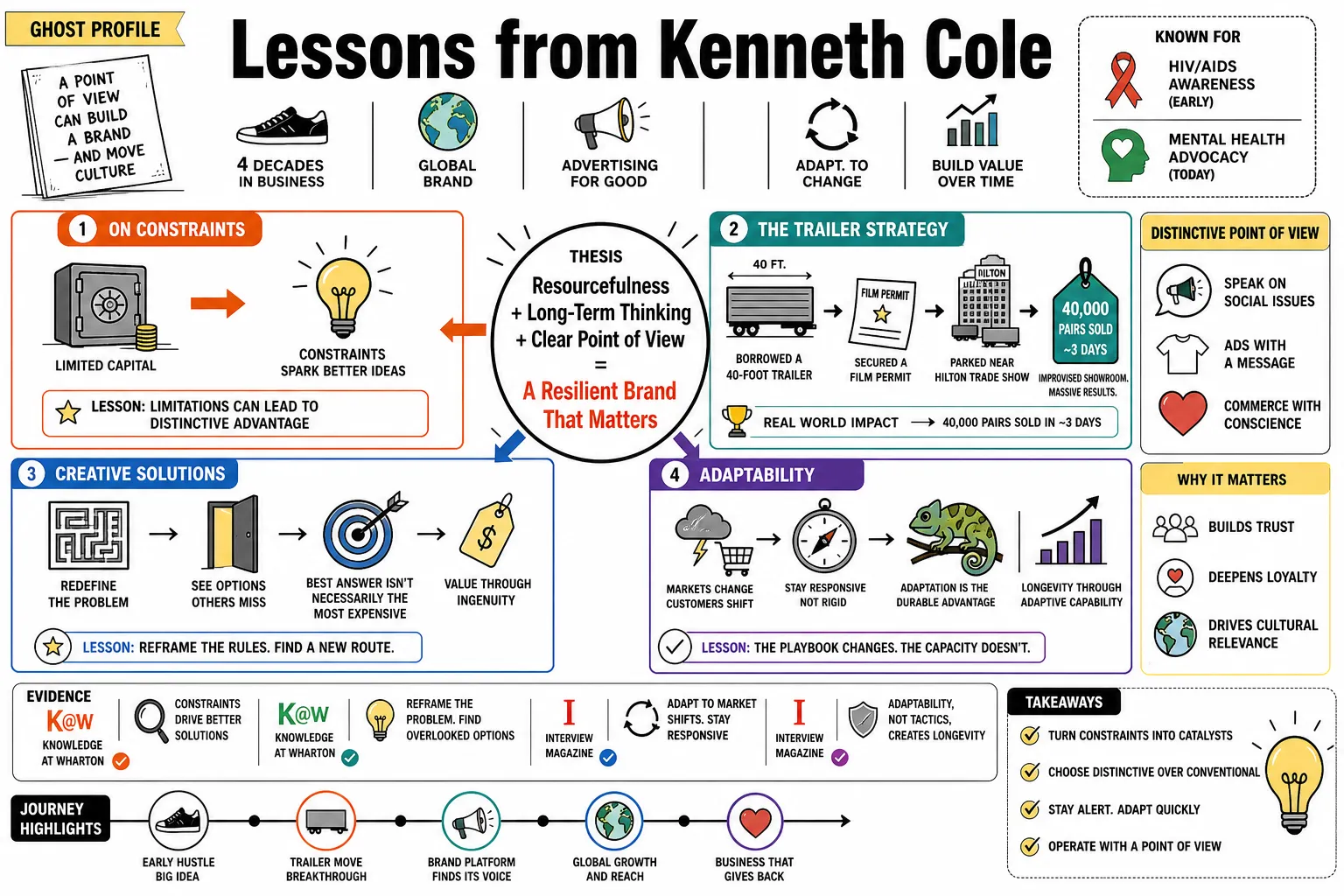
- On Constraints: Limited capital can force a better solution. When Cole could not afford the conventional trade-show options, he treated the constraint as a prompt to find a more distinctive route to customers. — Reference: Knowledge at Wharton
- On The Trailer Strategy: Cole borrowed a 40-foot trailer, renamed his company Kenneth Cole Productions, and secured a film permit to park near the Hilton trade show. The improvised showroom helped him sell 40,000 pairs of shoes in roughly three days. — Reference: Interview Magazine
- On Creative Solutions: The best answer is not necessarily the most expensive one. Cole's launch story illustrates how reframing the rules of a problem can reveal an option competitors have overlooked. — Reference: Knowledge at Wharton
- On Adaptability: A durable business model must respond positively when markets and customer behavior shift unexpectedly. Longevity depends less on preserving yesterday's playbook than on keeping the organization responsive. The stable element is the capacity to adapt, not a fixed set of tactics. — Reference: Interview Magazine
- On Distinctive Design: A product does not need to be unrecognizable to feel original. Cole's design instinct was to take a familiar garment or shoe, change a meaningful detail, and make the result unmistakably his. — Reference: Interview Magazine
- On Customer Dialogue: The designer's job is not simply to dictate taste. Cole framed it as learning what people want and then giving it to them in a form they did not quite expect. — Reference: Interview Magazine
Part 2: Integrating Cause and Commerce
- On Authenticity in Marketing: Purpose fails when customers perceive it as a device for selling more shoes. Social commitments have to be credible in their own right rather than an ornamental campaign theme. — Reference: Forbes
- On Deeper Connections: A brand can build a more substantive relationship by engaging with what is on customers' minds, not only what is on their bodies. That relationship must be earned through consistency. — Reference: Forbes
- On Purpose: Bringing a genuine sense of purpose to a business can make customer relationships more meaningful and durable. Purpose is strongest when it shapes what the company repeatedly does. — Reference: Forbes
- On Human Messages: Cole distinguished social and human messages from partisan ones. The aim was to provoke thought about issues affecting the community without reducing the work to party politics. — Reference: Forbes
- On Cause and Commerce: A company can connect products with public causes without making the cause subordinate to a transaction. The commercial partnership should create a useful contribution without overwhelming the underlying story. — Reference: Forbes
- On Real Stories: Social-impact work becomes more relatable when it gives real people room to describe both struggle and progress. The brand's role is to help carry the story, not make itself the hero. Emotional connection should come from the people and cause, not from enlarging the sponsor's logo. — Reference: Forbes
- On Speaking Early: Cole used a major advertising campaign to address HIV/AIDS in 1985, when stigma made public discussion unusually difficult. A platform matters most when it is used before a position becomes safe or fashionable. — Reference: Knowledge at Wharton
Part 3: Leadership and Advocacy
- On Service: Work becomes more fulfilling when it is made larger than the product itself and affects people in a meaningful way. Leadership can expand the relevance of an ordinary business platform. — Reference: Interview Magazine
- On Defying Stigma: Cole's early AIDS advertising focused not only on the disease but on the social cost of being unable to discuss it. Leaders can use attention to make a previously avoided conversation possible. — Reference: Knowledge at Wharton
- On Sustained Advocacy: Cole's activism extended across HIV/AIDS awareness, LGBTQ equality, gun safety, and rebuilding work in Haiti. Repeated commitments over decades carry more credibility than a one-off campaign. — Reference: Forbes
- On Platform Responsibility: Cole argued that businesses have an inherent responsibility to use their reach on important issues. Operational capability and public attention are resources leaders can direct beyond the company. — Reference: Forbes
- On Concise Communication: Cole's advertising often compressed a difficult issue into a short, memorable line. Brevity can invite reflection when the message is sharp enough to make people reconsider an assumption. The objective is not merely a clever pun; it is to create enough tension that the audience pauses and thinks. — Reference: Interview Magazine
Part 4: Mental Health Advocacy
- On Honest Answers: Cole described himself during the pandemic as living in a professional fog. Naming the experience plainly helped connect his private uncertainty to a struggle many others were also having. — Reference: Vineyard Gazette
- On Universal Mental Health: A clinical diagnosis is not the only reason to care about mental health. Everyone experiences pressures such as stress, burnout, or anxiety, which makes healthier workplace norms broadly relevant. — Reference: The Mental Health Coalition
- On Changing the Conversation: Reducing stigma requires a vocabulary people can actually use and visible permission to be vulnerable. Access begins partly with making the subject easier to discuss. — Reference: ELLE
- On Workplace Responsibility: Employers can treat mental health as an operating concern by building cross-functional ownership, measuring current practices, setting priorities, using trusted resources, and monitoring outcomes. That turns a public commitment into a continuing management practice rather than a once-a-year awareness message. — Reference: The Mental Health Coalition
Part 5: Business Evolution and Longevity
- On Long-Term Ownership: Taking the company private gave Cole room to invest in design, construction, and distribution over a longer horizon instead of optimizing quarter by quarter. Ownership structure should support the time scale of the work. — Reference: Interview Magazine
- On Brand Extension: Cole expanded from shoes into accessories and clothing when changing workplace norms created a new customer need. A trusted brand can enter adjacent categories when the move solves a real transition for customers. — Reference: Knowledge at Wharton
- On Changing Channels: Cole returned to the runway after social media changed how fashion was discovered and shared. A channel that once felt irrelevant can become useful again when its audience and distribution mechanics change. — Reference: Interview Magazine
- On Earning Relevance: Brand heritage does not guarantee future consideration. Cole viewed customer choice as something the company had to earn again every day by remaining useful, current, and distinctive. — Reference: Interview Magazine