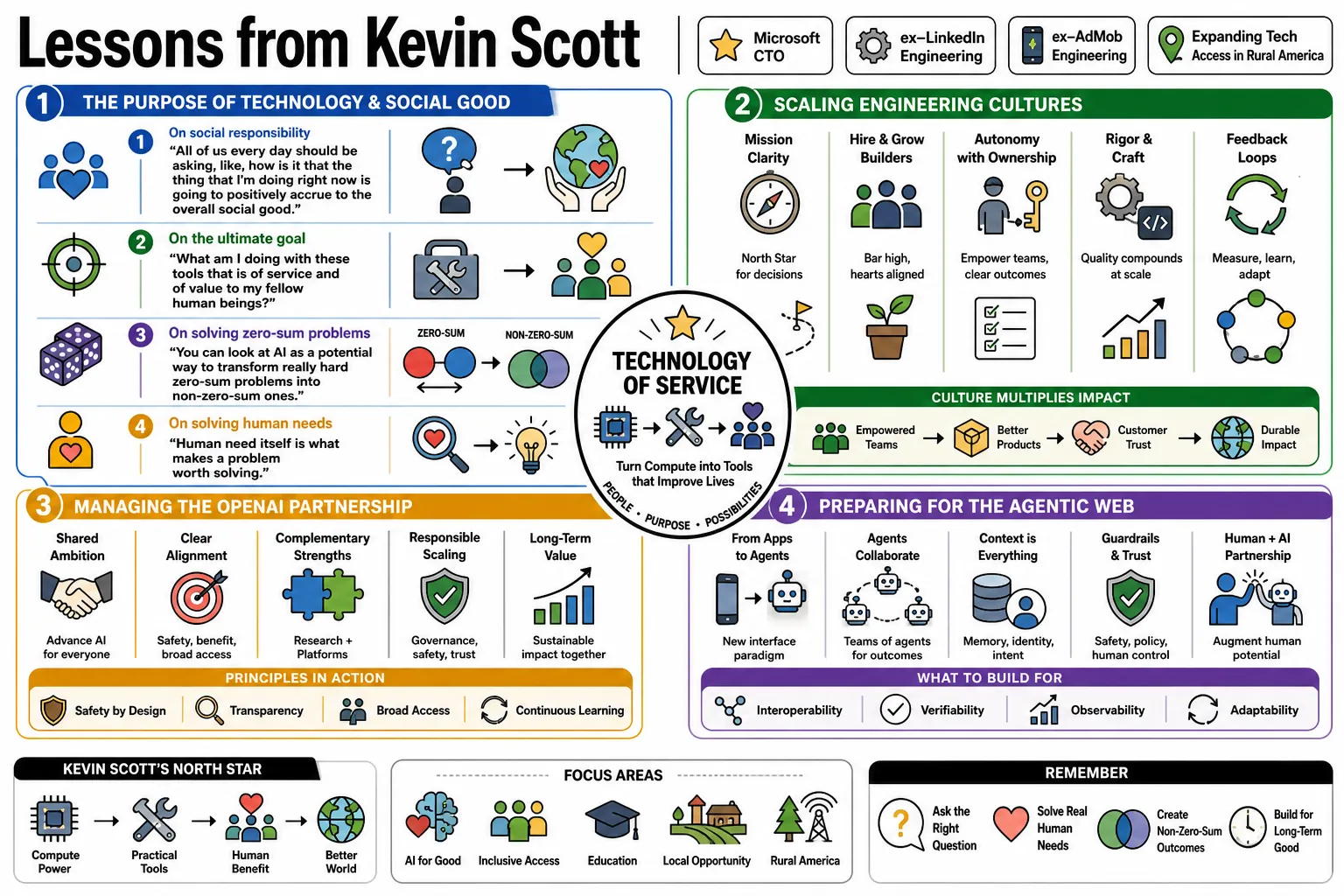
Lessons from Kevin Scott
Kevin Scott is Microsoft’s CTO and previously led engineering at LinkedIn and AdMob. He focuses on translating raw compute power into practical tools, alongside his efforts to expand technology access in rural America. This collection covers his approach to scaling engineering cultures, managing the OpenAI partnership, and preparing for the agentic web.
Part 1: The Purpose of Technology & Social Good
- On social responsibility: "All of us every day should be asking, like, how is it that the thing that I'm doing right now is going to positively accrue to the overall social good. Like, if you can't answer that question in an affirmative way, then maybe you're doing the wrong damn thing." — Source: [Behind the Tech]
- On the ultimate goal: "What am I doing with these tools that is of service and of value to my fellow human beings?" — Source: [Microsoft]
- On solving zero-sum problems: "You can look at AI as a potential way to transform really hard zero-sum problems into non-zero-sum ones. And I think that lens is one that we ought to use more because that's the true benefit and power of technology." — Source: [Behind the Tech]
- On solving human needs: "Human need itself is what makes a problem worth solving." — Source: [Reprogramming the American Dream]
- On evaluating long-term impact: "The question we have to ask ourselves as people who build technology: are we doing the best job that we possibly can to build technology in a way where 40 years from now our children and our grandchildren will look back and say, 'Wow, this was beneficial.'" — Source: [Behind the Tech]
- On building a positive future: "We're not on some sort of inexorable path where we're building these technologies and things are going to unfold in this very particular way that it's not inclusive. Like we get to choose our future." — Source: [Forbes]
- On the 'Star Trek' vision: "The acquisition of wealth is no longer the driving force in our lives. We work to better ourselves and the rest of humanity." — Source: [Reprogramming the American Dream]
- On unseen technology: "The best technology is the technology you don't notice." — Source: [Behind the Tech]
- On avoiding cynicism: "Effective leadership requires maintaining a sense of optimism about what technology can achieve for society while remaining patient with the complexities of human organizations." — Source: [First Round Review]
Part 2: AI's Agentic Web & The Future of Software
- On the next web: "The real breakthrough for the agentic web is better plumbing. Agents won't be useful until they can take action on your behalf by using tools and fetching data." — Source: [Decoder]
- On standardizing AI systems: "I want all of our systems internally to speak a standard protocol to all of the agents that we're writing inside of Microsoft." — Source: [Decoder]
- On the ubiquity of agents: "Agents are going to be everywhere." — Source: [Decoder]
- On AI-generated code: "95% [of code] is going to be AI-generated [within five years]... Very little is going to be — line by line — human-written code." — Source: [Economic Times]
- On human authorship: "Now, that doesn't mean that the AI is doing the software engineering job... the more important and interesting part of authorship is still going to be entirely human." — Source: [Business Insider]
- On the role of computer scientists: "If you are trying to solve the world's hardest computational problems, you're going to need computer scientists, and they're going to use these tools insanely well." — Source: [Business Insider]
- On empowering small teams: "I'm hoping that it will get easier for small teams to go do big things... small teams are just faster than big teams are." — Source: [Business Insider]
- On coding literacy: "I actually think everyone in the future should learn to code because that's how we get people and the computers to communicate at the deepest levels." — Source: [Behind the Tech]
- On the new web interface: "Websites will need to become legible to AI agents so they can perform tasks on behalf of users." — Source: [Decoder]
- On biological efficiency proofs: "You have a training cluster sitting between your ears that burns tens of watts of power. So there is a biological proof point that training could be much more efficient than it is right now." — Source: [Scale]
Part 3: Democratizing AI & Rural America
- On the untold story of tech: "The untold story of the tech industry over the past fifteen years is the extent to which we've put incredibly powerful technology... into the hands of a broader group of developers, builders, and entrepreneurs than ever before in human history." — Source: [Reprogramming the American Dream]
- On wealth concentration: "It is not right if the value created by the development of AI is concentrated solely in the hands of a few elite companies and their shareholders." — Source: [Reprogramming the American Dream]
- On the necessity of public research: "Much of the progress we've made building an AI platform... has been a direct consequence of publicly funded and widely disseminated research." — Source: [Reprogramming the American Dream]
- On the venture capital gap: "In 2016, 75 per cent of venture funding went to Silicon Valley, New York City, and Boston, with 50 per cent going to Silicon Valley alone. Venture funding in Tennessee that same year was less than 1 percent." — Source: [Reprogramming the American Dream]
- On rural reality: "What is rural? It's what you have to drive through to get to the city." — Source: [Buzzsprout]
- On preserving small farms: "By applying AI technologies, this 'Minimum Viable Economic Unit' [for agricultural enterprises] can be significantly reduced, helping to preserve smaller farming units." — Source: [Reprogramming the American Dream]
- On foundation infrastructure: "Job one is you actually have to have the infrastructure in place to support people using AI tools to solve the problems that they want to solve." — Source: [Buzzsprout]
- On widespread involvement: "If we really are going to get to this vision of powerful technology shaping the future, we really have to have as many people as humanly possible involved in the creation of the technology." — Source: [Behind the Tech]
- On AI as a democratizer: "I think one of the ironic things about AI is that it can be one of those democratizing influences." — Source: [Behind the Tech]
- On shifting focus from elites: "The role of a tech leader is to build tools that empower everyone, rather than the privileged few, doing so in a safe and ethical way." — Source: [Lex Fridman Podcast]
Part 4: The Microsoft-OpenAI Partnership
- On historic significance: "The most important partner that Microsoft has ever had." — Source: [CNBC]
- On the Wintel comparison: "The partnership's impact is comparable to the historic Windows and Intel alliance that drove the personal computing era." — Source: [CNBC]
- On the initial investment: "The 2019 investment was basically a bet on Sam Altman’s team." — Source: [Business Insider]
- On early worries about competitors: "In a 2019 email to Bill Gates and Satya Nadella, he expressed being very, very worried about Google’s AI lead." — Source: [Business Insider]
- On mutual dependency: "Microsoft couldn't do everything alone; OpenAI pushed Microsoft to build world-class infrastructure while Microsoft enabled OpenAI to do their best work." — Source: [Business Insider]
- On hardware pragmatism: "While Nvidia is a key partner, Microsoft is not religious about chips and will use whatever provides the best price-performance to meet AI demand." — Source: [CNBC]
- On organizational collaboration: "The partnership was a tough act of coordination that required both organizations to significantly change how they operate to achieve shared goals." — Source: [Stratechery]
- On building a platform: "The partnership is about building a platform of compute and models that other entrepreneurs and internal teams can build upon." — Source: [Stratechery]
- On partnership stability: "The relationship is stable because both sides are winning on a continuous basis." — Source: [Stratechery]
Part 5: Engineering Management & Scaling Teams
- On the purpose of engineering: "Stop confusing building technology with building a company... Your job is to figure out what it is that your company, your business, your marketplace, your competitive environment needs." — Source: [First Round Review]
- On driving business success: "Your job as an engineer and your purpose as a technology team is to help your company win." — Source: [First Round Review]
- On scaling culture: "The mistake of ignoring your engineering culture can silently break you." — Source: [First Round Review]
- On the engineering manifesto: "Take a very active step towards proactively drafting a manifesto, because deciding to write one when a crisis hits can be very hard." — Source: [First Round Review]
- On prioritizing process: "Leaders must prioritize the how (the process, culture, and decision framework) over the what (the specific database or language), because the what changes constantly in hyper-growth." — Source: [First Round Review]
- On organizational DNA: "The DNA of every company is different, and copying the culture of giants like Google is often a mistake for smaller, faster-moving startups." — Source: [First Round Review]
- On pausing to speed up: "During LinkedIn's hyper-growth, he initiated Operation InVersion, halting new feature development for two months to re-architect deployment, prioritizing long-term velocity over short-term output." — Source: [First Round Review]
- On risk and agility: "A high-growth startup culture requires agility and the willingness to take huge amounts of risk to maintain a first-mover advantage." — Source: [First Round Review]
- On coordination vs consensus: "You should seek coordination, not consensus, prioritizing alignment and speed over unanimous agreement on every technical detail." — Source: [First Round Review]
Part 6: Leadership, Culture, & Storytelling
- On articulating vision: "Leadership is having a vision, being able to articulate that so the people around you can understand it, and getting a consensus on a common vision." — Source: [Reddit AMAs]
- On the limits of compensation: "To motivate thousands of engineers, money and prestige are insufficient; true leadership requires a compelling narrative." — Source: [Dev.to]
- On creating inevitability: "A leader's storytelling must make the shared mission feel both compelling and inevitable." — Source: [Reddit AMAs]
- On the learn-it-all mindset: "Rather than showing up as a know-it-all, leadership requires a learn-it-all mindset that includes identifying your own biases." — Source: [Modern CTO]
- On celebrating others: "True leadership involves actively cheering on the success of your peers and team members." — Source: [Modern CTO]
- On managing culture like architecture: "Culture problems can metastasize just like bad technology decisions, making culture design an active engineering process." — Source: [First Round Review]
- On resolving conflicts: "Managing technology at Microsoft scale means accepting the responsibility to resolve the hard conflicts regarding massive resource and GPU allocations." — Source: [Decoder]
- On the human element: "People, people, people is the right thing. Honestly, that's the most important thing. It's more important than the regulation. It's more important than the implementation detail." — Source: [Behind the Tech]
- On proactive design: "Proactively design your engineering culture rather than letting it accumulate by accident." — Source: [First Round Review]
Part 7: Career Advice for Builders
- On permissionless innovation: "There's a real advantage in having permissionless innovation... the extent to which you can go innovate and build things without having to seek someone's permission." — Source: [Decoder]
- On the security dichotomy: "The tradeoff between open innovation and security is a false dichotomy; future AI agents can manage risk and detect suspicious activity on our behalf." — Source: [Decoder]
- On moving fast: "Everything's going to get cheaper and everything's going to get more capable every year. I think anyone who is using those as excuses to wait to get started is going to be super behind." — Source: [Every.to]
- On experimental curiosity: "Be curious, try stuff and if it works for you use it and if it doesn't, don't." — Source: [Decoder]
- On the builder's grind: "I know building things is hard. It's a grind. Just don't lose sight of how special this moment is... be fearless about how you put this technology at work for other people." — Source: [Microsoft]
- On aligning with trajectories: "Successful builders spot the forces that can't be ignored — technological, economic or behavioral — and align their work with that trajectory." — Source: [Microsoft]
- On timing your impact: "To truly make a difference, you must act before a trend becomes obvious to everyone." — Source: [DeepLearning.ai]
- On catching growth loops: "Find a fast growth driver and position yourself directly inside that growth loop." — Source: [DeepLearning.ai]
- On abstraction: "Like a computer scientist, use abstraction to suppress the complex details that are not relevant to the problem you are currently addressing." — Source: [Reprogramming the American Dream]
- On shifting focus to domain problems: "Engineers should move away from low-level plumbing and focus on using new tools to solve higher-level domain problems." — Source: [Behind the Tech]
Part 8: Philosophy, Curiosity, & The Future
- On the value of failure: "It's maybe even more valuable to do something and fail and learn something from the failure and then get up and go again as it is succeeding. Sometimes success teaches you nothing." — Source: [Behind the Tech]
- On AI replacing humans: "AI is a tool that we built for automating tasks and doing work that would otherwise require a human being to do." — Source: [Reprogramming the American Dream]
- On unlocking human potential: "AI also has the very real potential to... unlock human creativity in unprecedented ways." — Source: [Reprogramming the American Dream]
- On eliminating monotony: "AI can relieve human beings from unpleasant, monotonous, dangerous work and allows them to focus on the more interesting, fulfilling tasks." — Source: [Reprogramming the American Dream]
- On scaling laws in AI: "Increasing compute and data naturally leads to emergent capabilities, reflecting incipient scaling laws that govern modern intelligence." — Source: [Stratechery]
- On dropout and memory: "A simple way to think about dropout is that it's like selective forgetting. If the network remembers everything that it has seen, then it may never learn to generalize beyond its memory, which is a bad thing." — Source: [Reprogramming the American Dream]
- On the geek identity: "Leaning into precocious curiosity and an impulse to simplicity is a primary driver of scientific and engineering progress." — Source: [Behind the Tech]
- On search as reasoning: "Artificial intelligence changes the economics and user experience of search, moving from a static list of links to an active reasoning engine." — Source: [Stratechery]
- On human confidence: "Unflappable confidence in your ability to figure things out is the foundation of the engineering mindset." — Source: [Reprogramming the American Dream]