Before founding Bloom Energy in 2001, KR Sridhar engineered oxygen-producing fuel cells for NASA Mars missions. He now builds modular power generation systems designed to operate at the edge of the grid. This profile outlines his approach to replacing centralized electricity models, meeting the massive power demands of artificial intelligence, and achieving global energy sovereignty.
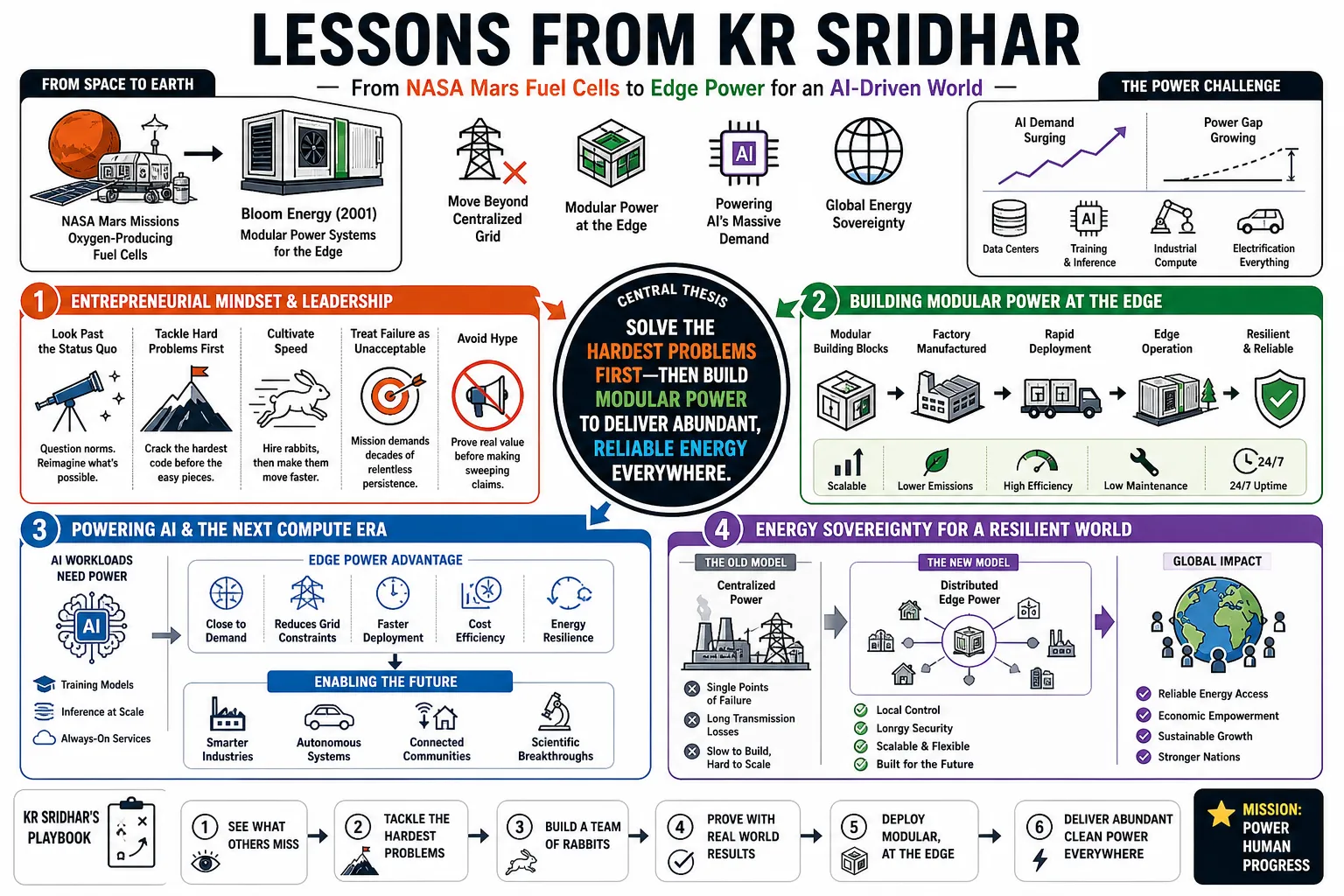
Part 1: The Entrepreneurial Mindset and Leadership
- On looking past the status quo: Entrepreneurs succeed by refusing to accept the world as it is. They adopt a perspective that questions fundamental assumptions and asks why accepted norms cannot be reimagined. — Reference: Fresh Dialogues
- On tackling hard problems first: "Most smart people who have done a lot of puzzles will start with the corner pieces, because it’s easy to find them and put them together. It’s the exact opposite in a business like mine, because if you don’t solve the most important thing, the most difficult thing out there, why do you need the corner pieces? You’re not 100% sure when you start that you have all the pieces. So why bother doing the easy pieces? You crack the code on the hardest things that you have to crack. Otherwise, go home." — Source: Semafor
- On cultivating speed: "There’s not much you can do to the culture of a turtle to make it go faster. You need to have the DNA of a rabbit, and then you can make the rabbit move faster." — Source: Semafor
- On treating failure as unacceptable: For a mission that demands decades of persistence, commitment cannot be conditional on an easy path. The founder has to keep moving as if finding a workable route is mandatory. — Reference: 20VC
- On avoiding hype: To build a lasting company, you have to prove your product works and delivers value before making sweeping public claims. Doing otherwise just adds to the noise of failed promises. — Reference: Fresh Dialogues
- On walking the floor: From Andy Grove, he learned that the best way to understand business problems is not through binders or reports, but by directly engaging with the team on the shop floor and listening to their honest feedback. — Reference: 20VC Newsletter
- On managing ambiguity: When hiring for leadership roles, look for individuals who demonstrate resilience, passion, and the ability to operate effectively when the path forward is unclear. — Reference: Semafor
- On maintaining a sense of urgency: Big missions require a timeline that feels almost unachievable. By setting a faster pace than seems humanly possible, you will arrive at your destination quicker than anyone expects. — Reference: Fresh Dialogues
- On financing long-horizon technology: Match patient technical bets with investors who understand both the capital required and the time needed to create a new category. A long build becomes survivable when the financing model fits the engineering reality. — Reference: C.O.B. Tuesday
- On building the ecosystem around the product: When the industry needed to support a new technology does not yet exist, the company must create more than the product. It must also assemble the processes, suppliers, and operating infrastructure that let the product reach the market. — Reference: Fresh Dialogues
- On turning complexity into a moat: In hard technology, durable advantage comes from combining disciplines, process knowledge, specialized talent, and long-term capital. Competitors must reproduce the whole system, not merely copy one component. — Reference: Fresh Dialogues
Part 2: The Energy Architecture of the Future
- On bringing electricity to the edge: Electricity still depends heavily on distant centralized plants and long transmission routes. Digital infrastructure needs power generated closer to where it is consumed so reliability does not depend on a single extended delivery chain. — Reference: 20VC
- On modular fault tolerance: Build power systems from small, stackable units that resemble server architecture. When one module needs service, the larger facility should continue operating instead of losing a monolithic source. — Reference: 20VC
- On scaling production through mature supply chains: Design manufacturing around equipment already produced for other industries at vastly greater volumes. That gives a new energy platform access to proven capacity instead of making every factory component bespoke. — Reference: Semafor
- On adapting spaces for manufacturing: "So we designed a factory where we did not need any clean rooms, which means that we can take warehouses and convert them into factories." — Source: Semafor
- On designing availability into the architecture: Data centers cannot tolerate the maintenance downtime of a single large generator. Reliability improves when maintenance can happen one replaceable unit at a time while the rest of the system stays online. — Reference: 20VC
- On matching power to digital loads: AI workloads rise and fall quickly, so their power systems must respond quickly too. Solid-state generation can follow those changes more directly than large mechanical systems built for steady output. — Reference: 20VC
- On making infrastructure speed a design constraint: When transmission cannot be built quickly enough, on-site generation is not merely a backup. It becomes the practical way to deliver capacity on the customer's timetable. — Reference: Semafor
- On designing power around the workload: Customers do not need generic electricity alone; they need power architectures customized for uptime, load behavior, deployment speed, and the economics of their specific facilities. — Reference: JC2 Ventures
- On applying a Moore's Law discipline to hardware: Treat cost reduction as a recurring engineering program rather than a one-time breakthrough. Annual improvements in design and manufacturing can make energy hardware compound in affordability over time. — Reference: C.O.B. Tuesday
- On scaling one platform across many loads: A modular energy system should expand from a single store to a factory or full data center without requiring a different underlying architecture at each scale. — Reference: C.O.B. Tuesday
Part 3: Powering the Artificial Intelligence Boom
- On electricity as the primary input: AI factories turn electricity and data into intelligence. Because data is broadly available, dependable power becomes the defining operating input and a major determinant of AI economics. — Reference: 20VC
- On an expanding market for intelligence: Manufacturing intelligence creates demand that compounds on top of the broader digitization wave. Infrastructure planning should assume continued growth rather than treat the current buildout as a temporary spike. — Reference: 20VC
- On corporate power strategies: "Think of AI as an intelligence factory, and that factory is going to need a dedicated power source, because its intelligence is what drives everything else. You can’t afford to lose power there, and you can’t afford to wait for physical infrastructure to catch up and provide you the power that you need." — Source: Semafor
- On compounding technological leaps: AI is accelerating an already rapid shift from mechanical infrastructure to digital infrastructure. Leaders should plan for the interaction of those curves, not evaluate AI demand in isolation. — Reference: 20VC
- On shifting from a fixed pie to abundance: Intelligence can expand without requiring one participant's gain to become another's loss. An abundance mindset changes strategic thinking from dividing scarce output to increasing what the system can produce. — Reference: 20VC
- On long-term foresight: Bloom's original 2001 investor vision already paired on-site power with data centers. Long-duration technical bets are easier to sustain when the eventual use case is explicit well before the market is ready. — Reference: 20VC
- On speed as a competitive moat: Deploying 50 megawatts for Oracle in 55 days showed that time to power can reshape data-center planning. Delivery speed becomes strategic when grid upgrades are measured in years. — Reference: 20VC
- On electricity outranking algorithms as the bottleneck: As models and chips proliferate, competitive advantage increasingly depends on who can secure reliable power. The AI race is also an infrastructure race. — Reference: 20VC
- On designing power, heat, and cooling as one system: When electricity is generated beside a data center, its waste heat can become a useful input for heating or cooling instead of being discarded at a remote plant. Co-location improves the economics of the whole facility. — Reference: 20VC
Part 4: Energy Sovereignty and Global Access
- On the geopolitical stakes of power: After food security, energy sovereignty is one of the most consequential supply-chain questions a country faces. Distributed generation can reduce dependence on distant infrastructure and geopolitical chokepoints. — Reference: 20VC
- On decentralizing authority: Distributed power systems are superior to centralized grids because they remove control from central authorities and place it directly into the hands of communities, democratizing access to energy. — Reference: Fresh Dialogues
- On energy as a prerequisite for wealth: "No country or population group that is energy poor is economically rich. There are no proven pathways for poor nations to economically develop without increasing their energy consumption." — Source: Bloom Energy
- On leapfrogging infrastructure: Developing regions can bypass the immense capital costs of a centralized grid entirely by adopting distributed microgrids, similar to how many countries skipped laying landlines in favor of cellular networks. — Reference: Bloom Energy
- On reshaping urban geography: Bringing reliable power closer to communities reduces the need to cluster around centralized infrastructure. Distributed energy can widen where people live and work and change the geography of opportunity. — Reference: 20VC
- On generational progress: "I deeply believe that unless we solve this energy issue and not make it a zero sum game – where more and more of the population as the world’s population grows has to use a fixed amount of energy and so each one uses a lot less – then we cannot promise our future generations a better life than what we had." — Source: Fresh Dialogues
- On avoiding false choices: Solving the climate crisis requires a global perspective that balances economic growth with environmental protection; policy must not force a choice between lifting populations out of poverty and saving the planet. — Reference: Bloom Energy
- On combining centralized and local infrastructure: Mature grids and local microgrids should coexist. A hybrid architecture preserves the scale of centralized generation while adding resilience where climate events or long transmission routes make the grid vulnerable. — Reference: Bloom Energy
Part 5: Pragmatism and the Path to Sustainability
- On the necessity of affordability: For a new energy technology to achieve mass-market adoption rather than remain a niche luxury, it must be priced affordably enough for everyday consumers. — Reference: Fresh Dialogues
- On meeting market expectations: Consumers will only adopt clean tech at scale if it matches the price they are already paying for standard utilities while offering new advantages. — Reference: Fresh Dialogues
- On debunking the energy-pollution myth: "The big misunderstanding in my opinion is: people believe that more energy is more pollution, more unsustainable. There is nothing in science or technology, no physical laws, no chemical laws that say more energy and sustainability have to be at odds with one another." — Source: Fresh Dialogues
- On bridging to renewables: Before a fully renewable future is realized, the most practical step is to extract the maximum possible efficiency from fossil fuels, minimizing pollution while building the foundation for sustainable technologies. — Reference: Fresh Dialogues
- On corporate buying behaviors today: Hyperscalers are so desperate for electricity that they prioritize speed of deployment above all else, though they are willing to pay a premium for solutions that offer a credible path to net-zero over time. — Reference: Semafor
- On the closed-loop future: Local renewables can serve demand when available, create hydrogen when supply exceeds demand, and use that stored hydrogen later for reliable power. The long-term goal is a locally balanced energy loop rather than dependence on one fuel or one grid. — Reference: 20VC
- On thinking in terms of "and": Future engineers must reject paradigms rooted in scarcity and "or" decisions; instead, they should focus on creating systems that are both reliable and clean and accessible to everyone. — Reference: Bloom Energy
- On supply chain independence: To ensure global energy abundance, companies must avoid becoming reliant on a single region or source for their components, thereby preventing supply bottlenecks from throttling growth. — Reference: Semafor
- On using natural gas pragmatically as a bridge: Commercialize with the fuel infrastructure customers can access today while designing the same platform to move toward biogas and hydrogen. Pragmatism can accelerate adoption without abandoning the longer-term destination. — Reference: C.O.B. Tuesday
- On choosing solutions by context: Energy transitions need a portfolio rather than a universal prescription. Geography, economics, technology readiness, implementation speed, and cost should determine which combination of solutions fits each market. — Reference: Bloom Energy