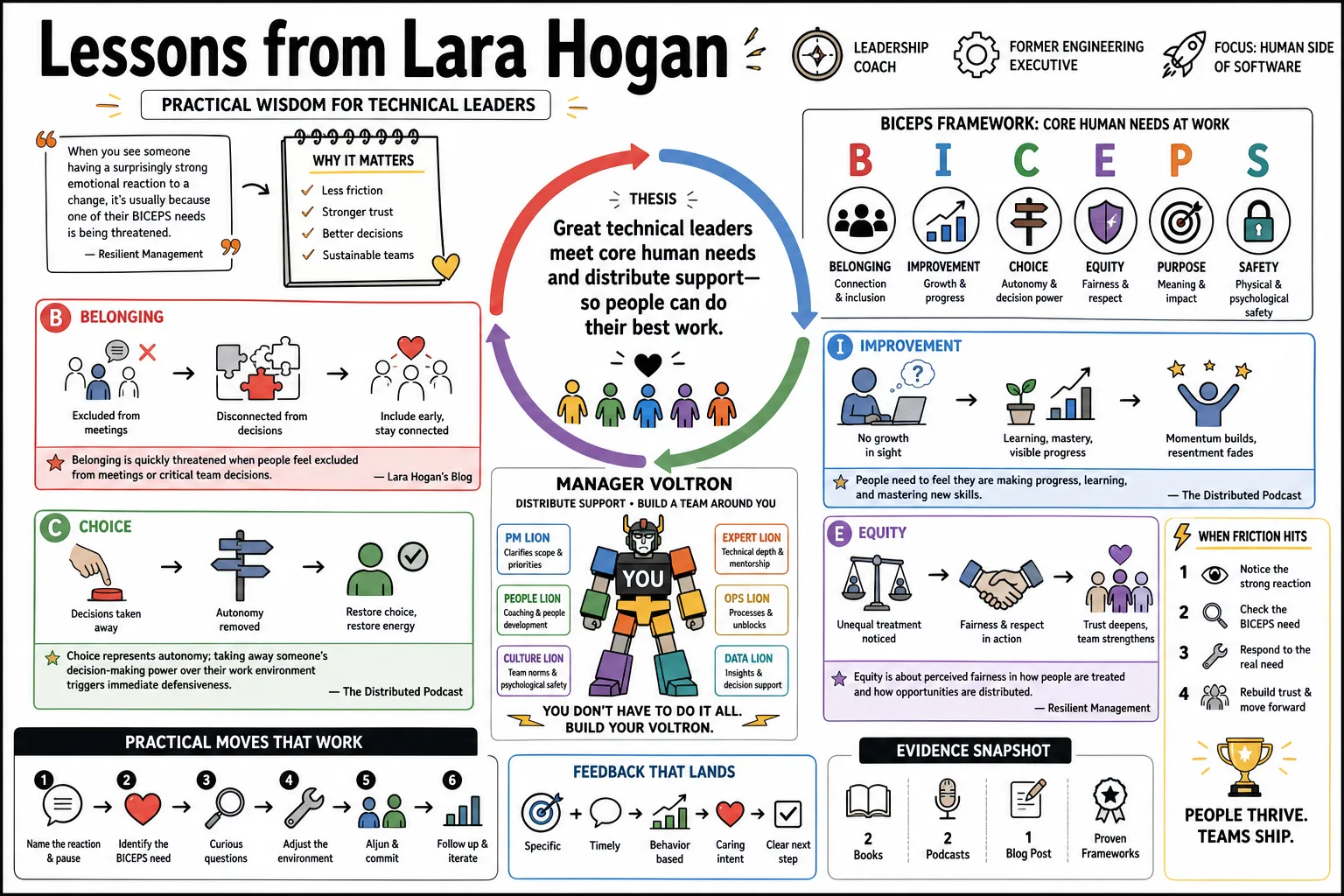
Lessons from Lara Hogan
Lara Hogan is a leadership coach and former engineering executive at Etsy and Kickstarter who clarified how technical leaders manage the human side of software development. She is best known for the BICEPS framework of core needs and the "Manager Voltron" approach to distributing support. This profile covers her methods for resolving team friction, giving clear feedback, and building practical management habits.
Part 1: Core Human Needs at Work (BICEPS)
- On Threat Responses: "When you see someone having a surprisingly strong emotional reaction to a change, it’s usually because one of their BICEPS needs is being threatened." — Source: Resilient Management
- On Belonging: Belonging is the need for connection to a community or a group, and it is quickly threatened when people feel excluded from meetings or critical team decisions. — Source: Lara Hogan's Blog
- On Improvement: People need to feel they are making progress, learning, and mastering new skills; without this, stagnation breeds resentment. — Source: The Distributed Podcast
- On Choice: Choice represents autonomy; taking away someone's decision-making power over their own work environment triggers immediate defensiveness. — Source: Scaling Software Teams
- On Equality: Equality means fairness and equal access to opportunities, information, and resources within the company. — Source: Resilient Management
- On Predictability: Predictability is about certainty regarding the future and expectations; rapid reorganizations threaten this need intensely. — Source: Inside Intercom
- On Significance: Significance is the desire for status, visibility, and feeling that your work fundamentally matters to the organization. — Source: Humans+Tech
- On Desk Moves: Even a simple office desk move can trigger defensive reactions because it subtly threatens a person's predictability, belonging, and choice. — Source: The Changelog Podcast
- On Addressing Needs: You cannot fix a threatened core need with logic; you have to identify which specific BICEPS element is compromised and address the emotional reality first. — Source: Lara Hogan's Blog
- On Varying Priorities: Not everyone weighs the six BICEPS needs equally; a manager must learn which one or two needs are the primary drivers for each direct report. — Source: Lead Time Chats
Part 2: Delivering Actionable Feedback
- On The Feedback Equation: Effective feedback requires three parts: Observation + Impact + Question or Request. — Source: Lara Hogan's Blog
- On Observations: Observations must be purely factual and objective, capturing only what a camera would record, without attached judgments or assumptions about intent. — Source: Inside Intercom
- On Impact: The impact statement clarifies how the observed behavior affected the team, the project, or the person delivering the feedback. — Source: Resilient Management
- On Asking Questions: Ending feedback with an open question invites the recipient to problem-solve and participate in the course correction. — Source: The Changelog Podcast
- On Avoiding Feedback Sandwiches: Masking negative feedback between two pieces of positive praise dilutes the message and damages long-term trust. — Source: Lara Hogan's Blog
- On Recognizing Behaviors: "Recognize what someone does, not who they are." Praise specific efforts rather than innate traits like being clever or smart. — Source: Practica
- On Public vs. Private Praise: What leaders choose to recognize publicly implicitly signals to the entire organization exactly what behaviors are actually valued and rewarded. — Source: Lara Hogan's Blog
- On Timeliness: Feedback loses its effectiveness the longer you wait to deliver it; aim to provide it as close to the event as possible. — Source: Resilient Management
- On Normalizing Feedback: Make micro-feedback a routine part of daily interactions so that the process loses its intimidating weight over time. — Source: Scaling Software Teams
- On The Privilege of Feedback: Delivering hard feedback is a core duty of management; avoiding it out of personal discomfort is a failure to support the employee's growth. — Source: Inside Intercom
Part 3: The Manager Voltron (Support Networks)
- On The Myth of the Perfect Manager: No single person, including your direct boss, has the capacity or experience to provide all the coaching, mentoring, and sponsorship you need. — Source: Lara Hogan's Blog
- On Building a Voltron: You must assemble a Manager Voltron—a diverse network of different people who fulfill distinct support roles in your career. — Source: The Distributed Podcast
- On Mentors: A mentor is someone who shares their specific lived experience and provides direct advice on how they solved a similar problem. — Source: Resilient Management
- On Coaches: A coach does not give advice; instead, they ask open-ended questions that force you to introspect and find your own solutions. — Source: The Changelog Podcast
- On Sponsors: A sponsor is someone with organizational power who advocates for your advancement and mentions your name in rooms you are not invited to. — Source: Lara Hogan's Blog
- On Peers: Peers provide empathy, tactical daily support, and a safe space to vent about shared struggles without judgment. — Source: Inside Intercom
- On Identifying Gaps: Periodically audit your support network to identify which of the four roles (mentor, coach, sponsor, peer) is missing from your career development. — Source: Resilient Management
- On Outgrowing Support: As you level up, the people in your network will naturally change; it is normal to outgrow a mentor and need to seek a new one. — Source: Scaling Software Teams
- On Sponsoring Others: Once you reach a leadership position, it is your responsibility to act as a sponsor for underrepresented individuals in your organization. — Source: Humans+Tech
- On External Voltrons: Your support network should not be limited to your current company; external perspectives are vital for unfiltered advice and long-term career resilience. — Source: Lead Time Chats
Part 4: The Four Hats of Management
- On Role Clarity: Effective managers continuously switch between four distinct hats: mentoring, coaching, sponsoring, and delivering feedback. — Source: Lara Hogan's Blog
- On Default Tendencies: Most managers default to the mentoring hat because giving direct advice feels helpful and fast, but it prevents the report from developing critical thinking. — Source: Resilient Management
- On Choosing the Coaching Hat: You should wear the coaching hat when an employee has the raw capability to solve a problem but lacks the confidence or clarity to see the path forward. — Source: Inside Intercom
- On Knowing When to Mentor: Mentoring is required when an employee is facing a completely novel situation where they lack the foundational context to guess the right answer. — Source: The Changelog Podcast
- On The Sponsoring Hat: Putting on the sponsoring hat means stepping back and giving up your own high-visibility opportunities so a direct report can shine. — Source: Lara Hogan's Blog
- On The Feedback Hat: The feedback hat is the most uncomfortable to wear, but it is the only way to correct course when an employee's impact diverges from their intent. — Source: Scaling Software Teams
- On Signaling the Hat: It is highly effective to explicitly tell your report which hat you are wearing, such as asking if they want to be coached through a problem or just given advice. — Source: Resilient Management
- On Switching Hats Mid-Conversation: You will often need to switch from coaching to mentoring if the employee gets stuck, and you must do so consciously. — Source: Lead Time Chats
- On Diagnosing the Need: If an employee is consistently struggling despite your advice, you are likely wearing the mentoring hat when they actually need the feedback hat. — Source: Lara Hogan's Blog
Part 5: 1:1 Meetings and Foundational Trust
- On First 1:1s: The very first 1:1 with a new report should be entirely dedicated to learning their working style, not discussing project statuses. — Source: Resilient Management
- On The Grumpiness Question: Always ask what makes an employee grumpy and how you will know when they are grumpy to establish a baseline for navigating future stress. — Source: Lara Hogan's Blog
- On Receiving Feedback: Ask your report early on how they prefer to receive feedback—whether they need it in writing first to process, or prefer verbal, immediate delivery. — Source: Inside Intercom
- On Recognition Preferences: Never assume how someone wants to be praised; ask if they prefer public acknowledgment in an all-hands meeting or a quiet, private note of thanks. — Source: The Changelog Podcast
- On Treating Yourself: Ask your reports about their favorite way to treat themselves so you know exactly how to celebrate their specific wins when they succeed. — Source: Lara Hogan's Blog
- On Managerial Support: Ask directly what makes 1:1s most valuable for them to tailor the recurring meeting to their specific definition of support. — Source: Scaling Software Teams
- On Status Updates: 1:1s are too valuable to waste on simple status updates; use async channels for status and reserve the meeting for blockers, growth, and alignment. — Source: Resilient Management
- On Taking Notes: Keep a running, shared document of 1:1 notes so both manager and report have a historical record of commitments and career discussions. — Source: Lead Time Chats
- On Consistency: Canceling a 1:1 sends an immediate signal that the employee is a lower priority than whatever else is on your calendar; reschedule, but never cancel. — Source: Lara Hogan's Blog
Part 6: Navigating Team Friction and Change
- On The Primordial Soup: When a team is in the storming phase of group development, it feels messy and uncomfortable; this is a necessary stage to reach high performance. — Source: Resilient Management
- On Repetition: "When you are tired of saying it, people are starting to hear it." Leaders must repeat core messages far past their own point of boredom. — Source: Lara Hogan's Blog
- On The Black Box: "Management explicitly needs to be a black box sometimes." Managers must absorb organizational noise and shield their team from unnecessary turbulence. — Source: Practica
- On Transparent Defaults: While shielding the team is important, a manager should default to transparency regarding the underlying reasons behind major organizational decisions. — Source: Inside Intercom
- On Empathy Assumptions: "I learned the hard way that assuming everybody functions the same way I do is not the case." Friction often stems from unacknowledged differences in working styles. — Source: The Changelog Podcast
- On Processing Change: Different team members process organizational shifts at different speeds; leaders must leave space for the slow processors to catch up. — Source: Scaling Software Teams
- On Brainstorming Safely: During periods of instability, clarify whether a meeting is for making a final decision or just exploring ideas, so people do not panic over early concepts. — Source: Resilient Management
- On Managing Resistance: Resistance to change is rarely malicious; it is almost always a defensive reaction to a perceived loss of predictability or belonging. — Source: The Distributed Podcast
- On Resetting Norms: When a new member joins or leaves, team dynamics fundamentally reset; managers must explicitly guide the team through re-establishing their working norms. — Source: Lara Hogan's Blog
Part 7: Career Growth and Transitions
- On The Pain of Growth: "Growth is beautiful; growth is magnificent... but in actuality, growth is painful." — Source: Goodreads
- On Giving Away Legos: "The best gift you can give your teammates is a messy, hard-to-measure, unscoped project that they can own and grow from." — Source: Resilient Management
- On The Transition to Management: Moving from individual contributor to manager is not a promotion; it is a total career change that requires an entirely new set of foundational skills. — Source: Inside Intercom
- On Letting Go of Code: New engineering managers must accept that their primary output is no longer code, but rather the productivity and health of their team. — Source: The Changelog Podcast
- On Defining Seniority: Seniority is less about technical perfection and more about the ability to navigate ambiguity, mentor others, and influence cross-functional outcomes. — Source: Lara Hogan's Blog
- On Career Ladders: Clear, explicit career ladders are essential to remove bias from the promotion process and give individuals concrete targets for their own development. — Source: Scaling Software Teams
- On Managing Up: Your relationship with your own manager requires active design; you must proactively communicate your needs, blockers, and preferred working style to them. — Source: Lead Time Chats
- On Industry Context: "It’s your responsibility to give advice that’s current and sensitive to the changing dialogue of what’s happening in our industry." — Source: Practica
- On Stepping Back: Sometimes growth means realizing management is not for you and actively choosing to transition back to an individual contributor role without shame. — Source: Lara Hogan's Blog
Part 8: Resilience and Emotional Energy
- On Energy Management: Management is profoundly emotionally taxing; you must actively manage your energy, not just your time, to avoid severe burnout. — Source: Resilient Management
- On Color-Coding Calendars: Audit your calendar by color-coding meetings based on how they affect your energy: draining, neutral, and energizing. — Source: Lara Hogan's Blog
- On The First Team: Your first team is not your direct reports; it is your peer group of fellow managers, who provide the essential support needed to survive leadership. — Source: The Distributed Podcast
- On Compartmentalization: Resilient managers develop the ability to compartmentalize a difficult emotional conversation so it does not bleed into the next meeting on their calendar. — Source: Inside Intercom
- On Recognizing Burnout: Burnout often manifests not as exhaustion, but as a sudden onset of cynicism and a lack of empathy toward team members' routine struggles. — Source: The Changelog Podcast
- On Decompression Rituals: Establish a strict transition ritual at the end of the workday to mentally detach from the emotional labor of managing people. — Source: Scaling Software Teams
- On Vacation Boundaries: A true vacation requires zero contact with the office; logging in to check email trains the team that you do not trust them to survive without you. — Source: Resilient Management
- On Modeling Self-Care: Leaders must visibly model taking time off and setting boundaries, because teams will mimic the behavior their manager actually practices, not what they preach. — Source: Lead Time Chats
- On Forgiving Mistakes: Resilience requires accepting that you will make mistakes as a leader, apologizing plainly when you do, and using the failure as a transparent learning moment for the team. — Source: Lara Hogan's Blog