Larry Fink co-founded BlackRock in 1988 after losing $100 million due to a misjudged interest rate trade earlier in his career. He built the firm into the world's largest asset manager by focusing heavily on risk management technology and advocating for long-term stakeholder capitalism. This collection outlines his specific approaches to capital allocation, retirement, and the practical realities of global markets.
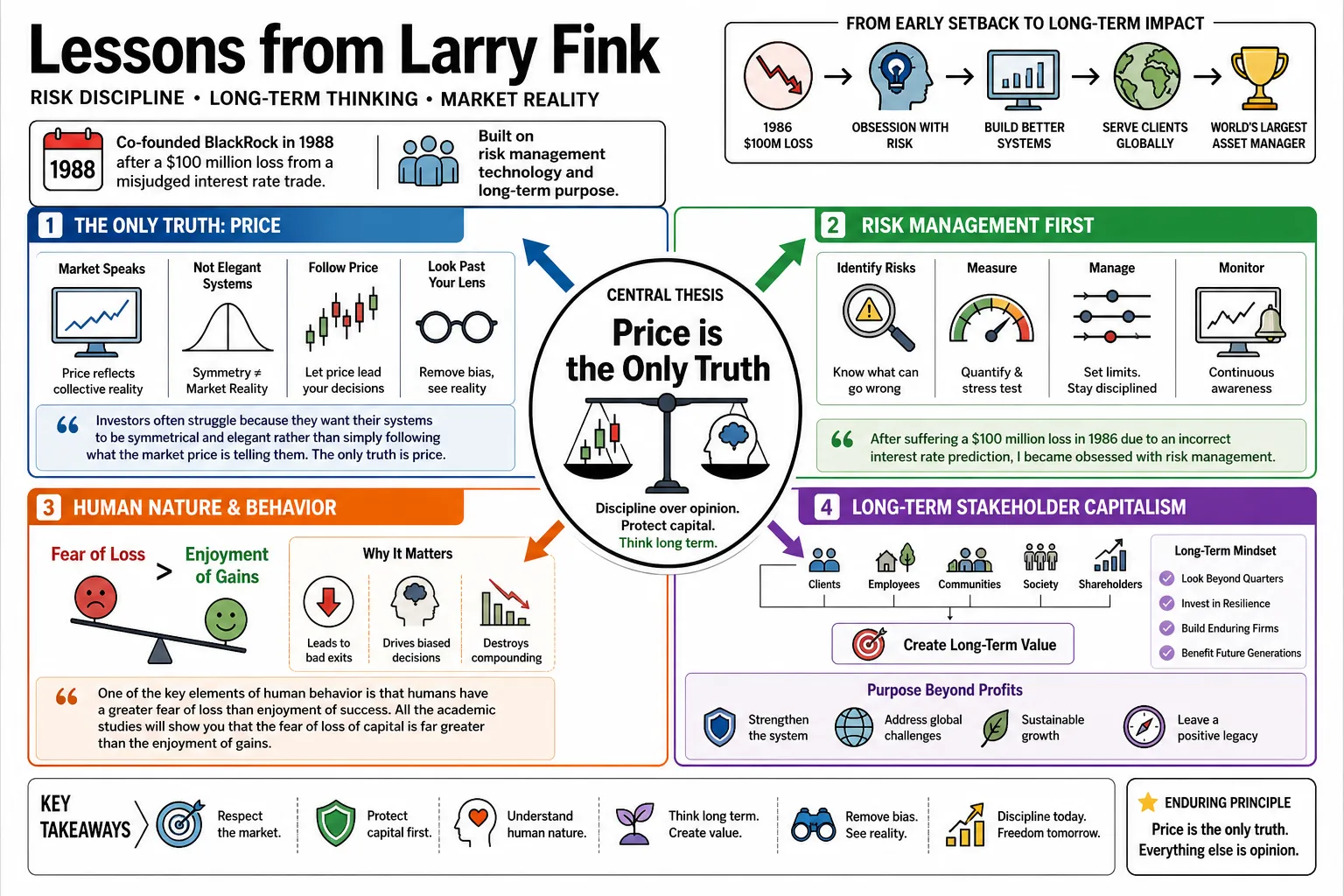
Part 1: Risk Management and Early Lessons
- On the only truth: "Investors often struggle because they want their systems to be symmetrical and elegant rather than simply following what the market price is telling them. The only truth is price." — Source: [Forbes]
- On early failure: "After suffering a $100 million loss in 1986 due to an incorrect interest rate prediction, I became obsessed with risk management." — Source: [Substack Profile]
- On behavioral economics: "One of the key elements of human behavior is that humans have a greater fear of loss than enjoyment of success. All the academic studies will show you that the fear of loss of capital is far greater than the enjoyment of gains." — Source: [India Times]
- On subjective lenses: "You must look past your own subjective lens to see the market reality." — Source: [Forbes]
- On a risk-first culture: "BlackRock was built on a risk-first culture, ensuring we never repeated the mistakes of my early career." — Source: [BlackRock Founder History]
- On the cost of inaction: "The inherent fear of loss can cause people to avoid risks even when potential rewards outweigh the downsides, or to hold onto declining assets because selling would make a loss feel real." — Source: [India Times]
- On fiduciary duty: "Boards and management teams must rigorously assess and monitor material risks because we manage money for clients saving for long-term goals like retirement." — Source: [BlackRock CEO Letter]
- On accountability: "In the absence of robust disclosures, investors will increasingly conclude that companies are not adequately managing risk." — Source: [ESG Today]
- On admitting mistakes: "Success and failure both require humility – knowing there are limits to your knowledge and your abilities. Humility is being able to admit that you were wrong." — Source: [Inc Magazine]
- On growth from failure: "It's not always easy. But if you can't admit you're wrong, you can't grow." — Source: [Inc Magazine]
Part 2: Corporate Purpose and Stakeholder Capitalism
- On the definition of stakeholder capitalism: "Stakeholder capitalism is not about politics. It is not a social or ideological agenda. It is not 'woke.' It is capitalism." — Source: [Harvard Law Forum]
- On purpose and profits: "Purpose is not the sole pursuit of profits but the animating force for achieving them." — Source: [Goodreads Quotes]
- On mutual benefit: "Capitalism is driven by mutually beneficial relationships between you and the employees, customers, suppliers, and communities your company relies on to prosper." — Source: [ESG Today]
- On long-term value: "In today's globally interconnected world, a company must create value for and be valued by its full range of stakeholders in order to deliver long-term value for its shareholders." — Source: [The Lipton Archive]
- On capital allocation: "It is through effective stakeholder capitalism that capital is efficiently allocated, companies achieve durable profitability, and value is created and sustained over the long-term." — Source: [Conservice]
- On navigating uncertainty: "Putting your company's purpose at the foundation of your relationships with your stakeholders is critical to long-term success and surviving uncertainty." — Source: [ESG Partners]
- On retaining talent: "A clear sense of corporate purpose is a vital tool that helps organizations retain talent and innovate." — Source: [MinterEllison]
- On societal contribution: "To prosper over time, every company must not only deliver financial performance, but also show how it makes a positive contribution to society." — Source: [Forbes]
- On pragmatic business practices: "Focusing on stakeholders is a pragmatic response to the changing global economy, including shifts related to technology and human capital management." — Source: [Forbes]
- On durable profitability: "Focusing on stakeholders such as employees and communities is essential for durable profitability rather than a distraction from it." — Source: [MinterEllison]
Part 3: Climate Risk and Energy Pragmatism
- On physical realities: "The evidence on climate risk is compelling investors to reassess core assumptions about modern finance." — Source: [Business Chief]
- On climate as investment risk: "Climate risk is investment risk, impacting everything from infrastructure needs and insurance markets to interest rates and inflation." — Source: [Net Zero Investor]
- On terminology: "I don't use the word ESG any more, because it's been entirely weaponized." — Source: [Sustainability Simplified]
- On energy pragmatism: "The energy transition must be fair; it cannot succeed if it makes energy unaffordable or unreliable." — Source: [Forbes]
- On hydrocarbons: "The path to decarbonization will continue to include hydrocarbons for some time." — Source: [Sustainability Simplified]
- On physical infrastructure: "We are focusing on industrial and practical realities, such as the massive infrastructure investment required for energy, power grids, pipelines, and data centers." — Source: [Business Chief]
- On data centers: "The growth of Artificial Intelligence demands unprecedented physical infrastructure and energy capacity." — Source: [RAO Global]
- On financial outcomes: "Our investment decisions are driven by financial outcomes and the physical realities of the global market, not ideology." — Source: [UPenn Wharton]
- On security: "National security and energy security are deeply intertwined, requiring practical investments over philosophical advocacy." — Source: [Forbes]
Part 4: Long-Term Investing and Retirement Security
- On market timing: "Staying invested has mattered far more than timing the market." — Source: [Funds Society]
- On the civic miracle: "When people invest their savings—over decades, not days—the capital markets put that money to work, financing companies, infrastructure, and jobs." — Source: [Impact Alpha]
- On retirement age: "The traditional retirement age of 65 is crazy; it is an outdated concept originating from the era of the Ottoman Empire." — Source: [Kiplinger]
- On longevity: "To finance longer life spans, we must convince individuals to start investing now for the long term. Longevity should be an asset that can be levered, not a curse." — Source: [Gracious Quotes]
- On the cost of cash: "People must understand that there's a cost to sitting in cash. No one talks about that cost." — Source: [Gracious Quotes]
- On inflation: "Traditional savings like bank deposits often fail to outpace inflation, eroding purchasing power and jeopardizing a dignified retirement." — Source: [Economic Times]
- On societal effort: "As a society, we focus a tremendous amount of energy on helping people live longer lives, but not even a fraction of that effort is spent helping people afford those extra years." — Source: [The Logic]
- On bottled up dreams: "We risk becoming a country where people keep their money under the mattress and their dreams bottled up in their bedroom." — Source: [Kiplinger]
- On his parents' example: "My parents lived their final years with dignity and financial freedom. The same kinds of markets that helped my parents in their time can help others in our time." — Source: [Florida Politics]
Part 5: Technology, Aladdin, and Innovation
- On competitive requirements: "Technology is transitioning from a competitive advantage to a competitive requirement." — Source: [Tearsheet]
- On operational resilience: "Our performance during market volatility would not have been possible without a unifying technology and careful business continuity planning." — Source: [The Trade News]
- On rebuilding beyond walls: "Aladdin has enabled us to rebuild BlackRock beyond its walls to deliver the operational resilience, advice and solutions our clients need." — Source: [The Trade News]
- On the origin of Aladdin: "Aladdin grew out of my personal experience with a significant trading loss early in my career due to a back-office modeling error." — Source: [Medium]
- On portfolio language: "We aim to make Aladdin the language of portfolios for the industry, serving as a comprehensive operating system." — Source: [Cognitive Finance]
- On cloud flexibility: "Moving to major cloud platforms provides clients with greater scalability and flexibility." — Source: [BlackRock Technology]
- On continuous evolution: "The platform must continually evolve to meet changing market standards and integrate risk across asset classes." — Source: [BlackRock Technology]
- On tokenization: "The tokenization of equities represents a significant vision for the future of financial markets." — Source: [CNBC Squawk Pod]
- On scaling services: "Aladdin crossing the $1 billion revenue milestone was a critical driver of our growth in technology services." — Source: [Business Insider]
- On risk integration: "An operating system must seamlessly integrate risk, investment, and operations to truly serve financial institutions." — Source: [Cognitive Finance]
Part 6: Geopolitics and Global Capital Markets
- On global capitalism: "The old model of global capitalism is fracturing as nations increasingly prioritize self-reliance in areas like energy, defense, and technology." — Source: [Disruption Banking]
- On turning points: "The magnitude of major geopolitical events marks a turning point in the world order of geopolitics, macro-economic trends and capital markets." — Source: [Forbes]
- On certainty: "Markets crave certainty, and in times of high geopolitical tension, volatility is inevitable." — Source: [CNBC Interview]
- On democratic systems: "Markets often struggle with the messy nature of democratic decision-making compared to the predictability of more concentrated power structures." — Source: [Clemens vd Linden]
- On artificial intelligence: "While AI will create significant economic value, it risks exacerbating the wealth divide by concentrating gains among asset owners." — Source: [Quartz]
- On market access: "Broadening access to capital markets is essential to ensure more people share in the growth generated by transformative technologies." — Source: [Quartz]
- On divestment mistakes: "Short-sighted divestment during market volatility is a mistake; over time, staying invested matters more than getting the timing right." — Source: [Dominion CS]
- On infrastructure demand: "There is an unprecedented demand for energy infrastructure, viewing it as a critical component for global growth." — Source: [BlackRock 2024 Annual Chairman's Letter]
- On private markets: "Private market investment is key in the face of shifting geopolitical alliances and the need for new supply chains." — Source: [Real Transparent Disclosure]
Part 7: Leadership, Humility, and Human Behavior
- On the terrarium: "We live in a terrarium today. We live in a glass bottle... you have to lead differently. You have to be a lot more thoughtful in every word you say." — Source: [Business Insider]
- On optimism in finance: "Being an optimist, especially in financial markets, has proven to be a good outcome." — Source: [Wikiquote]
- On capitalism as a model: "Being a pessimist out of any one periodic time, you may have good success, but over the long run, I believe in capitalism... it's the best economic model in the world." — Source: [Wikiquote]
- On team dynamics: "Building a firm requires rallying individuals to play as a team, a lesson I took from leaders outside of finance like Phil Jackson." — Source: [Business Insider]
- On discipline: "The discipline and vision required to build something lasting can be seen in nation-builders like Lee Kuan Yew." — Source: [Business Insider]
- On navigating scrutiny: "Heightened transparency and social scrutiny require leaders to remain guarded and systematic in their communication." — Source: [Inc Magazine]
- On emotional investing: "Investors hold onto declining assets because selling makes a paper loss feel painfully real." — Source: [India Times]
- On the origin of culture: "A major trading loss early in my career was a pivotal experience that taught me the absolute necessity of accepting mistakes." — Source: [Medium]
- On self-awareness: "Knowing the limits of your knowledge is the foundation of any resilient organization." — Source: [Substack Profile]
Part 8: The Future of Capitalism and Society
- On civic participation: "Investing in capital markets links individual financial futures to the broader growth of the nation." — Source: [Pension Age]
- On wealth distribution: "We must actively broaden capital market participation to prevent technology from widening societal inequality." — Source: [Quartz]
- On public discourse: "The current state of public discourse and free speech presents distinct challenges for corporate leadership." — Source: [Free Expression Podcast]
- On practical transitions: "We are moving away from philosophical advocacy toward industrial realities when addressing global transitions." — Source: [Forbes]
- On infrastructure financing: "When capital markets put money to work, they finance the very foundations of society." — Source: [Impact Alpha]
- On demographic realities: "Society must adapt its financial structures to prepare for rapidly aging populations." — Source: [The Logic]
- On financial freedom: "Most people don't have the chance to retire with dignity, but providing access to markets can change that." — Source: [Florida Politics]
- On national reordering: "The reordering of international trade requires a new approach to private investment." — Source: [Disruption Banking]
- On the ultimate goal: "The purpose of finance is to provide individuals with the security to live out their dreams without fear." — Source: [BlackRock Retirement Letter]