Lessons from Lee Ainslie
Lee Ainslie founded Maverick Capital after serving as a managing director at Julian Robertson's Tiger Management. His fundamental long/short equity strategy relies on exhaustive company research rather than macroeconomic timing. This profile details his approach to picking stocks, managing risk, and running a firm.
Part 1: Investment Philosophy & Stock Picking
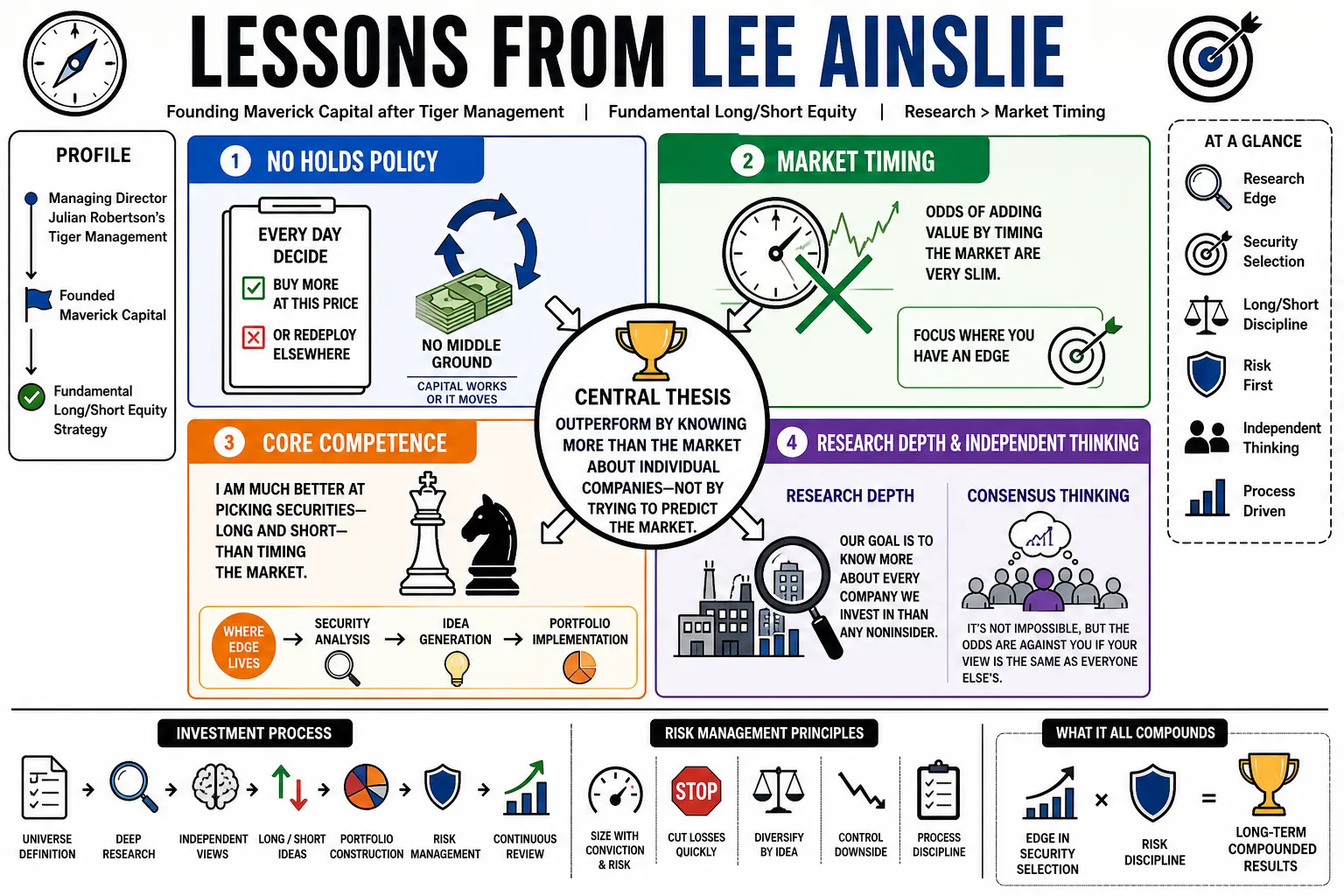
- On the No Holds Policy: "There are no 'holds.' Everyday you're either willing to buy more at the current price, or, if you aren't, you should redeploy the capital to something you believe does deserve incremental capital." — Source: [Graham & Doddsville]
- On Market Timing: "The odds of my adding value consistently by trying to time the market are very slim." — Source: [Invest Like the Best]
- On Core Competence: "I realized long ago that I am much, much better at picking securities, long and short, than I am at trying to time the market." — Source: [Bloomberg Wealth]
- On Research Depth: "Our goal is to know more about every one of the companies in which we invest than any noninsider." — Source: [Hedge Fund Alpha]
- On Consensus Thinking: "It's not impossible, but the odds are against you if your view is the same as everyone else's because that view is probably already reflected in a stock's valuation." — Source: [Graham & Doddsville]
- On Investing Complexity: "At the end of the day, investing is not rocket science." — Source: [Bloomberg Wealth]
- On Generating Returns: "Generating excess returns requires understanding a business's sustainability and capital deployment better than your competitors." — Source: [Maverick Capital]
- On Macro Bets: "The strategy focuses on uncovering company-specific fundamentals rather than attempting to make bets on currencies or broad market direction." — Source: [Invest Like the Best]
- On True Hedging: "The objective of a long/short equity model is to generate returns that remain independent of broader market fluctuations." — Source: [Hedge Fund Alpha]
- On Emotional Detachment: "It is crucial to view positions solely as buys or sells to prevent forming an emotional attachment to a specific stock." — Source: [Graham & Doddsville]
Part 2: Short Selling & Risk Management
- On Shorting as Alpha: "Shorting is utilized primarily as a source of excess return rather than just a mechanism to mitigate overall market risk." — Source: [Invest Like the Best]
- On Short Portfolio Turnover: "The greater diversification of our short portfolio reflects the riskier nature of these investments and that these positions turn over more frequently." — Source: [Graham & Doddsville]
- On Intellectual Rigor: "Having responsibility for both long and short positions naturally sharpens the analytical judgment of the entire investment team." — Source: [Bloomberg Wealth]
- On Asymmetric Risk: "The inherent risk of a short position is its theoretically infinite loss, meaning successful shorting requires active management as position sizes shrink with success." — Source: [Hedge Fund Alpha]
- On Tracking Failures: "We distribute every day something we call the 'Sheet of Shame.' It shows our ten largest losses... It's a way of focusing our attention on what's not working." — Source: [Graham & Doddsville]
- On Sector Balancing: "Rather than using index-level hedges, macroeconomic risks are mitigated by balancing long and short positions directly within the same industry sectors." — Source: [Invest Like the Best]
- On Index Puts: "Relying on S&P 500 puts for hedging is typically less effective than dedicated, research-heavy short selling within specific industries." — Source: [Maverick Capital]
- On Diagnosing Errors: "Following periods of poor performance, the primary driver is often a combination of individual analytical mistakes and insufficient risk constraints." — Source: [Hedge Fund Alpha]
- On Market Recoveries: "Even after suffering quarters with negative returns, maintaining a disciplined risk framework consistently yields positive results over the subsequent year." — Source: [Maverick Capital]
- On Downside Limits: "The upside of a short position is inherently capped at 100%, emphasizing the necessity of sizing short bets conservatively compared to longs." — Source: [Bloomberg Wealth]
Part 3: Valuation & Capital Allocation
- On Primary Metrics: "The most commonly used valuation metric at Maverick is sustainable free cash flow in comparison to enterprise value." — Source: [Graham & Doddsville]
- On the Limits of Valuation: "While we place great emphasis on valuation in our investment decisions, valuation alone should never be the driver of either a long or a short investment." — Source: [Invest Like the Best]
- On Catalysts: "I believe it is important to identify a catalyst that should benefit the valuation." — Source: [Graham & Doddsville]
- On Adapting Models: "Valuation metrics must be adapted to the specific sector being analyzed, rather than applying a universal framework to every business." — Source: [Hedge Fund Alpha]
- On Capital Deployment: "Understanding exactly how a company plans to allocate its capital is often the differentiating factor between a good business and a great investment." — Source: [Bloomberg Wealth]
- On Competitive Advantage: "Deep fundamental research serves as a firm's primary competitive moat against market volatility." — Source: [Maverick Capital]
- On Fresh Perspectives: "Sustaining performance requires incorporating new information and adjusting valuation models when market results contradict your initial thesis." — Source: [Invest Like the Best]
- On Position Sizing: "In terms of sizing, our average long is roughly twice the size of an average short at Maverick." — Source: [Graham & Doddsville]
- On Assessing Growth: "It is vital to determine the long-term sustainability of growth and returns on capital before committing significant portfolio sizing." — Source: [Hedge Fund Alpha]
- On Intrinsic Value: "The core of the investment process is assessing the difference between the market's perception of value and the intrinsic reality of the business's cash flow." — Source: [Maverick Capital]
Part 4: Portfolio Construction & Discipline
- On Concentration: "Our long portfolio is more concentrated than our short portfolio." — Source: [Graham & Doddsville]
- On Maintaining Discipline: "At the time of maximum pain, you need to maintain your discipline." — Source: [Invest Like the Best]
- On Capital Preservation: "Our objective is to preserve and grow capital." — Source: [Bloomberg Wealth]
- On Hybrid Structures: "Utilizing a structure where sector heads manage respective industries ensures deep expertise while balancing overall portfolio exposure." — Source: [Maverick Capital]
- On Conviction: "Position sizes must continually reflect the current assessment of risk and potential reward, preventing overextension in any single idea." — Source: [Hedge Fund Alpha]
- On the Three Pillars: "The three key components to running a successful investment firm are stock picking, constructing a good portfolio, and running the business." — Source: [Invest Like the Best]
- On Avoiding Style Drift: "Discipline means refusing to abandon your core strategy just because short-term market environments are unfavorable for fundamental investing." — Source: [Graham & Doddsville]
- On Active Management: "An effective portfolio requires constant re-evaluation of every holding to ensure it still represents the best possible use of capital." — Source: [Bloomberg Wealth]
- On Independent Bets: "A truly hedged strategy relies on pairing long and short bets independently rather than attempting to guess the broader economic cycle." — Source: [Hedge Fund Alpha]
Part 5: Hiring & Talent Development
- On Human Capital: "The only asset we have at the end of the day is people." — Source: [Invest Like the Best]
- On Hiring Criteria: "The most important components we gauge include competitiveness, mental flexibility and emotional consistency." — Source: [Graham & Doddsville]
- On Emotional Consistency: "Emotional stability is a surprisingly important trait for investment professionals to navigate the inevitable volatility of the markets." — Source: [Bloomberg Wealth]
- On Competitiveness: "The drive to win and the resilience to persist through adversity are non-negotiable requirements for successful stock pickers." — Source: [Hedge Fund Alpha]
- On Mental Flexibility: "Analysts must be willing to abandon their preconceived theses quickly when presented with contradictory fundamental evidence." — Source: [Invest Like the Best]
- On Compounding Talent: "Building a repeatable culture relies entirely on hiring top-tier individuals and ensuring they continuously learn from one another." — Source: [Maverick Capital]
- On Accountability: "Empowering analysts with direct responsibility for portions of the portfolio builds a deeper sense of ownership and personal accountability." — Source: [Graham & Doddsville]
- On Sector Specialization: "Deep expertise is built by organizing the investment team into dedicated sector specialists, particularly in complex industries like technology." — Source: [Bloomberg Wealth]
- On the Primary Edge: "The true competitive advantage of an investment firm is not its access to information, but the depth of its research and the quality of its team." — Source: [Hedge Fund Alpha]
Part 6: Evaluating Management
- On Evaluating Management: "The most critical factor that we're trying to evaluate is the quality of management—their intelligence, competitiveness and, most importantly, their desire to create shareholder value." — Source: [Graham & Doddsville]
- On Julian Robertson's Influence: "Julian was maniacal on the importance of management. 'Have you done your work on management?' 'Yes, sir.' 'Where did the CFO go to college?'" — Source: [Invest Like the Best]
- On Executive Incentives: "Assessing a management team's desire to create shareholder value requires looking past their words and directly at their capital allocation history." — Source: [Hedge Fund Alpha]
- On Granular Research: "Truly understanding management means tracking specific details about their background, tendencies, and past strategic decisions." — Source: [Bloomberg Wealth]
- On Insider Knowledge: "The goal of fundamental analysis is to reach a level of understanding about a company's operations that rivals the executives running it." — Source: [Maverick Capital]
- On Business Durability: "The long-term sustainability of a business model is intrinsically tied to the mental flexibility of the management team guiding it." — Source: [Graham & Doddsville]
- On Challenging Assumptions: "An analyst must rigorously debate and stress-test the claims made by corporate management rather than accepting their guidance at face value." — Source: [Invest Like the Best]
- On Free Cash Flow: "A management team's ability to intelligently deploy free cash flow is the single most critical driver of long-term equity valuation." — Source: [Hedge Fund Alpha]
- On Executive Drive: "Just as a fund looks for competitiveness in its new hires, it must demand that same fierce drive from the executives running its portfolio companies." — Source: [Bloomberg Wealth]
Part 7: The Tiger Management Legacy
- On Early Mentorship: "The opportunity to be surrounded by exceptionally talented people at Tiger Management was the most formative experience of his career." — Source: [Invest Like the Best]
- On Intense Debate: "Cultivating a culture of intense debate, where analysts must defend their ideas against numerous skeptics, is a direct inheritance from Julian Robertson." — Source: [Graham & Doddsville]
- On Fundamental Focus: "The rigorous, bottom-up approach to stock picking pioneered at Tiger remains the foundational philosophy at Maverick Capital." — Source: [Bloomberg Wealth]
- On Testing Conviction: "The practice of viewing every position strictly as a buy or a sell was a discipline honed during the high-stakes environment of Tiger Management." — Source: [Hedge Fund Alpha]
- On Integrity: "Beyond raw intelligence, the deepest lesson learned from early mentors was an unyielding commitment to honesty and professional ethics." — Source: [Invest Like the Best]
- On Risk Control: "Despite the bold bets associated with the Tiger legacy, the core operational lesson was always centered on strict risk control and capital preservation." — Source: [Maverick Capital]
- On Structural Evolution: "While inheriting the long/short model, Maverick evolved it by implementing tighter sector balancing to mitigate macroeconomic swings." — Source: [Graham & Doddsville]
- On Contrarianism: "The Tiger framework demands that analysts build conviction strong enough to confidently stand against the prevailing market consensus." — Source: [Bloomberg Wealth]
- On Repeatable Culture: "The ultimate lesson from Tiger was that a firm's culture of intellectual rigor can be systematically compounded if the right people are hired." — Source: [Hedge Fund Alpha]
Part 8: Learning & Firm Culture
- On Continuous Learning: "If a week goes by that I haven't learned something new, then that is really a wasted week." — Source: [Invest Like the Best]
- On Stagnation: "If you're not improving you eventually get left behind." — Source: [Bloomberg Wealth]
- On Reading: "I've been able to learn something from almost every book I have ever read." — Source: [Graham & Doddsville]
- On Borrowing Ideas: "There’s a quote by Picasso, which basically says good artists copy and great artists steal. We look at other investors and we also observe other fields to see how star performers do their jobs and continue to improve." — Source: [Invest Like the Best]
- On Embracing Failure: "Confronting daily losses through mechanisms like the 'Sheet of Shame' ensures the culture remains humble and strictly focused on objective reality." — Source: [Hedge Fund Alpha]
- On Soliciting Input: "A successful firm culture requires constantly asking for input from sector experts to balance out the inherent biases of the portfolio manager." — Source: [Maverick Capital]
- On Simplicity: "Despite the massive infrastructure of modern finance, the core act of investing fundamentally remains a simple exercise in assessing business value." — Source: [Graham & Doddsville]
- On Collective Intelligence: "The primary benefit of a multi-manager hybrid structure is the ability to aggregate localized expertise into a unified risk framework." — Source: [Bloomberg Wealth]
- On Enduring Principles: "While the tools and technologies of investing evolve, the necessity for deep research, emotional discipline, and intellectual honesty remains permanent." — Source: [Invest Like the Best]