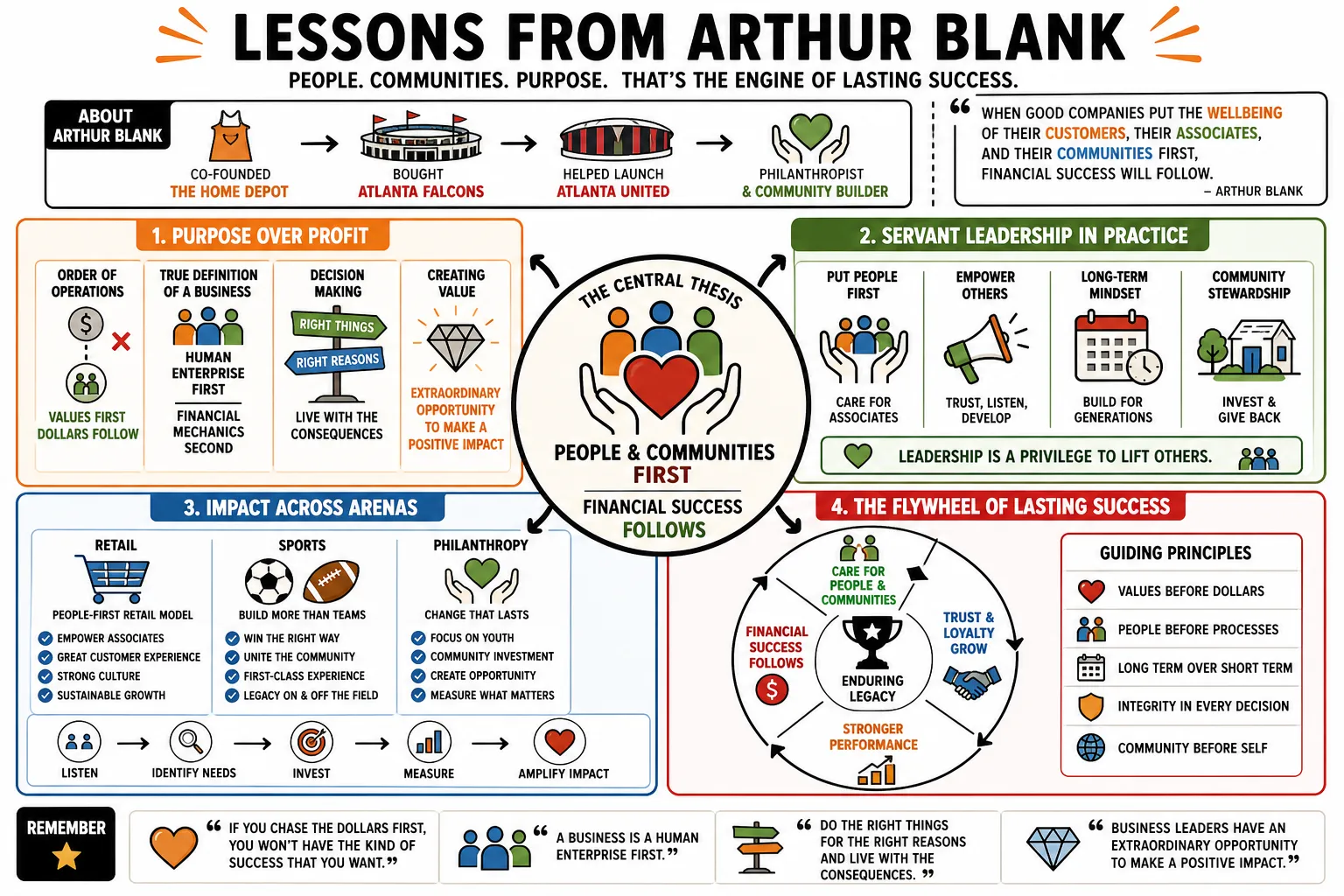
Lessons from Arthur Blank
Arthur Blank co-founded The Home Depot and owns the Atlanta Falcons and Atlanta United. His sports portfolio also includes Atlanta’s forthcoming NWSL club, scheduled to begin play in 2028. His management philosophy emphasizes people, communities, and long-term value across retail, sports, and philanthropy. — About Arthur Blank. — NWSL Atlanta — Club FAQ. — NWSL Atlanta — 2028 Club Plans.
Part 1: Purpose Over Profit
- On the relationship between purpose and success: Blank believes serving customers, associates, and communities supports financial success; this is his business philosophy, not a guarantee. — Good Company — HarperCollins.
- On the order of operations: Choose an industry and company that fit your values before prioritizing compensation. — Terry Leadership Speaker Series.
- On the true definition of a business: Blank treats relationships with customers, associates, and communities as central to business—not merely financial performance. — On Purpose with Jay Shetty.
- On making decisions: Blank follows his mother's advice: choose the right action for the right reasons, then accept the consequences. — Arthur Blank — Commencement Remarks.
- On creating value: Blank argues that lived values can benefit the company, its customers, and its community. — Good Company — HarperCollins.
- On how success is achieved: Judge financial success by the values used to achieve it. — Blank Family — Our Core Values.
- On sustaining a business: Build enduring relationships through care, rather than treating every interaction as a transaction. — Learning Leader — Episode 387.
- On finding purpose: His mother's reminder that life offers one passage motivates Blank to make a difference. — Terry Leadership Speaker Series.
Part 2: Putting People First
- On treating employees: People should feel they work with the organization, not merely for it. — Future of Work — Arthur Blank Interview.
- On the concept of associates: Blank describes associates as participants in the culture, responsible for customers, themselves, and one another. — LEADERS — Living the Culture.
- On employee retention: Treat associates as people who choose to stay because they connect with the culture. — Learning Leader — Episode 387.
- On frontline importance: Put customers, fans, and guests first, then frontline associates; management supplies resources, strategy, realistic goals, and support. — On Purpose with Jay Shetty.
- On shared values: Surround yourself with people who understand the organization's values and demonstrate them in their behavior. — On Purpose with Jay Shetty.
- On personal well-being: Blank urges people to care for their physical and mental well-being and make room for balance. — Arthur Blank — Commencement Remarks.
- On leadership responsibility: Demonstrate service through your own actions. Blank describes doing frontline work himself to show that no job is beneath the leader. — Future of Work — Arthur Blank Interview.
- On investing in people: Invest in associates' skills and career development. — Blank Family — Our Core Values.
- On sensitivity and respect: Build rapport through sensitivity and respect. — Blank Family — Our Core Values.
Part 3: The Art of Listening
- On customer feedback: Ask customers what needs improvement, including those who leave dissatisfied; Blank describes their feedback as guidance for refining the business. — LEADERS — Living the Culture.
- On active listening: Understand the customer's issue rather than challenging it, then act decisively enough to show it was heard. — Babson — Blank Family Lessons.
- On humility in leadership: Listen to those you serve without letting ego override what they tell you. — Babson — Blank Family Lessons.
- On responding to criticism: Actively seek criticism of your work. Blank asks readers for critiques even after deciding the book is ready. — GaryVee — Interview with Arthur Blank.
- On frontline insight: Ask the people closest to the work what they need; Blank describes player conversations informing changes to the Falcons' facilities. — Babson — Blank Family Lessons.
- On giving associates a voice: Empower associates to suggest, decide, voice opinions, and stand by convictions. — Blank Family — Our Core Values.
- On listening to the community: Foundation president Fay Twersky describes listening to neighbors as part of the foundation's place-based work. — Blank Foundation — A Year in Reflection.
- On listening to non-customers: Blank stopped shoppers leaving Home Depot without a purchase to learn what the stores had failed to provide. — Babson — Core Values in Practice.
- On frontline knowledge: Listen to associates as a primary source of information and ideas. — Blank Family — Our Core Values.
Part 4: Fostering an Inclusive Culture
- On individual differences: Use differing perspectives to strengthen the organization and its partnerships. — Blank Family — Our Core Values.
- On building community: Seek work that serves others and connects you with a wider community. — On Purpose with Jay Shetty.
- On promotion and values: Make lived values a condition of promotion, not just technical competence; Blank describes promoting people who demonstrated the culture. — LEADERS — Living the Culture.
- On shared success: Blank values success that improves associates' lives and their ability to support families and communities. — On Purpose with Jay Shetty.
- On bureaucracy and innovation: Remove unnecessary bureaucracy that obstructs innovation. — Blank Family — Our Core Values.
- On equitable opportunity: Twersky describes using the foundation's assets to advance equitable opportunity and bring community voices into its work. — Blank Foundation — A Year in Reflection.
- On unity through listening: Blank links working together with listening to one another, showing respect, and responding. — National Football Foundation — Blank's Remarks.
Part 5: Continuous Innovation
- On resisting complacency: Keep criticism visible as a reminder not to become complacent; Blank describes displaying negative press in his office hallway. — Learning Leader — Episode 387.
- On taking risks: Blank connects innovation with taking risks to do what he believes is right, illustrated by changing stadium food pricing. — Good Company — Blank's Book Excerpts.
- On the entrepreneurial spirit: Exercise initiative in support of the organization's culture and vision. — Blank Family — Our Core Values.
- On entrepreneurial freedom: Avoid top-down controls that constrain associates' entrepreneurial initiative. — Learning Leader — Episode 387.
- On reinvention: Keep seeking better results through ongoing reinvention. — Blank Family — Our Core Values.
- On curiosity: Learn how the work actually happens by observing and participating on the front lines, as Blank describes doing across his businesses. — Future of Work — Arthur Blank Interview.
- On improving what customers receive: Improve processes, products, and services around customer expectations. — Blank Family — Our Core Values.
- On customer-led innovation: Let customer feedback guide innovation rather than assuming leadership already knows what customers need. — Babson — Core Values in Practice.
Part 6: The Responsibility of Leadership
- On taking responsibility: Take responsibility for your decisions and actions. — Blank Family — Our Core Values.
- On the privilege of leading: Treat the opportunity to shape the future through values-based leadership as a privilege. — Arthur Blank — Commencement Remarks.
- On transparency: Blank urges leaders to embrace difficult conversations rather than avoid uncomfortable issues. — Molly Fletcher — Values-Based Leadership.
- On responding to unexpected challenges: When challenges arrive, focus on the next action you can control. — Arthur Blank — Commencement Remarks.
- On values beyond financial metrics: Evaluate the behavior and relationships behind a business, not only revenue, profitability, or return on sales. — On Purpose with Jay Shetty.
- On personal integrity: Stay faithful to your principles when circumstances make doing so difficult. — Arthur Blank — Commencement Remarks.
- On fan responsibility: Blank says ownership owes fans sound decisions while making clear that fans do not run the franchise. — Atlanta Falcons — Owner's Responsibilities.
Part 7: Giving Back to Others
- On the purpose of wealth: Blank says he intends to use his wealth and time to help people, especially children, lead healthier, more productive lives. — About Arthur Blank.
- On giving back: Contribute time, talent, labor, and money—not only financial donations. — Blank Family — Our Core Values.
- On community engagement: Treat business well-being as connected to society's well-being. — Blank Family — Our Core Values.
- On lasting solutions: Work with people and organizations seeking lasting solutions to complex problems. — About Arthur Blank.
- On environmental responsibility: The foundation's environmental strategy supports clean electricity and healthy soils to address climate-fueling emissions. — Blank Foundation — Environment.
- On supporting civil and human rights: Blank directs his personal proceeds from Good Company to the National Center for Civil and Human Rights. — Good Company — HarperCollins.
- On associate-led philanthropy: Give associates a role in community funding decisions and site visits, as Blank describes in his businesses' charitable funds. — On Purpose with Jay Shetty.
- On the legacy of business: Blank wants businesses to be a force for good and leave a positive example beyond their financial results. — Good Company — Blank's Book Excerpts.
- On expanding service: Treat good fortune as a reason to ask how you can help others and extend that work. — On Purpose with Jay Shetty.
Part 8: The Long Game
- On a meaningful life: Keep seeking greater meaning in personal and professional life rather than treating achievement as a finish line. — Terry Leadership Speaker Series.
- On finding joy in work: Find work aligned with your passion and purpose so that it can feel more like play than obligation. — Future of Work — Arthur Blank Interview.
- On overcoming failure: Being fired from Handy Dan led Blank and Bernie Marcus to start Home Depot rather than return to their previous jobs. — Molly Fletcher — Values-Based Leadership.
- On growing culture deliberately: When expansion outpaces cultural integration, pause and retrain rather than trying to change everything while operating as usual. — Future of Work — Arthur Blank Interview.
- On leaving a foundation: Embed values throughout the organization so they can endure leadership changes, not depend entirely on the founders. — Future of Work — Arthur Blank Interview.
- On continuous learning: Keep learning when entering a new field. Blank credits experienced NFL owners with helping him understand team ownership. — Good Company — Blank's Book Excerpts.
- On enduring principles: Apply the same core values across businesses while adapting how they are expressed in each setting. — Arthur Blank — Commencement Remarks.
- On creating the future: Blank encourages graduates to believe in their capacity and take part in shaping the future. — Arthur Blank — Commencement Remarks.
- On thoughtful change: Balance performance accountability with patience; Blank warns against change merely for its own sake. — NFL — Leadership and Continuity.