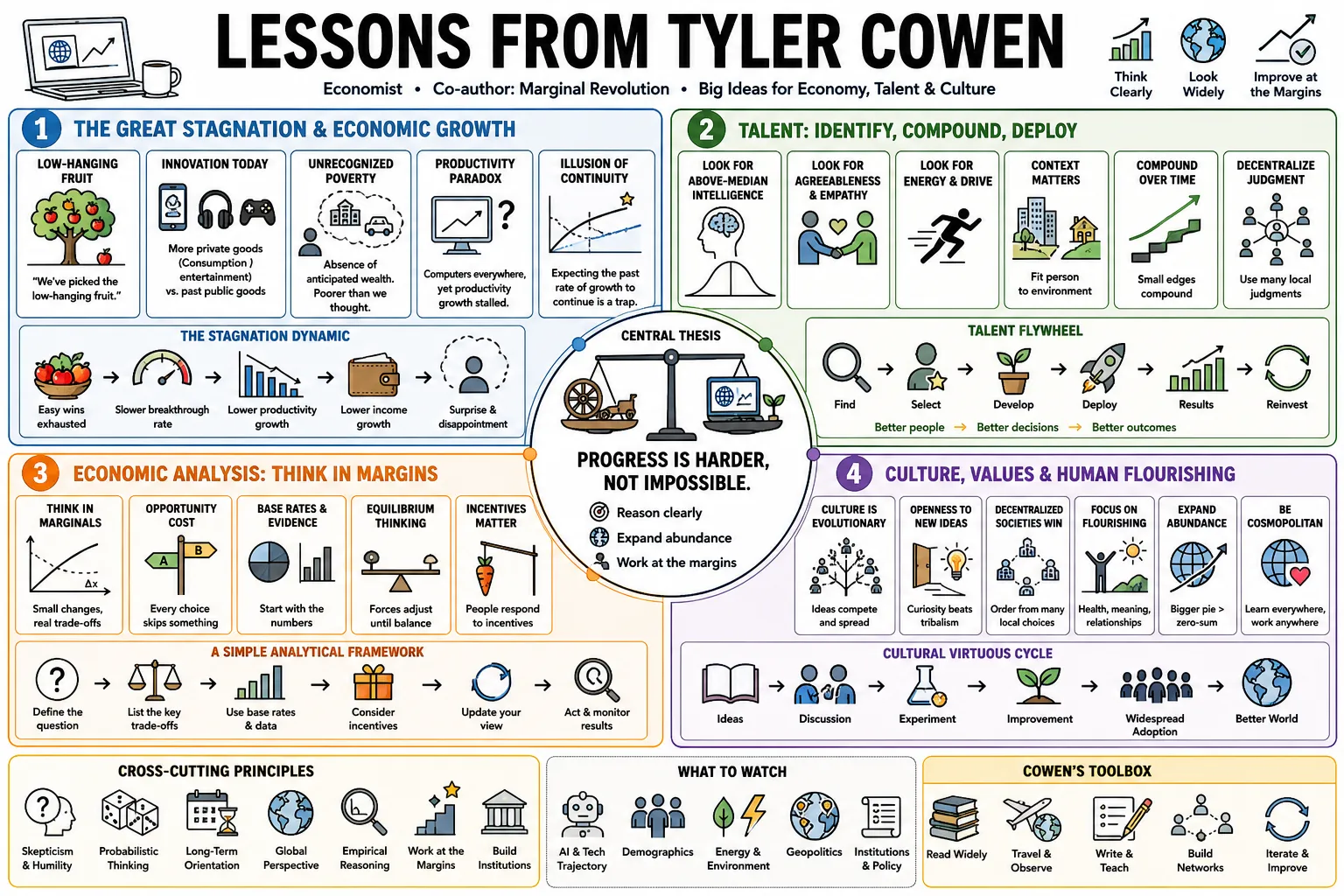
Lessons from Tyler Cowen
Economist Tyler Cowen co-authors the daily blog Marginal Revolution, covering everything from monetary policy to regional food. He is best known for his Great Stagnation theory, which argues that the American economy stalled after exhausting its easy technological breakthroughs. This profile collects his specific frameworks for identifying talent, analyzing the economy, and understanding culture.
Part 1: The Great Stagnation and Economic Growth
- On low-hanging fruit: "We’ve picked the low-hanging fruit, and that is slowing down our economic growth." — Source: [The Great Stagnation]
- On modern innovation: "Recent and current innovation is more focused on creating private goods, often for consumption or entertainment, rather than the public goods that drove the major improvements in our standard of living in previous eras." — Source: [The Great Stagnation]
- On unrecognized poverty: "We suffer instead from an absence of anticipated wealth. We're simply poorer than we thought." — Source: [The Great Stagnation]
- On the productivity paradox: "It is truly surprising (and worrisome) that the era when computers took over the world has also been an era of failed productivity growth and stunted economic growth." — Source: [The Great Stagnation]
- On the illusion of progress: The internet has created vast amounts of consumer surplus and entertainment, but it has not generated the broad-based income growth that defined the post-war era. — Source: [The Great Stagnation]
- On historical context: We often forget that the massive leaps in living standards from 1880 to 1940 (electricity, indoor plumbing, and automobiles) were historically anomalous one-time gains. — Source: [The Great Stagnation]
- On the limits of education: The strategy of simply sending more people to college yields diminishing returns once the baseline level of societal education has already peaked. — Source: [The Great Stagnation]
- On political dysfunction: Much of our political gridlock is actually a symptom of economic stagnation, as politicians fight over a pie that is no longer growing at historical rates. — Source: [The Great Stagnation]
- On technological exhaustion: "When you look at the actual data on technological innovation, one thing you see is that what I call the 'low-hanging fruit' has been exhausted." — Source: [Tyler Cowen Interviews]
- On returning to growth: The primary question of our time is what we can do to boost the rate of economic growth and end the stagnation. — Source: [80,000 Hours Podcast]
Part 2: Talent and Interviewing
- On finding anomalies: To identify truly exceptional talent, you must look for people whose career trajectories look weird or non-linear, rather than perfectly optimized for corporate ascent. — Source: [Talent]
- On unconventional interviewing: "If I was the perfect Netflix, what type of movies would I recommend for you and why?" — Source: [Talent]
- On assessing drive: "How do you feel you are different from the people at your current company?" — Source: [Talent]
- On conviction: "What views do you hold religiously, almost irrationally?" — Source: [Talent]
- On preparation: "How did you prepare for this interview?" — Source: [Talent]
- On intellectual curiosity: "What subreddits, blogs, or online communities do you enjoy?" — Source: [Talent]
- On hidden passions: "What is something esoteric you do?" — Source: [Talent]
- On deep inquiry: The goal of an interview is to practice appreciative inquiry, asking how they built their unique mental models rather than trying to catch them in a mistake. — Source: [Conversations with Tyler]
- On learning from everyone: A key skill of the interviewer is adapting your language and inquiry style to perfectly match the expertise of the person you are speaking with. — Source: [Conversations with Tyler]
- On ambition: The most important trait to look for in a young person is the sheer scale and intensity of their ambition. — Source: [Talent]
Part 3: Average is Over
- On machine collaboration: "The smarter machines become the more it shapes how human beings have to change. There's a new scale, and that's knowing when to defer." — Source: [Average is Over]
- On predicting success: "The measure of self-motivation in a young person will become the best way to predict upward mobility." — Source: [Average is Over]
- On modern scarcity: "In today's global economy here is what is scarce: Quality land. Intellectual property. Quality labor with unique skills. Unskilled labor and money in the bank are not." — Source: [Average is Over]
- On information overload: "For the high earners, life will feel better than ever before, but at the same time life will feel more harried and more overloaded with information than ever before." — Source: [Average is Over]
- On the speed of reading: "The best way to read quickly is to read lots. And lots. And to have started a long time ago. Then maybe you know what is coming in the current book." — Source: [Average is Over]
- On cognitive friction: "Players do their absolute best when they are faced with a slight disadvantage in their position. When decisively up or down, they don't concentrate with the same facility." — Source: [Average is Over]
- On economic polarization: "I see three forces militating in favor of growing inequality: increasing measurement of worker value added, automation through smart software, and globalization." — Source: [Average is Over]
- On the new elite: The future belongs to those who can act as effective complements to highly intelligent algorithms. — Source: [Average is Over]
- On hyper-meritocracy: We are moving toward a world where your economic value is measured with ruthless, inescapable precision. — Source: [Average is Over]
Part 4: The Complacent Class
- On static culture: "A culture of the casual is a culture of people who already have achieved something and who already can prove it. It is a culture of the static and the settled." — Source: [The Complacent Class]
- On the decline of mobility: "Economists see migration as a kind of investment. In the beginning, the move is not supposed to be easy, but it's a sign of hope, faith in the future." — Source: [The Complacent Class]
- On generational priorities: "Millennials as a generation just don't seem that interested in grand projects, unless of course you count wired interconnectivity, at which they excel." — Source: [The Complacent Class]
- On the paradox of safety: "We all have taken many steps to make our lives safer and more comfortable. Nonetheless, when applied collectively, these strategies ultimately choke off dynamism." — Source: [The Complacent Class]
- On segregation by choice: People increasingly use technology to match with people exactly like themselves, creating comfortable but intellectually sterile bubbles. — Source: [The Complacent Class]
- On the loss of restlessness: The defining American trait used to be a willingness to uproot everything for a better life; today, it is the desire to stay put and optimize local comforts. — Source: [The Complacent Class]
- On societal fragility: By trying to engineer away all risk and volatility, we actually make our social structures far more vulnerable to catastrophic shocks. — Source: [The Complacent Class]
- On the veto society: "Technological progress slows down when there are too many people who have the right to say no." — Source: [The Complacent Class]
- On the illusion of peace: The current era of domestic tranquility and low crime may simply be a byproduct of a society that has forgotten how to take meaningful risks. — Source: [The Complacent Class]
Part 5: Food, Culture, and Diversity
- On the economics of eating: "Food is a product of supply and demand, so try to figure out where the supplies are fresh, the suppliers are creative, and the demanders are informed." — Source: [An Economist Gets Lunch]
- On the necessity of good meals: "Every meal counts. A bad or mediocre meal is more than an unpleasant taste, it is an unnecessary negation of life's pleasures." — Source: [An Economist Gets Lunch]
- On price and quality: "Good food is often cheap food. Who has the patience, the time, and the money to take most meals in fancy restaurants? Hardly anyone." — Source: [An Economist Gets Lunch]
- On dining atmosphere: "It is often best when the people in a restaurant look a little serious or even downright grim. You do want to see a certain seriousness of purpose." — Source: [An Economist Gets Lunch]
- On ordering strategies: "Avoid dishes that are ingredients-intensive. Go for dishes that are composition-intensive. Order the ugly and order the unknown." — Source: [An Economist Gets Lunch]
- On finding the best Thai food: "The two worst signs for Thai restaurants are Thai restaurants with large bars and also Thai restaurants that serve sushi. Eat at a Thai restaurant that is attached to a motel." — Source: [An Economist Gets Lunch]
- On the miracle of agribusiness: "Cheap, quick food is the single most important advance in human history. It is the foundation of modern civilization and the reason why most of us are alive." — Source: [An Economist Gets Lunch]
- On cross-subsidization: "The wealthy and the myopic are the friend and supporter of the non-drinking gourmand. By paying the markup on the drinks, certain customers make quality food cheaper." — Source: [An Economist Gets Lunch]
- On authentic diversity: "Real cultural diversity results from the interchange of ideas, products, and influences, not from the insular development of a single national style." — Source: [Creative Destruction]
Part 6: Stubborn Attachments
- On moral commitment: "We need to develop a tougher, more dedicated, and indeed a more stubborn attachment to prosperity and freedom than is currently the case." — Source: [Stubborn Attachments]
- On the long-term impact: "These goals, strictly rather than loosely pursued, are of world-historic importance for civilization and if we adhere to them they will bring an enormous amount of good into our world." — Source: [Stubborn Attachments]
- On the virtues of wealth: "Growth is good. Through history, economic growth in particular has alleviated human misery, improved human happiness and opportunity, and lengthened human lives." — Source: [Stubborn Attachments]
- On evaluating the future: "We tend to visualize future events very poorly and with a deficit of proper imagination." — Source: [Stubborn Attachments]
- On existential risk: "If the future really matters, we can't be doing things that are going to wreck the future." — Source: [Stubborn Attachments]
- On moral realism: "I treat questions of right and wrong as having correct answers, at least in principle. Right and wrong are a kind of 'natural fact'." — Source: [Stubborn Attachments]
- On societal stability: "Wealthier societies are more stable, offer better living standards, produce better medicines, and ensure greater autonomy." — Source: [Stubborn Attachments]
- On inherited prosperity: "The most important gifts of the past generation to the current generation come from wise investments, a belief in rules of just conduct, good political institutions, and good values." — Source: [Stubborn Attachments]
- On foundational principles: "When it comes to the future of our world, we have lost our way in a fundamental manner. We must return to principles, but we do not always have good principles to guide us." — Source: [Stubborn Attachments]
- On resolving ethical clashes: We must place a premium on sustainable economic growth because it serves as the ultimate resolution to most zero-sum moral dilemmas. — Source: [Stubborn Attachments]
Part 7: Marginal Revolution and Economics
- On pragmatism in policy: "Effective political ideas are those that can still do good in half-baked form." — Source: [Marginal Revolution]
- On radical pessimism: "But are you short the market?" (If you truly believe society is collapsing, your financial portfolio should reflect that conviction). — Source: [Marginal Revolution]
- On information abundance: "The more information that's out there, the greater the returns to just being willing to sit down and apply yourself. Information isn't what's scarce; it's the willingness to do something with it." — Source: [Marginal Revolution]
- On state capacity: A functioning free market requires a highly capable, competent state to provide infrastructure, fund basic science, and enforce the rules of the game. — Source: [Marginal Revolution]
- On evaluating thinkers: To truly understand a philosopher or economist, you must identify what they are reacting against in their own time and context. — Source: [Conversations with Tyler]
- On behavioral economics: People are far more rational than we give them credit for, but they are optimizing for social status and signaling rather than purely monetary outcomes. — Source: [Discover Your Inner Economist]
- On intellectual humility: The best way to test your own theories is to try to pass an Ideological Turing Test, seeing if you can state the opposing argument so well that your opponent agrees with your summary. — Source: [Marginal Revolution]
- On the value of travel: "Eating out in a different country is not about the food, it's a quest. It's a chance to create an adventure or a memory." — Source: [An Economist Gets Lunch]
- On solving environmental issues: The answer to climate change is not degrowth, but accelerating technological innovation to invent our way out of the problem. — Source: [Marginal Revolution]
Part 8: Big Business and Markets
- On defending corporations: Big businesses are not uniquely evil; they are among the most essential and beneficial institutions in American life, providing unseen infrastructure for our prosperity. — Source: [Big Business]
- On corporate honesty: The average large corporation is statistically far more honest and reliable than the average individual on a dating app or a resume. — Source: [Big Business]
- On CEO pay: While it appears exorbitant, the compensation of top executives largely reflects the massive, scaled impact their decisions have on globally integrated firms. — Source: [Big Business]
- On the tech giants: The major tech monopolies provide extraordinary amounts of consumer surplus for free, making them historically unique and vastly underappreciated by their critics. — Source: [Big Business]
- On the nature of work: Corporations do not exploit workers so much as they organize human capital into highly productive, specialized structures that raise wages for the skilled. — Source: [Big Business]
- On finance: The financial sector is routinely demonized, but it is the central nervous system of the economy, efficiently allocating capital to the ideas that will shape the future. — Source: [Big Business]
- On the profit motive: Profit is not a dirty word; it is the most reliable signal we have that a firm is creating value that human beings actually want. — Source: [Big Business]
- On market friction: We often complain about bad customer service, but we fail to notice the millions of seamless, frictionless transactions that occur daily thanks to corporate logistics. — Source: [Big Business]
- On institutional trust: If we destroy trust in our largest commercial enterprises, we undermine the very engines that make the modern world survivable and pleasant. — Source: [Big Business]