Lessons from Jonathan Frankle
Jonathan Frankle is the Chief AI Scientist at Databricks and co-founder of MosaicML. He co-authored the Lottery Ticket Hypothesis, which demonstrated that dense neural networks hide smaller, highly efficient subnetworks. These notes collect his practical views on building, evaluating, and scaling machine learning systems without the usual industry hype.
Part 1: The Lottery Ticket Hypothesis
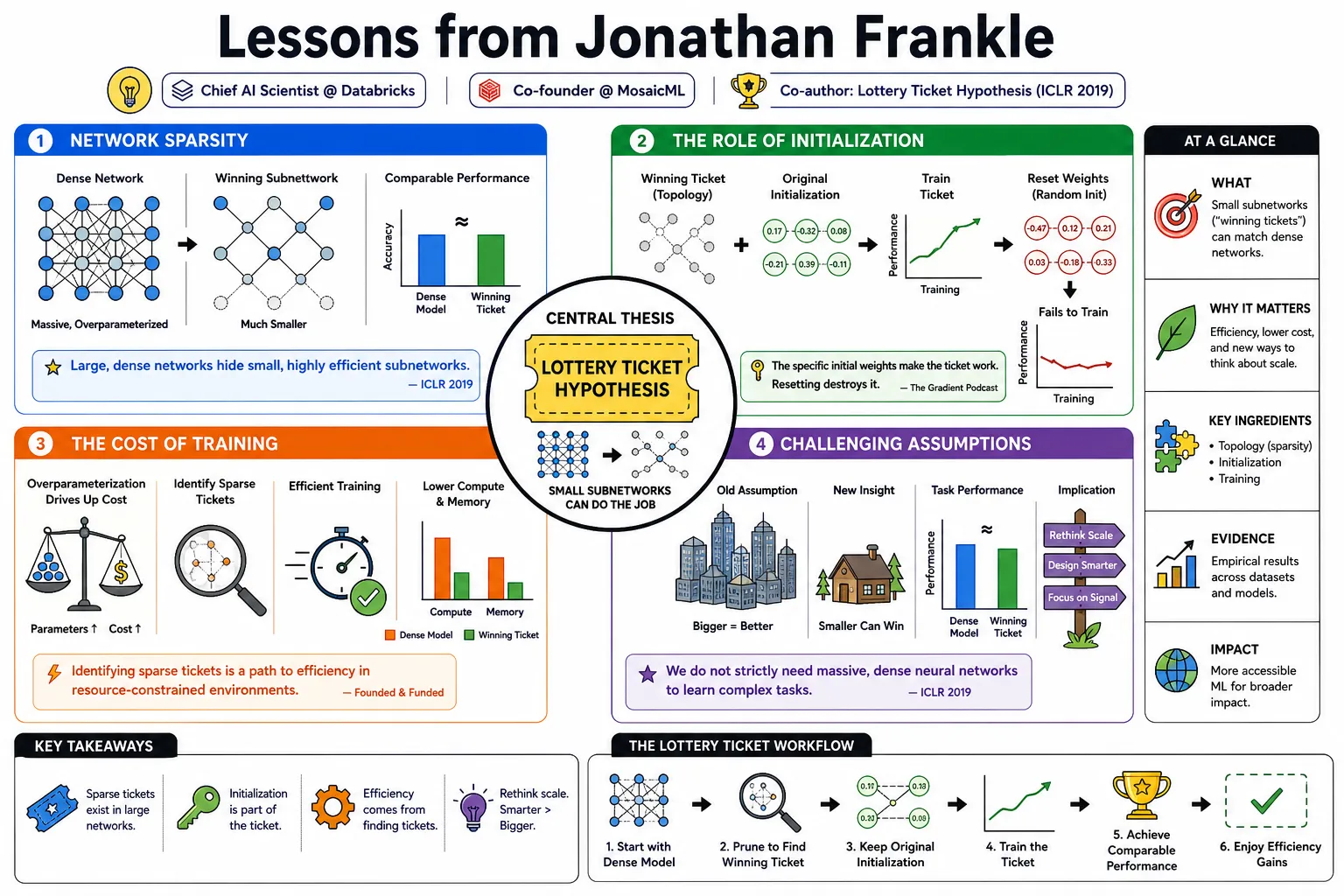
- On Network Sparsity: "Large, dense neural networks contain much smaller subnetworks that, when trained in isolation, can achieve comparable performance." — Source: ICLR 2019 Presentation
- On the Role of Initialization: "The specific initial weights of these winning subnetworks are what make the subsequent training process particularly effective; resetting them destroys the ticket." — Source: The Gradient Podcast
- On the Cost of Training: "Standard neural networks carry immense overparameterization. Identifying sparse tickets is a path toward more efficient model training in resource-constrained environments." — Source: Founded & Funded
- On Challenging Assumptions: "We do not strictly need massive, dense neural networks to learn complex tasks. Much of the heavy lifting in training actually occurs at initialization." — Source: ICLR 2019 Presentation
- On Finding Tickets: "The process is iterative: train a dense network, prune the smallest-magnitude weights, reset the remaining weights to their original values, and retrain." — Source: The Gradient Podcast
- On Edge Computing: "Understanding sparse subnetworks allows us to optimize machine learning models for deployment on edge devices where memory and compute are limited." — Source: Wandb.ai Interviews
- On the Lottery Analogy: "These winning subnetworks are essentially lucky in their random initialization. They drew the right starting numbers to learn the task efficiently." — Source: ICLR 2019 Presentation
- On Transferability: "Winning tickets often generalize across different datasets and optimizers, suggesting they capture something fundamental about the architecture's inductive bias." — Source: The Gradient Podcast
- On the Limits of Randomness: "If a winning subnetwork is re-initialized with new random weights, it typically fails to train as effectively as it did with its original initialization." — Source: ICLR 2019 Presentation
- On Future Architectures: "The principles of the lottery ticket hypothesis extend beyond basic convolutional networks and are actively being explored in modern architectures like Transformers." — Source: Wandb.ai Interviews
Part 2: The Philosophy of Efficiency
- On Democratizing AI: "The core thesis quite simply was making machine learning efficient for everyone. The idea is that this is not a technology that should be reserved for only a few." — Source: Founded & Funded
- On Equitable Impact: "The impact of artificial intelligence will never be equitable if there's only one company that builds and controls the models." — Source: Bloomberg Interviews
- On Practical Constraints: "Research impact often lies less in preserving specific techniques than in reshaping how practitioners think about constraints." — Source: Radical Ventures AI Masterclass
- On Workload Flexibility: "There's a certain level of latent flexibility in how AI workloads are typically run. Often, a small percentage of jobs are truly non-preemptible, whereas training or batch inference have different priority levels." — Source: VentureBeat
- On Organizational Autonomy: "Anyone, no matter the resources, can study better querying languages and possibly beat a big model they could never afford to train." — Source: Founded & Funded
- On Algorithmic Efficiency: "Hardware improvements are critical, but algorithmic improvements that allow us to train better models with fewer FLOPs are equally important for the ecosystem." — Source: The Gradient Podcast
- On the Value of Small Models: "Not every problem requires a trillion-parameter model. Smaller, specialized models trained on proprietary data often outperform generalized giants for enterprise tasks." — Source: Databricks Data + AI Summit
- On Cost Barriers: "By driving down the cost of training, we enable more researchers and businesses to participate in AI development rather than just acting as API consumers." — Source: Founded & Funded
- On Infrastructure Utilization: "Efficiency isn't just about the model architecture; it's about maximizing GPU utilization and minimizing the idle time across the cluster during training." — Source: VentureBeat
Part 3: Evaluation and Measurement
- On the Missing Infrastructure: "Evaluation remains the missing infrastructure for enterprise AI adoption." — Source: Radical Ventures AI Masterclass
- On Evaluation-First Design: "We need a shift from vague AI 'vibes' to rigorous engineering, which requires an evaluation-first approach to design." — Source: SiliconANGLE (theCUBE)
- On the Limits of Metrics: "Honestly, I don't really believe that any of these eval metrics capture what we care about." — Source: Invisible Machines Podcast
- On Real-World Testing: "The ultimate test for any AI system is whether it delivers measurable value in a production environment, not its performance on academic benchmarks." — Source: Databricks Data + AI Summit
- On the Ouroboros Problem: "Using AI to evaluate other AI systems creates a circular problem where you must determine if the 'judge' model is itself reliable." — Source: VentureBeat
- On Ground Truth: "We must measure the distance to human expert ground truth as a primary way to ground our evaluations." — Source: VentureBeat
- On Benchmarks vs Reality: "Standard academic benchmarks like HellaSwag do not always reflect real-world constraints or the specific needs of an enterprise." — Source: Invisible Machines Podcast
- On Earning Confidence: "The intelligence of the model is typically not the bottleneck. Instead, it's really about asking, how do we get the models to do what we want, and how do we know if they did what we wanted?" — Source: VentureBeat
- On Developing Standards: "The field currently lacks mature, standardized methodologies for evaluating complex, real-world, or agentic workflows." — Source: Radical Ventures AI Masterclass
- On Inventing Frameworks: "Organizations are often forced to invent their own evaluation frameworks under pressure, which introduces significant risk into the deployment process." — Source: SiliconANGLE (theCUBE)
Part 4: Confronting the Hype Cycle
- On Value Extraction: "If we never saw another advance in intelligence beyond GPT-4, we'd still be extracting value from it for the next 20 years." — Source: Bloomberg Interviews
- On Early Gains: "Early efficiency gains in AI were significant, but they now feel quaint compared to the structural challenges of scaling and deployment." — Source: Radical Ventures AI Masterclass
- On Scientific Rigor: "Serious scientific communities operate on proof, not rhetoric. In a landscape crowded with hype, receipts matter." — Source: Radical Ventures AI Masterclass
- On the Real Hard Problems: "The hardest problems are no longer about building models, they are about earning confidence, defining standards, and delivering outcomes that hold up in production." — Source: Radical Ventures AI Masterclass
- On Measurable Value: "The industry is transitioning from token maximization to measurable business value, which is the defining storyline of recent years." — Source: Databricks Data + AI Summit
- On Deliberate Practice: "Companies will succeed not by being the fastest in theory, but by being the most deliberate and careful in practice." — Source: SiliconANGLE (theCUBE)
- On Demos vs Reality: "Building a demo is relatively easy; determining if a system is reliable enough for actual production is extremely difficult." — Source: VentureBeat
- On the Illusion of Intelligence: "We often mistake eloquent text generation for reasoning. We need to look closely at where models fail systematically to understand their true capabilities." — Source: The Gradient Podcast
- On Moving Beyond Chatbots: "The enterprise value of AI is not in building another chatbot, but in deeply integrating models into data pipelines and core business operations." — Source: Databricks Data + AI Summit
Part 5: Pragmatism in Enterprise AI
- On the AI Adoption Ladder: "My prescription is never 'trust the vendor.' It is climb the ladder. If prompting works, stop. If a vector database solves retrieval, great. If not, fine-tune a little, then a lot, then pre-train if you must." — Source: Invisible Machines Podcast
- On Treating AI as a Fractal Problem: "Treat AI deployment as a fractal problem. Start by working alongside humans, bootstrap evaluations, and prove concepts before committing to large-scale fine-tuning." — Source: Databricks Data + AI Summit
- On Organizational Confidence: "Enterprise AI adoption is often constrained less by engineering talent and more by the need for organizational confidence, measurement, and proof." — Source: Radical Ventures AI Masterclass
- On Synthetic Data Limits: "There is no 'free lunch' with synthetic data. If you don't have human insight filtering the data, the model is merely reproducing its own existing behavior." — Source: Bloomberg Interviews
- On Proprietary Data: "The true moat for an enterprise is not the model itself, but the proprietary data used to contextualize and fine-tune that model." — Source: Founded & Funded
- On Cost-Benefit Tradeoffs: "You have to rigorously measure whether the marginal improvement in accuracy from a larger model justifies the exponential increase in serving costs." — Source: SiliconANGLE (theCUBE)
- On Model Customization: "Enterprises need the ability to customize models to their specific jargon and workflows; off-the-shelf generalized models often fall short on niche tasks." — Source: Databricks Data + AI Summit
- On AI Portability: "Avoiding vendor lock-in means ensuring that your AI infrastructure and training pipelines can run efficiently across different cloud environments." — Source: Founded & Funded
- On Operational Reality: "It is much harder to maintain and monitor a model in production than it is to train it in the first place." — Source: VentureBeat
- On Iterative Development: "Don't jump straight to pre-training. Use off-the-shelf APIs to validate the product experience before investing millions in custom compute." — Source: Invisible Machines Podcast
Part 6: The Imperative of Open Source
- On Scientific Proof: "Open source acts as scientific proof. It allows the community to verify capability claims and build robustly upon existing research." — Source: Databricks Data + AI Summit
- On Ecosystem Collaboration: "Open-sourcing code and models fosters collaboration where users contribute features and improvements that ultimately help the entire customer base." — Source: Founded & Funded
- On Corporate Tension: "There are inherent, complicated tensions companies face regarding open source, balancing safety concerns against the need for transparency and community innovation." — Source: Databricks Data + AI Summit
- On Reproducibility: "Without access to the weights, the training data, and the code, we cannot perform the scientific reproduction that moves the field of machine learning forward." — Source: The Gradient Podcast
- On Decentralized Innovation: "A healthy AI ecosystem requires decentralized innovation, where academic labs and startups can compete and contribute alongside massive tech conglomerates." — Source: Radical Ventures AI Masterclass
- On Security through Transparency: "Security by obscurity rarely works in software. Open source models allow the global research community to identify vulnerabilities and patch them faster." — Source: The Markup Interview
- On Kneecapping Models: "The debate over whether to 'kneecap' open source models for safety reasons must be balanced against the loss of utility and the stifling of academic research." — Source: Databricks Data + AI Summit
- On Building Trust: "Enterprises are more willing to trust and deploy models when they can inspect the architecture and understand exactly how the system was trained." — Source: SiliconANGLE (theCUBE)
- On Community Momentum: "The open source community moves faster than any single corporate lab. Harnessing that momentum is essential for building scalable infrastructure." — Source: Founded & Funded
Part 7: Evidence-Based Policy and Regulation
- On Techno-Hubris: "Computer scientists should avoid the hubris of believing they should be the primary policymakers. We should instead act as a source of technical expertise to help realize policy goals." — Source: Wandb.ai Interviews
- On Data-Driven Policy: "We must prioritize measurement and empirical data over purely value-driven or speculative arguments when designing AI regulations." — Source: The Markup Interview
- On Predicting Progress: "A major challenge in long-term AI policy is the need to make assumptions about how technology will evolve, which is rarely a linear path." — Source: The Markup Interview
- On Non-Linear Growth: "I push back against the idea that technology progresses in a simple, linear fashion based on scaling laws; it often moves in big bursts of progress followed by consolidation." — Source: The Markup Interview
- On Focus Areas: "Instead of focusing solely on regulating hypothetical future harms, the industry needs better methodologies and techniques to measure what models actually do today." — Source: Databricks Data + AI Summit
- On System Approachability: "Rigorous evaluation and measurement are what will ultimately make AI systems more approachable, transparent, and safer for society." — Source: Wandb.ai Interviews
- On Legislative Realities: "Regulation must target specific, measurable use cases rather than attempting to govern the mathematics of neural networks themselves." — Source: The Markup Interview
- On Global Standards: "Developing international standards for AI evaluation is critical to ensuring that safety and compliance don't become fragmented across borders." — Source: Radical Ventures AI Masterclass
- On Regulatory Capture: "We must ensure that regulatory frameworks do not inadvertently create a moat that only the largest and wealthiest tech companies can navigate." — Source: Founded & Funded
Part 8: The Reality of Autonomous Agents
- On Delegating Authority: "For AI today, only consider delegating decision-making power if there are many ways to be right, it isn't super important to be right, and a human can verify results at a glance." — Source: VentureBeat
- On the Agentic AI Hype: "Giving AI systems autonomous decision-making power is a huge step, and it won't be easy to get that done. Small improvements will happen and will take time." — Source: VentureBeat
- On System Architecture: "Building agents isn't just about calling an API; it requires robust systems architecture for state management, tool usage, and error recovery." — Source: Databricks Data + AI Summit
- On Predictability: "The fundamental challenge with autonomous AI agents in the enterprise is predictability. Businesses run on reliable processes, and language models are inherently probabilistic." — Source: SiliconANGLE (theCUBE)
- On Human-in-the-Loop: "For the foreseeable future, high-stakes agentic workflows will require a human-in-the-loop to approve actions and manage edge cases." — Source: Invisible Machines Podcast
- On Evaluating Agents: "Evaluating an agent is exponentially harder than evaluating a language model. You have to measure the trajectory of actions over time, not just a single text output." — Source: Radical Ventures AI Masterclass
- On Tool Use: "An agent's utility is bottlenecked by the quality of the tools and APIs it has access to. Garbage tools lead to garbage agent behavior." — Source: Databricks Data + AI Summit
- On Scope Creep: "When deploying agents, scope them strictly to specific tasks. Open-ended autonomy is a recipe for cascading failures in an enterprise environment." — Source: SiliconANGLE (theCUBE)
- On the Long Game: "True autonomous agents that can reliably execute complex, multi-step enterprise workflows represent a multi-year engineering journey, not an immediate product feature." — Source: VentureBeat