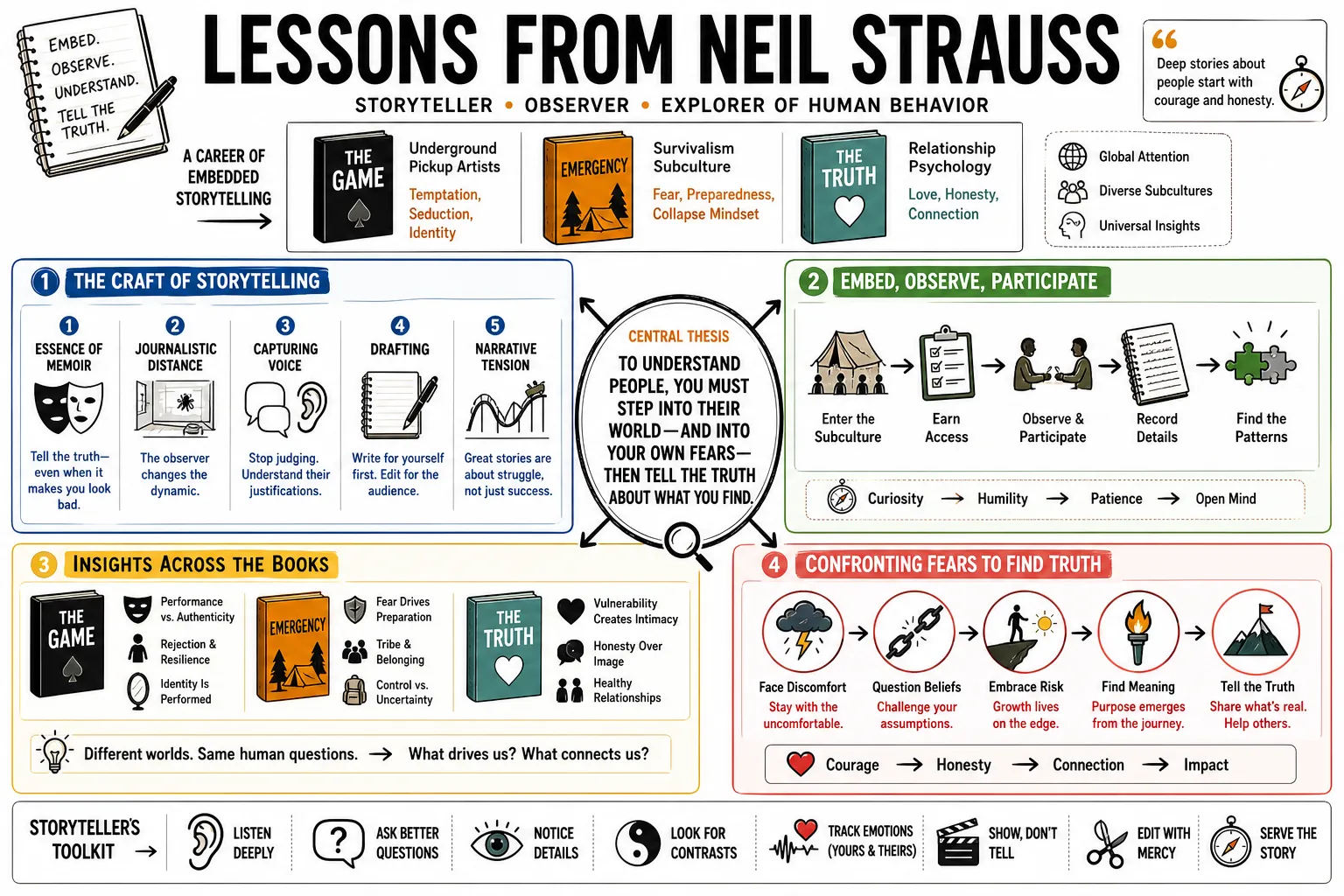
Lessons from Neil Strauss
Journalist and author Neil Strauss embeds himself in subcultures to write deeply personal non-fiction. He gained global attention with the underground pickup artists of "The Game," later exploring survivalism in "Emergency" and relationship psychology in "The Truth." This profile collects insights from across his career on how people interact and confront their fears.
Part 1: The Craft of Storytelling
- On the essence of memoir: "If you are going to write your memoir, then you must be willing to tell the truth. And to do so, you must not be afraid to share things that may make you look bad." — Source: [NeilStrauss.com]
- On journalistic distance: "The observer always affects the observed. You can't just be a fly on the wall; your presence changes the dynamic of the room." — Source: [The Tim Ferriss Show]
- On capturing voice: "To capture someone else's voice, you have to stop judging them. You have to understand how they justify their own actions to themselves." — Source: [The Dirt]
- On drafting: "Write for yourself first. Then edit for the audience. If you try to write for the audience first, you lose your own voice." — Source: [Lewis Howes Interview]
- On narrative tension: "The best stories aren't about someone achieving a goal; they are about someone being forced to change who they are in order to achieve it." — Source: [MasterClass Podcast]
- On honesty: "The bricks that create each of us are not all made of gold. Some are shit. And we're all a combination of both... it's the shit that makes us unique." — Source: [NeilStrauss.com]
- On ghostwriting: "You essentially have to become a method actor. You have to inhabit their trauma and their triumphs until you think the way they think." — Source: [I Can't Make This Up]
- On structure: "Chronology is the enemy of a good story. You have to start where the emotion is highest, not where the timeline begins." — Source: [The Tim Ferriss Show]
- On revision: "Writing is just rewriting. The first draft is just you telling yourself the story so you know what it is." — Source: [Aubrey Marcus Podcast]
Part 2: The Creative Process
- On creative exploration: "The essence of creativity is fucking around. You have to give yourself permission to play before you can build." — Source: [The Tim Ferriss Show]
- On distractions: "Friends can be a pain in the ass if you want to do something creative. You have to protect your time ruthlessly." — Source: [The Tim Ferriss Show]
- On self-sabotage: "You are the enemy you're fighting. The block isn't external; it's entirely your own fear disguised as procrastination." — Source: [The Tim Ferriss Show]
- On momentum: "Don't stop writing when you are stuck. Stop writing when you know exactly what happens next. That way, you have an on-ramp for tomorrow." — Source: [Tribe of Mentors]
- On setting boundaries: "What's helped with saying no to others is asking myself first if I'm saying yes out of guilt or fear. If so, then it's a polite no." — Source: [Tribe of Mentors]
- On dealing with critics: "You can't control how people react to your work. You can only control the integrity of the work itself." — Source: [The James Altucher Show]
- On vulnerability in art: "If you aren't a little bit terrified to hit publish, you haven't dug deep enough." — Source: [The Truth]
- On perfectionism: "Perfectionism is just procrastination in a tuxedo. It looks good, but it's still keeping you from doing the work." — Source: [The Tim Ferriss Show]
- On creative environments: "Your environment dictates your output. If you are easily distracted, build a physical space where distraction is impossible." — Source: [Emergency]
Part 3: Attraction and Social Dynamics
- On taking action: "In life, people tend to wait for good things to come to them. And by waiting, they miss out. Usually, what you wish for doesn't fall in your lap." — Source: [The Game]
- On self-presentation: "It's not enough to just be yourself. It's about discovering and permanently bringing to the surface your best self." — Source: [The Game]
- On confidence: "Confidence is not 'they will like me.' Confidence is 'I'll be fine if they don't.'" — Source: [Rules of the Game]
- On social value: "People are drawn to those who possess higher survival and replication value than they do. It's an evolutionary imperative." — Source: [The Game]
- On humor: "Humor isn't just about making people laugh; it's about breaking tension and demonstrating social intelligence." — Source: [The Game]
- On approach anxiety: "The anxiety never fully goes away. You just get better at functioning while the anxiety is happening." — Source: [Rules of the Game]
- On conversational threading: "A good conversation is like a tree. You don't just climb straight up the trunk; you explore the branches." — Source: [Rules of the Game]
- On male drives: "A man has two primary drives in early adulthood: one toward power, success, and accomplishment; the other toward love, companionship, and sex." — Source: [The Game]
- On social proof: "We rely on the reactions of others to determine the value of a person. If a room treats you like you matter, everyone else will assume you do." — Source: [The Game]
- On active listening: "Most people don't listen with the intent to understand; they listen with the intent to reply. Flipping that script is the most powerful social tool you have." — Source: [Rules of the Game]
Part 4: The Illusions of The Game
- On manipulation: "Any tactic designed to manipulate someone else ultimately manipulates you into becoming a less authentic version of yourself." — Source: [The Truth]
- On superficial success: "I got everything I wanted, and I was still miserable. That's the danger of optimizing for the wrong metrics." — Source: [The Truth]
- On validation: "If you need validation from strangers to feel good about yourself, you are building a house on a foundation of sand." — Source: [The Tim Ferriss Show]
- On the limits of pickup: "Pickup can get you into a relationship, but it gives you absolutely zero tools for keeping one or being healthy inside of one." — Source: [The Truth]
- On character: "You can fake confidence, but you can't fake character. Eventually, the mask slips." — Source: [Lewis Howes Interview]
- On empty conquests: "When intimacy is treated as a game, the prize is always hollow. You win the game, but you lose the connection." — Source: [The Truth]
- On projecting flaws: "We often try to fix in others the exact flaws we refuse to address in ourselves." — Source: [The Truth]
- On the pickup artist archetype: "We make fun of those we're most scared of becoming." — Source: [Emergency]
- On true confidence: "True confidence comes from not having anything to hide. It's the absence of the need to perform." — Source: [The Truth]
Part 5: Navigating Intimacy and Love
- On unspoken feelings: "Unspoken expectations are premeditated resentments." — Source: [The Tim Ferriss Show]
- On measuring success: "The only relationship that's truly a failure is one that lasts longer than it should. The success of a relationship should be measured by its depth, not by its length." — Source: [The Truth]
- On commitment: "Without commitment, you cannot have depth in anything, whether it's a relationship, a business or a hobby." — Source: [The Game]
- On the nature of love: "We have this idea that love is supposed to last forever. But love isn't like that. It's a free-flowing energy that comes and goes when it pleases." — Source: [The Truth]
- On genuine intimacy: "Intimacy is sharing your reality with someone else and knowing you're safe, and them being able to share their reality with you and also be safe." — Source: [The Truth]
- On neediness: "Only when our love for someone exceeds our need for them do we have a shot at a genuine relationship together." — Source: [The Truth]
- On relationship dynamics: "Being in an intimate relationship is a bit like asking someone to join hands with us, but only after walking across a field in which we had planted mines." — Source: [The Tim Ferriss Show]
- On choosing partners: "You don't choose a partner based on their best qualities; you choose them based on what kind of flaws you are willing to live with." — Source: [The Truth]
- On romantic illusions: "The romantic comedy model of love is incredibly toxic. It teaches us that conflict is cute and that someone else will complete us." — Source: [Aubrey Marcus Podcast]
- On growing together: "A relationship is a laboratory for personal growth. If you aren't growing, the relationship is dying." — Source: [The Truth]
Part 6: Trauma and Self-Deception
- On childhood wounds: "We spend our adult lives trying to resolve the traumas of our childhood, usually by recreating them with partners who have the same flaws as our parents." — Source: [The Truth]
- On self-awareness: "The best thing we can do for our relationships with others, is to render our relationship to ourselves more conscious." — Source: [The Tim Ferriss Show]
- On avoidance: "Addiction isn't just about drugs or alcohol. You can be addicted to chaos, to women, to anything that keeps you from having to sit quietly with your own pain." — Source: [The Truth]
- On therapy: "Going to therapy isn't about fixing something that's broken; it's about understanding how the machine operates so you stop crashing it." — Source: [The Truth]
- On the ego: "The ego is a bodyguard that was hired to protect a child. But the child grew up, and the bodyguard is still fighting ghosts." — Source: [Aubrey Marcus Podcast]
- On facing reality: "Lying to others is a symptom. Lying to yourself is the disease." — Source: [The Truth]
- On repetitive behavior: "If you keep finding yourself in the exact same painful situation with different people, you are the common denominator." — Source: [Lewis Howes Interview]
- On family dysfunction: "Every family is a cult. And it takes immense work to deprogram yourself from the rules you were taught as a child." — Source: [The Truth]
- On healing: "Healing isn't about forgetting the past. It's about stripping the past of its power to control your present." — Source: [The Truth]
Part 7: Survival and Preparedness
- On the fragility of society: "We're just fragile machines programmed with a false sense of our own importance. And every now and then the universe sends a reminder that we don't really matter to it." — Source: [Emergency]
- On true endurance: "True endurance, I think, comes from the inside. It comes from motivation and belief in what you're doing." — Source: [Emergency]
- On paranoia vs. preparation: "I'd started to look at the world through apocalypse eyes. But there is a difference between being paralyzed by fear and being empowered by preparation." — Source: [Emergency]
- On the illusion of safety: "Civilization is a thin veneer. When the grocery store shelves empty, the rules change immediately." — Source: [Emergency]
- On skill acquisition: "The most valuable currency in a crisis isn't gold or cash; it's useful skills. Knowing how to do things makes you indispensable." — Source: [Emergency]
- On self-reliance: "You cannot outsource your own survival. If you expect the government or the police to save you, you are making a very risky bet." — Source: [Emergency]
- On community: "Lone wolves die. In a disaster, the people who survive are the ones who can form alliances and work within a community." — Source: [Emergency]
- On adaptability: "The survival mindset is about flexibility. The rigid break. The adaptable survive." — Source: [Emergency]
- On facing mortality: "Coming face to face with how easily you can die is the fastest way to figure out exactly how you want to live." — Source: [Emergency]
Part 8: Identity and Personal Growth
- On continuous learning: "The moment you think you have it all figured out is the moment you start decaying. Mastery is a process of endless humbling." — Source: [Rules of the Game]
- On behavior change: "You don't think your way into new behaviors. You act your way into new thinking." — Source: [The Game]
- On extreme experiences: "I immerse myself in extremes because the margins of society tell you the most about the center." — Source: [The Tim Ferriss Show]
- On success metrics: "External success is rarely a reliable indicator of internal peace. Often, they are inversely correlated." — Source: [The Truth]
- On reinventing yourself: "Identity is not fixed. You can decide tomorrow to be someone entirely different, but you have to be willing to burn the old self down." — Source: [The Game]
- On physical fitness: "Treating your body like a garbage can inevitably poisons the mind. You have to tune the instrument if you want to play the music." — Source: [Emergency]
- On fear: "Fear is just a compass pointing towards the exact thing you need to do to grow." — Source: [The Game]
- On taking responsibility: "Nothing is your fault, but everything is your responsibility. Blame is just a way to avoid doing the work." — Source: [The Truth]
- On finding meaning: "Meaning isn't something you discover out in the world. It's something you construct through your daily actions." — Source: [Tribe of Mentors]
- On the ultimate goal: "The goal isn't to be the best at a specific game. The goal is to stop playing games altogether and just live truthfully." — Source: [The Truth]