Ali Hamed founded the investment firm now known as Treville and serves on its investment committees. His interviews and essays describe building CoVenture from college, financing novel assets, combining credit with venture investing, and studying emerging platform economies. This profile focuses on those directly attributable ideas. — Treville — Ali Hamed.
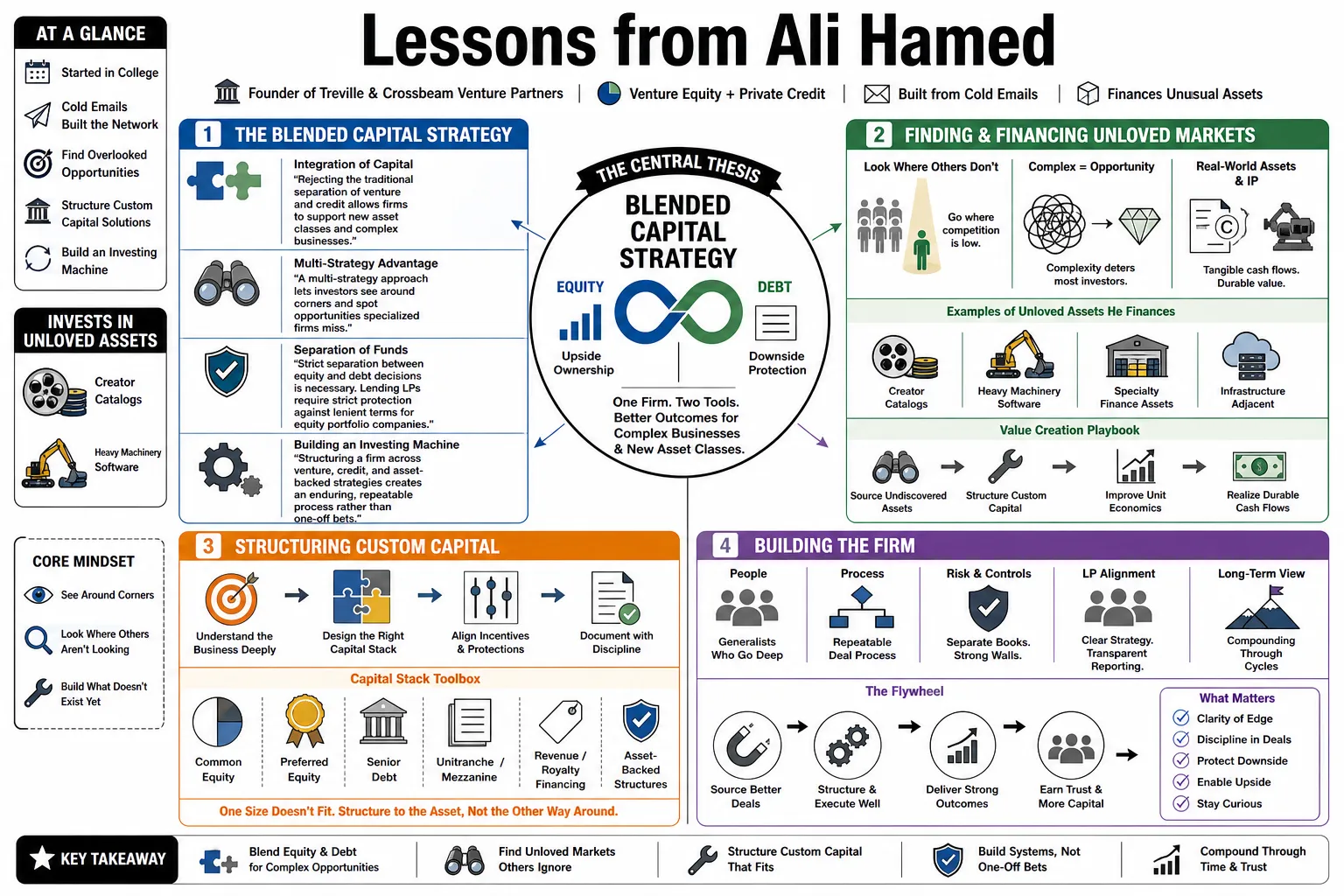
Part 1: The Blended Capital Strategy
- On the integration of capital: Hamed describes separate venture, asset-backed credit and special-situations pools that let his firm match a company’s financing need to the appropriate form of capital. — Interplay Interview.
- On multi-strategy advantages: Working in several asset classes lets Hamed compare relative value and adjust deployment rather than force every opportunity into a single venture or credit fund. — Turpentine VC Interview.
- On separation of funds: He says the affiliated venture and lending teams remain separate to avoid conflicts, including a lender giving lenient terms to protect an equity stake at the expense of credit LPs. — The Full Ratchet Interview.
- On building an investing machine: Hamed describes Treville as an investing firm with distinct venture, credit and asset-backed strategies; the purpose is to examine opportunities from more than one financing angle. — Fintech Leaders Interview.
- On inventing asset classes: For companies originating unfamiliar assets, CoVenture has provided asset-backed facilities or other bespoke structures when ordinary venture equity or corporate loans did not fit. — Interplay Interview.
- On esoteric credit: Hamed describes financing YouTube back catalogs as an example of building a position in a nascent asset market before established credit providers have standard models for it. — Main Street Summit Interview.
- On short-duration assets: Hamed says duration should fit the shape of the downturn: short-duration assets can return capital quickly in a gradual slowdown, but a sudden shock may be safer for a lender with a longer installment schedule. — The Full Ratchet Interview.
- On self-amortizing assets: When forecasts are uncertain, Hamed favors self-amortizing assets or profitable businesses that can repay from their own cash flows rather than depend entirely on refinancing. — Main Street Summit Interview.
- On market efficiency: Hamed distinguishes novel assets from necessarily risky ones: an asset can be underfinanced because institutions lack a rating history or an established underwriting channel. — Interplay Interview.
- On taking funding risk: During the March 2020 shock, Hamed said CoVenture would avoid relying on deal-by-deal SPV co-investments for incremental capital because outside funding could become uncertain. — What Markets Mean for the VC Industry.
Part 2: Venture Capital Market Dynamics
- On venture theses: Crossbeam’s thesis-led process begins by looking proactively at many companies in a space, so its team can identify promising patterns before reacting to a single pitch. — The Full Ratchet Interview.
- On sober investing: Hamed criticizes venture investing driven mainly by marketing or trend-following; his team tries to state an investment hypothesis and later test whether success came for the expected reasons. — The Full Ratchet Interview.
- On vertical specialization: Specialist knowledge in lending helps Hamed assess a financing startup’s origination, underwriting, servicing and capital advantages before conventional traction alone settles the question. — The Full Ratchet Interview.
- On recognizing patterns: Hamed says seeing roughly 10–15 similar deals can prompt a new thesis, while comparing many more companies in a space helps his team recognize an exceptional one. — The Full Ratchet Interview.
- On remaining disciplined: He warns that a favored thesis can make a mediocre company look attractive, so the team tries to separate conviction about a market from the quality of a particular deal. — The Full Ratchet Interview.
- On net sellers vs. buyers: Discussing overheated 2022 venture markets, Hamed likens going earlier and declining later pro-rata to a venture investor’s limited way of being a net seller at inflated follow-on prices. — The Full Ratchet Interview.
- On cold markets: Hamed says a colder market can favor later-stage, simpler businesses at more reasonable prices, while his firm may be more patient about deployment as valuations reset. — The Full Ratchet Interview.
- On valuation discipline: When obvious SaaS deals were heavily bid, Hamed looked for more complex fintech opportunities where specialist underwriting knowledge might give his team an edge. — The Full Ratchet Interview.
- On seed vs. later stages: Hamed distinguishes financing stages by the question being tested: pre-seed probes customer value, seed tests customer acquisition, and Series A asks whether growth channels can scale. — Pre-Seed Investing Is Not About Check Size.
Part 3: The Cold Email Playbook and Networking
- On the nature of advice: Hamed says broad requests such as “How do I get a venture job?” are difficult to answer; a narrowly framed request for a relevant introduction is easier to act on. — Interplay Interview.
- On warm introductions: To request an introduction, Hamed prepared individually forwardable emails naming the target and reason, then let the intermediary choose which contacts they actually knew well. — The Full Ratchet Interview.
- On clear communication: His cold-email advice is to make the action specific and manageable for the recipient, instead of asking a stranger to design an entire career path. — Interplay Interview.
- On building an early network: As a Cornell student, Hamed and a classmate researched industries, approached corporate-development teams and then used useful findings to start conversations with venture investors. — The Full Ratchet Interview.
- On the long game of relationships: He built his early network by staying useful to people over time—sharing industry research, making introductions and maintaining relationships before raising capital. — The Full Ratchet Interview.
- On being liked: Hamed says being liked matters in venture because syndicates, founders and future investors rely on trust, but he argues that preserving that goodwill must not prevent candid hard conversations. — Turpentine VC Interview.
- On actionable asks: Before asking a contact to introduce him, Hamed did the research and drafted a note they could forward with minimal extra work. — The Full Ratchet Interview.
- On bypassing gatekeepers: His initial outreach did not simply bypass intermediaries: he first built relationships with corporate-development officers, then offered relevant introductions when approaching VCs. — The Full Ratchet Interview.
Part 4: Evaluating Founders and Domain Expertise
- On domain experts: In describing CoVenture’s early software-for-equity model, Hamed says the firm looked for founders with deep domain expertise and helped them build the initial product and technical team. — Family Office Insights Interview.
- On technical prowess: Hamed argued that a founder with strong industry knowledge did not necessarily need to hire a senior technical executive on day one; CoVenture’s temporary engineering support was designed for that early gap. — Family Office Insights Interview.
- On founder-friendly speed: Hamed says his credit team can underwrite unusual asset-backed opportunities quickly once it understands the underlying asset and comparable risks; speed follows substantive diligence, not its absence. — Interplay Interview.
- On empathy vs. judgment: His diligence asks what problem a founder is solving, why the opportunity still exists, and whether the offering makes sense for both customer and financier rather than imposing a generic outside solution. — Initial Diligence.
- On interpreting revenue: At pre-seed, Hamed warns that revenue or user growth alone can obscure whether an individual customer receives meaningful value; the relevant metric should test that value first. — Pre-Seed Investing Is Not About Check Size.
- On founder resilience: Hamed recounts that his own early startup failed before he co-founded CoVenture; he says surviving that setback changed his willingness to take entrepreneurial risk. — The Merits of Having No Backup Plan.
- On aligning story and data: When underwriting a new asset, Hamed compares a deal’s story with its first-party data and pauses when they conflict; he explicitly introduces the underlying aphorism as a Jeff Bezos quote. — Interplay Interview.
- On early stage metrics: At seed Hamed tests customer acquisition, then at Series A asks whether those growth channels can scale beyond the founder’s effort or an unusually small initial customer base. — Pre-Seed Investing Is Not About Check Size.
Part 5: The Next-Gen Economy and Business Models
- On the next-gen economy: Hamed examines investable businesses built atop large platforms—creators, sellers and the services supporting them—rather than only the platform companies themselves. — Platform Economies.
- On media platforms: In a 2020 forecast, Hamed argued that social platforms would fund and professionalize creators and increasingly resemble media companies; his “next Disney” line was a prediction, not an observed outcome. — The Streaming Wars Will Turn into the Social Wars.
- On unloved industries: Hamed looks for small or overlooked markets that may become large enough to support a dominant lender, accepting time and origination risk before the credit opportunity is obvious. — Main Street Summit Interview.
- On affordable housing math: Hamed identifies the shortage of affordable housing as a problem his firm has studied, while saying in that interview it had not yet found a credit deal that solved it. — Turpentine VC Interview.
- On creator financing: He treats established YouTube catalogs as assets with recurring advertising cash flows that can be financed, while assessing platform dependency and creator economics. — Platform Economies.
- On ecosystem participation: Hamed argues that Amazon third-party sellers can benefit from the platform’s fulfillment and review systems, while creating adjacent opportunities in financing, analytics, ads and software. — The Amazon Third-Party Seller Ecosystem.
Part 6: Risk Management and Mindset
- On intellectual honesty: Hamed says a venture thesis must change when evidence changes, rather than making a mediocre company seem excellent merely because it fits a preferred theme. — The Full Ratchet Interview.
- On avoiding speculative bets: Crossbeam tries to write down why an investment could work and compare the outcome with that original hypothesis, instead of crediting itself for a lucky pivot or trend-driven bet. — The Full Ratchet Interview.
- On structural advantages: Hamed seeks a structural edge in small emerging credit markets: becoming a scaled participant as a niche grows can matter more than merely forecasting a mature market better. — Main Street Summit Interview.
- On the illusion of certainty: For asset-backed loans, Hamed’s diligence tests certainty of cash flow, sponsor dependence, liquidity, macro correlation, diversification and history before choosing structure and price. — Deeper Diligence.
- On continuous learning: When an asset class is unfamiliar, Hamed looks past its unfamiliar label to an established comparable risk and then checks whether the borrower’s actual performance confirms the analogy. — Interplay Interview.
- On quiet confidence: He looks for assets that appear unfamiliar to established lenders but can still be underwritten from comparable credit behavior; novelty alone is not proof of a good loan. — Interplay Interview.
Part 7: Strategic Growth and Firm Building
- On scaling a firm: Hamed traces Treville’s growth from deal-by-deal SPVs through funds with a track record, using that record and people development to support a broader investing firm. — Main Street Summit Firm-Building Conversation.
- On institutional backing: Hamed says Moelis Asset Management helped Crossbeam launch its first fund during the 2020 lockdown and supplied resources, connectivity and brand credibility. — Moelis Asset Management — Crossbeam.
- On talent density: CoVenture and Crossbeam use affiliated but distinct credit and venture teams, with Hamed serving on both investment committees while guarding against conflicts. — The Full Ratchet Interview.
- On capital alignment: Hamed argues that LPs should evaluate whether a manager’s strategy genuinely fits that manager’s strengths, rather than buy a fashionable story assembled for fundraising. — Turpentine VC Interview.
- On adapting to size: As his firm grew, Hamed weighed faster growth through senior lateral hires against developing younger investors internally with a compatible decision-making style. — Turpentine VC Interview.
- On maintaining culture: Hamed describes growing a firm by developing people internally, even when that slower path creates organizational complexity and limits the pace of expansion. — Main Street Summit Interview.
- On transparent operations: In the March 2020 downturn, Hamed urged founders to give investors candid updates on slowing growth and revised budgets, especially when they might later need bridge financing. — What Markets Mean for the VC Industry.
- On strategic patience: Hamed says investors should deploy against an absolute quality bar, not a calendar quota: wait when deals miss the bar, but invest repeatedly when several good opportunities arrive together. — Investing on an Absolute Basis.
- On defining success: He describes a thesis-driven process whose value is tested over time by whether the firm’s original investment reasoning—not merely a fortunate pivot—explains successful outcomes. — The Full Ratchet Interview.
Part 8: Esoteric Financing and the Future
- On the definition of esoteric: Hamed uses “esoteric” for novel assets that conventional institutions have not yet learned to rate or finance, even when familiar cash-flow comparisons may make them underwritable. — Interplay Interview.
- On the power of debt: Hamed argues that some mature private companies can use debt or other securities instead of funding every need with increasingly expensive preferred equity, provided lenders understand the real downside. — Should Private Startups Be Issuing More Bonds?.
- On future platforms: He expects businesses operating inside large platforms to develop their own financing and service needs as creators and merchants capture more economic value there. — Platform Economies.
- On data as collateral: For a YouTube library, Hamed treats historical content cash flow and platform behavior as underwriting inputs, while acknowledging dependence on the platform’s rules. — Platform Economies.
- On the evolution of media: His 2020 media essay predicted that social platforms would offer creators financing, revenue sharing and resources to secure professional content. — The Streaming Wars Will Turn into the Social Wars.
- On identifying alpha: Hamed looks for genuinely new but analyzable assets where a lender can understand the underlying risk before cheaper, more standardized institutional capital enters. — Interplay Interview.
- On bespoke structures: In hybrid transactions, Hamed describes structured equity or senior instruments that can bridge founders’ valuation expectations with investors’ required return and downside protection. — Main Street Summit Firm-Building Conversation.
- On software eating finance: Hamed’s Amazon-seller analysis describes how software platforms create new merchant businesses whose inventory, cash flow and adjacent services can attract specialized financing. — The Amazon Third-Party Seller Ecosystem.
- On the enduring edge: His initial diligence goes into the mechanics of origination, servicing, borrower value and competitive edge before treating a novel financing niche as investable. — Initial Diligence.