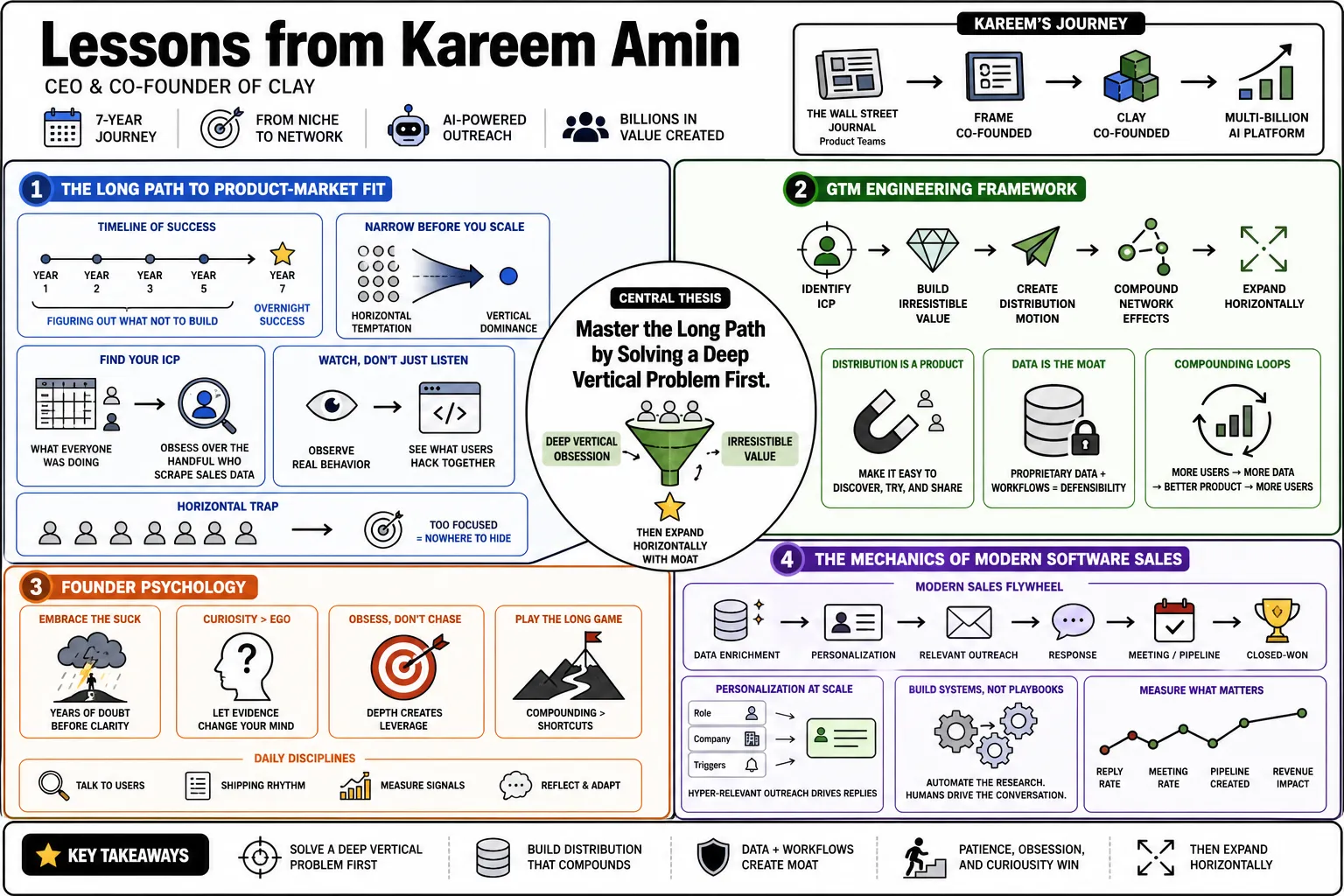
Lessons from Kareem Amin
Kareem Amin is the CEO and co-founder of Clay, a multi-billion-dollar AI platform that automates personalized sales outreach. Before his seven-year search for product-market fit at Clay, he co-founded Frame and led product teams at The Wall Street Journal. This profile covers his framework for GTM engineering, founder psychology, and the mechanics of modern software sales.
Part 1: The Long Path to Product-Market Fit
- On the timeline of success: "A seven-year overnight success usually means you spent the first five years figuring out what not to build before finally understanding your exact customer." — Source: [First Round Review]
- On narrowing scope: "You cannot build a horizontal product without first solving a vertical problem so deeply that users cannot live without it." — Source: [First Round Review]
- On identifying the Ideal Customer Profile: "We stopped looking at what everyone was doing with our spreadsheet tool and started obsessing over the handful of users who were using it to scrape sales data." — Source: [First Round Review Podcast]
- On user feedback: "Don't just listen to what users request; observe what they actually hack together in your product when you aren't looking." — Source: [First Round Review]
- On horizontal products: "The trap of a flexible tool is that it does everything decently but nothing perfectly. You have to earn the right to be horizontal." — Source: [Sequoia Capital Podcast]
- On surviving the pivot: "Pivoting isn't just changing the code; it is completely resetting the psychology of the founding team to care about a new problem." — Source: [First Round Review Podcast]
- On the danger of early traction: "Sometimes early, broad traction is a false signal. You want intense traction from a specific group, not lukewarm usage from everybody." — Source: [First Round Review]
- On killing features: "We had to strip away eighty percent of what we built to make the remaining twenty percent obvious to the people who actually needed it." — Source: [First Round Review]
- On the spreadsheet interface: "People already know how to use spreadsheets. If you can inject complex programming logic into a familiar grid, you remove the adoption barrier." — Source: [Sequoia Capital Podcast]
- On defining product-market fit: "It feels like a physical pull from the market. You stop trying to convince people to use the tool and start scrambling to keep up with their demands." — Source: [First Round Review Podcast]
Part 2: Founder Psychology and Mental Models
- On founder identity: "A startup is ultimately a mirror of its founder's psychology. If the founder is scattered, the product will be scattered." — Source: [First Round Review Podcast]
- On building from wholeness: "You cannot build a sustainable company if you are operating from a place of seeking external validation. You have to build from an internal sense of completeness." — Source: [Invest Like the Best]
- On second-time founders: "The transition to a second-time founder mindset isn't about knowing the right answers, but about recognizing your own predictable behavioral traps." — Source: [First Round Review Podcast]
- On self-respect: "Make decisions that allow you to maintain your self-respect over the long term, rather than feeding your ego in the short term." — Source: [Invest Like the Best]
- On detaching from outcomes: "When you detach your personal worth from the daily metrics of the company, you ironically make much clearer, faster business decisions." — Source: [Invest Like the Best]
- On managing anxiety: "Anxiety usually stems from a gap between what is happening and what you think should be happening. Close the gap by accepting the reality of the market." — Source: [First Round Review Podcast]
- On mimicry: "Copying another founder's playbook ignores the context in which that playbook was written. You have to write your own based on your specific team and market." — Source: [Invest Like the Best]
- On the CEO transition: "Being a founder is about inventing something from nothing. Being a CEO is about building the machine that builds the thing." — Source: [First Round Review]
- On the utility of meditation: "Practices like non-dual meditation don't just calm you down; they allow you to observe your company's problems without immediately identifying with them." — Source: [Invest Like the Best]
- On truth in leadership: "You have to cultivate an environment where telling the hard truth is the default state, starting with how you talk to yourself." — Source: [First Round Review Podcast]
Part 3: Go-To-Market Engineering
- On defining the GTM Engineer: "We are seeing the emergence of a new role: someone who applies strict software engineering rigor to go-to-market data and campaigns." — Source: [SaaStr]
- On the IDE for Sales: "Sales teams didn't need another static database; they needed an integrated development environment to build revenue engines." — Source: [Sequoia Capital Podcast]
- On replacing generic outbound: "The era of bulk-emailing thousand-person lists is over. Outbound is now a highly technical exercise in data aggregation." — Source: [SaaStr]
- On engineering principles in sales: "If you treat a sales campaign like a software deployment, with staging, testing, and observability, your conversion rates fundamentally change." — Source: [Topline Podcast]
- On closing the data-action gap: "The biggest inefficiency in modern GTM is the distance between enriching a lead and actually taking a personalized action on it." — Source: [SaaStr]
- On the evolution of SDRs: "The Sales Development Representative role is transitioning from a manual labor job of copying and pasting to an analytical job of programming workflows." — Source: [Sequoia Capital Podcast]
- On data enrichment: "Enrichment is no longer a one-time setup step. It is a continuous, dynamic process that should trigger actions the moment data changes." — Source: [SaaStr]
- On creative rebellion: "GTM Engineering is a form of creative rebellion against the rigid, unhelpful structures of legacy CRM systems." — Source: [Invest Like the Best]
- On campaign flexibility: "Your GTM tooling should be as flexible as a blank canvas, allowing your growth team to experiment with logic without asking a developer." — Source: [Topline Podcast]
- On technical debt in sales: "Just like software, sales processes accumulate technical debt when they rely on messy integrations and duct-taped automation." — Source: [SaaStr]
Part 4: AI and the System of Action
- On Systems of Action: "A CRM is a system of record. We built Clay to be a system of action, where the software does the work instead of just logging it." — Source: [Sequoia Capital Podcast]
- On balancing AI and imagination: "AI should handle the rote execution of data scraping and drafting, leaving the human to supply the strategic imagination." — Source: [Sequoia Capital Podcast]
- On AI agents in workflows: "Deploying an AI agent to read a company's SEC filing and extract custom buying signals changes the economics of personalization entirely." — Source: [SaaStr]
- On the diminishing value of raw data: "Raw contact data is effectively a commodity. The competitive moat is now your ability to reason over that data using language models." — Source: [Sequoia Capital Podcast]
- On AI-native architecture: "You can't just bolt an LLM onto a legacy database. The interface itself has to treat AI reasoning as a fundamental primitive." — Source: [First Round Review Podcast]
- On the capability of web scraping: "When an AI agent can browse the open web and synthesize context about an account, the concept of missing fields in your CRM disappears." — Source: [Sequoia Capital Podcast]
- On AI as a teammate: "Think of AI in the GTM stack not as a feature, but as a hyper-competent researcher that works instantly across thousands of rows." — Source: [Topline Podcast]
- On deterministic vs probabilistic outcomes: "The challenge of AI in sales is combining the probabilistic nature of LLMs with the strict, deterministic logic required for routing and automation." — Source: [Sequoia Capital Podcast]
- On future workflows: "Soon, we won't be building static lists; we will be building intelligent systems that continuously evaluate the internet for our ideal buyers." — Source: [SaaStr]
Part 5: Rethinking Sales and Outbound
- On the failure of volume: "Sending ten thousand identical emails isn't a strategy, it's a technical failure. Volume without relevance burns your brand." — Source: [SaaStr]
- On intent signals: "Relying on a single source of intent is dangerous. You need to cross-reference multiple data points to confirm a company is actually in a buying window." — Source: [Topline Podcast]
- On hyper-personalization: "True personalization isn't injecting a first name; it's referencing an obscure technical blog post their engineering team just published." — Source: [SaaStr]
- On campaigns as features: "Modern growth teams should design outbound campaigns with the same rigorous spec and user empathy as a core product feature." — Source: [Invest Like the Best]
- On timing: "The best message sent a month late is spam. The core of good outbound is engineering the system to detect the trigger instantly." — Source: [SaaStr]
- On scaling relevance: "The goal of GTM technology is to take the care and precision of a founder-led sale and scale it programmatically." — Source: [Sequoia Capital Podcast]
- On data orchestration: "You shouldn't have to write Python scripts to tie three APIs together just to find out if a prospect uses AWS." — Source: [First Round Review Podcast]
- On ethical scraping: "We built systems to aggregate public data respectfully, ensuring that the outreach driven by that data is genuinely helpful rather than invasive." — Source: [Topline Podcast]
- On abandoning spray-and-pray: "The spray-and-pray era was an artifact of bad tooling. With AI, you have no excuse for sending an irrelevant email." — Source: [SaaStr]
Part 6: Focus, Restraint, and Iteration
- On ruthless focus: "Focus is not just ignoring distractions; it is actively killing things you love because they do not serve the immediate goal." — Source: [First Round Review]
- On the speed of decisions: "A fast, slightly wrong decision is almost always superior to a slow, perfectly researched one in the early days of a startup." — Source: [First Round Review Podcast]
- On saying no: "You have to say no to good ideas from good customers if they drag your product out of its core competency." — Source: [First Round Review]
- On the smallest viable product: "Don't build the platform. Build the single, tiny, sharp tool that solves the most acute pain point for a very specific user." — Source: [Invest Like the Best]
- On iterating: "Iteration only works if your cycle time is brutally short. If it takes a month to test a hypothesis, you're dead." — Source: [First Round Review Podcast]
- On avoiding the Swiss Army Knife: "A Swiss Army knife is convenient, but you wouldn't use it to cut down a tree. Startups need to build chainsaws, not pocket knives." — Source: [Sequoia Capital Podcast]
- On scope reduction: "The most effective product meetings end with fewer features on the roadmap than they started with." — Source: [First Round Review]
- On discipline: "Discipline in software design means resisting the urge to abstract a problem before you've solved it manually ten times." — Source: [Invest Like the Best]
- On defining the core: "If you can't explain why a user logs into your product in exactly one sentence, you have built too much." — Source: [First Round Review Podcast]
Part 7: Team Building and Hiring for Growth
- On hiring GTM Engineers: "We look for people who are highly technical but possess deep empathy for the quota-carrying salesperson." — Source: [Topline Podcast]
- On scaling the team: "Scaling from ten to one hundred people breaks every communication structure you relied on. You have to rebuild the company's nervous system." — Source: [First Round Review Podcast]
- On giving up hats: "The hardest part of growth for a founder is looking at a job you love doing and handing it to someone else." — Source: [First Round Review]
- On post-PMF hiring: "Before product-market fit, you hire for adaptability. After product-market fit, you hire for deep, specialized expertise." — Source: [First Round Review Podcast]
- On technical rigor in sales: "Building a technical culture within a sales org means ending the tolerance for sloppy data and manual hacks." — Source: [SaaStr]
- On identifying talent: "The best early-stage hires are often the ones who are slightly frustrated with how slow everything moves at their current corporate job." — Source: [Invest Like the Best]
- On managing hypergrowth: "During rapid growth, your main job as CEO shifts from building the product to aggressively unblocking the people building the product." — Source: [First Round Review Podcast]
- On cross-functional empathy: "If engineering doesn't respect sales, and sales doesn't understand engineering, your company will tear itself apart at scale." — Source: [Topline Podcast]
- On building the machine: "You have to spend as much time designing the organizational chart and the operating cadence as you do designing the actual software." — Source: [First Round Review]
Part 8: Philosophy and the Craft of Company Building
- On music and business: "Studying music theory teaches you that strict structural rules are actually what enable true improvisation and creativity in business." — Source: [Invest Like the Best]
- On courage as a principle: "Courage in a startup isn't about making massive, bet-the-company pivots; it is having the daily nerve to face metrics that tell you you're failing." — Source: [First Round Review Podcast]
- On transitioning from big media: "Working at The Wall Street Journal taught me scale, but building a startup required unlearning the bureaucracy that scale usually demands." — Source: [Invest Like the Best]
- On lessons from past failures: "My earlier venture taught me that building good technology is useless if you are not fiercely aligned with a specific market current." — Source: [First Round Review Podcast]
- On intuitive product development: "Data tells you what users are doing, but intuition is what tells you what they actually want to be doing." — Source: [Invest Like the Best]
- On the art of software: "Great software design should feel inevitable to the user, masking the chaotic complexity of the engineering underneath." — Source: [Sequoia Capital Podcast]
- On building a lasting company: "You should only start a company if you are designing a place where you would enthusiastically want to work for the next ten years." — Source: [First Round Review Podcast]
- On internal justice: "Justice in a company means that political maneuvering is ignored, and the truth of the work is what actually gets rewarded." — Source: [Invest Like the Best]
- On the ultimate goal: "The goal is not to build software. The goal is to build a system that fundamentally increases the capability of the people using it." — Source: [Sequoia Capital Podcast]