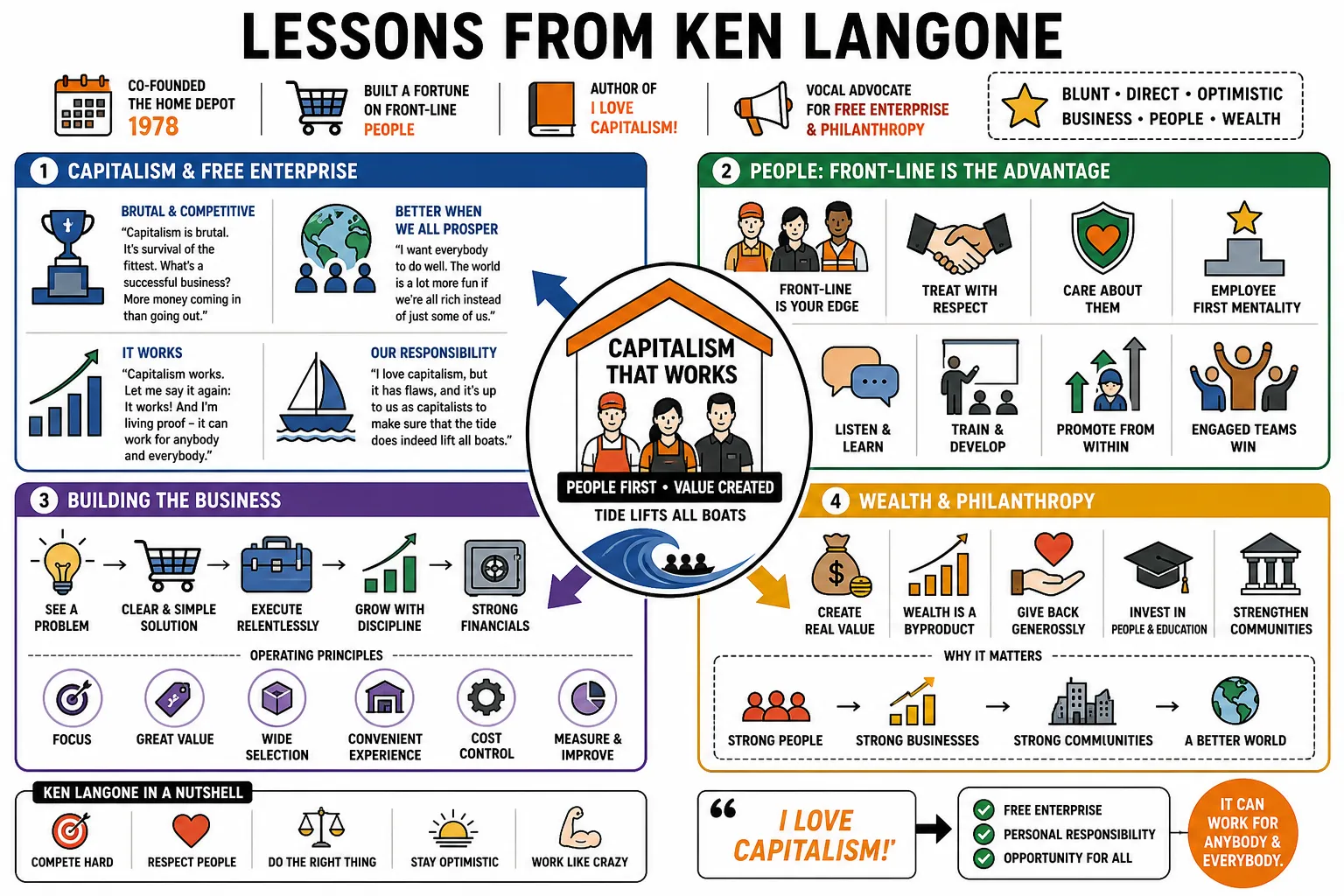
Lessons from Ken Langone
Ken Langone co-founded The Home Depot in 1978 and founded the investment firm Invemed Associates. These lessons examine his approach to business leadership, employees, investing and philanthropy. — LEADERS — Langone on Leadership.
Part 1: Capitalism and Free Enterprise
- On the philosophy of wealth: Langone argues that commerce should benefit both the buyer and the seller, rather than treating one person’s gain as necessarily another’s loss. — Capitalism: America’s Engine of Prosperity.
- On capitalism's effectiveness: Langone presents his own rise as a reason for believing in free enterprise and encouraging people to pursue ambitious goals. — I Love Capitalism! — Publisher’s Author Excerpt.
- On fixing capitalism's flaws: Langone argues that capitalism’s beneficiaries have a responsibility to expand opportunity rather than ignore the system’s flaws. — Philanthropy Roundtable — Interview with Ken Langone.
- On income inequality: Langone sees unequal access to opportunity as a serious problem, especially when people lose confidence that they can improve their circumstances. — Philanthropy Roundtable — Interview with Ken Langone.
- On optimism about America: In his 2016 address, Langone urged students to see challenges as opportunities and approach their careers with optimism, while acknowledging setbacks. — Palm Beach Atlantic — Optimism, Enthusiasm and Passion.
- On the necessity of risk: Langone treats willingness to take risks as an important part of pursuing opportunity. This is his advice, not a promise of success. — I Love Capitalism! — Memoir Preview.
- On gratitude for country: Langone credits opportunities in the United States with helping make his career possible. This is his personal assessment. — The James Altucher Show — Ken Langone.
Part 2: Leadership and Management
- On collaborative leadership: Think of colleagues as working with you, not merely for you, and demonstrate that everyone’s contribution matters. — Palm Beach Atlantic — Optimism, Enthusiasm and Passion.
- On executing ideas: Langone emphasizes execution across operations, merchandising and supply chains, arguing that leadership must help people perform in each function. — Real-World Branding — The Power of People.
- On taking a stance: When Altucher mentioned hiring a contractor, Langone urged him to state a purchasing preference explicitly. The exchange illustrates speaking up about what you want, not a universal rule to override others. — The James Altucher Show — Ken Langone.
- On fighting complacency: Do not assume past recognition protects future performance. Langone describes a daily concern with avoiding a slide backward. — LEADERS — Langone on Leadership.
- On encouraging creativity: Give frontline employees room to try practical improvements. Langone illustrates this with a worker’s suggestion for changing a merchandise display. — Invest Like the Best — The American Dream.
- On respecting people: Treat employees as people whose contribution matters, not as instruments of the leader’s success. — How Leaders Lead — Being There for People.
- On authentic leadership: Be courteous without pretending to feel a personal affinity you do not have. — The James Altucher Show — Ken Langone.
- On knowing the business: Before committing to a valuation, understand the business behind the figures. Langone describes withholding confidence until he could get a better understanding of the company. — Invest Like the Best — The American Dream.
- On the value of failure: Langone acknowledges many failures alongside Home Depot’s success; a successful career does not imply an unbroken record. — Fordham — Langone’s Advice on Business and Life.
Part 3: Hiring and People
- On the waitstaff test: Observe how potential colleagues or partners treat service staff. Langone describes using meals to learn about their character, not as a test that reveals everything about a person. — Worldly Partners — Conversation with Ken Langone.
- On credentials vs. integrity: Langone values humility and honest acknowledgment of what a leader does not know, rather than choosing solely on conventional experience. — How Leaders Lead — Being There for People.
- On frontline insight: Understand the experience of the person serving the customer; Langone urges leaders to imagine what that worker is facing. — How Leaders Lead — Being There for People.
- On showing up: Visit overlooked teams in person; Langone’s account emphasizes showing employees that they matter. — Philanthropy Roundtable — Interview with Ken Langone.
- On authentic candidates: Look beyond successes when assessing character; Langone argues that failures reveal something important about a person. — NYU Stern — Langone Speaker Series.
- On the foundation of success: Langone stresses the effort of pursuing opportunities in person, rather than waiting for deals to arrive. He also acknowledges the uncertainty involved. — Real-World Branding — The Power of People.
- On mutual success: Langone connects employee ownership with a sense of responsibility for the whole business, not just one assigned department. — Palm Beach Atlantic — Optimism, Enthusiasm and Passion.
- On building loyalty: Protect your reputation by keeping your word and delivering more than you promise. — 365 Collective — Acts of Kindness.
- On humility in teamwork: Langone credits other people’s hard work for his own success rather than claiming he achieved it alone. — The James Altucher Show — Ken Langone.
Part 4: The Home Depot Culture
- On the upside-down hierarchy: Put the employee who meets the customer at the center of management’s priorities, rather than treating the CEO as the most important person. — Invest Like the Best — The American Dream.
- On the core formula: Support the employees who serve customers through training and fair treatment. Langone connects their work with customers’ willingness to return. — Invest Like the Best — The American Dream.
- On unified objectives: Owners and employees share the task of satisfying customers; Langone uses that common objective to explain why people work with him, not merely for him. — CSIS — Don’t Sell America Short!.
- On comprehensive service: Langone describes retail’s core offer as service, price and assortment, with particular emphasis on service. — Palm Beach Atlantic — Optimism, Enthusiasm and Passion.
- On empowering the frontline: Help frontline employees see how their work makes a difference to customers and to the organization’s purpose. — Philanthropy Roundtable — Interview with Ken Langone.
- On career mobility: Langone points to associates who advanced from entry-level store work as examples of the opportunities he wants a business to create. — Palm Beach Atlantic — Optimism, Enthusiasm and Passion.
- On listening to the floor: Make it possible for employees to raise concerns, including when their immediate manager is unresponsive. — Philanthropy Roundtable — Interview with Ken Langone.
- On the essence of retail: Help customers find what meets their needs rather than pushing a more expensive product when a cheaper one will do. — The James Altucher Show — Ken Langone.
Part 5: Investing and Risk
- On investment philosophy: Langone places the quality of the people running a business at the center of his investment judgment. — Fordham — Langone’s Advice on Business and Life.
- On sticking your neck out: Take intelligent commercial risks while recognizing that outcomes remain uncertain; Langone distinguishes this from reckless, life-threatening gambles. — Real-World Branding — The Power of People.
- On evaluating deals: Negotiate a worthwhile deal for yourself while leaving the other party feeling well treated; Langone prizes trust over extracting every possible concession. — Invest Like the Best — The American Dream.
- On financial survival: Ambitious deals must respect the capital a firm can afford to risk. Langone recalls a trading commitment that nearly exhausted his firm’s resources. — NYU Stern — Conversation with Kenneth Langone.
- On the nature of wealth creation: Langone describes offering stock compensation to make employees participants in the enterprise, alongside working together and listening to customers. — Capitalism: America’s Engine of Prosperity.
- On market perspective: Langone describes holding investments for the long term while remaining attentive to management quality and the business’s prospects. — Invest Like the Best — The American Dream.
- On learning from loss: Expect some ventures not to work and develop the capacity to recover, rather than assuming a business career can avoid failure. — Real-World Branding — The Power of People.
- On independence in diligence: Form firsthand impressions of a business by visiting its operations and talking with employees. Langone describes bringing those observations into board discussions. — Worldly Partners — Conversation with Ken Langone.
Part 6: Philanthropy and Giving Back
- On the true definition of charity: Giving involves personal concern and empathy, not only writing checks. — 365 Collective — Acts of Kindness.
- On personal net worth: Judge wealth partly by the good you do with it, rather than treating a financial total as the measure of a life. — Palm Beach Atlantic — Optimism, Enthusiasm and Passion.
- On the irreplaceable asset: Langone treats donated time as an irrecoverable contribution, unlike money he may earn again. — Philanthropy Roundtable — Interview with Ken Langone.
- On active philanthropy: Accept a charitable board role to contribute actively and scrutinize effectiveness, not merely lend your name. — Philanthropy Roundtable — Interview with Ken Langone.
- On the manure principle: Langone endorses an old comparison: money is useful when spread around to help things grow, rather than simply accumulated. He does not claim to have originated the saying. — Crazy Good Turns — The Generosity of Time.
- On the duty of gratitude: Express gratitude through actions that share your good fortune, rather than stopping at words of thanks. — 365 Collective — Acts of Kindness.
- On societal ideals: Elaine and Ken Langone connect their giving with gratitude for opportunity and a commitment to service and selflessness. — The Giving Pledge — Elaine and Ken Langone’s Letter.
- On applying business skills to charity: Bring operating skills to philanthropy as well as financial support. — Philanthropy Roundtable — Interview with Ken Langone.
- On childhood influences: Langone traces his impulse to give to parents who shared what little they had with people in greater need. — 365 Collective — Acts of Kindness.
- On seeing loans as gifts: Remember help received at a pivotal moment; Langone’s gratitude for his college loan persisted long after repayment. — Philanthropy Roundtable — Interview with Ken Langone.
Part 7: Personal Growth and Mindset
- On stubborn curiosity: Langone values persistent curiosity as a characteristic of intelligent people. — The James Altucher Show — Ken Langone.
- On asking questions: Directors should ask hard questions about management performance and remember that they represent the owners. — LEADERS — Langone on Leadership.
- On the fear of looking dumb: Ask for an explanation when you do not understand something. Langone describes openly seeking a colleague’s help rather than pretending to understand the calculations. — Worldly Partners — Conversation with Ken Langone.
- On youth: Langone rejects the idea that there is only one age for starting a company, pointing to Bernie Marcus’s later-career opportunity. — Real-World Branding — The Power of People.
- On checking your ego: Examine whether your apparent humility is genuine or merely a performance for an audience. — The James Altucher Show — Ken Langone.
- On enthusiasm: Combine hard work with genuine enthusiasm for what you do; Langone does not treat effort alone as sufficient. — Horatio Alger — Kenneth G. Langone.
- On self-reliance: Do not depend on others to do tasks that you can perform yourself. — Horatio Alger — Kenneth G. Langone.
- On continuous learning: Keep learning rather than assuming you already know everything; Langone warns that confidence in complete knowledge can precede trouble. — Worldly Partners — Conversation with Ken Langone.
- On defining your own success: Langone measures business success partly by whether former counterparts would willingly do business with him again, not simply by wealth. — Horatio Alger — Kenneth G. Langone.
Part 8: Life Lessons and Values
- On simple kindness: Langone values a kind word and a thoughtful gesture alongside enthusiasm, rather than treating success as hard work alone. — Horatio Alger — Kenneth G. Langone.
- On leaving things better: Langone argues that success carries an obligation to share good fortune and leave the world better than you found it. — Palm Beach Atlantic — Optimism, Enthusiasm and Passion.
- On blue-collar roots: Langone recalls growing up in a household supported by a plumber’s wages and cafeteria work. His account places his business career against that working-class background, without claiming that upbringing guarantees management ability. — I Love Capitalism! — Memoir Preview.
- On persistence: Langone acknowledges repeated setbacks and emphasizes refusing to give up when a business gets into difficulty. — LEADERS — Langone on Leadership.
- On honoring your upbringing: Remember the family, teachers and colleagues whose support helped create your opportunities. — Horatio Alger — Kenneth G. Langone.