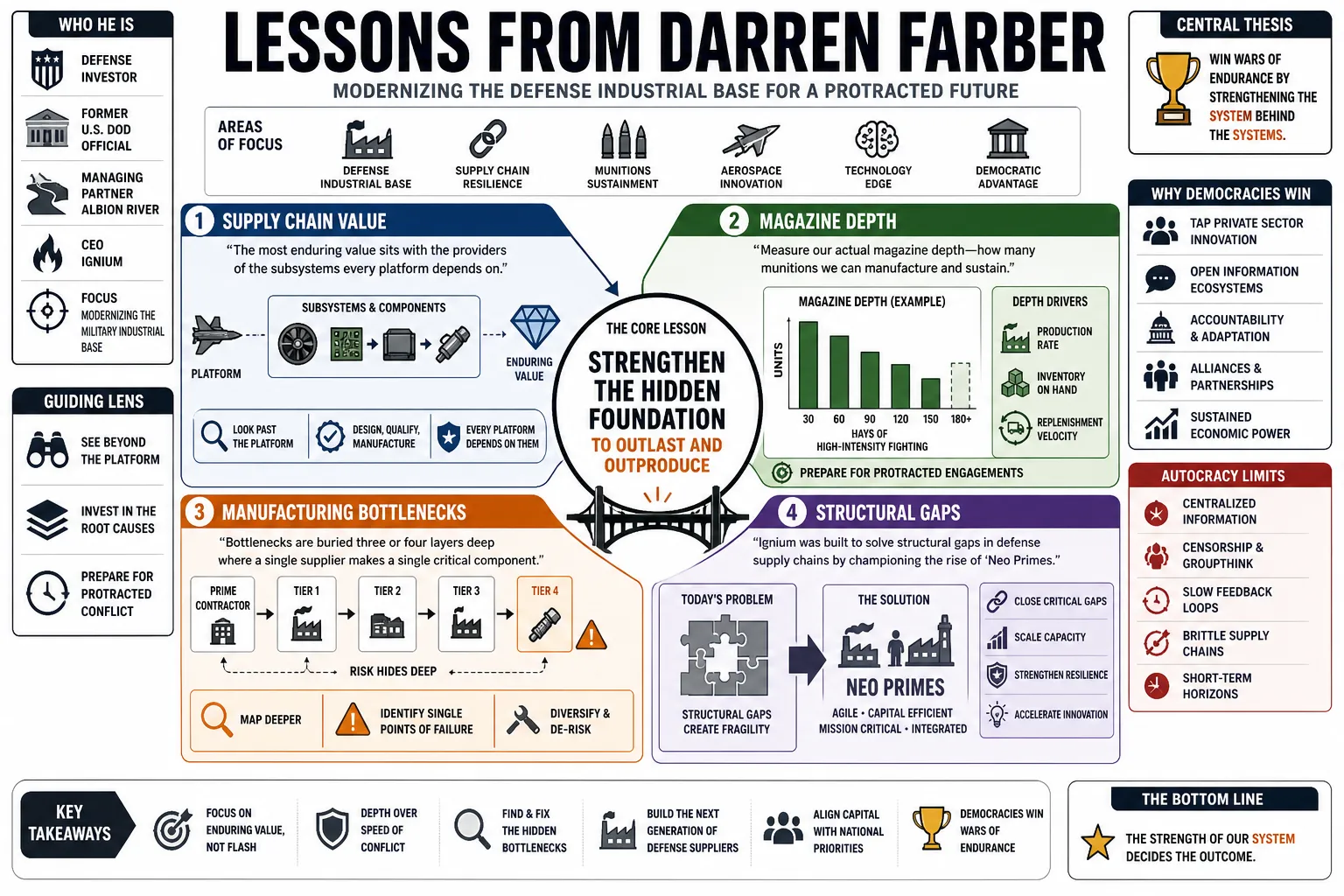
Darren Farber is the founder and managing partner of Albion River and chairman and CEO of Ignium, a portfolio of defense-subsystem suppliers. His interviews discuss industrial capacity, procurement, geopolitics and defense investing. — Ignium Launch Announcement.
Part 1: The Defense Industrial Base
- Supply-Chain Value: Farber argues that qualified subsystem suppliers can retain value across multiple weapons platforms and prime contractors. — Ignium Launch Announcement.
- Magazine Depth: Farber says U.S. planning must include the stockpiles and production capacity needed to sustain a conflict, not just the quality of individual platforms. — The New Rules of War.
- Scarce Inputs: His investment thesis seeks one-of-one suppliers whose qualified components are difficult and expensive to replace. — The Business of Defense.
- A Structural Industrial Gap: Farber says Ignium combines established, IP-rich suppliers to address a gap in the defense industrial base. — Ignium Launch Announcement.
- Procurement Incentives: Farber says detailed requirements, funding categories and entrenched programs make it slow and costly for new defense products to win adoption. — The Business of Defense.
- Subsystem Dependency: He looks for hard-to-replace inputs close to the physical basis of weapons systems, where a supplier can matter across many platforms. — The Business of Defense.
- Defense Consolidation: Farber describes the post-Cold-War consolidation of defense businesses as part of the backdrop to today’s industrial capacity challenge. — The Business of Defense.
- Physical Capacity: Farber emphasizes that defense firms must finance and build production capacity; a promising prototype is not enough to supply large volumes. — The Business of Defense.
- Resilient Suppliers: Ignium’s merchant-supplier model aims to serve multiple contractors and programs rather than depend on a single platform winner. — Ignium Launch Announcement.
Part 2: Geopolitics and Great Power Competition
- China’s Industrial Scale: Farber sees China’s large conventional-weapons stockpiles as a serious challenge while arguing that U.S. private markets and joint military operations offer countervailing strengths. — The Business of Defense.
- Define Victory Politically: In discussing Iran, Farber says victory must be defined by political objectives, including whether the Strait of Hormuz reopens and Iranian capability can quickly reconstitute. — The New Rules of War.
- Political Will and Deterrence: Farber argues that an unclear political objective erodes the will, congressional support and funding needed to sustain military action. — The New Rules of War.
- Allies as Force Multipliers: Farber expects allies, including Australia and European partners, to contribute capacity and maintenance to a shared defense posture. — The Business of Defense.
- Taiwan Is Not a Single Scenario: Farber considers both military and political paths in a Taiwan crisis and says a coercive political outcome might occur without a shot being fired. This is his scenario assessment, not a prediction of fact. — The New Rules of War.
- Flexible Response: Farber contrasts maximal nuclear deterrence with Maxwell Taylor’s graduated response and argues that practical defense needs both high-end deterrence and proportionate options. — The New Rules of War.
- Long-Horizon Capability: Farber says multiyear procurement authority is needed so suppliers can invest in stockpiles and new capabilities with more confidence. — The New Rules of War.
Part 3: Autocracies vs. Democracies
- Autocratic Strength and Fragility: Farber describes dictatorships as simultaneously powerful through state control and vulnerable through weak legitimacy. This is his political assessment. — The New Rules of War.
- Democratic Legitimacy: Farber regards the U.S. system of separated powers and political contestation as a source of legitimacy, while acknowledging it can make action slow. — The New Rules of War.
- The Cost of Low Trust: Farber argues that mistrust and corruption within a military chain of command can make joint operations harder; he applies this concern to the PLA. — The Business of Defense.
- Commercial Dynamism: Farber sees U.S. private capital and commercial technology as advantages for adapting new capabilities to defense needs. — The Business of Defense.
- Trust Inside Authoritarian Systems: Farber argues that leadership purges and distrust can weaken an authoritarian military despite its industrial strength. This remains his assessment. — The New Rules of War.
- The Trade-off in Democratic Gridlock: Farber says U.S. institutional checks slow decision-making by design, even as they protect against concentrated power. — The New Rules of War.
- Military Coordination: He worries that low trust across PLA services could impede joint command and might encourage more reliance on AI for coordination. — The Business of Defense.
- Private-Market Advantage: Farber argues that U.S. firms’ incentives and access to commercial markets can help deliver defense technology. — The Business of Defense.
Part 4: The Rise of "Neo Primes"
- A New-Entrant Opening: He says a genuinely new defense requirement can give a startup a better opening than trying to replace a deeply entrenched program. — The Business of Defense.
- Hardware and Software Economics: Farber expects low-cost drone hardware to commoditize and sees more durable value in coordinating software and mission-critical payloads. — The Business of Defense.
- Rapid Battlefield Iteration: Farber points to Ukraine’s inexpensive drones as an example of commercial supply chains enabling fast, repeated battlefield improvements. — The New Rules of War.
- Different Risk Incentives: Farber says established primes retain substantial engineering ability but their contract incentives differ from entrants willing to wager capital on an unrequested design. — The Business of Defense.
- Buying from Entrants: Farber argues that new defense firms need more than a promising product: Congress must support multiyear procurement and the military must test and integrate systems. — The New Rules of War.
- Talent Returns to Defense: Farber says the end of the Cold War released defense scientists into other sectors and sees renewed technical energy flowing into defense firms. — The Business of Defense.
- Capital-Intensive Scale: Farber says firms building defense hardware need large balance sheets and production facilities to move beyond a single prototype. — The Business of Defense.
- Integration Before Scale: Farber notes that a new system is not fielded at scale merely because it works; the military must train with it and integrate it into joint doctrine. — The New Rules of War.
Part 5: Modern Warfare and Technology
- Operate Without the Network: Farber expects near-peer opponents to attack networks and argues that connected systems need autonomy and navigation that still function when links or GPS are denied. — The Business of Defense.
- Low-Cost Drones: Farber says cheap, commercially available drones became useful military inputs because they can be produced and lost at low cost. — The New Rules of War.
- Connected Situational Awareness: His account of net-centric warfare emphasizes sharing situational awareness across drones, ships and troops while recognizing the network as a vulnerability. — The Business of Defense.
- AI Decision Risk: Farber worries that manipulated source material could contaminate AI systems used in consequential military decision-making. — The New Rules of War.
- Old and New Warfare: Farber argues that conflicts continue to require conventional weapons and personnel alongside drones and other new systems. — The Business of Defense.
- Precision and Mass: He says modern targeting offers precision but the U.S. also needs greater quantities of affordable weapons and munitions. — The New Rules of War.
- Protect Communications: Farber warns that a network-dependent force may lose much of its situational awareness when an adversary disables connectivity. — The Business of Defense.
Part 6: Aerospace and Space Innovation
- Dual-Use Supply: Farber favors adapting commercially developed technologies for defense and recounts selling one acquired supplier’s products to commercial space-launch customers. — The Business of Defense.
Part 7: Investment Strategy in Defense Tech
- Evaluate the Buying Path: Farber warns defense investors to understand how budgets and incumbency shape the time it takes a new product to win government demand. — The Business of Defense.
- Patient Defense Capital: Farber says defense firms often take longer than conventional startups to displace established programs and convert technical promise into revenue. — The Business of Defense.
- A Physical Supply Moat: His investment thesis emphasizes scarce, qualified physical inputs with high replacement costs rather than a generic claim that software cannot be copied. — The Business of Defense.
- Combine Established Suppliers: Ignium combines established, IP-rich subsystem businesses under a merchant-supplier model intended to expand defense production. — Ignium Launch Announcement.
- Invest Near the Mission: Farber seeks suppliers close to weapons’ physical inputs and customers across multiple defense programs, rather than betting on one platform design. — The Business of Defense.
- Build Production Capacity: Farber says a defense firm needs the financing and industrial capability to manufacture in volume, not only a working prototype. — The Business of Defense.
Part 8: Strategic Frameworks and History
- Taylor’s Flexible Response: Farber describes Taylor’s flexible-response doctrine as a way to answer smaller incursions without making nuclear weapons the only option. — The New Rules of War.
- Procurement Friction: Farber says one-year appropriations and continuing resolutions can block new starts and undermine the multiyear commitments new defense producers need. — The New Rules of War.
- Industrial Capacity Matters: Farber points to World War II industrial massing and says modern U.S. defense planning must rebuild capacity to produce at scale. — The Business of Defense.
- Deterrence Needs Credible Options: Farber argues that deterrence depends on both strategic weapons and enough conventional stockpile to answer smaller challenges credibly. — The New Rules of War.
- A Long Investment Horizon: Farber cautions that new defense firms may need sustained capital and procurement reform before their technology turns into durable government revenue. — The Business of Defense.