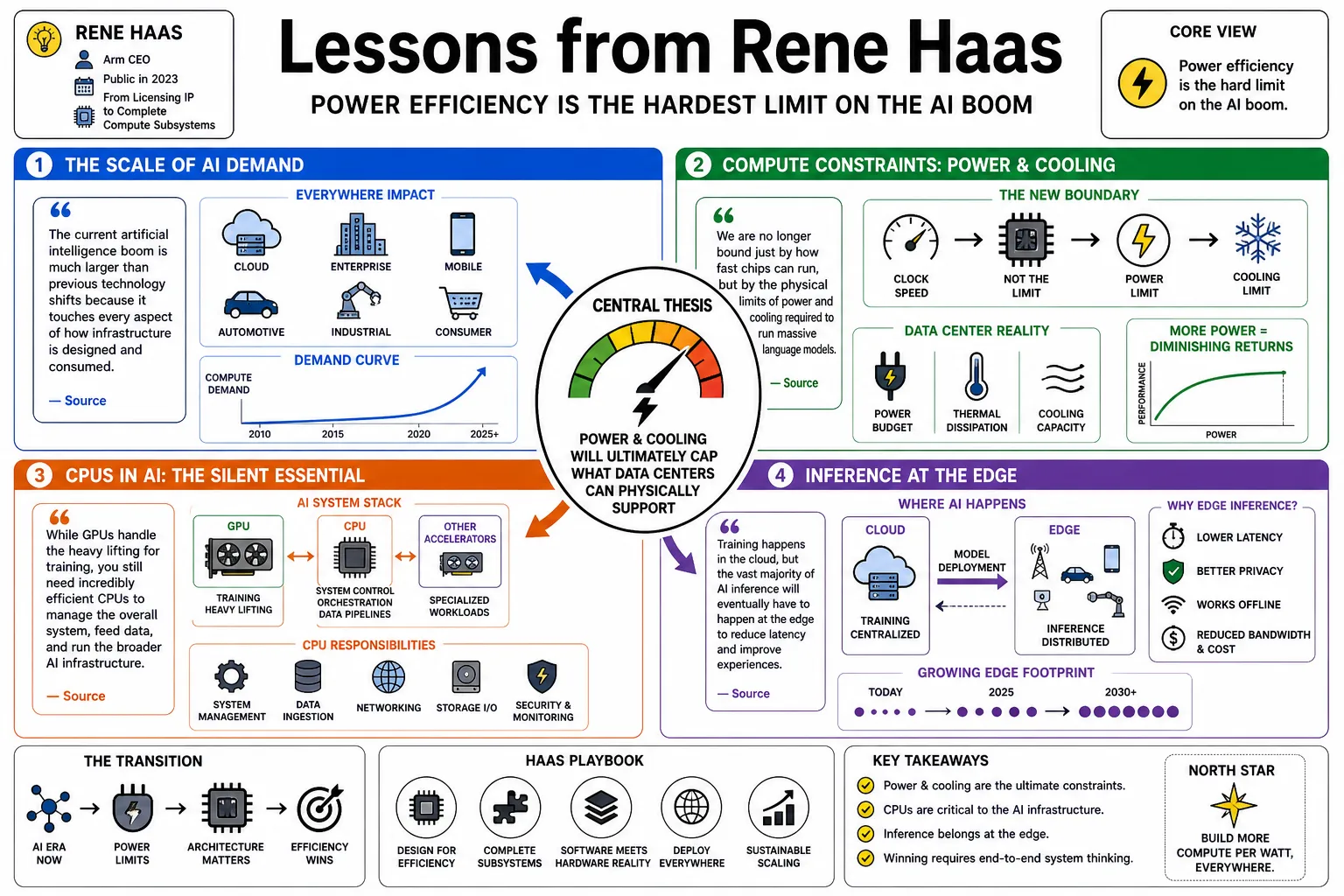
Lessons from Rene Haas
Arm CEO Rene Haas took the company public in 2023 and shifted its business from licensing basic chip designs to selling complete compute subsystems. He views power efficiency as the hard limit on the AI boom, arguing it will ultimately cap what data centers can physically support. This profile covers his take on custom silicon, computing economics, and how hardware realities constrain software.
Part 1: The Transition to the AI Era
- On the scale of AI demand: "The current artificial intelligence boom is much larger than previous technology shifts because it touches every aspect of how infrastructure is designed and consumed." — Source: [Bloomberg Technology]
- On compute constraints: "We are no longer bound just by how fast chips can run, but by the physical limits of power and cooling required to run massive language models." — Source: [FT Davos Interview]
- On CPUs in AI: "While GPUs handle the heavy lifting for training, you still need incredibly efficient CPUs to manage the overall system, feed data, and run the broader AI infrastructure." — Source: [Stratechery Interview]
- On inference at the edge: "Training happens in the cloud, but the vast majority of AI inference will eventually have to happen at the edge to reduce latency and save power." — Source: [COMPUTEX 2026 Keynote]
- On the pace of AI development: "The hardware industry used to operate on predictable multi-year cycles; AI has compressed that, forcing us to iterate at a speed we haven't seen before." — Source: [Tech Unheard Podcast]
- On agentic AI: "When AI shifts from a prompt-response model to agents running continuously in the background, power efficiency becomes the absolute critical requirement." — Source: [COMPUTEX 2026 Keynote]
- On infrastructure investment: "The capital expenditures we are seeing from cloud providers indicate that the transition to AI-native data centers is a structural shift, not a temporary spike." — Source: [Arm Q4 2026 Earnings Call]
- On small language models: "Not every task requires a trillion-parameter model; small, optimized models running locally on devices will handle everyday tasks without hitting the cloud." — Source: [Bloomberg Technology]
- On the AI memory wall: "Moving data in and out of memory takes more energy than the computation itself, which changes how we have to architect the entire system for AI." — Source: [Stratechery Interview]
- On data center capacity: "You can't just build infinite data centers; at some point, you run out of grid capacity in the locations where you actually want to put them." — Source: [FT Davos Interview]
Part 2: Power Efficiency as a Bottleneck
- On Arm's origin advantage: "Because Arm started in mobile phones where battery life was everything, our entire engineering culture was built around a constrained power budget." — Source: [Carnegie Mellon Lecture]
- On the power cost of AI: "If we don't drastically improve the performance-per-watt of our chips, AI's energy consumption will become environmentally and economically unsustainable." — Source: [Bloomberg Technology]
- On thermal limits in the cloud: "Cloud providers aren't just looking at the cost of the chip; they are looking at the total cost of ownership, which is increasingly dominated by power and cooling." — Source: [Arm Q4 2026 Earnings Call]
- On battery anxiety: "Consumers expect their devices to become much smarter with AI, but they will not accept a return to the days of charging their phones multiple times a day." — Source: [COMPUTEX 2026 Keynote]
- On sustainable computing: "We have to decouple the growth in compute capabilities from a linear growth in carbon emissions." — Source: [Tech Unheard Podcast]
- On efficiency in automotive: "Electric vehicles are fundamentally giant batteries on wheels; any power saved on computing directly translates to increased driving range." — Source: [Stratechery Interview]
- On design compromises: "You always trade off between area, performance, and power, but today, power is the hardest constraint to negotiate." — Source: [Carnegie Mellon Lecture]
- On always-on functionality: "For intelligent assistants to be truly useful, they need to be listening and analyzing constantly, which demands a sub-milliwatt power profile." — Source: [COMPUTEX 2026 Keynote]
- On grid limitations: "We are reaching the point where local municipalities cannot simply approve new data centers because the local power grid cannot handle the load." — Source: [FT Davos Interview]
- On legacy architectures: "Older, power-hungry instruction sets struggle to compete in an era where every watt is accounted for and optimized." — Source: [Stratechery Interview]
Part 3: Custom Silicon and Compute Subsystems
- On changing customer needs: "Historically we handed over a blueprint and said 'good luck'; today, customers want a complete, pre-validated compute subsystem so they can get to market faster." — Source: [Stratechery Interview]
- On cloud providers building chips: "Hyperscalers realized that to optimize their specific software workloads, they needed to design their own silicon from the ground up." — Source: [Bloomberg Technology]
- On the cost of custom silicon: "Designing a leading-edge chip has become so expensive that companies can only justify it if it perfectly matches their exact use case." — Source: [FT Davos Interview]
- On Arm's Compute Subsystems (CSS): "CSS allows our partners to focus their engineering resources on their unique differentiators, like custom accelerators, rather than reinventing the CPU core." — Source: [Arm Q4 2026 Earnings Call]
- On the semiconductor ecosystem: "No single company can do everything anymore; it requires a tightly integrated network of IP providers, foundries, and software developers." — Source: [Tech Unheard Podcast]
- On differentiation: "The value isn't in building the standard components; the value is in how you integrate them to solve a specific system-level problem." — Source: [Carnegie Mellon Lecture]
- On faster time-to-market: "By providing more of the foundational block, we cut months or even years out of our customers' silicon development cycles." — Source: [Stratechery Interview]
- On the democratization of chip design: "Tools and pre-packaged IP are lowering the barrier to entry, allowing companies that aren't traditional semiconductor players to build custom chips." — Source: [COMPUTEX 2026 Keynote]
- On testing and validation: "A huge portion of the cost of a modern chip is verifying that it works; pre-validating our subsystems removes a massive burden for our partners." — Source: [Arm Q4 2026 Earnings Call]
- On foundry partnerships: "Working closely with foundries ensures that when we deliver a subsystem, we know exactly how it will perform on their most advanced nodes." — Source: [Bloomberg Technology]
Part 4: The Edge and Automotive Computing
- On cars as computers: "The modern automobile is essentially a high-performance server rack on wheels, requiring massive compute for autonomy and infotainment." — Source: [Tech Unheard Podcast]
- On automotive lifecycles: "You can't treat car silicon like a smartphone chip; it has to be reliable for fifteen years, in extreme temperatures, with zero tolerance for failure." — Source: [Carnegie Mellon Lecture]
- On software-defined vehicles: "Automakers are shifting to central compute architectures so they can update the car's features via software over its entire lifespan." — Source: [FT Davos Interview]
- On IoT fragmentation: "The Internet of Things has historically been highly fragmented, which makes it difficult for software developers to write code that scales." — Source: [Stratechery Interview]
- On standardization at the edge: "By driving standardized hardware platforms at the edge, we make it economically viable for developers to build rich applications for billions of devices." — Source: [COMPUTEX 2026 Keynote]
- On local processing: "Sending all sensor data to the cloud is too slow, too expensive, and often a privacy risk; processing has to happen locally where the data is generated." — Source: [Bloomberg Technology]
- On industrial applications: "In a factory setting, a latency delay of a few milliseconds in an automated system can be the difference between safety and a catastrophic failure." — Source: [Tech Unheard Podcast]
- On smart cameras: "Vision systems at the edge now require enough compute to not just capture video, but to understand and categorize what they are seeing in real time." — Source: [Carnegie Mellon Lecture]
- On mixed criticality: "In automotive, you need systems that can run a basic infotainment display while simultaneously ensuring the braking system never misses a microsecond." — Source: [Stratechery Interview]
Part 5: Arm's Evolving Business Model
- On the IPO transition: "Going public wasn't an endpoint; it was a mechanism to give us the structure and capital to invest aggressively in our next phase of growth." — Source: [Bloomberg Technology]
- On capturing value: "As we deliver more complex, validated subsystems rather than just raw IP, the value we provide to customers increases, and our royalty rates reflect that." — Source: [Arm Q4 2026 Earnings Call]
- On v9 adoption: "The transition to the Arm v9 architecture is critical because it brings the vector extensions and security features that modern workloads demand." — Source: [Stratechery Interview]
- On licensing flexibility: "Our business model has to adapt to companies that want to build one specific chip versus those that want a broad license to experiment across portfolios." — Source: [Tech Unheard Podcast]
- On market expansion: "We already dominate mobile; our growth is coming from taking that efficiency into the data center, automotive, and the broad IoT market." — Source: [FT Davos Interview]
- On customer stickiness: "Once a customer builds a software ecosystem around an architecture, it becomes very difficult and expensive to switch away from it." — Source: [Carnegie Mellon Lecture]
- On the R&D cycle: "We have to invest in architectures today that our partners won't actually ship in silicon for another three to five years." — Source: [Stratechery Interview]
- On balancing ecosystems: "Arm's unique position is that we don't compete with our customers; our success is entirely derived from ensuring they can build successful products." — Source: [Bloomberg Technology]
- On recurring revenue: "The royalty model provides incredible long-term visibility; we are still earning revenues on chips that were designed a decade ago." — Source: [Arm Q4 2026 Earnings Call]
Part 6: Leadership and Career Trajectory
- On lessons from NVIDIA: "My time at NVIDIA taught me the absolute necessity of building a robust software ecosystem around your hardware." — Source: [Carnegie Mellon Lecture]
- On taking the CEO role: "Stepping into the CEO role required shifting my focus from running a product group to understanding the geopolitical and financial dynamics of a global company." — Source: [Tech Unheard Podcast]
- On navigating the private era: "Being privately held gave us the cover to make deep investments in v9 and our infrastructure products without quarter-to-quarter market pressure." — Source: [Stratechery Interview]
- On leading engineers: "You don't manage great engineers by telling them what to do; you give them an impossibly hard constraint and let them solve it." — Source: [Carnegie Mellon Lecture]
- On prioritizing focus: "The hardest part of leadership in technology isn't deciding what to do, it is having the discipline to kill good ideas so you can focus on the great ones." — Source: [FT Davos Interview]
- On cultural shifts: "Transforming Arm from an IP licensing company into a platform company required changing how our teams thought about customer deliverables." — Source: [Stratechery Interview]
- On global teams: "Innovation doesn't happen in a single headquarters anymore; you have to stitch together talent from Cambridge to Silicon Valley to Asia." — Source: [Bloomberg Technology]
- On continuous learning: "In semiconductors, the moment you think you understand the market perfectly, a new workload like generative AI emerges and resets the board." — Source: [Tech Unheard Podcast]
- On building partnerships: "Trust in this industry takes years to build and seconds to lose; you have to be consistent with your partners over decades." — Source: [Carnegie Mellon Lecture]
Part 7: Supply Chain and Geopolitics
- On semiconductor resilience: "The supply chain shocks of recent years proved that geographical concentration of manufacturing is a massive risk for the global economy." — Source: [FT Davos Interview]
- On export controls: "We have to comply with regulations, but the reality is that compute demand is global, and fragmentation makes standardization harder for everyone." — Source: [Bloomberg Technology]
- On the China market: "China remains a critical market for smartphones and IoT, and we navigate it by being very clear about what technology falls within legal boundaries." — Source: [Stratechery Interview]
- On government investments: "The CHIPS Act and similar global initiatives are necessary, but building a fab takes years and it is not a quick fix for supply constraints." — Source: [Tech Unheard Podcast]
- On talent shortages: "You can build all the fabs you want, but if you don't have the specialized engineering talent to operate them and design the chips, the buildings are useless." — Source: [Carnegie Mellon Lecture]
- On global standards: "The tech industry functions best when we have global standards; balkanizing architectures by region would massively slow down innovation." — Source: [FT Davos Interview]
- On intellectual property protection: "Our business model relies on the absolute integrity of our IP; if trust in that protection erodes, the licensing model collapses." — Source: [Bloomberg Technology]
- On supply chain visibility: "Companies used to only know their direct suppliers; now, automotive CEOs are calling us to understand the deep nodes of their silicon supply chain." — Source: [Stratechery Interview]
- On adapting to friction: "Geopolitics is now a permanent factor in technology strategy; you can't just operate as a neutral platform without awareness of the political landscape." — Source: [Tech Unheard Podcast]
Part 8: The Software Ecosystem
- On Windows on Arm: "The transition to Windows on Arm is finally reaching an inflection point because the hardware performance now allows for flawless emulation of legacy apps." — Source: [Bloomberg Technology]
- On developer friction: "If a developer has to write custom code just to make their software run on your chip, you have already lost the battle." — Source: [Stratechery Interview]
- On open source: "The open-source community is the lifeblood of our architecture; ensuring Linux and major compilers run perfectly on Arm is foundational." — Source: [Tech Unheard Podcast]
- On AI frameworks: "We spend a massive amount of resources optimizing frameworks like PyTorch and TensorFlow so they run efficiently on our CPUs out of the box." — Source: [COMPUTEX 2026 Keynote]
- On the software-hardware co-design: "You can't design hardware in a vacuum anymore; you have to understand the specific compiler paths and software libraries that will run on it." — Source: [Carnegie Mellon Lecture]
- On legacy code: "The sheer volume of legacy x86 code in the enterprise is the biggest moat for incumbents, but cloud-native development is slowly eroding that." — Source: [Stratechery Interview]
- On cross-platform tools: "Developers want to write code once and deploy it anywhere, from a cloud server to a smartphone, which is why architecture consistency matters." — Source: [Arm Q4 2026 Earnings Call]
- On mobile app dominance: "Because every mobile app developer already targets Arm natively, extending that ecosystem into laptops and edge devices is a natural progression." — Source: [FT Davos Interview]
- On future software paradigms: "As software gets written more by AI agents than by humans, the underlying hardware needs to be optimized for those new machine-generated workloads." — Source: [COMPUTEX 2026 Keynote]