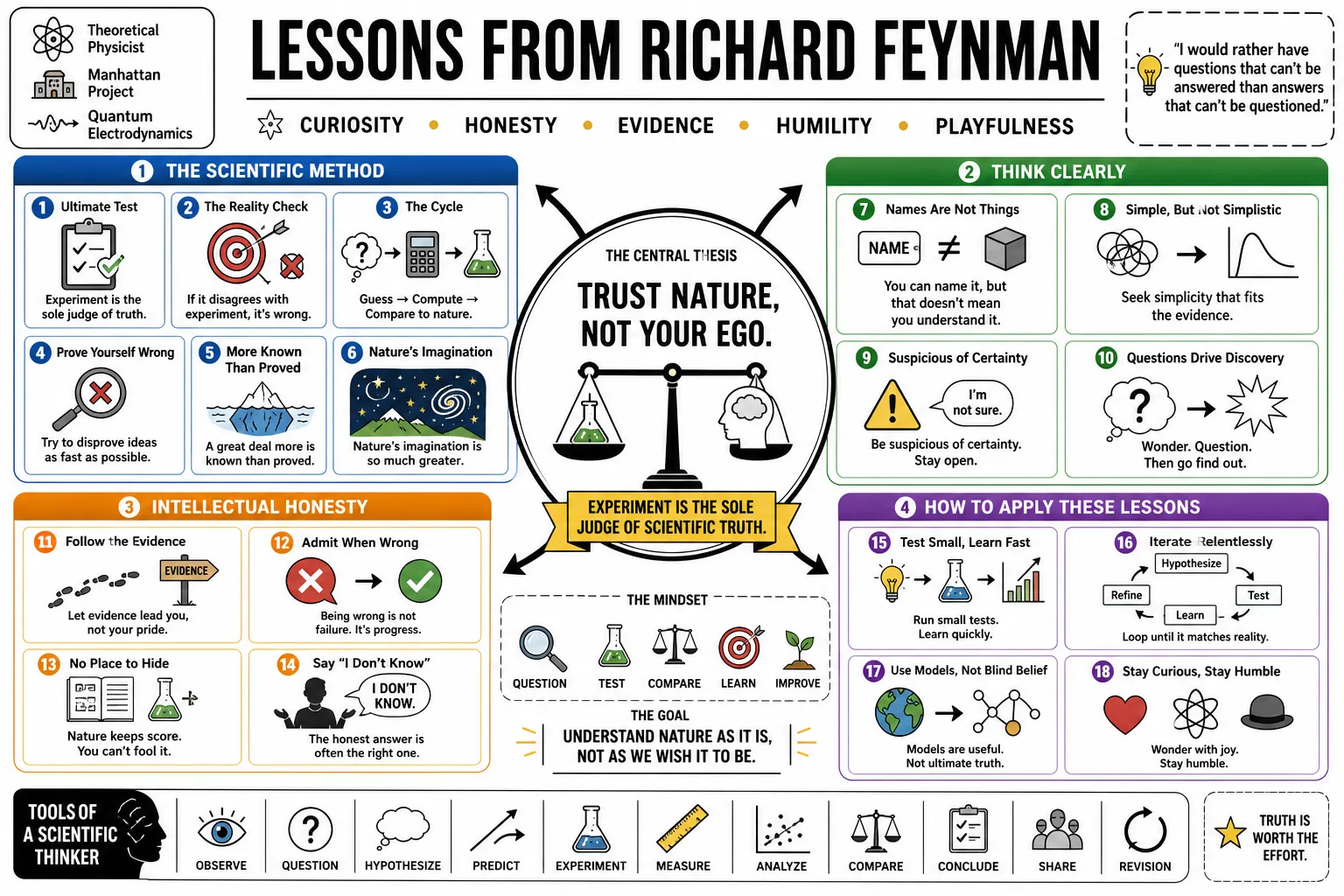
Lessons from Richard Feynman
Theoretical physicist Richard Feynman helped develop quantum electrodynamics and worked on the Manhattan Project. Beyond his research, he was known for explaining complex physics plainly and insisting on strict intellectual honesty. This collection organizes his observations on curiosity and the scientific method into a practical framework to test ideas and avoid self-deception.
Part 1: The Scientific Method
- On the ultimate test: "Experiment is the sole judge of scientific truth." — Source: [The Feynman Lectures on Physics]
- On theories vs. reality: "If it disagrees with experiment, it's wrong. In that simple statement is the key to science." — Source: [The Character of Physical Law]
- On the cycle of discovery: "First we guess it. Then we compute the consequences of the guess... then we compare the computation results to nature." — Source: [The Character of Physical Law]
- On proving yourself wrong: "We are trying to prove ourselves wrong as quickly as possible, because only in that way can we find progress." — Source: [The Meaning of It All]
- On prior knowledge: "A great deal more is known than has been proved." — Source: [The Feynman Lectures on Physics]
- On nature's complexity: "Nature's imagination is so much greater than man's, she's never going to let us relax." — Source: [The Character of Physical Law]
- On the illusion of naming: "You can know the name of a bird in all the languages of the world, but when you're finished, you'll know absolutely nothing whatever about the bird... So let's look at the bird and see what it's doing." — Source: [The Pleasure of Finding Things Out]
- On anomalies: "The thing that doesn't fit is the thing that's the most interesting." — Source: [The Pleasure of Finding Things Out]
- On hidden patterns: "There is a rhythm and a pattern between the phenomena of nature which is not apparent to the eye, but only to the eye of analysis." — Source: [The Character of Physical Law]
- On the definition of science: "The principle of science, the definition, almost, is the following: The test of all knowledge is experiment." — Source: [The Feynman Lectures on Physics]
Part 2: Intellectual Honesty and Truth
- On self-deception: "The first principle is that you must not fool yourself—and you are the easiest person to fool." — Source: [Cargo Cult Science]
- On public communication: "You should not fool the layman when you're talking as a scientist." — Source: [Cargo Cult Science]
- On full disclosure: "If you're doing an experiment, you should report everything that you think might make it invalid—not only what you think is right about it." — Source: [Cargo Cult Science]
- On protecting objectivity: "Details that could throw doubt on your interpretation must be given, if you know them." — Source: [Cargo Cult Science]
- On wishful thinking: "When you have put a lot of ideas together to make an elaborate theory, you want to make sure, when explaining what it fits, that those things it fits are not just the things that gave you the idea for the theory." — Source: [Cargo Cult Science]
- On truth and uncertainty: "What is not surrounded by uncertainty cannot be the truth." — Source: [The Meaning of It All]
- On approximations: "Each piece, or part, of the whole of nature is always merely an approximation to the complete truth, or the complete truth so far as we know it." — Source: [The Feynman Lectures on Physics]
- On open questions: "I would rather have questions that can't be answered than answers that can't be questioned." — Source: [The Pleasure of Finding Things Out]
- On accepting reality: "For a successful technology, reality must take precedence over public relations, for nature cannot be fooled." — Source: [Rogers Commission Report]
Part 3: The Value of Doubt and Uncertainty
- On the necessity of doubt: "It is important to doubt and that the doubt is not a fearful thing, but a thing of great value." — Source: [The Value of Science]
- On not knowing: "I can live with doubt and uncertainty and not knowing. I think it's much more interesting to live not knowing than to have answers that might be wrong." — Source: [The Pleasure of Finding Things Out]
- On scientific responsibility: "It is our responsibility as scientists... to teach how doubt is not to be feared but welcomed and discussed." — Source: [The Value of Science]
- On the engine of learning: "We absolutely must leave room for doubt or there is no progress and no learning." — Source: [The Value of Science]
- On human ignorance: "A satisfactory philosophy of ignorance is essential for progress." — Source: [The Meaning of It All]
- On intellectual humility: "The scientist has a lot of experience with ignorance and doubt and uncertainty, and this experience is of very great importance, I think." — Source: [The Meaning of It All]
- On alternative possibilities: "If we will only allow that, as we progress, we remain unsure, we will leave opportunities for alternatives." — Source: [The Meaning of It All]
- On trusting experts: "Science is the belief in the ignorance of experts." — Source: [What Is Science?]
- On accepting confusion: "I don't feel frightened by not knowing things, by being lost in a mysterious universe without any purpose, which is the way it really is as far as I can tell." — Source: [The Pleasure of Finding Things Out]
- On religious certainty: "I don't have to know an answer. I don't feel frightened by not knowing things." — Source: [The Pleasure of Finding Things Out]
Part 4: Curiosity and the Beauty of Nature
- On appreciation: "I can appreciate the beauty of a flower... I could imagine the cells in there, the complicated actions inside, which also have a beauty." — Source: [The Pleasure of Finding Things Out]
- On layers of reality: "There are all kinds of interesting questions that the science knowledge only adds to the excitement, the mystery and the awe of a flower." — Source: [The Pleasure of Finding Things Out]
- On the joy of discovery: "The prize is the pleasure of finding the thing out, the kick in the discovery, the observation that other people use it." — Source: [The Pleasure of Finding Things Out]
- On deep understanding: "Our imagination is stretched to the utmost, not, as in fiction, to imagine things which are not really there, but just to comprehend those things which are there." — Source: [The Character of Physical Law]
- On looking closely: "If you look at a glass of wine closely enough you see the entire universe." — Source: [The Feynman Lectures on Physics]
- On everyday wonders: "The world looks so different after learning science." — Source: [The Meaning of It All]
- On the universe's structure: "Nature uses only the longest threads to weave her patterns, so that each small piece of her fabric reveals the organization of the entire tapestry." — Source: [The Character of Physical Law]
- On persistent inquiry: "Nobody ever figures out what life is all about, and it doesn't matter. Explore the world." — Source: [What Do You Care What Other People Think?]
- On vastness: "It does no harm to the mystery to know a little about it." — Source: [The Feynman Lectures on Physics]
Part 5: Learning, Understanding, and Education
- On false knowledge: "Knowing the name of something doesn't mean you understand it." — Source: [The Pleasure of Finding Things Out]
- On true comprehension: "If you can't explain something to a first-year student, then you haven't really understood it." — Source: [Feynman's Lost Lecture]
- On independent study: "Study hard what interests you the most in the most undisciplined, irreverent and original manner possible." — Source: [Surely You're Joking, Mr. Feynman!]
- On teaching as an anchor: "I don't believe I can really do without teaching... when I don't have any ideas and I'm not getting anywhere I can say to my students... 'I'm teaching.'" — Source: [Surely You're Joking, Mr. Feynman!]
- On effective instruction: "The best teaching can be done only when there is a direct individual relationship between a student and a good teacher." — Source: [The Feynman Lectures on Physics]
- On solving problems: "You have to keep a dozen of your favorite problems constantly present in your mind, although by and large they will lay in a dormant state." — Source: [The Pleasure of Finding Things Out]
- On asking questions: "There is no learning without having to pose a question. And a question requires doubt." — Source: [The Meaning of It All]
- On rote memorization: "I don't know what's the matter with people: they don't learn by understanding; they learn by some other way—by rote, or something. Their knowledge is so fragile!" — Source: [Surely You're Joking, Mr. Feynman!]
- On intellectual play: "Physics is like sex: sure, it may give some practical results, but that's not why we do it." — Source: [The Pleasure of Finding Things Out]
- On admitting ignorance: "The first step to learning anything is to admit that you do not know it." — Source: [The Meaning of It All]
Part 6: Communication and Simplicity
- On jargon: "I couldn't reduce it to the freshman level. That means we don't really understand it." — Source: [Feynman's Lost Lecture]
- On clear writing: "When you write, you should try to make it so that the reader can understand exactly what you mean, without having to work at it." — Source: [Cargo Cult Science]
- On intellectual pretension: "An artist friend of mine... holds up a flower and says 'look how beautiful it is'... then he says 'I as an artist can see how beautiful this is but you as a scientist take this all apart and it becomes a dull thing,' and I think that he's kind of nutty." — Source: [The Pleasure of Finding Things Out]
- On plain language: "If you are teaching a beginner, you must be able to use plain English to explain what you mean." — Source: [Surely You're Joking, Mr. Feynman!]
- On complex explanations: "Truth always turns out to be simpler than you thought." — Source: [QED: The Strange Theory of Light and Matter]
- On breaking down concepts: "In order to talk to each other, we have to have words... It's a good idea to know when we are teaching the tools of science, such as words, and when we are teaching science itself." — Source: [What Is Science?]
- On translation: "Math is a language plus reasoning; it's like a language plus logic. Mathematics is a tool for reasoning." — Source: [The Character of Physical Law]
- On physical intuition: "I don't know how to do it any other way. I can't think of a problem unless I have a physical picture." — Source: [The Pleasure of Finding Things Out]
- On the limits of language: "It is impossible to explain honestly the beauties of the laws of nature in a way that people can feel, without their having some deep understanding of mathematics." — Source: [The Character of Physical Law]
Part 7: Authority, Rules, and Independent Thought
- On ignoring opinions: "What do you care what other people think?" — Source: [What Do You Care What Other People Think?]
- On expert fallibility: "Have no respect whatsoever for authority; forget who said it and instead look what he starts with, where he ends up, and ask yourself, 'Is it reasonable?'" — Source: [What Is Science?]
- On guarding against bias: "You must not fool yourself, and you are the easiest person to fool. So you have to be very careful about that. After you've not fooled yourself, it's easy not to fool other scientists." — Source: [Cargo Cult Science]
- On social conventions: "I always feel uncomfortable when people say 'the average person' or 'ordinary people.' I don't know who they're talking about." — Source: [Surely You're Joking, Mr. Feynman!]
- On titles and honors: "I don't like honors. I appreciate it for the work that I did, and for people who appreciate it... I don't need anything else." — Source: [The Pleasure of Finding Things Out]
- On challenging assumptions: "The idea is to try to give all the information to help others to judge the value of your contribution." — Source: [Cargo Cult Science]
- On institutional thinking: "The first principle of building a machine is that it has to work. Everything else is secondary." — Source: [Rogers Commission Report]
- On defying expectations: "You have no responsibility to live up to what other people think you ought to accomplish." — Source: [Surely You're Joking, Mr. Feynman!]
- On independent verification: "Learn by trying to understand, not by trying to memorize." — Source: [Surely You're Joking, Mr. Feynman!]
Part 8: Life, Meaning, and Mathematics
- On finding purpose: "Fall in love with some activity, and do it! Nobody ever figures out what life is all about, and it doesn't matter." — Source: [What Do You Care What Other People Think?]
- On humor and physics: "I am going to give what I hope is a humorous lecture... I'm going to tell you what I think of the situation in physics." — Source: [Surely You're Joking, Mr. Feynman!]
- On the meaning of life: "The meaning of it all is that there is no meaning, except the meaning you give it." — Source: [The Meaning of It All]
- On human potential: "We are at the very beginning of time for the human race. It is not unreasonable that we grapple with problems." — Source: [The Meaning of It All]
- On intellectual playfulness: "I was just playing... I would just do things for the fun of it." — Source: [Surely You're Joking, Mr. Feynman!]
- On working with math: "To those who do not know mathematics it is difficult to get across a real feeling as to the beauty, the deepest beauty, of nature." — Source: [The Character of Physical Law]
- On avoiding boredom: "I wanted to be a physicist, I didn't want to be a boss." — Source: [Surely You're Joking, Mr. Feynman!]
- On mortality: "I'd hate to die twice. It's so boring." — Source: [The Quotable Feynman]
- On the future: "Our responsibility is to do what we can, learn what we can, improve the solutions, and pass them on." — Source: [The Value of Science]