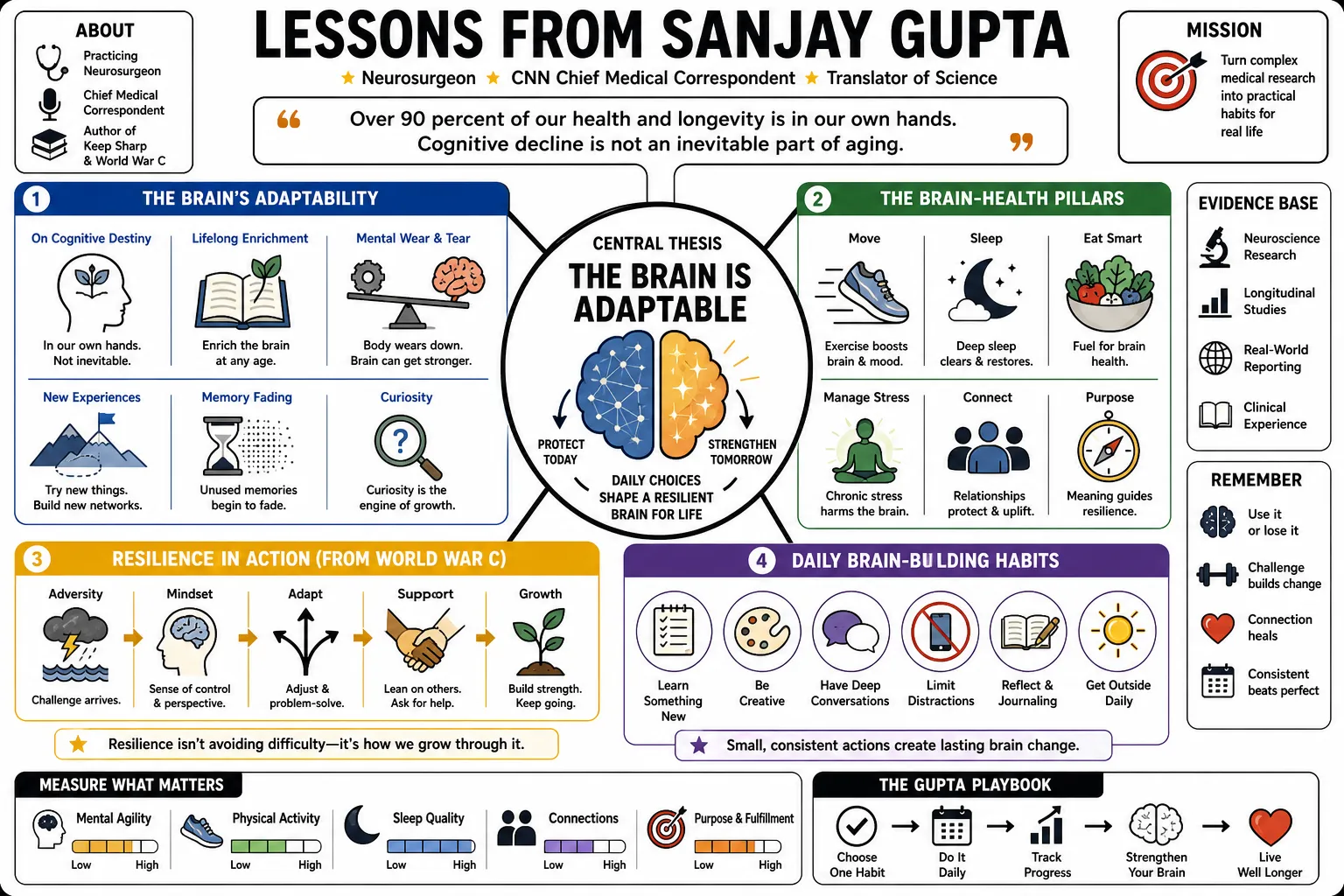
Lessons from Sanjay Gupta
As a practicing neurosurgeon and CNN's chief medical correspondent, Dr. Sanjay Gupta turns complex medical research into practical habits for the public. Drawing from his reporting and books like Keep Sharp and World War C, this profile organizes his views on brain health and resilience to outline his overall approach to medicine.
Part 1: The Brain's Adaptability
- On Cognitive Destiny: "Over 90 percent of our health and longevity is in our own hands. Cognitive decline is not an inevitable part of aging." — Source: [Keep Sharp]
- On Lifelong Enrichment: "The brain can be continuously and consistently enriched throughout your life no matter your age or access to resources." — Source: [Keep Sharp]
- On Mental Wear and Tear: "There's a natural wear and tear that happens to our bodies, but the brain is different. It can be sustained throughout your entire life and can even get stronger." — Source: [Parade Magazine]
- On New Experiences: "If you do something new, you are building new networks in the brain. It makes the brain more resilient." — Source: [NPR]
- On Memory Fading: "Memories that are not recalled often can begin to fade away because those memories are not being used." — Source: [Keep Sharp]
- On Curiosity: "Curiosity is the fuel for brain health. When you stop being curious, the brain begins to atrophy." — Source: [Chasing Life Podcast]
- On Cognitive Reserve: "Think of your brain like a bank account. You want to build up a cognitive reserve early so you have something to draw upon later in life." — Source: [CNN Health]
- On Mental Resistance Training: "Learning a new language or how to play an instrument is like resistance training for the brain. It physically alters the tissue." — Source: [Keep Sharp]
- On Structural Brain Changes: "Every conversation, every interaction, and every new skill leaves a physical trace on the brain." — Source: [Chasing Life Podcast]
- On Brain Optimization: "You don't simply want to avoid dementia; you want to optimize your function today. A sharp brain makes every other aspect of life better." — Source: [Keep Sharp]
Part 2: Rethinking Movement and Rest
- On Inactivity: "We need to view inactivity as the disease and movement as the cure, rather than the other way around." — Source: [Men's Health]
- On Exercise and the Brain: Exercise is, according to Gupta, the single most important thing anyone can do to improve brain function and resiliency to disease, in part by stimulating the release of growth factors that support the healthy function and production of brain cells. — Source: [McKnight Brain Research Foundation]
- On Micro-Movements: "You don't need a heavy gym routine. Simply taking brisk walks or climbing stairs throughout the day keeps the brain bathed in nutrients." — Source: [Keep Sharp]
- On the Sedentary Lifestyle: "Sitting for extended periods signals to the body that it is time to shut down. Movement signals life and growth." — Source: [Chasing Life Podcast]
- On Sleep's Function: "Sleep is not a period of inactivity. It is an incredibly active time for the brain, a rinse cycle where it flushes out metabolic waste." — Source: [Keep Sharp]
- On Sleep Deprivation: "Chronic sleep deprivation is essentially a form of self-induced brain damage over time." — Source: [NPR]
- On Restorative Sleep: "Seven to eight hours is not a luxury; it is a biological imperative for the brain to consolidate memories." — Source: [CNN Health]
- On Consistency in Sleep: "Waking up and going to bed at the same time every day does more for your circadian rhythm than catching up on weekends ever could." — Source: [Chasing Life Podcast]
- On Movement and Mood: "When you move your body, you release neurochemicals that naturally combat anxiety and depression. It is nature's most effective antidepressant." — Source: [Keep Sharp]
Part 3: Nourishing the Body and Mind
- On Sugar's Impact: "Excess sugar is toxic to the brain. It drives inflammation and metabolic dysfunction that accelerate cognitive decline." — Source: [Keep Sharp]
- On Hydration: "The brain struggles to distinguish between hunger and thirst. People are often dehydrated when they think they are starving. Drink before you eat." — Source: [Men's Health]
- On Omega-3s: "Fats are not the enemy. The brain is mostly fat, and it thrives on the healthy omega-3 fatty acids found in fish and nuts." — Source: [Keep Sharp]
- On Portion Control: "Reducing portions reduces the metabolic stress on your entire system, including your brain." — Source: [Keep Sharp]
- On Processed Foods: "Highly processed foods confuse our biological sensors. They deliver empty calories that fail to nourish the nervous system." — Source: [Chasing Life Podcast]
- On Mindful Eating: "Eating should be a deliberate act, not something done mindlessly while staring at a screen. It changes how the body digests." — Source: [Chasing Life]
- On Dietary Flexibility: "There is no single perfect diet for everyone, but heavily plant-based, Mediterranean-style diets consistently show the best outcomes for brain longevity." — Source: [CNN Health]
- On Fasting Windows: "Giving your gut a break for twelve to fourteen hours overnight allows the body to focus on cellular repair rather than digestion." — Source: [Keep Sharp]
Part 4: Navigating Pandemics and Preparedness
- On the Nature of COVID-19: "It was an unusual combination of highly lethal and highly contagious, a pathogen perfectly tuned to exploit our global interconnectedness." — Source: [AARP]
- On Public Health Messaging: Gupta has said a health message can be beautifully crafted, but if people do not understand it, communicators have to go back to the drawing board -- clarity people can act on matters more than sounding comprehensive. — Source: [BayToday]
- On Herd Immunity: "I never liked the phrase 'herd immunity.' It implies a finish line. We should instead focus on managing the virus to a low, controllable threshold." — Source: [CNN Health]
- On Pandemic Preparedness: "We cannot wait for the house to catch fire before we decide to build a fire department. We must prepare for the next pathogen during peacetime." — Source: [World War C]
- On the Endemic Phase: Gupta compared the end of the pandemic public health emergency to a patient finally being discharged from the hospital after a long illness, moving from acute crisis into ongoing, chronic management. — Source: [NIH]
- On Zoonotic Diseases: "How did a novel bat coronavirus get to a major city? Our encroachment into wild habitats virtually guarantees that these spillovers will continue." — Source: [World War C]
- On Global Inequity: "A pandemic is truly global. Leaving vast populations unvaccinated anywhere gives the virus a laboratory to mutate and return." — Source: [CNN Health]
- On Trust in Science: "Science is an iterative process. Changing guidelines don't mean scientists are lying; they mean the scientific method is working as new data emerges." — Source: [Chasing Life Podcast]
- On Long-term Impacts: "The virus isn't strictly a respiratory pathogen; it affects the vascular system and the brain, and we will be studying its long-term effects for decades." — Source: [World War C]
Part 5: The Power of Social Connection
- On Social Isolation: "Loneliness is a profound health risk. It increases inflammation and is as dangerous to your health as smoking a pack of cigarettes a day." — Source: [Chasing Life Podcast]
- On Connection for Protection: Gupta likes to say connection for protection, even when physically distanced -- the strength of our relationships turns out to matter more for long-term health than previously recognized. — Source: [McKnight Brain Research Foundation]
- On Multigenerational Bonds: "Interacting with people from different generations forces the brain to adapt to different communication styles, which builds cognitive resilience." — Source: [Keep Sharp]
- On Quality Over Quantity: "It is not about how many people you know, but the depth of a few relationships where you feel truly seen and heard." — Source: [Chasing Life Podcast]
- On Empathy as Exercise: "Practicing empathy, trying to genuinely understand another person's perspective, is a complex cognitive task that exercises multiple brain regions." — Source: [Keep Sharp]
- On Shared Purpose: "Communities that thrive into old age often share a deep sense of collective purpose. They take care of one another." — Source: [Chasing Life]
- On Volunteerism: "Helping others creates a biochemical feedback loop. It releases oxytocin and reduces cortisol, benefiting the giver as much as the receiver." — Source: [CNN Health]
- On Digital Connectivity: "Social media can simulate connection, but it rarely replaces the neurochemical benefits of in-person, face-to-face interaction." — Source: [Chasing Life Podcast]
- On Conflict Resolution: "Navigating minor social conflicts rather than avoiding them builds emotional intelligence and mental flexibility." — Source: [Keep Sharp]
- On Vulnerability: "Asking for help when you need it is a sign of psychological strength, and it strengthens the social bonds of the person helping you." — Source: [Chasing Life Podcast]
Part 6: Reframing Aging and Longevity
- On Functional Aging: "The goal should never be just a longer lifespan. It must be a longer 'healthspan,' maximizing the years you are fully functional and engaged." — Source: [Chasing Life]
- On the Anti-Aging Industry: "Much of the anti-aging industry is built on false promises. Real longevity comes from quiet, daily lifestyle choices, not expensive pills." — Source: [Chasing Life Podcast]
- On Acceptance: "Aging is a biological reality, but how we experience it is largely dictated by our mindset and our environment." — Source: [Keep Sharp]
- On Cultural Attitudes: "Cultures that revere their elders and integrate them into daily life see drastically lower rates of cognitive decline and depression." — Source: [Chasing Life]
- On Adapting to Change: "Resilience in aging is about adapting to physical changes without losing your core sense of self or your curiosity." — Source: [Chasing Life Podcast]
- On Purposeful Living: "Having a reason to get out of bed in the morning, what the Japanese call ikigai, is a potent predictor of longevity." — Source: [Chasing Life]
- On Preventative Care: "Modern medicine is incredible at treating acute crises, but it struggles with chronic diseases. Prevention is the only viable path to true longevity." — Source: [World War C]
- On Biological Clocks: "Chronological age is just a number. Your biological age, which measures your cellular health, is what actually matters." — Source: [Chasing Life Podcast]
- On Life Extensions: "Chasing immortality is a distraction. The pursuit should be adding quality, joy, and meaning to the years we have." — Source: [Chasing Life]
Part 7: Mental Resilience and Stress Management
- On Chronic Stress: "Chronic stress is inherently toxic. It continuously bathes the brain in cortisol, which literally shrinks the hippocampus, the memory center." — Source: [Parade Magazine]
- On Analytical Meditation: "Meditation isn't entirely about clearing the mind; analytical meditation allows you to deeply examine a problem without the emotional attachment." — Source: [Keep Sharp]
- On Daily Pauses: "Taking five minutes of complete silence during a chaotic day is an immediate reset for the nervous system." — Source: [Chasing Life Podcast]
- On Reframing Anxiety: "Anxiety is a physiological signal, not a character flaw. It is the body telling you to pay attention to something." — Source: [Chasing Life Podcast]
- On Media Consumption: "Doomscrolling puts the brain in a perpetual state of threat detection. Curating your information diet is essential for mental health." — Source: [World War C]
- On Finding Flow: "Engaging deeply in a task where you lose track of time, the state of flow, is profoundly restorative for an overworked mind." — Source: [Keep Sharp]
- On Managing Expectations: "Burnout often happens when our expectations dramatically misalign with reality. Adjusting expectations is a tool of resilience." — Source: [Chasing Life Podcast]
- On Breathing: "Deep, diaphragmatic breathing is the only conscious tool we have to directly slow down our autonomic nervous system in real time." — Source: [Chasing Life Podcast]
- On Post-Traumatic Growth: "Trauma can leave scars, but it can also force a profound restructuring of personal priorities. Post-traumatic growth is a real and documented phenomenon." — Source: [World War C]
Part 8: The Empathy of Modern Medicine
- On the Patient Narrative: "The most important tool a doctor has is their ability to listen. The patient will often tell you the diagnosis if you let them." — Source: [CNN Health]
- On Medical Communication: "If you cannot explain a medical condition so that a layperson understands it, you do not understand it well enough yourself." — Source: [Chasing Life Podcast]
- On Surgery: "Surgery is an incredibly invasive act of trust. You are literally holding someone's life in your hands, and that weight should never feel normal." — Source: [Chasing Life Podcast]
- On Medical Uncertainty: "A good physician must be comfortable with the words 'I don't know.' Medicine is an evolving science, not an absolute doctrine." — Source: [Chasing Life Podcast]
- On Health Equity: "Your zip code is a better predictor of your health outcomes than your genetic code. That is a failure of the system." — Source: [World War C]
- On Technological Advances: "New medical technology is miraculous, but it should enhance the doctor-patient relationship, never replace the human touch." — Source: [CNN Health]
- On Compassion Fatigue: "Healthcare workers are not immune to the trauma they witness. Compassion fatigue is a systemic issue, not a personal weakness." — Source: [World War C]
- On the Vocation of Healing: "Medicine is an art built on the foundation of science. The science tells you what to do; the art tells you how to do it with humanity." — Source: [Chasing Life Podcast]