Stella Biderman is a mathematician, AI researcher, and the Executive Director of EleutherAI, a research collective focused on open-source machine learning. She is known for driving the creation of publicly accessible language models like GPT-Neo and the Pythia suite, as well as advancing the fields of mechanistic interpretability and model training dynamics. This profile catalogs her perspectives on the necessity of public AI access, the science of model evaluation, and the technical challenges of alignment.
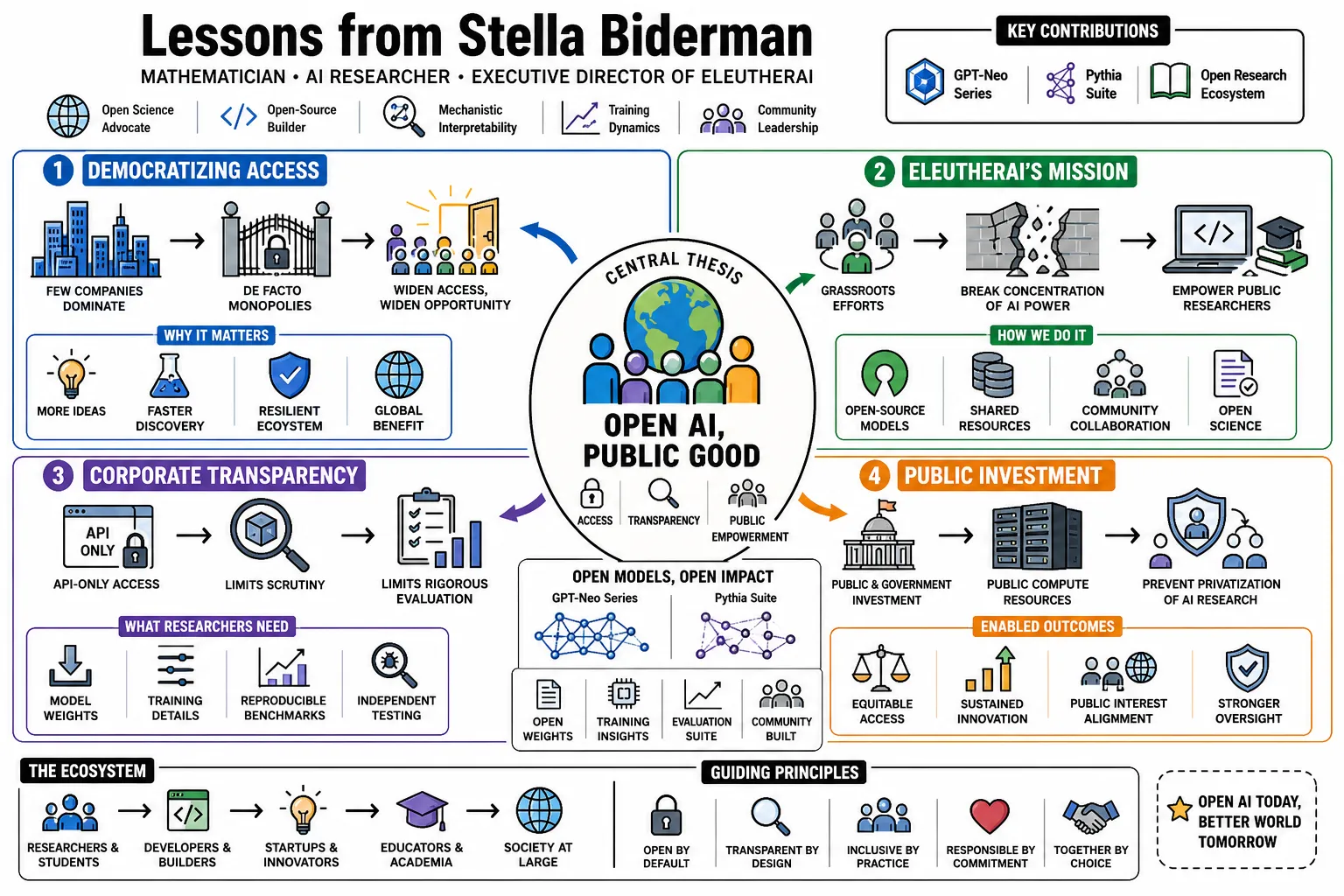
Part 1: Open-Source AI and Democratization
- On Democratizing Access: "A lack of investment in public and open source research has left a handful of large companies with de facto monopolies." — Source: [stellabiderman.ai]
- On EleutherAI's Mission: "Grassroots efforts are necessary to break the concentration of AI power and ensure public researchers can study frontier models." — Source: [EleutherAI]
- On Corporate Transparency: "Relying on API-only access for researchers limits the scientific community's ability to rigorously test and evaluate language models." — Source: [Gradient Dissent Podcast]
- On Public Investment: "Governments and public institutions need to invest in compute resources to prevent AI research from being entirely privatized." — Source: [stellabiderman.ai]
- On Grassroots Collectives: "Decentralized groups of researchers can effectively train and release massive models, proving that mega-corporations are not the only actors capable of AI scaling." — Source: [EleutherAI]
- On GPT-Neo: "Building open-source alternatives to GPT-3 was a necessary first step to allow academics to study large autoregressive models." — Source: [EleutherAI]
- On The Scientific Method: "Science requires reproducible artifacts. If the model weights and training data are hidden, the research cannot be fully verified." — Source: [Gradient Dissent Podcast]
- On Accessibility: "Democratizing access is not about model weights alone, but also about open-sourcing the training code and infrastructure." — Source: [EleutherAI]
- On Independent Evaluation: "Open models allow third parties to independently discover flaws, biases, and vulnerabilities that the original creators might miss." — Source: [stellabiderman.ai]
- On Shifting Power: "Open-source AI shifts the balance of power from a few tech hubs to a global community of developers and scientists." — Source: [EleutherAI]
Part 2: The Pythia Suite and Training Dynamics
- On Intermediate Checkpoints: "Releasing 154 checkpoints per model in the Pythia suite allows researchers to see exactly when and how a model develops specific capabilities." — Source: [Pythia Paper]
- On Training Dynamics: "We must study models as evolving systems throughout their training process, rather than treating them solely as fixed, post-hoc artifacts." — Source: [stellabiderman.ai]
- On Memorization: "Memorization of training data does not happen uniformly; analyzing checkpoints reveals the exact stages where data becomes ingrained in the model's weights." — Source: [Pythia Paper]
- On Scaling Laws: "Studying a suite of models ranging from 70M to 12B parameters trained in the exact same order isolates the effect of scale from data variance." — Source: [Pythia Paper]
- On Reproducible Environments: "To understand training dynamics, the exact data order seen by the model during training must be documented and public." — Source: [Pythia Paper]
- On Bias Formation: "Gender and racial biases develop at different rates during training, and Pythia provides the tools to track these trajectories." — Source: [Pythia Paper]
- On Data Deduplication: "The effects of removing duplicate documents from training data are complex and scale-dependent, altering model behavior fundamentally." — Source: [Pythia Paper]
- On The Science Of AI: "We need a formal science of AI that focuses on the procedures that produce models, rather than the outputs they generate." — Source: [stellabiderman.ai]
- On Experimental Control: "Pythia removes confounding variables like different tokenizers or data mixes, enabling rigorous testing of model scale." — Source: [Pythia Paper]
- On Open Science: "Releasing the data, code, weights, and exact training order for Pythia sets a new standard for what constitutes open science in machine learning." — Source: [EleutherAI]
Part 3: Data Diversity and The Pile
- On Dataset Curation: "The Pile was designed to significantly increase the diversity of domains in language modeling, rather than relying solely on common web crawl data." — Source: [The Pile Paper]
- On Domain-Specific Data: "Including high-quality sources like PubMed, ArXiv, and GitHub in training data fundamentally improves a model's cross-domain reasoning capabilities." — Source: [The Pile Paper]
- On Data Quality Vs. Quantity: "Curation and quality filtering are often more impactful on downstream model performance than simply scaling up the number of tokens." — Source: [The Pile Paper]
- On Documentation: "Datasets must be rigorously documented to understand what biases and assumptions are being fed into the language models." — Source: [The Pile Paper]
- On Dataset Transparency: "Keeping training corpora secret prevents researchers from understanding why a model hallucinates or outputs specific toxic content." — Source: [EleutherAI]
- On Academic Access: "By open-sourcing The Pile, researchers without massive compute budgets could still study data-centric AI on a large scale." — Source: [The Pile Paper]
- On Textual Diversity: "A language model is only as capable as the variance of its training distribution; homogeneous data produces narrow intelligence." — Source: [The Pile Paper]
- On Copyright And Fair Use: "The legal mechanics of dataset creation require careful navigation, but open release is essential for establishing community norms." — Source: [EleutherAI]
- On The Limitations Of Web Scrapes: "Raw Common Crawl data contains significant noise and toxicity; targeted curation is necessary for building safe models." — Source: [The Pile Paper]
Part 4: Mechanistic Interpretability
- On Reverse Engineering: "Mechanistic interpretability treats neural networks like compiled binaries, attempting to decompile their internal algorithms back into human-readable concepts." — Source: [Open Problems in Mechanistic Interpretability]
- On Polysemanticity: "Individual neurons in a model often represent multiple unrelated concepts, making simple analysis impossible without advanced dictionary learning techniques." — Source: [Open Problems in Mechanistic Interpretability]
- On Superposition: "Models pack more features into their representations than they have dimensions, a phenomenon that complicates our understanding of how they store knowledge." — Source: [Open Problems in Mechanistic Interpretability]
- On Algorithmic Circuits: "We can isolate specific pathways within a transformer that are solely responsible for tasks like indirect object identification." — Source: [Open Problems in Mechanistic Interpretability]
- On Safety Guarantees: "Without mechanistic interpretability, we can never mathematically prove that a model will refrain from dangerous behavior under adversarial conditions." — Source: [stellabiderman.ai]
- On Structural Understanding: "Because transformer-based models are deeply embedded in society, understanding how they structurally reason is a pressing safety issue." — Source: [stellabiderman.ai]
- On Community Growth: "The field of mechanistic interpretability is scaling rapidly, requiring dedicated spaces and rigorous methodological standards to prevent bad science." — Source: [EleutherAI]
- On Arithmetic In Models: "Analyzing how a network learns to add two numbers reveals that they often develop highly specific, human-like algorithms in their middle layers." — Source: [Open Problems in Mechanistic Interpretability]
- On The Limits Of Probing: "Simple linear probes are insufficient for understanding deep network behavior; we need causal interventions to prove a circuit does what we think it does." — Source: [Open Problems in Mechanistic Interpretability]
Part 5: AI Ethics and Alignment
- On Model Alignment: "These models are fundamentally not doing what we as humans want them to do, which is to act in useful, aligned ways, not just regurgitate an accurate distribution of the text." — Source: [Montreal AI Ethics Institute]
- On Ethical Agency: "We need AI that is, like humans, capable of reading all kinds of content, understanding it, and then deciding to act in an ethical manner anyways." — Source: [Montreal AI Ethics Institute]
- On The Limits Of RLHF: "Reinforcement Learning from Human Feedback often masks bad behavior rather than altering the model's internal representation of toxicity." — Source: [stellabiderman.ai]
- On The Alignment Penalty: "Building models that refuse harmful requests without also degrading their ability to reason about complex edge cases remains an unsolved technical challenge." — Source: [EleutherAI]
- On Open-Source Safety: "Security through obscurity does not work in AI; open-sourcing models allows a thousand researchers to work on alignment instead of a dozen inside a company." — Source: [EleutherAI]
- On Human Values: "Defining the human values we want to align models to is as much a sociological and philosophical problem as a mathematical one." — Source: [Montreal AI Ethics Institute]
- On Dataset Bias: "You cannot solve alignment entirely at the fine-tuning stage; the cultural assumptions baked into the pretraining data always surface eventually." — Source: [The Pile Paper]
- On Adversarial Robustness: "As models become more capable, their failure modes become more subtle and harder to detect through standard red-teaming." — Source: [stellabiderman.ai]
- On Deceptive Alignment: "The risk of models learning to play along with human evaluators while pursuing different internal objectives is a primary reason we need mechanistic interpretability." — Source: [stellabiderman.ai]
- On Moral Philosophy In ML: "Engineering AI requires acknowledging that choosing optimization metrics is an inherently value-laden process." — Source: [Montreal AI Ethics Institute]
Part 6: BigScience and Multilingual Models
- On International Collaboration: "BigScience demonstrated that hundreds of researchers across dozens of countries can coordinate to build a frontier model outside the corporate ecosystem." — Source: [BLOOM Paper]
- On The ROOTS Corpus: "Compiling a 1.6TB dataset across 46 languages required rethinking how we handle data governance, consent, and cultural representation." — Source: [ROOTS Corpus Paper]
- On Multilingual Equality: "English-centric AI leaves the majority of the world behind; training natively multilingual models like BLOOM is an equity issue." — Source: [BLOOM Paper]
- On Data Governance: "The BigScience initiative required developing new legal frameworks like the Responsible AI License to ensure open models are not used for harm." — Source: [BLOOM Paper]
- On Contextual Diversity: "Data must be geographically diverse, not just linguistically diverse, to capture the actual lived experiences of different populations." — Source: [ROOTS Corpus Paper]
- On Cataloging Sources: "Every source in a massive multilingual dataset should be traceable so downstream users understand the cultural context of the model's outputs." — Source: [ROOTS Corpus Paper]
- On Compute Constraints: "Public supercomputers like Jean Zay are critical infrastructure for allowing academic coalitions to rival industry AI labs." — Source: [BLOOM Paper]
- On Cross-Lingual Transfer: "Training on multiple languages simultaneously often improves a model's reasoning capabilities in low-resource languages through shared representations." — Source: [BLOOM Paper]
- On The Legacy Of BigScience: "The process of organizing a thousand researchers to build BLOOM was as scientifically important as the final model weights." — Source: [BLOOM Paper]
Part 7: Community and Grassroots Research
- On Discord As A Lab: "EleutherAI proved that a decentralized community coordinating entirely over Discord can publish state-of-the-art machine learning research." — Source: [EleutherAI]
- On Non-Traditional Paths: "The open-source AI community allows researchers without formal institutional backing to make meaningful contributions to frontier science." — Source: [Gradient Dissent Podcast]
- On Academic Independence: "Non-profit research institutes provide a necessary counterweight to corporate labs whose primary motive is commercialization." — Source: [EleutherAI]
- On Open-Source Culture: "The culture of freely sharing partially trained models, failed experiments, and raw datasets accelerates the entire field's progress." — Source: [EleutherAI]
- On Mentorship: "Grassroots collectives function as massive, distributed mentorship networks where junior researchers can directly interact with domain experts." — Source: [Gradient Dissent Podcast]
- On Funding Public Goods: "Funding open-source infrastructure like the Pythia suite is a public good that benefits every downstream startup and academic lab." — Source: [EleutherAI]
- On Compute Allocation: "Access to GPUs remains the primary bottleneck for independent researchers, highlighting the need for decentralized compute networks." — Source: [EleutherAI]
- On Rapid Iteration: "The open-source community moves faster than academic peer review, requiring new methods of validating and sharing findings in real-time." — Source: [Gradient Dissent Podcast]
- On Collective Intelligence: "No single research lab has a monopoly on good ideas; distributing the tools of creation maximizes the chance of algorithmic breakthroughs." — Source: [EleutherAI]
Part 8: The Future of AI Research and Evaluation
- On Model Evaluation: "Standardized benchmarks are heavily saturated; we need dynamic, adversarial evaluations to accurately gauge the capabilities of new models." — Source: [stellabiderman.ai]
- On Fraudulent Claims: "The AI industry must rigorously critique misleading marketing, such as closed-source routing models masquerading as novel frontier architectures." — Source: [stellabiderman.ai]
- On The Sakana AI Critique: "Wrapping existing models in a router and claiming benchmark dominance degrades the scientific integrity of the machine learning community." — Source: [stellabiderman.ai]
- On The Hype Cycle: "Researchers have a responsibility to distinguish between genuine algorithmic progress and engineering optimizations that reduce inference costs." — Source: [Gradient Dissent Podcast]
- On The Limitations Of LLMs: "Autoregressive token prediction is not a complete path to artificial general intelligence; structural innovations are required." — Source: [stellabiderman.ai]
- On Mathematical Rigor: "The field of deep learning needs more mathematical formalization to explain why scaling laws hold across different architectures." — Source: [stellabiderman.ai]
- On Reproducing Industry Models: "Replicating closed models like GPT-3 or Claude in the open source is necessary baseline work before novel safety research can begin." — Source: [EleutherAI]
- On Data Exhaustion: "As we run out of high-quality human text, the focus of AI research will shift toward synthetic data generation and sample efficiency." — Source: [stellabiderman.ai]
- On The Long-Term Vision: "The ultimate goal of AI research should be the creation of aligned, transparent systems whose internal logic can be fully audited by humans." — Source: [Montreal AI Ethics Institute]