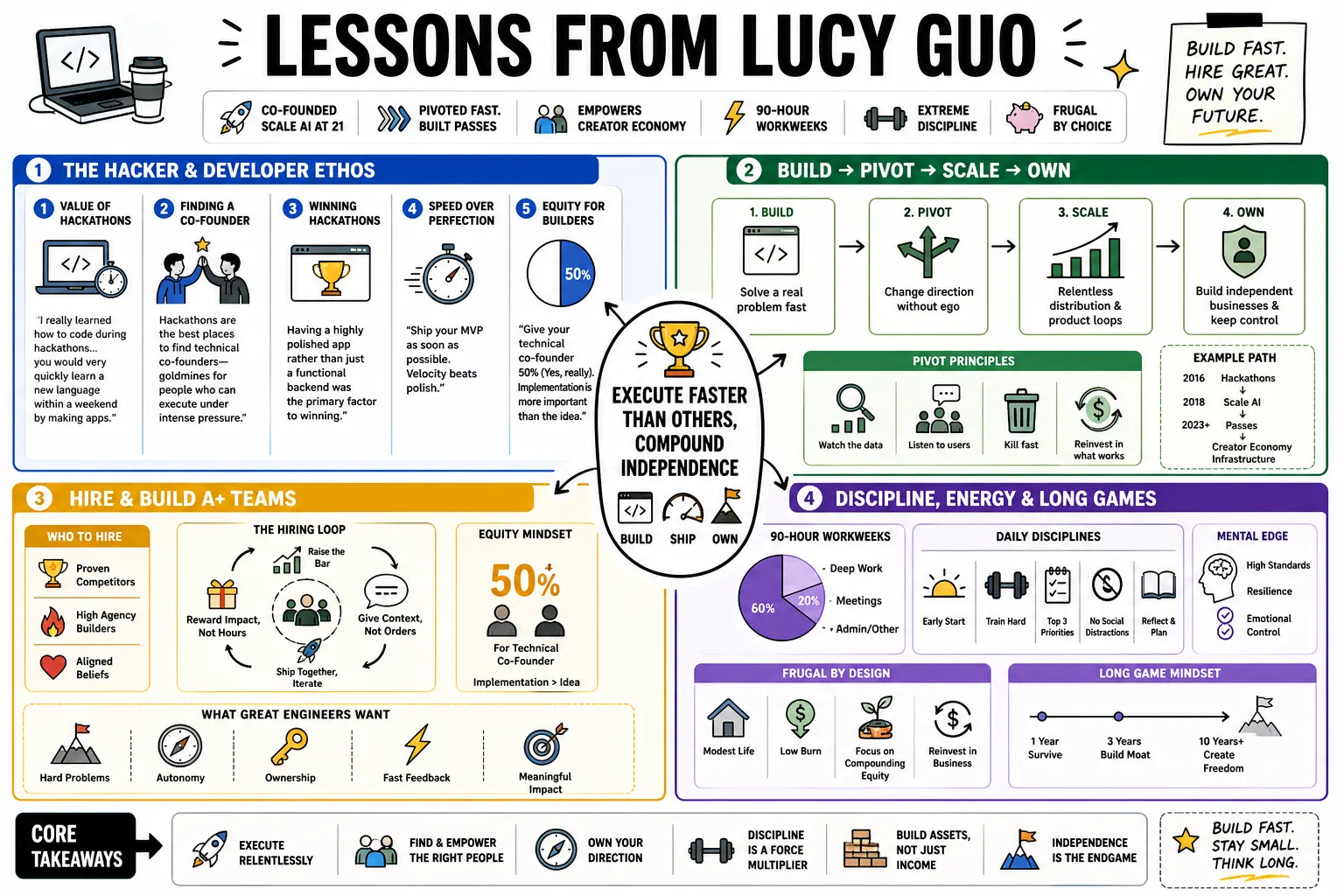
Lessons from Lucy Guo
Lucy Guo co-founded Scale AI at 21 before launching Passes to help creators build independent businesses. Behind a polarizing internet presence used to recruit fiercely loyal engineers, she operates with extreme physical discipline and a frugal approach to wealth. This collection details her specific methods for pivoting, hiring, structuring taxes, and sustaining 90-hour workweeks.
Part 1: The Hacker & Developer Ethos
- On the value of hackathons: "I really learned how to code during hackathons... you would very quickly learn a new language within a weekend by making apps." — Source: [Medium]
- On finding a co-founder: Hackathons are the best places to find technical co-founders because they act as goldmines for identifying people who can execute under intense pressure. — Source: [The Wantrepreneur Show]
- On winning hackathons: She realized early on that having a highly polished app rather than just a functional backend was the primary factor to winning. — Source: [Medium]
- On speed over perfection: "Ship your MVP as soon as possible. Velocity beats polish." — Source: [Outlander VC]
- On equity for builders: "Give your technical co-founder 50% (Yes, really). Implementation is more important than the original idea." — Source: [Medium]
- On technical literacy: "If you are just a business person and you are hiring a team of engineers, you're gonna get ripped off." — Source: [YouTube]
- On coding as an advantage: Being technical is not just about writing code; it is about understanding what is structurally possible and seeing opportunities others overlook. — Source: [eBoona]
- On the nature of software: "Code and content are the only things that scale with zero marginal cost." — Source: [Passes Blog]
- On pivoting: Do not fall into the sunk cost fallacy by waiting too long to change direction; she generally advises founders to make a pivot within three weeks if initial traction fails. — Source: [Aspire Podcast]
Part 2: Founding & Scale AI Lessons
- On the early days of Scale AI: The company was an accident; they originally applied to Y Combinator with a healthcare app but pivoted to "Scale API" to build infrastructure they needed themselves. — Source: [School of Hard Knocks]
- On co-founder dynamics: "Be very, very careful who you start a company with. Your co-founder must be your loudest supporter." — Source: [School of Hard Knocks]
- On defining a CEO's mindset: "Change equals opportunity." — Source: [My First Million]
- On the execution gap: "Ideas are the easy part; it's the execution that slows everything down." — Source: [YouTube]
- On the gold rush strategy: "Who got rich during the gold rush? It wasn't all the people going out west looking for gold; it was the people selling the shovels." — Source: [Anchor FM]
- On competitive density: "If I didn't become a billionaire, I was a failure, because everyone around me was so intelligent... everyone around me was going to be a billionaire." — Source: [School of Hard Knocks]
- On hiring criteria: "Hire people smarter than you because a competitor can easily move in and copy you and do better." — Source: [Tech-Now]
- On firing fast: "You'll never regret firing someone too early, but you always regret firing them too late." — Source: [Outlander VC]
- On entrepreneurial sanity: "Entrepreneurs are all a little crazy because you have to be a little crazy to decide 'I can build a multi-billion dollar company.'" — Source: [My First Million]
- On leaving early: She admitted that selling a portion of her Scale AI stake early was a bad financial decision, though her retained 5% still made her a billionaire. — Source: [Scribd]
Part 3: The Creator Economy & Passes
- On creator independence: Creators are entrepreneurs who should own their audience relationships rather than merely renting them from algorithms that can change overnight. — Source: [Business Women]
- On income inequality: Currently, about 10% of creators make almost all the money; there needs to be a structural shift so more creators can build sustainable wealth. — Source: [Outlander VC]
- On the unicorn creator: The ultimate goal of Passes is to empower individuals to become billion-dollar brands by monetizing their reach directly. — Source: [Fast Company]
- On AI as a creator's partner: She views AI not as a replacement for human talent, but as a copilot that helps creators optimize pricing and analyze data. — Source: [Mirror]
- On predatory industry practices: "360 deals are terrible... some people have extremely predatory contracts. The industry thinks very short term." — Source: [Wave]
- On financial tools for creators: Her long-term vision involves turning her platform into a bank for creators, offering high-yield savings to build wealth. — Source: [Business Insider]
- On high-touch monetization: Platforms must focus on direct fan engagement like pay-to-view DMs and calls to move creators from making hundreds a month to tens of thousands. — Source: [PR Newswire]
- On the future of work: "I believe we'll see the world moving towards everyone being an entrepreneur." — Source: [Business Women]
- On protecting equity: Creators should be able to build real businesses around their followers without surrendering ownership or a massive cut of their earnings. — Source: [Outlander VC]
Part 4: Investment & Backend Capital
- On the fundraising approach: When fundraising, approach investors for advice to lower the stakes. — Source: [Passes Blog]
- On engineering-first investing: Backend Capital explicitly focuses on funding technical founders and evaluates teams based on debugging speed rather than pitch decks. — Source: [eBoona]
- On authentic scarcity: Do not manufacture fake deadlines; create legitimate scarcity by timing your fundraise alongside real product momentum and user growth. — Source: [Medium]
- On pitching the vision: Venture capitalists are looking for massive outcomes, so planning an early acquisition means you are not thinking big enough for venture scale. — Source: [Passes Blog]
- On gradient descent for startups: She likens pivoting to the machine learning concept of gradient descent where smart founders realize when they are stuck at a local minima and quickly shift direction. — Source: [Passes Blog]
- On backing the plumbing: Her firm focuses on infrastructure and developer tools because they form the necessary backend architecture that enables all other companies to scale. — Source: [eBoona]
- On founder obsession: She looks specifically for founders who are deeply obsessed with the problem they are solving, not just enamored with the idea of running a startup. — Source: [eBoona]
- On pattern-breaking: "Too many VCs try to pattern-match to past successes. The most valuable companies often break the pattern." — Source: [eBoona]
- On capital efficiency: "I want to build something that $2 million could get me very far." — Source: [My First Million]
Part 5: Frugality & Wealth Mindset
- On the frugal billionaire lifestyle: "Act broke and constantly reinvest your money. That’s how you stay rich." — Source: [School of Hard Knocks]
- On the airplane tax hack: By financing a $12 million airplane and utilizing accelerated depreciation, wealthy individuals can write off the entire purchase price against their tax bill in the first year. — Source: [My First Million]
- On fast fashion over luxury: Despite a massive net worth, she famously fills her closet with $10 pieces from Shein and avoids spending on designer labels unless attending a specific event. — Source: [Economic Times]
- On budget transportation: She prefers taking UberX over luxury tiers, noting that she still used Uber Pool even after her net worth crossed the millionaire mark. — Source: [YouTube]
- On optimizing food delivery: "I don't like the concept of wasting money. So when I get buy-one-get-ones on Uber Eats it makes me feel good about getting a deal." — Source: [My First Million]
- On airport lounge hacks: In her scrappier days, she would book fully refundable flights just to eat for free at the Amex lounge before canceling the ticket. — Source: [Entrepreneur]
- On wealth versus riches: "I'm not rich, I'm wealthy," drawing a distinction between flashy spending and quiet asset accumulation. — Source: [My First Million]
- On inherited discipline: She credits her strict financial mindset to her Chinese immigrant parents, who were electrical engineers that refused to use air conditioning to save money. — Source: [Forbes]
- On viewing spending as investment: "I like to think of every dollar spent as an investment." — Source: [My First Million]
- On the social experiment of wealth: She began displaying a more flashy lifestyle online purely to test how people treated her differently compared to when she wore Walmart clothing. — Source: [My First Million]
Part 6: Risk, Dropping Out & Learning
- On the Thiel Fellowship decision: "It was a no-brainer the second that I heard that I got the Thiel Fellowship. It was $100,000 to drop out of school... I didn't view it as a risk." — Source: [Anchor FM]
- On optimizing for knowledge: The number one rule is to optimize for learning; leaving college is not a risk if you are gaining knowledge, because your knowledge will always have value. — Source: [School of Hard Knocks]
- On parental friction: When she dropped out, her father sent angry emails for a year questioning her risk calculation and calling her foolish. — Source: [Anchor FM]
- On the illusion of risk: "Things might feel risky, but they're not. The most I lose is a few years... I can always go back to college." — Source: [Wondermind]
- On the dropout halo effect: "When you drop out, people automatically assume you are smarter than you are or that you're going to be a prodigy, so they want to meet you." — Source: [School of Hard Knocks]
- On idea sourcing: Rather than brainstorming in a vacuum, she scrapes Y Combinator's Request for Startups list and Reddit to find validated problems to solve. — Source: [My First Million]
- On evaluating opportunity cost: "If it’s not life-changing money on the table, then it just makes sense to go do the next thing and optimize for learning." — Source: [School of Hard Knocks]
- On protecting ideas: "I'm super afraid to share ideas," but recognizing that execution is the true moat helps overcome the fear of theft. — Source: [My First Million]
- On unselfish mentorship: "Help people without keeping score... that unselfish help comes back in ways you can't predict." — Source: [Medium]
Part 7: Work Ethic & Physical Discipline
- On early-stage commitment: She firmly advocates for 90-hour workweeks when launching a startup, stating it is nearly impossible to succeed without that initial intensity. — Source: [India Times]
- On the 9-to-9 rule: Work-life balance in the beginning means working from 9 a.m. to 9 p.m.; you can still go to dinner with friends, but you do not need to sleep 12 hours. — Source: [Scribd]
- On hiring killers: She specifically looks to hire former athletes and math competitors because they possess an ingrained discipline that exceeds the average worker. — Source: [School of Hard Knocks]
- On physical fitness as fuel: "No matter how shitty I'm feeling, I will still get up and go work out because I know I'm going to have more energy to be better at my job." — Source: [Inc.]
- On extreme competition: Her competitive drive is so intense that she once completed 7 Barry’s Bootcamp classes in a single day just to reach the number one spot on a global leaderboard. — Source: [My First Million]
- On the concept of balance: She suggests that if an early-stage founder is constantly craving work-life balance, they might simply be in the wrong career. — Source: [The Star]
- On sleep architecture: She typically sleeps only 3 to 5 hours a night, a genetic trait she credits to her parents that allows her to maximize waking hours. — Source: [School of Hard Knocks]
- On strategic location: She chose her apartment in Miami based on its 5-minute proximity to both her office and her gym to eliminate dead time spent commuting. — Source: [YouTube]
- On building with obsession: "Don't build if you're not obsessed." — Source: [Inc.]
- On filtering out distractions: She believes you can maintain an active social life while working extreme hours simply by cutting out doom-scrolling and digital time-wasters. — Source: [Medium]
Part 8: Networking, Brand & Miami Scene
- On social leverage: "Your network is your net worth." — Source: [The Wantrepreneur Show]
- On polarizing online brands: She intentionally acts controversial and polarizing on Twitter to serve as a sales funnel for recruiting die-hard talent who align with her persona. — Source: [Outlander VC]
- On the power of asking: "Ask for things. Rejection is uncomfortable, but it’s survivable. One single 'yes' can undo a hundred 'nos'." — Source: [School of Hard Knocks]
- On embracing the party brand: After a hackathon leak turned her house into a massive party, she simply owned the "party girl" label, knowing her actual work discipline spoke for itself. — Source: [Medium]
- On competing with big tech: Early-stage startups cannot compete with massive cash salaries; instead, they must attract talent through the founder's vision and public cult of personality. — Source: [Outlander VC]
- On social anxiety as an asset: Identifying as an ambivert who experiences social anxiety in large groups, she forces herself into deep one-on-one conversations to build genuine rapport. — Source: [My First Million]
- On building local ecosystems: By organizing hackathons and founder houses in Miami, she creates a dense network of ambitious builders that organically generates deal flow. — Source: [Medium]
- On leadership positivity: "Be everyone's cheerleader." — Source: [My First Million]
- On leveraging Twitter: She credits Twitter with launching her career, noting that it was the platform where she directly connected with her first critical mentors and investors. — Source: [Outlander VC]