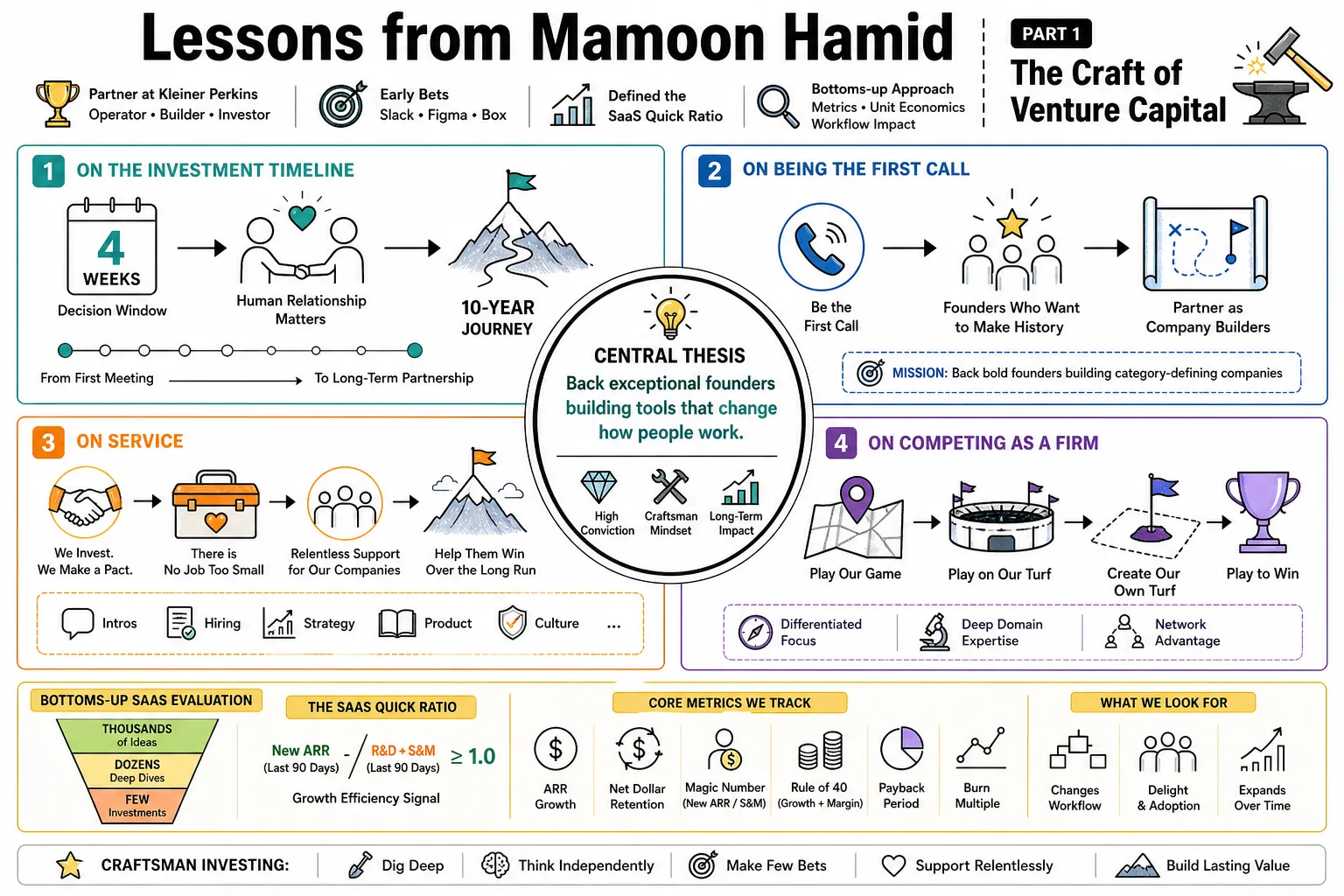
Lessons from Mamoon Hamid
Mamoon Hamid is a partner at Kleiner Perkins known for early bets on Slack, Figma, and Box. He defined the SaaS Quick Ratio and the core metrics used to evaluate bottoms-up enterprise software. This collection covers how he evaluates founders, tracks growth efficiency, and spots tools that actually change how people work.
Part 1: The Craft of Venture Capital
- On the investment timeline: "You're deciding on investing in a company in a four-week cycle... and you're about to go on a ten-year journey with them. Building a true human relationship matters in what we do." — Source: [Deciphr]
- On being the first call: "Our mission is to be the first call for founders who want to make history and partner with them as company builders in pursuit of that goal." — Source: [Deciphr]
- On service: "Once we've invested and made the pact to serve one of our companies, there is no job too small for me." — Source: [Deciphr]
- On competing as a firm: "We need to go play our game, play on our turf and create our own turf... so that we can play to win." — Source: [Sajith Pai]
- On craftsmanship in investing: Venture capital should return to its roots with a craftsman mentality, emphasizing high-conviction investing over broad index-style deployment. — Source: [Sajith Pai]
- On the YOLO bucket: When dealing with extreme valuations for exceptional founders, maintaining discipline is required while keeping a YOLO bucket to occasionally break the rules. — Source: [20VC]
- On the purpose of early-stage funds: A typical early-stage fund requires backing roughly thirty-five companies, with the explicit mathematical reality that at least two must become massive outliers to return the fund. — Source: [Kleiner Perkins]
- On majors and minors: Venture capitalists should develop majors in deep sector expertise and minors in exploratory interests to remain adaptable to new technological shifts. — Source: [20VC]
- On Series A versus Series B: "With Series A, I'm thinking a lot about the vision, the team, the market that they are going into. In Series B, it's really about execution since the Series A." — Source: [Business Insider]
Part 2: The Bottom-Up Software Revolution
- On the shift in enterprise software: The consumerization of the enterprise means business software must have the same ease of use and viral growth characteristics as consumer applications. — Source: [Wikipedia]
- On design as a differentiator: In a world where software is everywhere, great user experience has become the primary point of differentiation. — Source: [Newcomer]
- On the designer-to-engineer ratio: A rapidly increasing ratio of designers to developers in the workforce signals that design tools represent a massive market. — Source: [Newcomer]
- On the daily job thesis: The most valuable enterprise companies build tools that employees must use every single day to perform their core job functions. — Source: [Full Ratchet]
- On solving internal communication: Tools like Slack succeed by solving internal communication the same way email solved external communication, adding the speed and transparency of modern chat. — Source: [Tundra Angels]
- On lessons from Yammer: Viral bottoms-up growth within an organization creates a groundswell that eventually forces a top-down enterprise sale. — Source: [Wikipedia]
- On identifying real pain: "What that means is you built a product that now customers are saying: 'This is useful for me. I will pay for it.' You've identified a pain point for them that they are willing to take out their credit card." — Source: [Business Insider]
- On the grandfather of bottoms-up: Box proved that individual employees could adopt a free tool, bypassing IT approval and creating gravity that pulled the whole enterprise to the cloud. — Source: [20VC]
- On collaborative platforms versus single-player tools: Deep engagement metrics in products like Figma show that a tool is truly valuable when eighty percent of its active users sit outside the core discipline the tool was built for. — Source: [Newcomer]
Part 3: Data, Metrics, and the SaaS Quick Ratio
- On growth efficiency: Top-line revenue growth is deceptive if churn is high, meaning investors must measure the underlying health of that growth. — Source: [SaaStr]
- On the SaaS Quick Ratio: A company's growth health is calculated by dividing newly added and expansion MRR by churned and contracted MRR. — Source: [ChartMogul]
- On the benchmark for success: "Companies on the right, four or above. Companies on the left, less than four. Simple: pass, invest." — Source: [SaaStr]
- On the leaky bucket: A ratio below two suggests a dangerous leaky bucket problem, indicating the company is burning too much cash to mask high customer churn. — Source: [SaaSly]
- On maintaining efficiency: As a company scales, maintaining a Quick Ratio of greater than four becomes an aspirational target for enduring success. — Source: [SaaStr]
- On the engine of SaaS: Net New MRR represents the true engine of a SaaS business, driving sustainable expansion when the numerator outpaces the denominator. — Source: [Full Ratchet]
- On knowing your numbers: In a data-rich environment, founders must track every metric and accurately contextualize them within their specific business model. — Source: [Full Ratchet]
- On accounting for users: Growth accounting requires breaking down user growth into specific components like newly acquired users plus resurrected users minus churned users. — Source: [Social Capital]
- On the danger of shrinking growth: A Quick Ratio below one means a company is losing more recurring revenue than it is adding, inherently shrinking the business despite new customer acquisition. — Source: [Drivetrain]
- On investing with data: "It’s not always that simple. But we try to use data as much as we can to make good decisions." — Source: [SaaStr]
Part 4: Evaluating Founders and Vision
- On the founder's motivation: Elite investors listen for the underlying motivation. Founders must clearly articulate why they are the right people to solve a specific problem. — Source: [YouTube]
- On perseverating on the problem: The best founders have perseverated around a problem so deeply that they can poke holes in their own ideas better than any investor can. — Source: [YouTube]
- On rigorous customer discovery: Extensive customer interviews are necessary to identify precise pain points and verify actual willingness to pay before writing lines of code. — Source: [Business Insider]
- On seeing around corners: Founders must be able to tell a compelling story that accounts for unknowns and changing technological environments. — Source: [Business Insider]
- On timing and older ideas: "Things that couldn't have been possible five years ago may be possible today. You don't want to take yourself too seriously by saying, 'It was done before and it can't be done today.'" — Source: [Leveling Up]
- On founder humanity: Long-term success requires a strong North Star and a fundamental belief in the founder's moral character and humanity. — Source: [20VC]
- On extreme conviction: The best investments often come from having extreme conviction in a category-winning team before the financial metrics even exist. — Source: [SaaStr]
- On the self-aware founder: A founder's ability to criticize their own business model demonstrates a level of self-awareness required for long-term survival. — Source: [20VC]
- On focusing on execution: By Series B, the emphasis shifts completely away from the initial vision and lands squarely on the team's ability to execute and develop the product. — Source: [Business Insider]
Part 5: Navigating Board Dynamics and Partnerships
- On collaborative decision-making: A high-touch culture where partners physically work together ensures collective intelligence is applied to every investment decision. — Source: [YouTube]
- On doubling down: Firms should use select funds to concentrate capital and double down on their highest-conviction companies where they hold board seats. — Source: [Kleiner Perkins]
- On being the first institutional partner: The most effective way to assist founders is to lead early rounds, take board seats, and guide them through their entire journey. — Source: [Deciphr]
- On the value of shared context: Meeting weekly as a partnership builds shared context, allowing the firm to react faster to market shifts and support portfolio companies collectively. — Source: [YouTube]
- On post-investment commitment: The real work begins after the check is written, meaning a VC must be willing to perform unglamorous tasks to support the founder. — Source: [Deciphr]
- On market-creating products: Investors should prioritize companies that define their own playing field and establish entirely new categories of software. — Source: [YouTube]
- On concentration over indexing: Building a massive portfolio valuation from a concentrated early-stage fund requires focusing time and capital on massive outliers. — Source: [Kleiner Perkins]
- On technology as a uniter: "Technology is a leveler, a uniter of people from all walks of life," making it a necessary tool for addressing systemic societal issues. — Source: [Leveling Up]
- On the limits of investor knowledge: An investor should recognize that a truly prepared founder will always understand the nuances of their specific problem space better than the board does. — Source: [YouTube]
Part 6: Building 100-Year Companies
- On the transition of scale: To build an enduring institution, a company's culture must successfully evolve from a founder-led stage to a system-led stage. — Source: [SaaStr]
- On hiring for scale: Executives should be hired for their demonstrated ability to scale ten times beyond their immediate role. — Source: [SaaStr]
- On avoiding growth at all costs: The shift from a growth at all costs mindset to focusing on unit economics is essential for a company to survive beyond its initial hype cycle. — Source: [SaaStr]
- On identifying the North Star: To build a enduring company, you must identify and optimize for the metric that captures the actual value delivered to the user. — Source: [YouTube]
- On the danger of the vicious cycle: Focusing solely on MRR can lead to over-hiring in sales to fill a leaky bucket, driving up burn rates and starving product development. — Source: [SaaStr]
- On market ranking: When evaluating startups, market potential ranks alongside founder quality and product execution as a mandatory pillar of a long-term business. — Source: [20VC]
- On changing how work happens: Enduring companies fundamentally alter the behavioral habits of modern workers. — Source: [Newcomer]
- On building a category: Companies like Slack and Figma had to educate the market on why their category needed to exist in the first place. — Source: [YouTube]
- On revenue vs usage: In the early stages, depth of engagement and genuine user love are far better predictors of an enduring company than immediate monetization. — Source: [20VC]
- On patience in venture: Returns in venture capital require a decade-long horizon, demanding patience from both the founders building the company and the partners funding it. — Source: [Deciphr]
Part 7: Product Value Over Pure Revenue
- On the difference between price and value: "MRR is the price the customer pays. Your North Star is the value they get." — Source: [SaaStr]
- On measuring the North Star: For Slack, the true measure of value was messages sent. For Box, it was files shared. These metrics reflect actual human engagement. — Source: [YouTube]
- On the trap of false growth: A company can artificially grow from zero to one million in revenue with great top-line metrics, only to collapse later if they stop leading with the product. — Source: [SaaStr]
- On the consequence of ignoring product: High churn is usually a symptom of a product that has stopped delivering compounding value to its core users. — Source: [SaaStr]
- On depth of engagement: High daily active use indicates a product has moved from being a discretionary tool to a core piece of infrastructure. — Source: [Full Ratchet]
- On the limits of sales: No amount of sales engineering or marketing budget can fix a product that users do not inherently want to open every morning. — Source: [SaaStr]
- On the designer's mindset: Treating software development as a design problem first ensures that the resulting product feels intuitive rather than purely functional. — Source: [Newcomer]
- On value accrual: Software captures the most value when it seamlessly integrates into the user's existing habits rather than forcing them to adopt clunky new workflows. — Source: [20VC]
- On the ultimate test of fit: Product-market fit is proven when a user is so frustrated by the status quo that they proactively seek out and pay for a new solution. — Source: [Business Insider]
Part 8: The AI Supercycle and the Future of Work
- On the AI supercycle: The current AI wave is comparable to the internet boom, but operating at a scale and speed multiplied by ten. — Source: [20VC]
- On where value accrues: While infrastructure is important, the majority of long-term value in the AI shift will ultimately accrue in the application layer. — Source: [YouTube]
- On the sugar high: Investors must be wary of "sugar high" revenues in AI, which are fast-scaling metrics driven by novelty rather than sustainable utility. — Source: [YouTube]
- On labor as software: AI fundamentally changes how work is monetized by shifting the software model from providing tools to providing capabilities and labor. — Source: [Forbes]
- On supercharging professionals: The most exciting AI applications act as co-pilots, dramatically increasing the output of doctors, lawyers, and developers. — Source: [20VC]
- On investing across the stack: A complete thesis in the AI era requires deploying capital across the entire stack, from advanced semiconductors to end-user applications. — Source: [Forbes]
- On the next platform shift: Enterprise AI represents the next major platform shift, demanding the same disciplined early-stage evaluation process used for cloud and mobile. — Source: [Kleiner Perkins]
- On moving beyond linear software: Traditional linear software digitizes a process, while AI software actively participates in completing the process. — Source: [YouTube]
- On the obsolescence of old interfaces: As models become more capable, chat and conversational interfaces will replace traditional dashboards as the primary way humans interact with enterprise data. — Source: [20VC]
- On the new system of record: AI applications have the potential to bypass existing systems of record by serving as the intelligence layer where the actual work and decision-making occur. — Source: [Forbes]