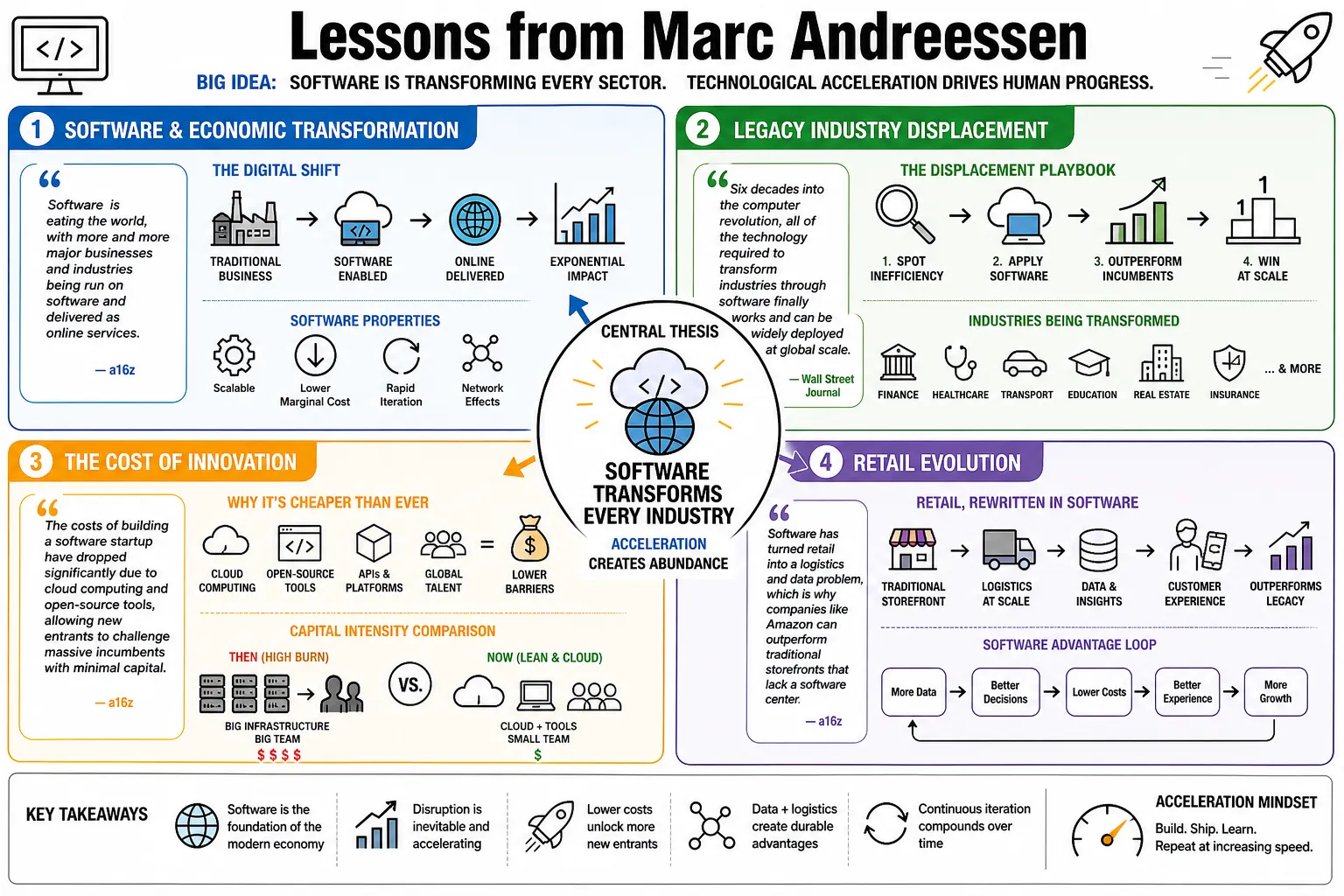
Lessons from Marc Andreessen
Marc Andreessen co-founded Netscape and a16z, but he is best known for the ideas he champions. He famously argued that software is transforming every sector of the global economy and remains a vocal advocate for the belief that technological acceleration is the primary engine of human progress.
Part 1: Software and Economic Transformation
- On the Digital Shift: "Software is eating the world, with more and more major businesses and industries being run on software and delivered as online services." — Source: a16z
- On Legacy Industry Displacement: "Six decades into the computer revolution, all of the technology required to transform industries through software finally works and can be widely deployed at global scale." — Source: Wall Street Journal
- On the Cost of Innovation: "The costs of building a software startup have dropped significantly due to cloud computing and open-source tools, allowing new entrants to challenge massive incumbents with minimal capital." — Source: a16z
- On Retail Evolution: "Software has turned retail into a logistics and data problem, which is why companies like Amazon can outperform traditional storefronts that lack a software-centric core." — Source: a16z
- On Financial Services: "Banking is essentially a ledger of transactions, a perfect candidate for software disruption through fintech platforms that bypass traditional physical infrastructure." — Source: PMarchive
- On Creative Destruction: "The creative destruction of the software revolution is painful for those in legacy roles but essential for the creation of new, more efficient economic structures." — Source: Wall Street Journal
- On the Global Marketplace: "Software allows any company to be born global from day one, reaching billions of internet users without the need for traditional international expansion phases." — Source: a16z
- On the Speed of Adoption: "The cycle time for software-driven disruption is faster than any previous industrial shift because the distribution is nearly instantaneous via the web and mobile." — Source: a16z
- On Software as Infrastructure: "We are moving to a world where software is not just a tool we use, but the fundamental infrastructure upon which the entire economy is built." — Source: Invest Like the Best
Part 2: The Art of the Startup
- On Product/Market Fit: "The only thing that matters is getting to product/market fit; being in a good market with a product that can satisfy that market." — Source: PMarchive
- On the Power of Markets: "When a great team meets a lousy market, market wins. When a lousy team meets a great market, market wins. When a great team meets a great market, something special happens." — Source: PMarchive
- On The Onion Theory of Risk: "Running a startup is a process of peeling away layers of risk—technical, market, and team risk—one milestone at a time." — Source: YouTube
- On Strategic Pivots: "If you’re not reaching product/market fit, you must be willing to change everything—your team, your product, and your market—to find the 'pull' from customers." — Source: PMarchive
- On Fear and Courage: "The number one trait I look for in a founder is courage—the ability to get punched in the face repeatedly and keep moving forward." — Source: Business Insider
- On First-Time Founders: "Most successful founders are not just young geniuses; they are often people who spent years in a specific industry and identified a deep, unaddressed pain point." — Source: a16z Podcast
- On Excessive Planning: "The best startups often look like accidents because they are built by people who are simply obsessed with solving a problem rather than following a rigid business plan." — Source: PMarchive
- On Competitive Moats: "A startup's only real moat is its speed of execution; if you stop moving faster than the incumbents, you have already lost." — Source: Stanford University
- On Raising Capital: "Raise enough money to get to the next significant milestone where a major layer of risk has been removed, but not so much that you lose the discipline of scarcity." — Source: YouTube
- On The Lean Myth: "While lean is good for discovery, you cannot starve your way to greatness. Eventually, you must spend aggressively to capture the market." — Source: a16z
Part 3: Venture Capital and the Power Law
- On Extreme Outliers: "Venture capital is a game of outliers; about 15 companies a year generate nearly all of the returns for the entire industry." — Source: Medium
- On Investing in Strength: "We look for startups with extreme strengths, even if they have serious flaws, because well-rounded companies without a 'superpower' rarely generate 100x returns." — Source: Medium
- On The Agency Model: "Venture capital should be a service industry. We modeled our firm after CAA in Hollywood, providing specialists to help founders scale their organizations." — Source: Forbes
- On Market Timing: "Being too early is the same thing as being wrong. In VC, you have to be right about the 'what' and the 'when'." — Source: Conversations with Tyler
- On Contrarianism: "To make a fortune in investing, you have to be right and you have to be non-consensus. If you are right and everyone agrees, the profit is already priced in." — Source: a16z
- On The Value of Networks: "The primary value of a VC is not the money, but the network of talent, customers, and partners that can accelerate a startup's growth." — Source: Forbes
- On Due Diligence: "You can’t due diligence your way out of uncertainty. At some point, you have to make a leap of faith based on the quality of the founder's vision." — Source: Invest Like the Best
- On Portfolio Construction: "The goal is not to have a high batting average, but to have a high slugging percentage. One massive win pays for all the strikeouts." — Source: Medium
- On The VC 'Vibe': "We are in the business of saying 'yes' to the crazy ideas that the rest of the world thinks are impossible." — Source: a16z Podcast
Part 4: Management and Organizational Culture
- On Pricing Strategy: "The number one piece of advice I give to startups is: Raise your prices. Most companies are under-pricing and killing their ability to grow." — Source: Tools of Titans
- On The Founder-CEO: "Founders have the moral authority to make the radical changes necessary to survive; professional managers are often too focused on preserving the status quo." — Source: a16z
- On Data-Driven Decisions: "If we have data, let’s look at data. If all we have are opinions, let’s go with mine." — Source: YouTube (quoting Jim Barksdale)
- On The Managerial Class: "We are seeing a revolution of the 'managerial class' where bureaucracy and process have replaced the owner-operator's focus on results." — Source: Conversations with Tyler
- On Communication: "Over-communicate your vision until you are sick of hearing yourself speak; only then will your employees actually start to understand it." — Source: PMarchive
- On Hiring Standards: "Hire for strength rather than lack of weakness. You want people who are brilliant at one thing, even if they are difficult to manage." — Source: PMarchive
- On Flat Organizations: "Keep your R&D teams small and flat. Large engineering organizations usually spend more time communicating than building." — Source: a16z
- On The Principal-Agent Problem: "The biggest threat to any organization is when the people running it have no personal skin in the game and prioritize their own careers over the mission." — Source: Fortune
- On Accountability: "The buck has to stop somewhere. In a founder-led company, it stops with the person whose name is on the door, which drives radical accountability." — Source: Fortune
Part 5: Techno-Optimism and Progress
- On The Source of Wellbeing: "Everything good is downstream of growth. Stagnation is the enemy of human flourishing." — Source: a16z
- On Technological Morality: "It is a moral obligation to build technology that solves human problems. Deceleration is a choice to let people suffer longer." — Source: a16z
- On The Power of Intelligence: "Intelligence is the ultimate lever on the world. AI is a way to make everyone smarter and everything we care about better." — Source: a16z
- On Effective Accelerationism: "We believe that we should accelerate the development of technology as fast as possible to reach a state of abundance and solve global challenges." — Source: a16z
- On Stagnation Risks: "A society that stops building and starts redistributing is a society in decline. We must return to a culture of production." — Source: a16z
- On The Precautionary Principle: "The 'precautionary principle'—the idea that we shouldn't do anything until it's proven safe—is a suicide pact for innovation." — Source: a16z
- On Energy Abundance: "With enough energy and enough intelligence, we can solve almost any material problem humanity faces." — Source: a16z
- On The Romanticism of Industry: "We should celebrate the engineers, the builders, and the creators as the heroes of our civilization." — Source: a16z
- On Solving Natural Problems: "There is no problem created by nature that cannot be solved with more technology." — Source: a16z
- On The Frontier: "Technology is the last remaining frontier where people can still build new worlds and escape the constraints of legacy systems." — Source: a16z
Part 6: Market Dynamics and American Dynamism
- On Building for National Interest: "American Dynamism is about investing in sectors like defense, energy, and manufacturing that are critical to the country's future." — Source: a16z
- On The Industrial Base: "We have offshored too much of our industrial capacity; we need to use software and robotics to bring manufacturing back to the U.S." — Source: a16z
- On The Failure of Public Institutions: "When the government can't build, the private sector must step in to provide the infrastructure that society needs." — Source: a16z
- On Geopolitical Tech Rivalry: "The battle for tech supremacy is the defining geopolitical struggle of our time. Whoever wins AI and chips will set the rules for the next century." — Source: Invest Like the Best
- On The Role of Hard Tech: "Bits are easy; atoms are hard. We need more geniuses working on the physical world, from rocket engines to nuclear reactors." — Source: a16z
- On Defense Innovation: "Modern warfare is being transformed by software-defined weapons and autonomous systems. Silicon Valley must support the national defense." — Source: Invest Like the Best
- On The Vibe Shift: "There is a massive cultural shift happening where people are tired of stagnation and are ready to start building big things again." — Source: Substack
- On Market Capture: "In the new economy, the winner-take-all dynamics are stronger than ever because software creates massive economies of scale and network effects." — Source: PMarchive
- On The New Industrialists: "The great founders of today are the spiritual successors to the Vanderbilts and Fords of the 19th century." — Source: Fortune
Part 7: Productivity and Career Strategy
- On Career Planning: "The first rule of career planning: Do not plan your career. The world is too complex to predict where the opportunities will be." — Source: PMarchive
- On Skill Acquisition: "Focus on building 'career capital'—a unique combination of skills and experiences that make you rare and valuable." — Source: PMarchive
- On Being a Growth Missile: "Aim yourself at the fastest-growing companies in the most interesting markets; the tailwind of a growing industry will fix many of your mistakes." — Source: PMarchive
- On The Portfolio Approach: "Treat your career as a portfolio of bets. Take high-upside risks when you are young and have low downside." — Source: PMarchive
- On Personal Productivity: "Keep only three lists: Todo, Watch, and Later. If it’s not on one of those, it shouldn't be in your head." — Source: PMarchive
- On The Anti-Schedule: "In my early career, I refused to keep a schedule so I could focus on whatever was most important or interesting at any moment." — Source: PMarchive
- On The Pivot to Structure: "As you scale, you must move from an anti-schedule to a hyper-structured calendar to manage the complexity of a large organization." — Source: Invest Like the Best
- On The 3x5 Card: "Every night, write the 3 to 5 things you must do tomorrow on a 3x5 index card. Then, do them. It’s the simplest, most effective system." — Source: PMarchive
- On Saying No: "Only agree to new commitments when both your head and your heart say yes. Half-hearted commitments are a drain on your focus." — Source: PMarchive
- On Networking: "Don't network for the sake of networking; build things and the network will find you." — Source: PMarchive
Part 8: Artificial Intelligence and the Future
- On AI Safety Myths: "AI is not a living being; it is math and code. It doesn't 'want' to kill us any more than your toaster does." — Source: a16z
- On Cognitive Augmentation: "AI is the most important tool we have ever built to augment human intelligence, effectively giving every person a genius-level research assistant." — Source: a16z
- On The Lump of Labor Fallacy: "The idea that AI will permanently destroy all jobs is a fallacy. Technology has always created more jobs than it destroyed by making goods cheaper and increasing demand." — Source: a16z
- On Defense Against Bad Actors: "The way to stop a 'bad person' with AI is to give 'good people' even more powerful AI to detect and counter them." — Source: a16z
- On AI in Education: "Every child should have an AI tutor that is infinitely patient, infinitely knowledgeable, and perfectly tailored to their learning style." — Source: a16z
- On Open Source AI: "Open source AI is a critical check on the power of large tech companies and a way to ensure that the benefits of intelligence are widely distributed." — Source: Invest Like the Best
- On AI and Managerialism: "AI might allow small, principal-led teams to compete with massive bureaucratic organizations, effectively dismantling the managerial class." — Source: Fortune
- On The Speed of Progress: "We should not slow down AI development; we should speed it up. Every day we delay is a day we don't have cures for diseases or solutions to energy." — Source: a16z
- On The Future of Humanity: "Our goal should be to build a civilization where technology handles the mundane and humans are free to focus on creativity, connection, and discovery." — Source: a16z