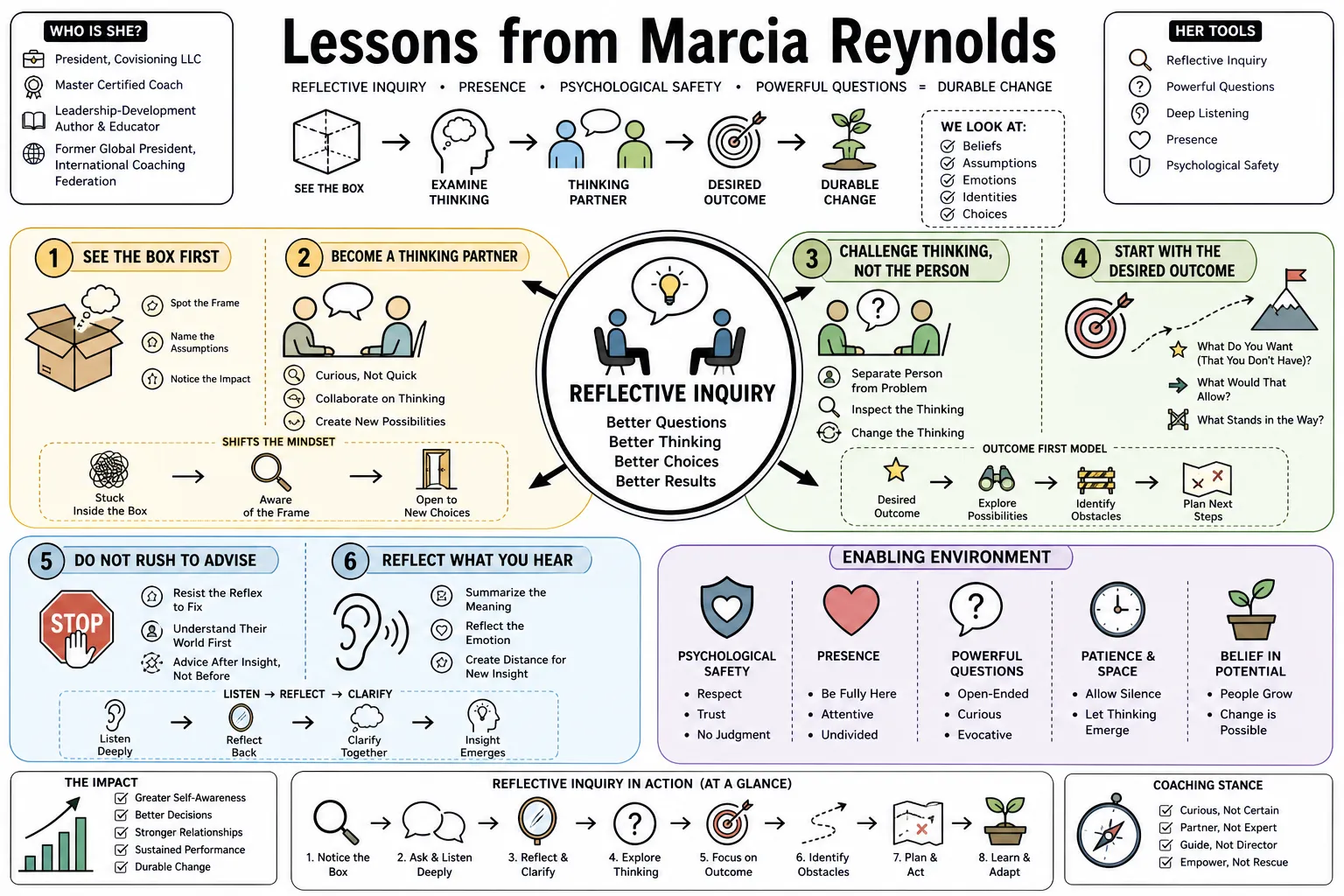
Dr. Marcia Reynolds is President of Covisioning LLC, a Master Certified Coach, and a leadership-development author and educator. A former global president of the International Coaching Federation, she focuses on reflective inquiry: helping people examine the beliefs, assumptions, emotions, and identities shaping their choices. Her work shows how presence, psychological safety, and carefully framed questions can create durable personal and professional change.
Reflective Inquiry and Coaching
- On See the Box First: Before people can think beyond a limiting frame, they have to recognize the frame that currently contains their thinking. — Reference: How to Be Awesome at Your Job 575 — reflective inquiry transcript
- On Become a Thinking Partner: A coach creates more value as a thinking partner than as the person who supplies the answer. — Reference: How to Be Awesome at Your Job 575 — reflective inquiry transcript
- On Challenge Thinking, Not the Person: Useful coaching does not solve the problem for someone; it helps that person inspect and change the thinking producing the problem. — Reference: How to Be Awesome at Your Job 575 — reflective inquiry transcript
- On Start with the Desired Outcome: Begin by clarifying what the person wants but does not yet have, then explore what appears to stand in the way. — Reference: How to Be Awesome at Your Job 575 — reflective inquiry transcript
- On Do Not Rush to Advise: When someone brings you a problem, resist the reflex to prescribe a solution before understanding how that person sees it. — Reference: How to Be Awesome at Your Job 575 — reflective inquiry transcript
- On Reflect What You Hear: Summarizing the meaning and emotion you hear lets the other person examine their own thinking from a slight distance. — Reference: How to Be Awesome at Your Job 575 — reflective inquiry transcript
- On Let Silence Work: A long pause often signals that a question has interrupted an automatic story and opened space for new thinking. — Reference: How to Be Awesome at Your Job 575 — reflective inquiry transcript
- On Bookend the Conversation: A coaching conversation needs a clear desired outcome at the beginning and a reflection on learning and action at the end. — Reference: How to Be Awesome at Your Job 575 — reflective inquiry transcript
- On Name What Emerged: Close by asking what the person learned or what became visible, converting a conversation into conscious insight. — Reference: How to Be Awesome at Your Job 575 — reflective inquiry transcript
- On Presence Before Perfection: Effective coaching depends more on full attention and responsiveness than on delivering a flawless sequence of questions. — Reference: How to Be Awesome at Your Job 575 — reflective inquiry transcript
Presence, Safety, and Breakthrough Conversations
- On Create a Safe Space: People think more honestly when they feel safe enough to show up without performing or defending themselves. — Reference: How to Be Awesome at Your Job 575 — reflective inquiry transcript
- On Clarify Your Intent: Before a difficult conversation, become clear about the helpful purpose you want the interaction to serve. — Reference: How to Be Awesome at Your Job 932 — breakthrough conversations transcript
- On Respect Shapes the Question: The same words can feel curious or judgmental depending on the emotional state and respect behind them. — Reference: How to Be Awesome at Your Job 932 — breakthrough conversations transcript
- On Ask What They Mean: A simple request for meaning can slow assumptions and reveal the experience behind a person's language. — Reference: How to Be Awesome at Your Job 932 — breakthrough conversations transcript
- On Explore the Basis of Belief: Ask what experiences or observations led someone to a conclusion instead of debating the conclusion immediately. — Reference: How to Be Awesome at Your Job 932 — breakthrough conversations transcript
- On Invite the Counterargument: Asking how another person might challenge a belief helps expose gaps without turning the exchange into combat. — Reference: How to Be Awesome at Your Job 932 — breakthrough conversations transcript
- On Make the Future Specific: A useful conversation develops a vivid picture of what the person wants to create rather than settling for a vague aspiration. — Reference: How to Be Awesome at Your Job 932 — breakthrough conversations transcript
- On Move from Telling to Asking: Questions engage the creative brain and allow people to form connections that instructions often bypass. — Reference: How to Be Awesome at Your Job 932 — breakthrough conversations transcript
- On Help People See Better: The aim is not merely to make someone feel better in the moment, but to help them perceive their situation more accurately. — Reference: How to Be Awesome at Your Job 932 — breakthrough conversations transcript
- On Define What Different Looks Like: When a goal is abstract, ask what the desired change would look like in practice. — Reference: How to Be Awesome at Your Job 932 — breakthrough conversations transcript
Emotional Mastery and Bias
- On Start with the Body: When emotion narrows thinking, release physical tension before trying to reason your way into a different state. — Reference: How to Be Awesome at Your Job 014 — emotional mastery transcript
- On Release Tension First: Calming the body creates room for the mind to consider responses that were unavailable under stress. — Reference: How to Be Awesome at Your Job 014 — emotional mastery transcript
- On Choose a Guiding Emotion: Select a word for the emotional state you want to embody and use it as an anchor during the interaction. — Reference: How to Be Awesome at Your Job 014 — emotional mastery transcript
- On Emotion Precedes Explanation: People often decide through emotion and construct a logical justification afterward, so good judgment must account for both layers. — Reference: How to Be Awesome at Your Job 014 — emotional mastery transcript
- On See the Person: Recognition can change a relationship: stop long enough to notice the strengths and needs of the person in front of you. — Reference: How to Be Awesome at Your Job 014 — emotional mastery transcript
- On Being Unseen Has a Cost: High performance does not erase the human need to feel recognized; people can achieve visibly while feeling invisible. — Reference: How to Be Awesome at Your Job 014 — emotional mastery transcript
- On Notice Unconscious Bias: Bias can quietly turn differences in accent or language fluency into false judgments about intelligence and ability. — Reference: How to Be Awesome at Your Job 014 — emotional mastery transcript
- On Interrupt Judgment with a Question: A well-timed question can make hidden judgment visible and create the pause needed to reconsider it. — Reference: How to Be Awesome at Your Job 014 — emotional mastery transcript
- On Audit Habitual Judgment: Self-awareness grows when you notice how often you evaluate others automatically rather than meeting them with curiosity. — Reference: How to Be Awesome at Your Job 014 — emotional mastery transcript
- On Shift Before You Speak: Choose the emotional quality you want to bring to a conversation before attempting to influence anyone else. — Reference: How to Be Awesome at Your Job 932 — breakthrough conversations transcript
Identity and Sustainable Transformation
- On Change Identity, Not Only Behavior: Durable transformation requires a shift in how people define themselves, not merely a temporary adjustment in conduct. — Reference: Covisioning — Coaching People to Lose and Find Themselves
- On Ask Who Comes Next: When an old role no longer fits, ask who you want to become now rather than only what you want to do next. — Reference: Covisioning — Coaching People to Lose and Find Themselves
- On Identity Contains Many Selves: A person is not one fixed identity but a collection of selves activated by different roles, relationships, and moments. — Reference: Covisioning — Coaching People to Lose and Find Themselves
- On Expect Identity to Defend Itself: The brain protects a familiar identity by producing rationalizations that make old patterns feel necessary or correct. — Reference: Covisioning — Coaching People to Lose and Find Themselves
- On Peel Back the Layers: Transformation often requires examining the beliefs, fears, guilt, and resentment wrapped around a threatened identity. — Reference: Covisioning — Coaching People to Lose and Find Themselves
- On Coach at the Client's Pace: Move slowly enough to see what the other person sees instead of forcing insight from your own frame. — Reference: Covisioning — Coaching People to Lose and Find Themselves
- On Experiment with a New Identity: A new sense of self becomes real through small or large risks that let a person test it in action. — Reference: Covisioning — Coaching People to Lose and Find Themselves
- On Transformation Is a Process: A change can happen at a moment in time, but transformation unfolds through continued practice and integration. — Reference: Covisioning — Coaching People to Lose and Find Themselves
- On Bring Courage, Curiosity, and Compassion: Identity work asks for courage to face uncertainty, curiosity to explore alternatives, and compassion for the difficulty of change. — Reference: Covisioning — Coaching People to Lose and Find Themselves
- On Expand the Definition of Self: The largest and most sustainable gains often come from broadening who a person believes they can be. — Reference: Covisioning — Coaching People to Lose and Find Themselves