Matt Shumer is the CEO of OthersideAI and the creator of HyperWrite, an early AI agent designed to operate web browsers and automate digital workflows. He is widely known for his 2026 essay "Something Big Is Happening," which warned that AI had crossed the threshold from a software tool to an autonomous worker. This profile collects his insights on building modular AI systems, the rapid displacement of cognitive labor, and how professionals can adapt by managing agents rather than executing tasks manually.
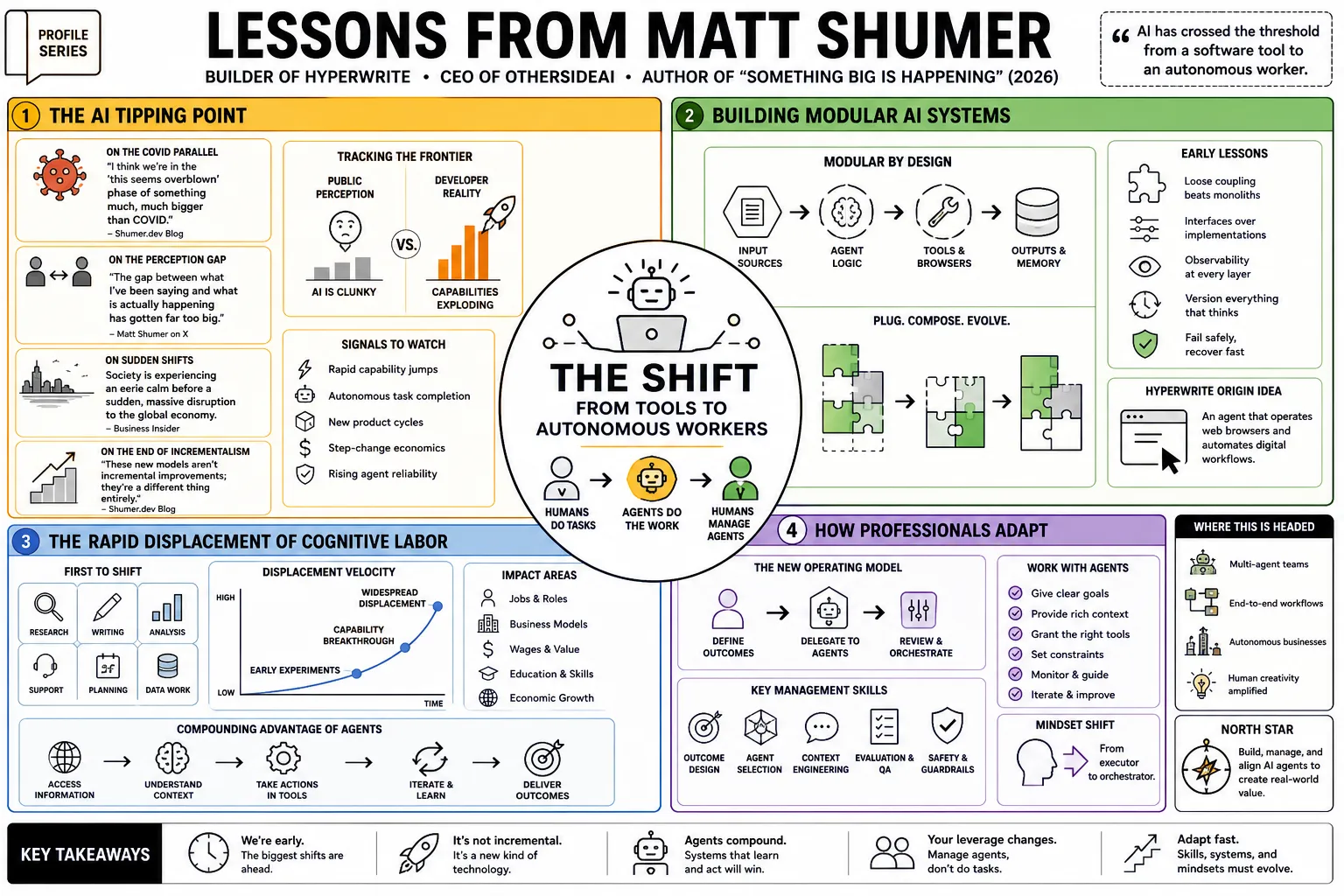
Part 1: The AI Tipping Point
- On the COVID parallel: "I think we're in the 'this seems overblown' phase of something much, much bigger than COVID." — Source: Shumer.dev Blog
- On the perception gap: "The gap between what I’ve been saying and what is actually happening has gotten far too big." — Source: Matt Shumer on X
- On sudden shifts: Society is experiencing an eerie calm before a sudden, massive disruption to the global economy. — Source: Business Insider
- On the end of incrementalism: "These new models aren’t incremental improvements; they’re a different thing entirely." — Source: Shumer.dev Blog
- On tracking the frontier: The general public still views AI as clunky, while developers see systems capable of executing complete jobs. — Source: Inc. Magazine
- On inevitable disruption: The capability to automate complex tasks exists today, even if it has not yet fully proliferated through the broader economy. — Source: YouTube Interview
- On stating facts over predictions: "We’re not making predictions. We’re telling you what already occurred in our own jobs, and warning you that you’re next." — Source: Matt Shumer on X
- On warning others: The speed of internal AI benchmarks compelled him to publicly warn those he cares about regarding their career stability. — Source: Shumer.dev Blog
- On the lack of preparation: The next two to five years will be profoundly disorienting for knowledge workers who are not prepared. — Source: The Indian Express
- On shifting focus: The conversation must move from questioning if AI can do the work to figuring out what humans should do when it can. — Source: Matt Shumer on X
Part 2: The Evolution of Agents
- On autonomous action: The goal of an AI agent is not just to generate text, but to operate digital environments like a human would. — Source: VentureBeat
- On HyperWrite's mission: The tool evolved from a simple email drafter into a personal assistant that navigates the web autonomously. — Source: HyperWrite AI
- On operating browsers: Agents must be able to visually parse websites, click buttons, and enter text to be genuinely useful. — Source: VentureBeat
- On modular agent architecture: Building agent harnesses modularly ensures they can be swapped out as base models become natively stronger. — Source: GitHub Repository
- On brittle systems: Early agent frameworks are inherently brittle; the engineering challenge is building robust recovery mechanisms. — Source: Matt Shumer on X
- On task-specific agents: The future points toward a paradigm of 'one agent per task,' spinning up infinite virtual workers as needed. — Source: Matt Shumer on X
- On marginal costs: The near-zero marginal cost of spawning a new agent fundamentally changes how software companies scale. — Source: Business Today
- On complex delegation: Users should be able to hand off multi-step research or booking tasks to an assistant and forget about them. — Source: HyperWrite AI
- On outcome-based building: Engineering is shifting from writing step-by-step instructions to defining the desired outcome for an agent to achieve. — Source: Shumer.dev Blog
Part 3: The Future of Cognitive Work
- On cognitive substitution: "AI isn’t replacing one specific skill. It’s a general substitute for cognitive work." — Source: Shumer.dev Blog
- On replacing the act of thinking: AI models are now replicating the core organizational and analytical thinking required in white-collar jobs. — Source: Hindustan Times
- On job displacement: Up to 50% of entry-level white-collar roles in finance, law, and accounting could be eliminated within a few years. — Source: Business Insider
- On the 2 vs. 20 shift: A small team of two experts managing a fleet of agents can now match the output of a traditional twenty-person department. — Source: Reddit AI Communities
- On the end of skill moats: Relying on a single technical skill is no longer a viable long-term career strategy. — Source: Matt Shumer on X
- On non-linear careers: Professionals must prepare for volatile, non-linear career paths as industries are rapidly reorganized by AI. — Source: The Indian Express
- On financial resilience: In the face of industry-wide disruption, prioritizing personal financial stability is a necessary defensive move. — Source: Matt Shumer on X
- On dropping ego: Workers must abandon the ego associated with doing the manual work themselves to survive the transition. — Source: Hindustan Times
- On becoming an architect: The most valuable role is becoming an architect of outcomes, directing AI systems to execute the details. — Source: Matt Shumer on X
- On vulnerability: Nothing done exclusively on a computer is safe from automation in the medium term. — Source: Shumer.dev Blog
Part 4: Prompt Engineering & Open Source Tools
- On automating discovery: The `gpt-prompt-engineer` tool was built to remove the manual guesswork from prompt creation. — Source: GitHub Repository
- On ELO ratings: Treating prompts as competitors in an ELO-rated tournament objectively identifies the most effective instructions. — Source: GitHub Repository
- On trial and error: Automated pipelines allow the AI to explore the prompt space faster and more thoroughly than a human can. — Source: Matt Shumer on X
- On prompt experimentation: Prompt engineering should be treated as a rigorous, iterative scientific experiment. — Source: GitHub Repository
- On open source velocity: The open-source AI community consistently catches up to frontier closed models faster than incumbents anticipate. — Source: VentureBeat
- On accessible tools: Releasing experiments directly via Google Colab notebooks democratizes access to complex AI workflows. — Source: GitHub Repository
- On automated fine-tuning: Projects like `gpt-llm-trainer` demonstrate how a single prompt can generate an entire dataset for fine-tuning a custom model. — Source: GitHub Repository
- On reinforcement learning: Tools like AutoRL represent early attempts to apply reinforcement learning frameworks outside of massive corporate labs. — Source: GitHub Repository
- On deep research agents: Combining logic models like Claude with search APIs creates agents capable of synthesizing deep, multi-source research. — Source: GitHub Repository
Part 5: The Reflection 70B Controversy
- On independent validation: Community benchmarks are the only true measure of an open-source model's capabilities. — Source: Medium Data Science Logs
- On the core concept: Reflection-tuning was designed to enable models to output their reasoning, identify errors, and correct them before finalizing an answer. — Source: Air Street Capital Reviews
- On error correction: Teaching an LLM to recognize its own mistakes internally is a necessary leap forward for reliability. — Source: Air Street Capital Reviews
- On evaluation bugs: Flawed evaluation code that incorrectly handles external APIs can drastically inflate benchmark scores like MATH and GSM8K. — Source: VentureBeat
- On rushing releases: Launching without verifying the community's ability to run the exact same weights damages trust. — Source: Medium Data Science Logs
- On persistence: Despite the launch failure, the underlying concept of forcing models to reflect remains a critical area of AI research. — Source: Matt Shumer on X
- On community scrutiny: The open-source ecosystem acts as a ruthless, effective immune system against unverified claims. — Source: Reddit LocalLLaMA
Part 6: Practical Advice for the AI Era
- On career insurance: Deep, practical AI literacy is the only reliable form of career insurance available today. — Source: Reddit AI Communities
- On managing vs. doing: The workers who thrive will be those who transition from executing tasks to managing a fleet of AI agents. — Source: Matt Shumer on X
- On the personal benchmark: "Make what I call a 'personal benchmark': write down the things in your role you don't think AI can do." — Source: Inc. Magazine
- On tracking capabilities: Feed your personal benchmark tasks to the latest models every three months to accurately track your job's vulnerability. — Source: Inc. Magazine
- On early advantages: "The single biggest advantage you can have right now is simply being early." — Source: The Indian Express
- On adoption speed: Understanding and integrating new models faster than your peers is the primary differentiator in the modern workforce. — Source: The Indian Express
- On daily usage: "If you’re not already using AI, you’re way behind." — Source: Inc. Magazine
- On letting go of creation: Professionals must learn to be editors and reviewers rather than the sole creators of their work. — Source: Hindustan Times
- On expanding capacity: The goal is not just to do the same work faster, but to use AI to drastically expand the scope of what one person can build. — Source: Matt Shumer on X
Part 7: Vision for Software Development
- On the end of manual coding: "I am no longer needed for the actual technical work of my job." — Source: Shumer.dev Blog
- On plain English execution: "I describe what I want built, in plain English, and it just... appears." — Source: Shumer.dev Blog
- On trusting the output: "I tell the AI what I want, walk away from my computer for four hours, and come back to find the work done." — Source: The Indian Express
- On exceeding human skill: Modern models can build and test software better and more thoroughly than a human developer working alone. — Source: Shumer.dev Blog
- On vibe coding: Development is shifting from syntax perfection to 'vibe coding,' where the human guides the overarching logic while the AI writes the code. — Source: Matt Shumer on X
- On moving past micro-edits: The workflow has evolved past line-by-line editing into trusting the AI to generate complete, functional applications. — Source: The Indian Express
- On architectural trust: Developers must learn to trust agents to execute complex architectural decisions without human hand-holding. — Source: Matt Shumer on X
- On the changing CEO role: Technical founders are transitioning from lead engineers into product managers directing AI resources. — Source: Hindustan Times
- On iteration speed: The time it takes to move from a conceptual idea to a deployed application has collapsed from months to hours. — Source: Matt Shumer on X
Part 8: Predictions on Models and Scale
- On developing judgment: "The most recent AI models make decisions that feel like judgment." — Source: The Indian Express
- On artificial taste: The latest generation of models demonstrates an intuitive sense of what the right call is, beyond just technical correctness. — Source: The Indian Express
- On surpassing instructions: Models are moving from strictly following human instructions to actively suggesting the best path forward. — Source: Shumer.dev Blog
- On rapid iteration: Successive model releases are compressing the timeline of technological advancement faster than society can process. — Source: Shumer.dev Blog
- On PhD-level intelligence: AI systems will soon reliably surpass the intelligence and analytical capabilities of human domain experts. — Source: Business Insider
- On the jagged frontier: AI will disrupt different industries at different times, creating a jagged frontier of automation across the economy. — Source: Matt Shumer on X
- On recursive improvement: The feedback loop of using AI to write code to train better AI has already been initiated. — Source: 36Kr Technology News
- On self-building systems: Future generations of foundational models will be largely architected and optimized by previous models. — Source: 36Kr Technology News
- On the intelligence explosion: The exponential curve of AI capability suggests a fundamental reorganization of society within the next 12 to 24 months. — Source: Shumer.dev Blog