Max Levchin is a legendary Silicon Valley entrepreneur, engineer, and investor best known as the co-founder of PayPal and the CEO of Affirm. His approach to business is defined by a relentless focus on solving mathematically difficult problems, fostering high-density talent, and building "honest" products that align company profits with consumer success. The following insights capture his philosophies on startups, leadership, and the future of technology.
Part 1: Entrepreneurship and The Startup Journey
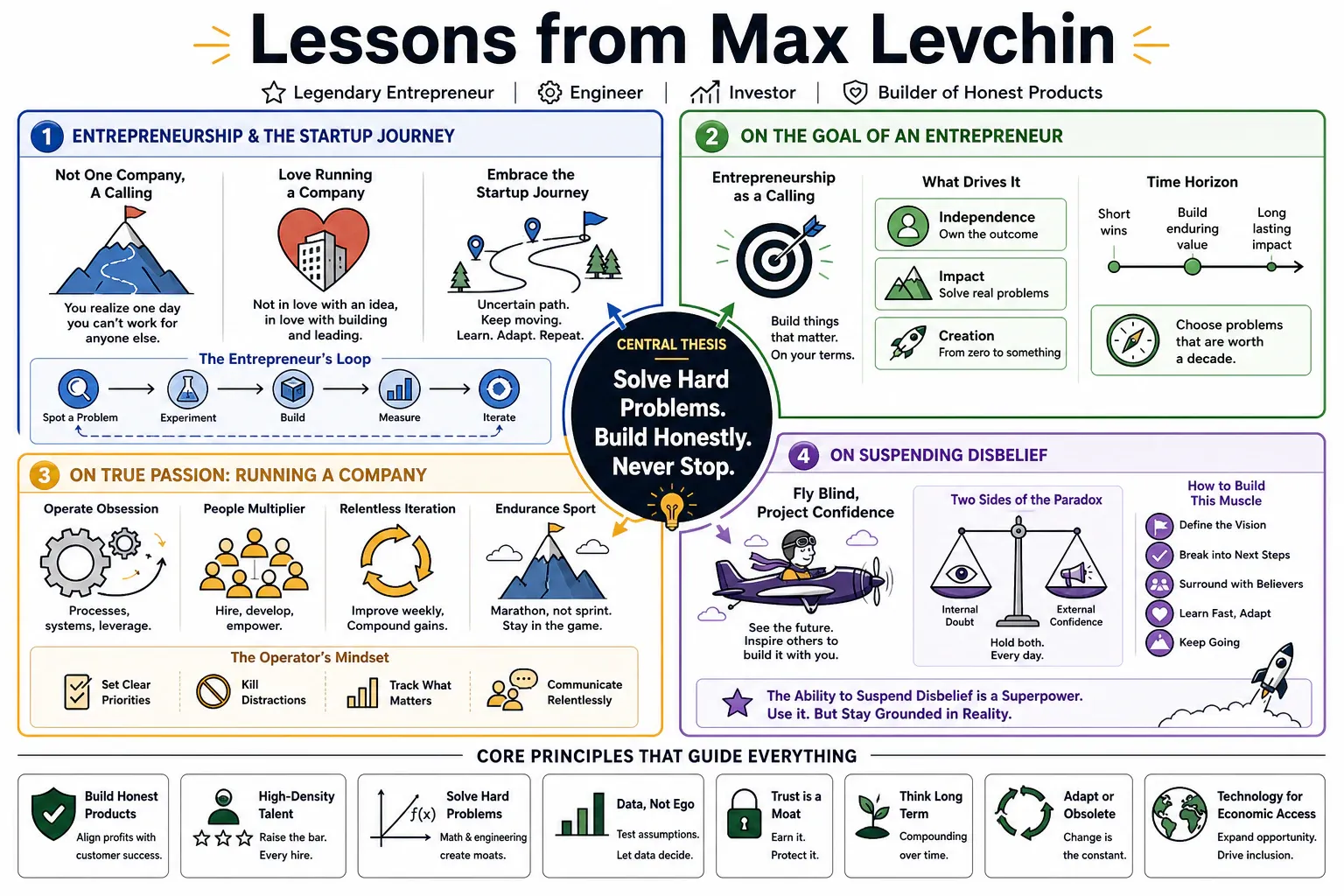
- On the Goal of an Entrepreneur: "I think the hallmark of a really good entrepreneur is that you're not really going to build one specific company... you realize one day that you can't really work for anyone else. You have to start your own thing." — Source: [AZQuotes]
- On the True Passion of Founders: "Being an entrepreneur is not about being in love with an idea, it's about being in love with running a company." — Source: [QuoteFancy]
- On Suspending Disbelief: "Entrepreneurship is this weird process of constantly flying blind... and also of constantly projecting this extreme confidence that everything is going to be just fine... it's the continuous ability to suspend your own disbelief." — Source: [Startup Book]
- On Traits of Founders: "The unifying characteristics are all the same: drive, inability to play well with others, decisiveness, general indifference to reason on occasion." — Source: [Startup Book]
- On Decisiveness: "Whenever there is any doubt, there is no doubt... always be decisive in battle and in business, and at a most basic level, trust your gut." — Source: [Substack]
- On Building Moats: "If it’s not technically or operationally difficult, it won’t have a moat. You must pursue the hard problems to build something defensible." — Source: [The Founder Hour]
- On Recognizing Growth Curves: "Leaders must recognize when a company is hitting the top of an S-curve and proactively find the next phase of expansion before momentum stalls." — Source: [Substack]
- On Timing the Market: "Being 'right' about the future is useless if you are early in the wrong way; you have to find where the market pull actually exists." — Source: [Fintech Takes]
- On The 15 Percent Problem: "You cannot just build for yourself and your friends. To scale, you must embody the mind of your customer and solve for their specific friction points." — Source: [Apple Podcasts]
- On Enduring the Roller Coaster: "The difference between winning and losing is most often not quitting... powering through the lows of the startup roller coaster ultimately just takes grit." — Source: [Meaning Ring]
Part 2: Leadership and Team Building
- On the CEO's Core Jobs: "The core roles of a CEO are setting a three-year strategy, hiring top talent, and ensuring the company never runs out of cash." — Source: [Substack]
- On Early Team Homogeneity: "The notion that diversity in an early team is important or good is completely wrong. Having a highly homogeneous background, education, values, and preferences in the very early team cuts down on time-wasting arguments." — Source: [AZQuotes]
- On Respect Versus Love: "You can have successful teams where people hate but deeply respect each other; the opposite—love but not respect among team members—is a recipe for disaster." — Source: [AZQuotes]
- On Titles and Egos: "We never thought about titles because we were too focused on valuable things to think about who was the VP of marketing and who was the chief marketing officer." — Source: [YouTube]
- On Mission as a Talent Magnet: "A strong moral stance isn't just good ethics, it's a tactic for attracting the best talent who might otherwise find an industry amoral." — Source: [Semafor]
- On Hiring Ambition: "If you want to build an incredible culture, hire people who are itching to found their own startups one day." — Source: [Semafor]
- On Ignoring Distractions: "You’re far better off asking the question, 'Am I still on strategy?' than getting distracted by the noise." — Source: [YouTube]
- On The Crucible of Shared Struggle: "Teams are forged when they are boiled in one crucible together for a long time with very little rest or sleep; that's when you truly learn to call on each other." — Source: [Semafor]
- On Honest Feedback: "You need a culture where teammates can call on each other for help, but also to tell them they’re doing it wrong without hesitation." — Source: [Semafor]
Part 3: The HVF Framework (Hard, Valuable, Fun)
- On Choosing Problems: "I want to solve really difficult problems. It can’t just be difficult; they also have to be value-creating for the world." — Source: [YouTube]
- On Puzzles vs. Problems: "Solving a 'puzzle'—a hard technical challenge—is useless if it doesn't solve a 'problem'—something people will actually pay for." — Source: [The Founder Hour]
- On the Importance of Fun: "There’s a short list of things that I find enjoyable... I don’t want to suffer for things that I don’t care about that much. The journey must be intrinsically rewarding." — Source: [YouTube]
- On Confusing Difficulty with Value: "A classic engineering mistake and one I've made is confusing what is hard and what is valuable." — Source: [AZQuotes]
- On Startup Failure Rates: "You have to enjoy the process, because the reality is startups have an 85% failure rate; if it isn't fun, it isn't worth the risk." — Source: [YouTube]
- On Asking How Things Work: "Don’t just believe that things work, actually find out how they work and ask the question, can they work better?" — Source: [YouTube]
- On First Principles Engineering: "The magic of being a successful entrepreneur is a combination of depth of understanding and curiosity around a process or a system that you can engineer or re-engineer." — Source: [YouTube]
- On Valuing Your Own Time: "We're all put on Earth for a limited amount of time. Am I using it in a way that is great, or good enough, or wasteful?" — Source: [AZQuotes]
- On Filtering Ideas: "If an idea doesn't meet the threshold of being incredibly difficult to copy, highly lucrative for the user, and enjoyable to build, it gets discarded." — Source: [The Founder Hour]
Part 4: Failure and Resilience
- On the Reality of Failure: "Failure sucks. The Silicon Valley mantra that failure is something to be proud of is a hallucination." — Source: [Semafor]
- On the Pain of Leadership: "Leading through tough moments actually involves a lot of pain... realizing that your mistakes will mean having to tell investors they lost their money, and employees they have lost their jobs." — Source: [Semafor]
- On Letting People Down: "Failing people who trust in you hurts a lot more than just failing yourself." — Source: [Global Advisors]
- On the Sequence of Failures: "The very first company I started failed with a great bang. The second one failed a little bit less... Number four almost didn't fail... Number five was PayPal." — Source: [AZQuotes]
- On Moving Past Mistakes: "Ignore your mistakes. The number one thing to worry about is—Am I doing what I'm good at?" — Source: [Global Advisors]
- On Building Resilience: "True resilience is forged not by celebrating failure, but by surviving the pain of it and fiercely refusing to let it happen again." — Source: [Semafor]
- On Projecting Confidence: "Even when you are flying blind, a founder must continually project the confidence that the company will navigate through the abyss." — Source: [Startup Book]
- On Taking Responsibility: "When a company fails, the founders must bear the emotional debt of the people who believed in them; it is a weight that shouldn't be taken lightly." — Source: [Global Advisors]
- On Refining the Model: "Each consecutive failure should teach you exactly what not to do next time; it is a brutal, but effective, optimization algorithm." — Source: [AZQuotes]
Part 5: Honest Finance and Affirm's Philosophy
- On the Mission of Affirm: "Our mission is simple: Deliver honest financial products that improve lives." — Source: [Trium Group]
- On Industry Amorality: "One of the things that struck me about financial services... was just how amoral the entire industry is. It doesn't really want you to fail, but it doesn't mind if you're late on a bill." — Source: [Trium Group]
- On Profiting from Failure: "Fifteen years ago, I sat down with a very prominent banker... who told me, 'Half my profit comes from late fees.' I said, 'Great. Zero of mine will come from there.'" — Source: [Tearsheet]
- On Locked-in Costs: "The most you'll ever pay us... even if you're late, even if you need to change your plans. That doesn't change." — Source: [Tearsheet]
- On Aligning Interests: "If we think you are not going to pay us back on time, we are screwing ourselves by lending you money because we are inherently creating a negative financial outcome for ourselves." — Source: [The Logic]
- On Clarity as a Feature: "Our philosophy is simple... no late fees, clear payment schedules, and no compounding interest." — Source: [Inc]
- On Consumer Empowerment: "What sets the company apart is how its core offering puts control in the hands of consumers." — Source: [Tearsheet]
- On Elevating Basic Tools: "The humble debit card now has a superpower. You can just open your app... and it just happens." — Source: [Tearsheet]
- On Being a Moral Capitalist: "We want to be a highly profitable enterprise, but without leaving our employees embarrassed to admit at cocktail parties what they do." — Source: [Semafor]
- On the Gospel of Transparency: "I spend a lot of time preaching the gospel of honest finance; transparency isn't just good ethics, it's a better business model." — Source: [Trium Group]
Part 6: The PayPal Mafia and Culture
- On the Origins of the Mafia: "Those who replied that they were itching to found their own startups one day got hired. The PayPal mafia was born." — Source: [Semafor]
- On Pivot and Market Pull: "PayPal originally focused on encrypted payments for Palm Pilots. While technically impressive, the market wasn't there. We only found success pivoting to the web where eBay users demanded it." — Source: [Fintech Takes]
- On High-Density Talent: "At PayPal, we created a culture so dense with ambition that it naturally spawned a generation of founders." — Source: [Wikipedia]
- On Intense Work Ethics: "We operated in a state of continuous urgency; the shared trauma of building something impossible forged lifelong bonds." — Source: [Semafor]
- On Hiring the Unhireable: "We hired top-tier talent we had no business hiring by selling them on a mission that felt like a rebellion." — Source: [Substack]
- On the Value of Homogeneity Early On: "At PayPal, our early homogeneity in background and thought processes allowed us to execute at lightning speed without debating the basics." — Source: [AZQuotes]
- On Post-Acquisition Legacy: "The true success of PayPal wasn't just the exit; it was the network of founders who went on to reshape the entire tech industry." — Source: [Medium]
- On Solving Hard Math Problems: "We survived the early days because we were willing to treat fraud and security as hardcore math and engineering problems, not just business hurdles." — Source: [Medium]
- On Trust Among Peers: "The PayPal network relies on absolute trust; we know each other's capabilities and flaws intimately, which makes investing in each other a no-brainer." — Source: [Play For Thoughts]
Part 7: Engineering, Product Design, and Vibe Coding
- On Designing for the User: "You are not designing for yourself, and shouldn't be. Most people using the Web don't understand what makes it work and don't want to. Design for those people." — Source: [AZQuotes]
- On the Future of "Vibe Coding": "With AI, 'vibe coding'—building apps through plain-English prompts—will wipe out scammy software companies because businesses can easily build better internal tools." — Source: [Entrepreneur]
- On AI Raising Baseline Intelligence: "AI will raise the 'Net IQ of the world' by 50 points, increasing the baseline capability of all builders and engineers." — Source: [YouTube]
- On Programming as an Art Form: "Despite the rise of AI, learning to code is essential. Programming is an art form where taste and elegance are required to steer AI toward the right outcomes." — Source: [Entrepreneur]
- On Over-Engineering: "Engineers must resist the urge to build complex systems just to prove they can; simplicity that solves a real user pain point always wins." — Source: [The Founder Hour]
- On Technical Debt: "Treat code quality seriously from day one; technical debt is like financial debt—it compounds until it bankrupts your product velocity." — Source: [YouTube]
- On Product Friction: "The best products don't just add features; they systemically eliminate the friction between a user and their goal." — Source: [Apple Podcasts]
- On Building for Truth: "In fintech, your code must enforce transparency; we insisted on showing the 'Full Truth in Lending' at checkout, even when advised it would hurt conversion." — Source: [Apple Podcasts]
- On the Role of the CTO: "A great technical founder doesn't just manage engineers; they define the architectural philosophy that allows the business to scale exponentially." — Source: [YouTube]
Part 8: Personal Philosophy, Grit, and Motivation
- On the Immigrant Drive: "I was 150 percent invested in this like, 'I'm going to write code.' Literally, if they told me they have better computers in some obviously bad place to go, I go, 'Mm-hmm, let's go there.'" — Source: [Business Insider]
- On the Definition of Grit: "The one trait that is fundamentally differentiating across the DNA of any company is 'grit.' It makes one an entrepreneur even if they don't know it yet." — Source: [CPP Investments]
- On Singular Focus: "When I decide to pursue something, I pursue it to the point of obsession. There is no half-measure in building something great." — Source: [QuoteFancy]
- On Urgency of Time: "We all have a finite amount of time on this planet. The ultimate metric of success is whether you spent it doing something that actually mattered." — Source: [AZQuotes]
- On Staying Curious: "Curiosity isn't a passive trait; it is an active, aggressive pursuit of understanding how systems are broken so you can fix them." — Source: [YouTube]
- On the Value of Hard Work: "There is no substitute for outworking your competitors. In the early days, sheer stamina is your greatest competitive advantage." — Source: [Startup Book]
- On Embracing Discomfort: "If you are perfectly comfortable, you are not learning and you are not growing. You have to seek out the hard puzzles." — Source: [The Founder Hour]
- On the Psychology of Winning: "Winning requires a level of irrational optimism mixed with a paranoid execution strategy; you have to believe you will win while planning for disaster." — Source: [Meaning Ring]
- On Integrity in Business: "Your reputation is the only currency that matters in the long run. Building a moral enterprise pays the highest dividends." — Source: [Semafor]
- On the Ultimate Reward: "The true reward of entrepreneurship is looking back and realizing you built a machine that improved the world, and you did it alongside people you deeply respect." — Source: [AZQuotes]