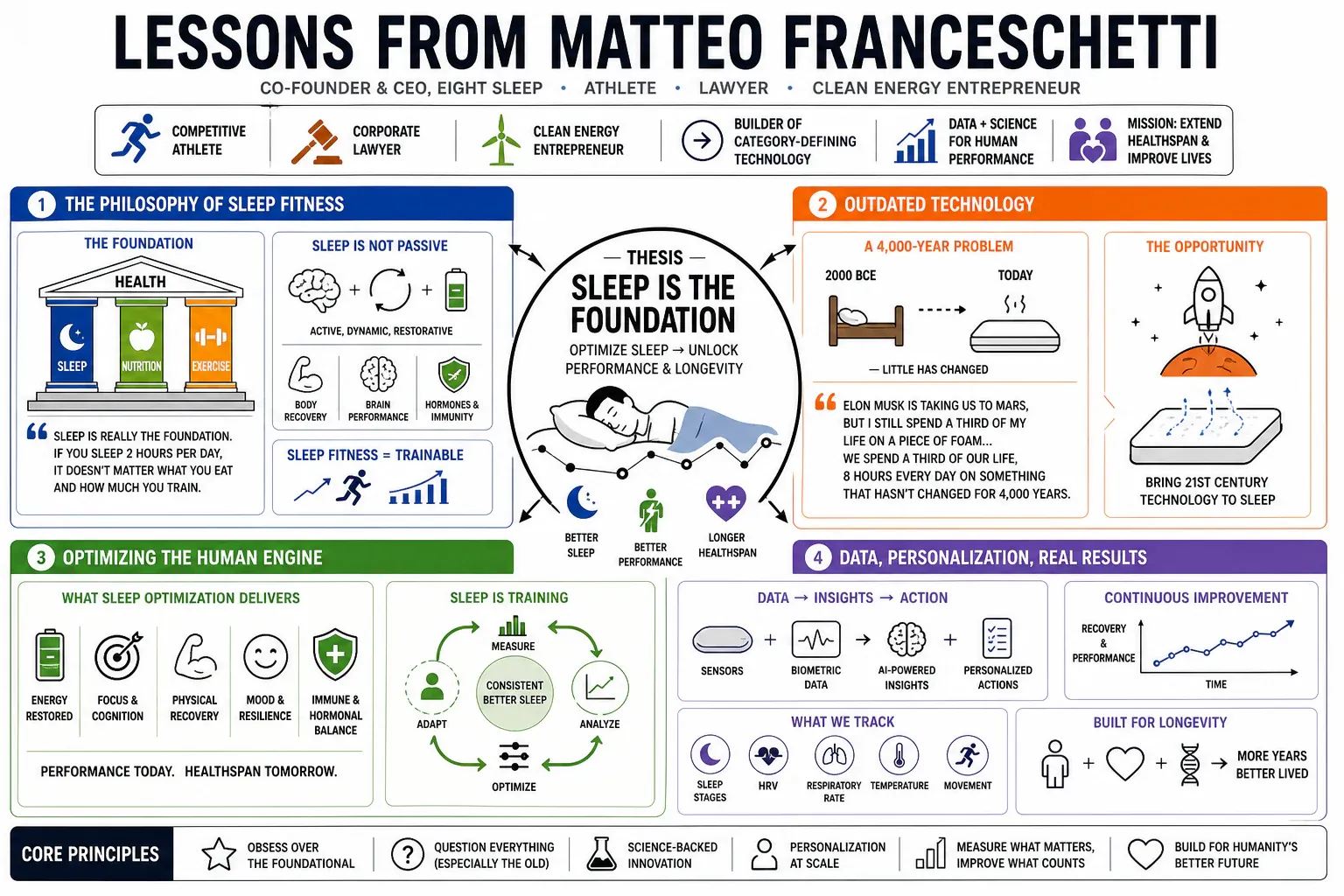
Matteo Franceschetti is the co-founder and CEO of Eight Sleep, a visionary company that has pioneered the "sleep fitness" movement. Drawing from his background as a competitive athlete, corporate lawyer, and clean energy entrepreneur, Franceschetti views sleep not as a passive state, but as the foundational pillar of human performance and longevity. The following compilation distills his core philosophies on building category-defining technology, optimizing the human body, and leveraging data to enhance recovery and extend healthspan.
Part 1: The Philosophy of Sleep Fitness
- On the Foundation of Health: "Health is based on three pillars: sleep, nutrition, and exercise. And actually, sleep is really the foundation. Because if you start sleeping two hours per day, it doesn't matter what you eat and how much you train." — Source: [YouTube]
- On Outdated Technology: "Elon Musk is taking us to Mars, but I still spend a third of my life on a piece of foam... we spend a third of our life, eight hours every single day on something that hasn't changed for 4,000 years." — Source: [BiOptimizers]
- On the Definition of Sleep Fitness: "We believe that helping to optimize your sleep is not just about getting people to sleep comfortably or sleep more; it's about improving sleep quality so that the hours of sleep you get are maximized." — Source: [Athletech News]
- On Sleep Compression: "What if you can sleep only six hours and get more rest than when you were sleeping eight hours? ... Eight hours is what our body needs today because there is no technology enhancing our recovery." — Source: [BiOptimizers]
- On Reframing the Category: By shifting the narrative from selling "mattresses" to offering "Sleep Fitness," companies can transition from competing on foam price to delivering performance and recovery. — Source: [Forbes]
- On Viewing Sleep as a Workout: Sleep should not be viewed as passive downtime, but rather as an active recovery state akin to a physical workout that requires the right equipment. — Source: [Man of Many]
- On the True Cost of Sleep Deprivation: Sleep deprivation is the new smoking; the long-term consequences of poor sleep are severe and chronically under-addressed in modern society. — Source: [Apple Podcasts]
- On Earning Your Rest: You must be active enough during your waking hours to put your body in a state where it has truly "earned" deep, restorative sleep at night. — Source: [The Split]
- On Athletic Parallels: An athletic background teaches you to view sleep not merely as rest, but as a critical fitness variable essential for sustaining high-level competitive performance. — Source: [The Org]
Part 2: Thermoregulation and The Science of Rest
- On the Highest Leverage Variable: "The 80/20 of life improvement is thermoregulation." — Source: [BiOptimizers]
- On Circadian Temperature Needs: The human body's circadian rhythm intrinsically requires a cooling environment to fall asleep quickly and a warming environment to wake up naturally. — Source: [Man of Many]
- On Individualized Algorithms: "Autopilot is a collection of proprietary algorithms... to create an individual blueprint of each sleeper to create the environment you need for your best sleep." — Source: [Athletech News]
- On Dynamic Adjustments: Static temperature is insufficient; the bed must dynamically adapt to your biometrics—cooling down during deep sleep and adjusting for REM—to maintain optimal recovery. — Source: [YouTube]
- On Eliminating Sleep Disruptors: Temperature is universally the number one disruptor of sleep quality, making its control the ultimate "killer app" for any sleep technology. — Source: [Forbes]
- On Data-Driven Blueprints: By continuously analyzing heart rate, HRV, and respiratory rate, technology can simulate a "digital twin" to predict and enhance your nightly recovery. — Source: [Crunchbase]
- On the Importance of Silence: Beyond temperature, creating a 100% quiet environment with earplugs is non-negotiable for eliminating micro-awakenings. — Source: [Podium Sports Med]
- On Thermal Shock Therapy: "Two hours before bed I do a shower where I keep switching between the max cold and a cold bath that thermal shocks really helps me to relax." — Source: [Podium Sports Med]
- On Pre-Sleep Light Control: Transitioning to orange and red lighting two hours before bed is critical to protect melatonin production from blue light interference. — Source: [YouTube]
Part 3: The Future of Health and Technology
- On the Ultimate Vision: "We want to do two things: we want to compress your sleep, and we want to save your life. What if we could scan your body while you're asleep to detect any illness in your body?" — Source: [Podium Sports Med]
- On the Bed as an MRI: Because a person is lying flat and still for 6-8 hours a night, the bed is uniquely positioned to act as a passive, non-invasive full-body health monitor. — Source: [YouTube]
- On Preventative Health Clinics: The long-term trajectory of sleep technology is to transform the bedroom into a preventative health clinic capable of identifying anomalies years before they become acute. — Source: [YouTube]
- On the Medicalization of Furniture: The strategy is to evolve beyond consumer electronics toward medical-grade, FDA-approved devices that diagnose and treat conditions like sleep apnea. — Source: [Forbes]
- On Deep Tech Innovation: True technological breakthroughs empower individuals by giving them sovereign, data-driven control over their own biological metrics. — Source: [Breaking Precedent]
- On Continuous Biometric Tracking: The future of healthcare relies on high-fidelity, continuous data collection during our most vulnerable and restorative state. — Source: [Crunchbase]
- On Using AI for Diagnostics: Artificial intelligence applied to millions of hours of sleep data can uncover patterns and predict health outcomes that traditional snapshot medicine misses. — Source: [Eight Sleep]
- On the Tesla Comparison: Just as Tesla reimagined the car as a connected computer, sleep technology must reimagine the bed as an intelligent, responsive platform. — Source: [Forbes]
- On Hardware as a Trojan Horse: High-end physical hardware serves as the essential gateway to acquiring the continuous biometric data needed to power life-saving software. — Source: [Forbes]
- On Visualizing the Future: "Live in the end." Founders must write down and visualize what their industry will look like in ten years to avoid getting derailed by short-term obstacles. — Source: [Forbes]
Part 4: Entrepreneurship and Building Eight Sleep
- On the Power of Naivety: Not fully understanding the sheer difficulty of building a hardware company and managing a global supply chain is often a founder's greatest superpower. — Source: [YouTube]
- On Hardware Complexity: "Hardware is hard," and traditional investors are right to be skeptical, but overcoming this requires focusing heavily on the software and data layers. — Source: [YouTube]
- On Taking Ownership: When early manufacturing processes stalled, the only solution was to physically fly to the factory in China and refuse to leave until the issues were resolved. — Source: [YouTube]
- On Proving Demand: When venture capitalists reject your idea, use crowdfunding or pre-sales to generate undeniable proof of consumer demand that forces them to pay attention. — Source: [YouTube]
- On Transitioning Careers: Moving from a corporate lawyer at Magic Circle firms to a cleantech and health-tech founder requires a fundamental shift in risk tolerance and problem-solving. — Source: [Il Sole 24 Ore]
- On Direct-to-Consumer Strategy: Maintaining high margins and a direct relationship with the customer through a DTC model is vital for iterating quickly on complex hardware. — Source: [Simplecast]
- On Subscription Models: Layering recurring software revenue over high-entry-price hardware creates the sustainable unit economics necessary for long-term survival. — Source: [Forbes]
- On the Importance of Unit Economics: Reaching free cash flow positivity is the ultimate metric of sustainability, especially in a capital-intensive hardware business. — Source: [Forbes]
- On Influencer Strategy: Gaining traction with tech elites, Formula 1 drivers, and high-profile investors provides the crucial social proof needed to legitimize a new product category. — Source: [Simplecast]
- On Pitching Visionaries: When pitching to investors like Naval Ravikant, you must frame your product not as an iteration of comfort, but as a deep-tech lever for human optimization. — Source: [YouTube]
Part 5: Leadership and High-Performance Culture
- On Expecting Crises: Operate with the mental model that "Sht is coming." Crises are an inevitable part of the startup journey, not an anomaly. — Source: [YouTube]*
- On the Role of an Executive: A leader's job is not to be loved, but to push their team to achieve significantly more than they ever believed they were capable of. — Source: [YouTube]
- On Hiring for Stamina: In a high-growth environment, you must hire individuals who possess the stamina to endure the inevitable turbulence and recover quickly from setbacks. — Source: [YouTube]
- On Paranoia: A healthy degree of founder paranoia is essential for anticipating market shifts and operational failures before they become fatal. — Source: [YouTube]
- On Interview Frameworks: Using a consistent, specific set of interview questions helps identify candidates whose resilience and ambition align with a high-performance culture. — Source: [YouTube]
- On Startup Resilience: Much like elite sports, building a company involves "injuries" and setbacks; your ultimate success is determined solely by your speed of recovery. — Source: [YouTube]
- On Category Design: You cannot win by building a marginally better version of an existing product; you must create an entirely new category that dictates how consumers value your innovation. — Source: [Forbes]
- On Focus During the Messy Middle: A documented, long-term vision acts as an anchor, keeping the team aligned when day-to-day operations become chaotic and overwhelming. — Source: [Forbes]
- On Work-Life Integration: Building a company alongside your spouse requires a seamless integration of personal ambition and professional execution, built on deep mutual trust. — Source: [YouTube]
Part 6: Personal Biohacking and Routines
- On Environmental Control: "Everything is optimized in my bedroom... my bed is thermoregulated, which is key so the temperature at which I sleep is designed around my circadian cycle." — Source: [Podium Sports Med]
- On Strict Consistency: Maintaining a rigid schedule—going to bed between 9:30 PM and 10:00 PM and waking up by 6:30 AM—is foundational to establishing a robust circadian rhythm. — Source: [YouTube]
- On the Impact of Alcohol: Alcohol drastically impairs deep sleep and lowers Heart Rate Variability (HRV), making its avoidance a key tactic for serious biohackers. — Source: [YouTube]
- On Caffeine Timing: Late-night caffeine consumption fundamentally disrupts the sleep architecture, underscoring the need for strict cut-off times. — Source: [YouTube]
- On Breathwork: Incorporating box breathing (4s inhale, 4s hold, 4s exhale, 4s hold) is an effective physiological tool to down-regulate the nervous system prior to sleep. — Source: [Man of Many]
- On Deep Sleep Targets: To feel truly "superhuman," one should target a minimum of 15% to 18% deep sleep each night, tracking it rigorously as a primary KPI. — Source: [YouTube]
- On Supplementation Limits: Exogenous melatonin should be used highly sparingly—no more than once a week—to prevent the body from down-regulating its own natural production. — Source: [YouTube]
- On Nightly Magnesium: Taking magnesium supplements before bed is a highly effective, low-risk method for promoting physical relaxation and muscle recovery. — Source: [YouTube]
- On Environmental Temperature: Keeping the ambient room temperature cool, around 71°F, creates the ideal baseline environment for a thermoregulated bed to operate effectively. — Source: [YouTube]
- On Vitamin D and Restlessness: Optimizing Vitamin D levels through sunlight exposure can have a profound impact on reducing conditions like restless leg syndrome and boosting daytime energy. — Source: [YouTube]
Part 7: Lessons Learned and Startup Realities
- On Acknowledging Mistakes: Refusing to accept the "furniture" label was a pivotal realization that saved the company from drowning in a low-margin, highly commoditized industry. — Source: [Forbes]
- On Overcoming the YC Rejection: Being rejected by top accelerators like Y Combinator should not be seen as a failure, but as a catalyst to find alternative validation through direct consumer demand. — Source: [YouTube]
- On the Necessity of Agility: When building deep tech, the initial plan will almost certainly fail; the capacity to pivot rapidly based on physical and data constraints is everything. — Source: [YouTube]
- On the Reality of Hardware: Software bugs can be patched overnight, but hardware mistakes are brutally expensive and time-consuming, requiring a fundamentally different risk management approach. — Source: [YouTube]
- On Trusting the Data Over Instinct: In a health-tech startup, subjective feelings about a product's efficacy must always take a back seat to objective biometric data and clinical validation. — Source: [Crunchbase]
- On the Value of Outsider Perspective: Transitioning from renewable energy to sleep tech proved that lacking deeply entrenched industry biases can allow a founder to completely reimagine a stagnant product. — Source: [MMA Global]
- On the Limits of Delegation: In the earliest stages, founders cannot outsource their most critical bottlenecks; if supply chain is broken, the CEO must become the supply chain manager. — Source: [YouTube]
- On Building a Cult Brand: Cultivating intense loyalty among a niche group of high-net-worth early adopters provides the foundation necessary to eventually scale to the mass market. — Source: [Simplecast]
- On Managing Investor Expectations: Pitching a revolutionary vision requires balancing the futuristic promise of "health scanning" with the grounded reality of current revenue and unit economics. — Source: [YouTube]
Part 8: Longevity, Fasting, and Physical Training
- On the OMAD Protocol: Adopting a One Meal A Day (OMAD) fasting protocol during the workweek optimizes energy levels, mental clarity, and metabolic efficiency. — Source: [YouTube]
- On Fasting Flexibility: While strict during the week, relaxing the fasting window to a 16:8 protocol on weekends provides the necessary balance to make the lifestyle sustainable. — Source: [YouTube]
- On Morning Efficiency: Beginning the day by immediately reviewing key metrics and executing a workout creates a momentum loop that drives executive performance. — Source: [My Morning Routine]
- On the Ketogenic Diet: Experimenting with dietary frameworks like Keto can provide profound insights into how macronutrient distribution impacts cognitive stamina and sleep architecture. — Source: [The Split]
- On HRV as a Guide: Heart Rate Variability (HRV) should be the primary metric that dictates the intensity of your daily physical training, ensuring you never overtrain an under-recovered body. — Source: [YouTube]
- On the Tools of Training: Integrating connected fitness ecosystems, such as the Peloton bike and Tonal, allows for highly customized, data-rich physical conditioning. — Source: [YouTube]
- On Post-Workout Recovery: Proactive physical recovery using tools like massage guns and compression boots is just as critical to the training cycle as the workout itself. — Source: [YouTube]
- On Lifelong Optimization: Longevity is not simply about extending lifespan; it is about utilizing continuous biometric feedback to maximize the quality and performance of your waking hours. — Source: [Finding Mastery]
- On Merging Tech and Biology: True biohacking occurs when external hardware seamlessly interfaces with our internal biology to passively elevate our baseline state of health. — Source: [Man of Many]