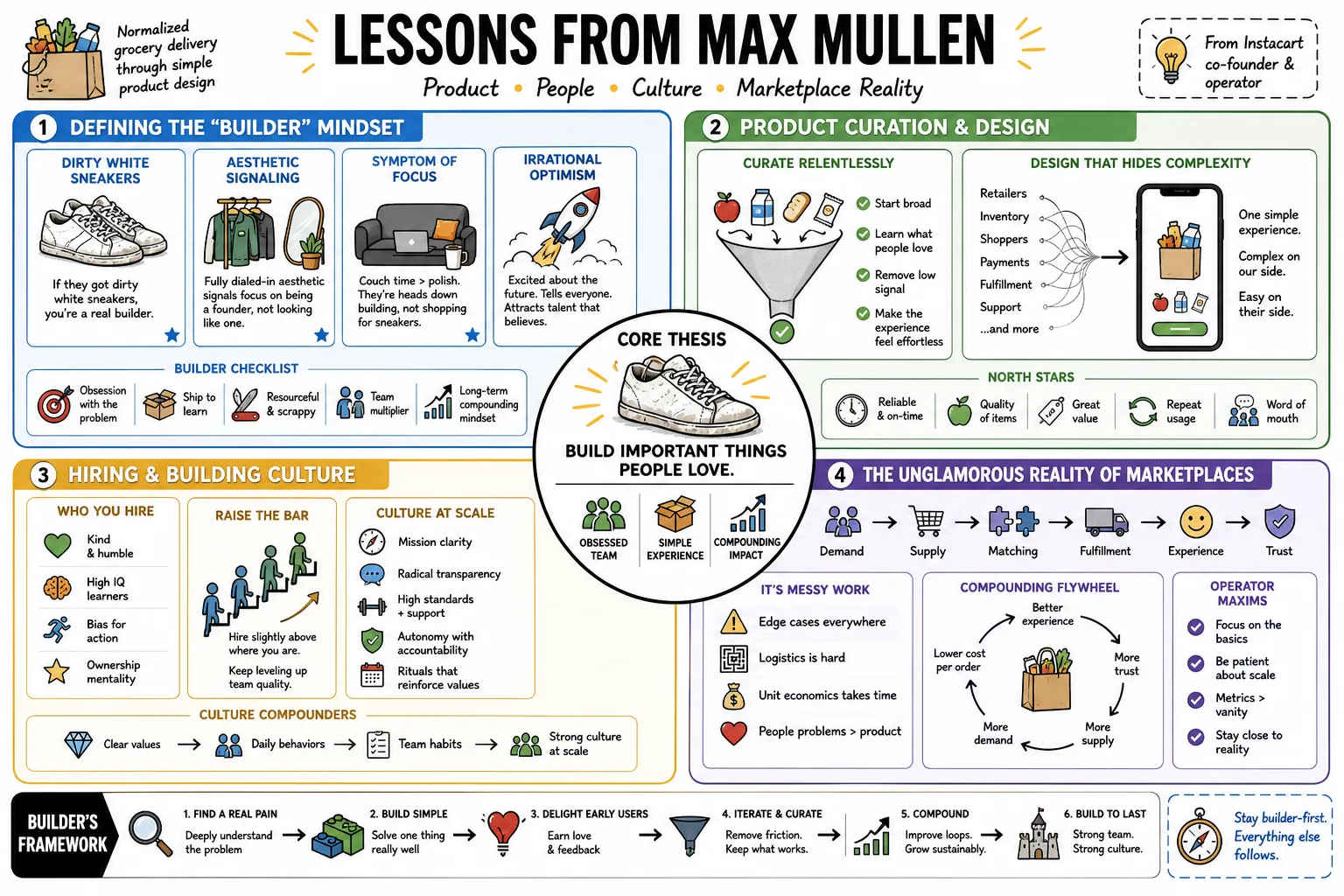
Lessons from Max Mullen
Max Mullen co-founded Instacart, an app that normalized grocery delivery by wrapping complex retail logistics in simple product design. He is also known for his "dirty white sneaker" theory of early investing and a structured approach to scaling company culture. This piece collects his frameworks on product curation, hiring, and the unglamorous reality of building a marketplace.
Part 1: Defining the "Builder" Mindset
- On dirty white sneakers: "If you’re looking at a founder and they got dirty white sneakers, you’re a real builder." — Source: [Dirty White Sneakers - Max Mullen]
- On aesthetic signaling: "A founder who has their aesthetic fully dialed in is usually signaling that they’re a great founder rather than spending every ounce of their energy becoming one." — Source: [Business Insider - Dirty sneaker founder test]
- On the symptom of focus: "The founders who care the least about looking polished are usually the ones crashing on the office couch and working on their startups nonstop. They don’t have time to buy nice sneakers." — Source: [Dirty White Sneakers - Max Mullen]
- On irrational optimism: "I’m always looking for people that are what I call irrationally optimistic... so excited about their version of the future that they’ll tell everyone about it and attract talent that way." — Source: [Uncapped #47 - Max Mullen from Instacart]
- On developing a thick skin: "You have to tolerate looking wrong and sort of looking silly for many years. You have to have that thick skin, you have to really have conviction and tenacity, and not pivot." — Source: [Instacart co-founder Max Mullen gets tactical on crafting company values]
- On pain tolerance: "Founder pain tolerance is the biggest moat." — Source: [Uncapped #47 - Max Mullen from Instacart]
- On evaluating risks early: "If we had sat down and listed everything that could go wrong in the beginning, we probably would have been too intimidated to start." — Source: [Building a Customer-focused Grocery Delivery Startup with Max Mullen]
- On enduring hard periods: "A founder's ability to endure brutally hard periods and maintain tenacity is one of the most significant competitive advantages a startup can have." — Source: [Business Insider - Dirty sneaker founder test]
- On hard mode execution: "Great founders are willing to operate in hard mode, executing unconventional and grueling strategies if it means moving the company forward." — Source: [Uncapped #47 - Max Mullen from Instacart]
- On authenticity over life hacks: "You cannot buy a pair of gross Allbirds on Thursday and become a better CEO by Friday. Dirty white sneakers or not, when you meet someone really locked in, you can tell." — Source: [Dirty White Sneakers - Max Mullen]
Part 2: Architecting Company Culture
- On defining culture: "Culture is the consciousness of the company, which includes its beliefs, its behaviors, and the norms of the company. So culture is who you are and it’s based in your values and your purpose." — Source: [Instacart co-founder Max Mullen gets tactical on crafting company values]
- On the 20-person rule: "One of the mistakes that I’ve observed is people have waited too long to think about culture or values. Twenty employees is the ideal time to codify company values." — Source: [Instacart co-founder Max Mullen gets tactical on crafting company values]
- On founding values: "When defining values, the founding team should focus on what has actually made the company successful so far and their own personal values." — Source: [Instacart co-founder Max Mullen gets tactical on crafting company values]
- On avoiding corporate speak: "Values should be clear and actionable. Avoid over-polishing the language; authenticity matters more than corporate-speak." — Source: [Instacart co-founder Max Mullen gets tactical on crafting company values]
- On the acronym trap: "Values don't need to form a clever acronym; they simply need to be authentic and useful for guiding decisions." — Source: [Instacart co-founder Max Mullen gets tactical on crafting company values]
- On culture as a product: "Culture is a foundational product that founders must design with the same intentionality as their software." — Source: [Instacart co-founder Max Mullen gets tactical on crafting company values]
- On the sentence test: "Core values really need to be clear and actionable. If it doesn’t feel like something that you could use in a sentence and a phrase in a meeting, it isn't working." — Source: [Instacart co-founder Max Mullen gets tactical on crafting company values]
- On creating shared history: "Launching values should be a special moment that galvanizes the team and creates a shared history or folklore." — Source: [Instacart co-founder Max Mullen gets tactical on crafting company values]
- On early delays: "Putting off discussions about values because you are busy building is a mistake that makes scaling exponentially more difficult." — Source: [Instacart co-founder Max Mullen gets tactical on crafting company values]
- On periodic refreshes: "As a company scales from 20 to 200 people, the founding team must re-evaluate if the original values still accurately reflect the culture." — Source: [Instacart co-founder Max Mullen gets tactical on crafting company values]
Part 3: Operationalizing Core Values
- On performance evaluations: "Values must live beyond a poster on the wall. They must be used in hiring and directly tied into performance evaluations." — Source: [Instacart co-founder Max Mullen gets tactical on crafting company values]
- On the culture framework: "To assess culture systematically, look at Values, Rituals, Ambitions, Rewards, and Environment." — Source: [Instacart co-founder Max Mullen gets tactical on crafting company values]
- On rewarding behavior: "Rewards are a critical piece of culture; a company must promote and celebrate the people who actually live the values." — Source: [Instacart co-founder Max Mullen gets tactical on crafting company values]
- On environment as a signal: "The physical or digital workspace must signal the right behaviors, as environment is a silent enforcer of culture." — Source: [Instacart co-founder Max Mullen gets tactical on crafting company values]
- On radical transparency: "A core value like 'Put it all on the table' centers on radical transparency and building trust, even when it is uncomfortable to share." — Source: [Instacart co-founder Max Mullen gets tactical on crafting company values]
- On solving for the customer: "Instead of simple customer focus, employees must balance the needs of all stakeholders to ultimately improve the end-consumer experience." — Source: [Instacart co-founder Max Mullen gets tactical on crafting company values]
- On sense of urgency: "'Every Minute Counts' speaks to time as a precious resource, encouraging the team to ship faster or reduce scope to deliver value quickly." — Source: [Instacart co-founder Max Mullen gets tactical on crafting company values]
- On extreme ownership: "'This is Your Baby' emphasizes extreme personal ownership, ensuring every item picked and packed is treated with care." — Source: [Instacart co-founder Max Mullen gets tactical on crafting company values]
- On mutual success: "'Grow the Pie' means creating value for all constituents in the marketplace, including retailers, customers, and shoppers, so that everyone succeeds together." — Source: [Instacart co-founder Max Mullen gets tactical on crafting company values]
- On long-term horizons: "'Go Far Together' focuses the company on teamwork and the long-term sustainability of the entire ecosystem." — Source: [Instacart co-founder Max Mullen gets tactical on crafting company values]
Part 4: Early-Stage Hustle and Execution
- On finding fit: "Product-market fit is a spectrum. It rarely happens in one isolated moment." — Source: [Uncapped #47 - Max Mullen from Instacart]
- On true market fit: "For Instacart, real product-market fit only happened when we moved from a single-store catalog to a multi-retailer platform that families could actually rely on." — Source: [Uncapped #47 - Max Mullen from Instacart]
- On doing unscalable things: "You have to roll up your sleeves and go do these crazy things to get the first customers to be really excited... just to get one city going." — Source: [Uncapped #47 - Max Mullen from Instacart]
- On handling your own support: "In the early days, the three founders handled all customer support calls on our personal cell phones. It is the only way to truly understand customer pain points." — Source: [Building a Customer-focused Grocery Delivery Startup with Max Mullen]
- On manual data entry: "When a retailer declined to provide a digital catalog, we manually bought one of every item in the store to create our own database." — Source: [Uncapped #47 - Max Mullen from Instacart]
- On hacking attention: "Apoorva Mehta used the early Instacart app to deliver a six-pack of beer to a Y Combinator partner to secure an interview after missing the deadline." — Source: [Uncapped #47 - Max Mullen from Instacart]
- On the necessity of speed: "There are no great consumer companies where there is not an extremely high sense of urgency in the DNA of the company." — Source: [Uncapped #47 - Max Mullen from Instacart]
- On moving fast: "Once an opportunity becomes obvious, you must execute and build faster than anyone else in the market." — Source: [Uncapped #47 - Max Mullen from Instacart]
- On contrarian ideas: "The best ideas look wrong at first. Investors had to get over the fact that other people had tried this in some form and failed in the past." — Source: [Building a Customer-focused Grocery Delivery Startup with Max Mullen]
- On leveraging luck: "Great companies figure out how to take those moments of luck and flip them and leverage them to build an advantage." — Source: [Uncapped #47 - Max Mullen from Instacart]
Part 5: Customer Empathy and Proximity
- On feeling the pain: "The pain of anything wrong with the service should be personally felt by the product leader, as this directly informs the roadmap." — Source: [Building a Customer-focused Grocery Delivery Startup with Max Mullen]
- On the perfect order: "Product success is defined by the 'perfect order': one that is on time, contains exactly what was ordered, is charged correctly, and receives a 5-star rating." — Source: [Building a Customer-focused Grocery Delivery Startup with Max Mullen]
- On metric alignment: "Measuring the perfect order aligns product, design, and operations toward a single, uncompromising customer-centric goal." — Source: [Building a Customer-focused Grocery Delivery Startup with Max Mullen]
- On feature creep: "Avoid adding features that merely satisfy power users but overwhelm new ones and clutter the experience." — Source: [How to Run a Product Brainstorm - Max Mullen]
- On the incremental user: "Keep the product experience simple and intuitive, ensuring that every incremental new user can understand the value proposition immediately." — Source: [How to Run a Product Brainstorm - Max Mullen]
- On breaking the bubble: "A great product mind understands that they are not the only user and actively seeks out how different demographics utilize the service." — Source: [Instacart co-founder Max Mullen gets tactical on crafting company values]
- On staying in touch: "Not being in touch with the customers is a guaranteed way of failing. From the start, we wanted to be very in touch." — Source: [Building a Customer-focused Grocery Delivery Startup with Max Mullen]
- On prioritizing the customer: "Customer obsession requires prioritizing the end user's success above personal ego and internal company politics." — Source: [Instacart co-founder Max Mullen gets tactical on crafting company values]
- On solving real problems: "The roadmap should never be based on theoretical feature lists, but on the exact pain points heard over support calls." — Source: [Building a Customer-focused Grocery Delivery Startup with Max Mullen]
Part 6: Running Effective Product Brainstorms
- On shifting roles: "As a company grows, a product leader's role must shift from personal idea generation to idea curation for the team." — Source: [How to Run a Product Brainstorm - Max Mullen]
- On setting context: "Start brainstorms with a clear understanding of goals, specifically the metrics you want to move or customer problems you want to solve." — Source: [How to Run a Product Brainstorm - Max Mullen]
- On pre-work: "Ask the team to develop ideas against specific themes before they even walk into the meeting." — Source: [How to Run a Product Brainstorm - Max Mullen]
- On visual inspiration: "Print out screenshots of current user flows and competitor products to spark ideas and ensure everyone is grounded in the current reality." — Source: [How to Run a Product Brainstorm - Max Mullen]
- On assessment frameworks: "Before brainstorming, the team should agree on how ideas will be judged, whether prioritizing biggest impact, smallest scope, or a specific combination." — Source: [How to Run a Product Brainstorm - Max Mullen]
- On psychological safety: "Brainstorms are not the time for critique, scope worries, or technical requirements. The atmosphere must remain entirely judgment-free." — Source: [How to Run a Product Brainstorm - Max Mullen]
- On half-baked ideas: "Set the expectation that there are no bad ideas. Odd or incomplete thoughts often lead to creative breakthroughs when others iterate on them." — Source: [How to Run a Product Brainstorm - Max Mullen]
- On alternating structures: "Alternate between individual silent writing and group discussion to ensure all voices are heard, especially in larger groups." — Source: [How to Run a Product Brainstorm - Max Mullen]
- On managing expectations: "Organize similar ideas into themes and be completely transparent with the team about what will and won't actually make the roadmap." — Source: [How to Run a Product Brainstorm - Max Mullen]
Part 7: Hiring and Interviewing Standards
- On evaluating product empathy: "One of my favorite ways to evaluate candidates is to ask how they use the product and what they would change." — Source: [Instacart co-founder Max Mullen gets tactical on crafting company values]
- On top-tier answers: "A top-tier candidate avoids simply giving their own opinion. They say: 'I use it this way, but I talked to my roommate who uses it for X, and my parents who use it for Y.'" — Source: [Instacart co-founder Max Mullen gets tactical on crafting company values]
- On testing for empathy: "Asking how someone would change the product is a direct test of their empathy and their ability to think beyond their own bubble." — Source: [Instacart co-founder Max Mullen gets tactical on crafting company values]
- On screening for builders: "I look for real builders who are scrappy, high-energy, and possess an irrational optimism about what they are creating." — Source: [Uncapped #47 - Max Mullen from Instacart]
- On assessing values: "Interviews should include specific questions designed solely to see if a candidate naturally lives the company's core values." — Source: [Instacart co-founder Max Mullen gets tactical on crafting company values]
- On attracting talent: "Founders must be so excited about their version of the future that they can easily attract top talent, even when the market is skeptical." — Source: [Uncapped #47 - Max Mullen from Instacart]
- On avoiding optics-driven candidates: "Avoid early hires who are more focused on the optics and status of working at a startup than the grueling reality of building one." — Source: [Business Insider - Dirty sneaker founder test]
- On identifying urgency: "Candidates for consumer startups must be able to demonstrate a high sense of personal urgency and a bias for speed." — Source: [Uncapped #47 - Max Mullen from Instacart]
- On radical honesty in hiring: "Seek out individuals who default to radical transparency and are comfortable putting all the facts on the table during tough conversations." — Source: [Instacart co-founder Max Mullen gets tactical on crafting company values]
Part 8: Angel Investing and Assessing Founders
- On becoming anti-fragile: "You’ve got to become anti-fragile. Things happen and we don’t get worse. We don’t stay the same and just repair, we get stronger." — Source: [Uncapped #47 - Max Mullen from Instacart]
- On evaluating acquisitions: "A successful acquisition requires three things to line up at the buying company: a strategic need, financial resources, and a senior internal champion." — Source: [Uncapped #47 - Max Mullen from Instacart]
- On the best path to an exit: "The highest-leverage move for a founder who wants to sell is simply building strong product-market fit. Acquirers materialize when a company is growing fast." — Source: [Uncapped #47 - Max Mullen from Instacart]
- On partnerships leading to buyouts: "Many successful acquisitions start as partnerships. Proving value as a partner is a smooth way to naturally lead into an acquisition." — Source: [Uncapped #47 - Max Mullen from Instacart]
- On spotting dedication: "I invested in Gumloop after noticing the co-founder's sneakers were so dirty and falling apart that I eventually felt compelled to buy him a new pair." — Source: [Business Insider - Dirty sneaker founder test]
- On the value of foundations: "Having a great foundation of your company and having exceptional investors is going to be something that follows you for the rest of your company. Founders underappreciate the signal." — Source: [How to Choose Investors - Max Mullen]
- On the AI wave: "The next wave of startups will be built around professionals orchestrating fleets of agents, bringing a massive productivity leap to fields like medicine and law." — Source: [Super Agents - Max Mullen]
- On true conviction: "Founders must maintain their conviction and refuse to pivot just because the market takes years to catch up to their thesis." — Source: [Uncapped #47 - Max Mullen from Instacart]