Max Spero is the co-founder and CEO of Pangram Labs, where he builds systems that distinguish human writing from AI-generated and AI-assisted text. Before Pangram, he deployed machine-learning products at Google, Two Sigma, Yelp, and Nuro, where he led active-learning work for autonomous vehicles. His central concern is larger than catching synthetic prose: once generating content becomes nearly free, readers, educators, platforms, and businesses need new ways to judge authorship, effort, and trust. These lessons cover how he thinks about detection, model development, online incentives, education, policy, and building a company around digital authenticity.
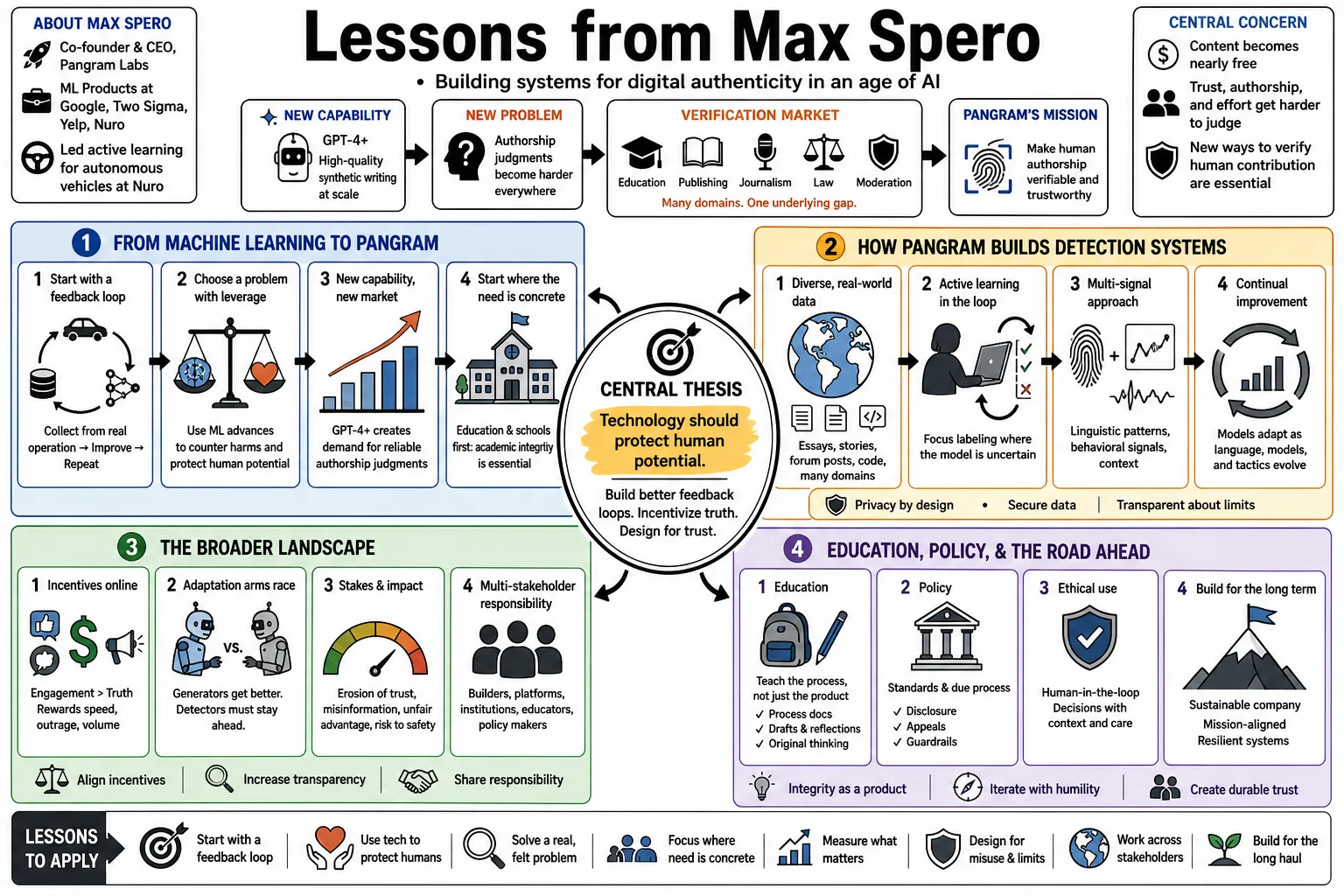
Part 1: From Machine Learning to Pangram
- Start with a feedback loop, not a static model: Spero and co-founder Bradley Emi carried forward a lesson from Stanford robotics: collect data from real operation, use it to improve the system, and repeat. Pangram applies that loop to a detection problem whose inputs keep changing. Reference: Pulse 2.0 interview
- Choose a problem where technical leverage protects human potential: After working on production AI systems, the founders looked for a use of machine learning that could counter the harms created by increasingly capable generative models. Detection offered a way to apply the same technical advances toward transparency. Reference: Pulse 2.0 interview
- A new capability creates a new verification market: GPT-4 made high-quality synthetic writing broadly accessible, but it also made reliable authorship judgments harder across education, publishing, journalism, law, and moderation. Pangram was formed around that gap. Reference: Pulse 2.0 interview
- Begin where the harm and the need are both concrete: Pangram initially concentrated on teachers and schools because academic integrity made the consequences of undisclosed AI writing immediate and understandable. The same detector could later serve broader trust-and-safety uses. Reference: Pulse 2.0 interview
- Production experience matters in adversarial machine learning: Spero's work at Google, Two Sigma, Yelp, and Nuro exposed him to models that must perform against messy real-world inputs. That background shaped Pangram's emphasis on continuous data collection, evaluation, and deployment rather than a one-time research result. Reference: Max Spero author profile
Part 2: Learn to See the Structure of AI Writing
- Do not reduce detection to a blacklist of words: Terms such as “delve” can be useful tells, but reliable judgment also considers structure, style, repetition, and the relationship between ideas. Any single phrase can be prompted away. Reference: How to detect AI writing
- Topic is usually a weak signal: A human can prompt a model toward any narrow subject, so the chosen topic says little about who wrote the text. Default structure and stylistic tendencies are more revealing. Reference: How to detect AI writing
- Models reveal themselves through defaults: When instructions are underspecified, language models tend to fall back on familiar document shapes, transitions, and rhetorical rhythms. Those defaults become useful signals precisely because many users do not spend time prompting around them. Reference: How to detect AI writing
- Build intuition by generating comparison sets: To understand AI writing in a specific domain, generate many examples of that document type across several models and compare them with human work. Repeated exposure makes shared patterns visible. Reference: How to detect AI writing
- Use adversarial games to discover durable signals: Pangram's early “human baseline” exercises mixed human and AI documents, asked people to classify them, and then made the next round harder. The process revealed which cues survived stronger prompting. Reference: How to detect AI writing
Part 3: Build Detection as a Living System
- Train on breadth, because writing is not a silo: A detector trained only on student essays may perform poorly on reviews, journalism, or forum answers. Pangram deliberately trains and evaluates across many domains so that the model learns more general signals of authorship. Reference: Pulse 2.0 interview
- Scale can turn an unusable error rate into a product: Spero describes a progression from roughly one false positive in 100 examples to one in 1,000 and then one in 10,000 as the model and data grew. The lesson is to keep scaling when reliability improves nonlinearly. Reference: Pulse 2.0 interview
- False positives deserve disproportionate attention: A mistaken accusation can harm a student, writer, or employee, so aggregate accuracy is not enough. A detector must be evaluated on the specific rate at which human work is mislabeled. Reference: Introducing Pangram 3.0
- Model the full spectrum of authorship: Modern writing is often neither fully human nor fully synthetic. Pangram 3.0 distinguishes fully human, lightly assisted, moderately assisted, and fully AI-generated text to reflect real co-authoring behavior. Reference: Introducing Pangram 3.0
- Define assistance by how much it changes the work: Grammar fixes and translations preserve underlying ideas, while restructuring, tone changes, added details, and substantial rewrites transfer more authorship to the model. Categories should track the depth of intervention, not merely whether a tool was opened. Reference: Introducing Pangram 3.0
Part 4: Understand the Economics of AI Slop
- Cheap generation changes the supply curve of content: Once articles can be produced for pennies, businesses optimized for search traffic can publish far more than human writers could. The result is not simply more content, but a flood of material whose marginal cost and editorial investment approach zero. Reference: Bloomberg Odd Lots interview
- Measure the problem by platform and format: Pangram's scan data found that the prevalence of AI writing varies sharply by site, length, and content type. A single internet-wide percentage hides where the strongest incentives and harms actually sit. Reference: AI Content Is Everywhere on Social Media
- Long-form content is especially exposed: Across Pangram's million-post social dataset, one in four items longer than 250 words was flagged as fully AI-generated. Longer formats offer more economic incentive for automation and more room for models to substitute for human effort. Reference: AI Content Is Everywhere on Social Media
- Professional identity does not prevent synthetic self-presentation: LinkedIn produced nearly two-thirds of the AI content flagged in Pangram's social sample, despite tying posts to real names and careers. People will automate their public voice even where authenticity should matter most. Reference: AI Content Is Everywhere on Social Media
- Moderation based on volume misses influential synthetic posts: Reddit replies in Pangram's sample were overwhelmingly human, but top-level posts were much more likely to be AI-written. Rate limits can catch mass reply spam while missing fewer, higher-impact posts designed to shape discussion. Reference: AI Content Is Everywhere on Social Media
Part 5: Protect Trust Where Decisions Are Made
- The harm is not limited to false facts: Even accurate synthetic writing can mislead readers about who invested the thought, experience, or effort behind it. Authorship transparency matters independently of factual accuracy. Reference: Bloomberg Odd Lots interview
- Trust declines when people cannot identify the authoring process: In a Pangram-commissioned YouGov survey, 69% of online users said they trusted AI-generated content less than human-generated content. Uncertainty about provenance can therefore reduce engagement even with legitimate information. Reference: Pangram AI sentiment survey
- Detection should return agency to the reader: Three-quarters of respondents in the same survey expressed interest in a tool that alerts them to AI-generated content. The product opportunity is not to ban AI writing, but to let people decide how to allocate attention and trust. Reference: Pangram AI sentiment survey
- Existing trust badges can be gamed: Pangram found that 93% of AI-generated reviews in its Amazon sample carried a “Verified Purchase” badge. Transaction verification does not prove that the accompanying opinion reflects a person's own experience or words. Reference: AI-generated Amazon reviews study
- Synthetic reviews skew the market, not just the prose: In Pangram's sample, 74% of AI-written reviews awarded five stars, compared with 59% of human reviews. Automating praise can directly distort rankings and purchase decisions. Reference: AI-generated Amazon reviews study
Part 6: Use Detection Carefully in Education and Policy
- Treat a detector as evidence, not a verdict: Because false accusations carry real costs, detection should open a conversation and prompt review rather than automatically punish a student. The surrounding process matters as much as the score. Reference: Pulse 2.0 interview
- Preserve the cognitive work of writing: The educational concern is not merely rule-breaking. When a student delegates the formation and organization of ideas, they may lose the practice needed to understand the material and develop their own ability. Reference: Useful AI policies for educators
- Distinguish assistance from substitution: A grammar correction and a fully generated essay should not trigger the same response. More granular authorship categories allow schools to align policy with the actual degree of AI involvement. Reference: Introducing Pangram 3.0
- Watermarks cannot be the only defense: Spero argues that watermarking can create false confidence because open-weight models, local fine-tuning, and post-generation edits can bypass it. Detection must work even when the generator does not cooperate. Reference: Statement on the AI Safety Executive Order
- Regulation should preserve open-source checks and balances: Pangram supports AI-safety rules while arguing that policy should not eliminate the transparency and independent scrutiny enabled by open models. Safety and open research should be designed together. Reference: Statement on the AI Safety Executive Order
Part 7: Build a Research-First Company
- Let independent researchers test the product: Pangram provides access to academics both to verify its claims and to use the detector in studies. External scrutiny is a stronger trust mechanism than asking the market to accept internal benchmarks. Reference: Pulse 2.0 interview
- Publish methods and limitations, not only headline accuracy: Detection claims are meaningful only when people can examine datasets, domains, false-positive rates, and failure modes. Spero advocates common benchmarks so buyers can compare systems honestly. Reference: Statement on the AI Safety Executive Order
- Use customers to widen the research surface: Working with educators, journalists, security teams, and content moderators exposes the model to different kinds of writing and adversarial behavior. Product adoption can improve the evidence base when feedback is systematically captured. Reference: Pulse 2.0 interview
- Relentless iteration can become the differentiation: Pangram's model changes as generators change, and the company keeps adding more detailed output for customers. In a moving technical category, standing still is equivalent to falling behind. Reference: Pulse 2.0 interview
- Authenticity is a cross-industry market: Education was the entry point, but the same authorship problem appears in journalism, marketplaces, expert networks, law, marketing, and fraud prevention. A narrow wedge can lead to a broad trust layer. Reference: Pulse 2.0 interview
Part 8: Design for a More Legible Internet
- Transparency is more durable than prohibition: Generative tools will remain widely available, so the practical goal is to make their involvement visible. Better provenance lets communities set their own norms instead of relying on a universal ban. Reference: Bloomberg Odd Lots interview
- The internet needs authorship infrastructure: As synthetic text expands, platforms need systems that surface whether a piece is human, assisted, or generated. Content labels can become as fundamental as spam filtering or identity verification. Reference: Introducing Pangram 3.0
- Do not assume users can reliably spot synthetic media themselves: Thirty-five percent of respondents in Pangram's survey said they could not definitively distinguish human from AI content. Individual intuition helps, but it cannot carry the whole verification burden. Reference: Pangram AI sentiment survey
- Track where AI changes behavior, not only how much exists: The important questions include whether people stop reading, distrust legitimate work, change purchases, or withdraw from public conversation. Prevalence metrics become useful when connected to decisions and incentives. Reference: Pangram AI sentiment survey
- Protect the value of information itself: Spero's broadest thesis is that authorship transparency will become part of how people defend themselves against manipulation, fraud, propaganda, and low-effort noise. Detection is ultimately infrastructure for deciding what deserves belief and attention. Reference: Pulse 2.0 interview
Part 9: Engineer Reliability Into Detection
- Create matched training pairs, not generic synthetic corpora: Pangram's “synthetic mirror” method pairs each human document with an AI document on the same topic and of similar length. Matching the underlying task forces the classifier to learn authorship signals instead of superficial differences in subject matter. Reference: Pangram technical report
- More data stops helping when the examples stay easy: Pangram's early model saturated even as ordinary examples were added. Progress resumed only when the team found the human documents the classifier struggled with and built harder synthetic counterparts. Reference: Pangram technical report
- Turn model errors into the next training curriculum: Hard-negative mining uses the current classifier to scan large human datasets, identify its most confusing mistakes, add those cases to training, and repeat. The failure distribution becomes a roadmap for improvement. Reference: Pangram technical report
- Make evaluation harder before the real world does: Easy benchmarks can reach near-perfect scores while masking practical weaknesses. Spero's approach is to keep raising the difficulty of adversarial evaluation sets so apparent performance does not outrun actual robustness. Reference: Pangram technical report
- Slice performance by both writing domain and source model: A single accuracy number can hide failure on emails, scientific papers, advanced models, or unfamiliar prose. Reliable evaluation tests across document categories and generator families to show where the detector truly generalizes. Reference: Pangram technical report
- Design for unseen models, then keep the refresh loop fast: A useful detector should generalize to new model releases without immediate retraining, while retaining a pipeline that can generate fresh data within hours when a genuinely new behavior appears. Robustness and adaptation are complementary. Reference: Pangram technical report
- Audit bias with the populations most likely to be harmed: Earlier detectors disproportionately mislabeled non-native English writing. Pangram evaluates separately on ESL benchmarks because overall accuracy can conceal systematic false accusations against a specific group. Reference: Pangram technical report
- Put safety filters where content reaches users: A generator cannot reliably know whether one request is legitimate or part of a thousand-post spam campaign. Detection at the application layer lets platforms evaluate behavior, context, and aggregate abuse where the consequences appear. Reference: Pangram technical report
- Investigate a flag with process evidence: When student work is flagged, teachers should ask about the writing process and review revision history, drafts, and the student's ability to explain the work. A classification should trigger evidence gathering, not automatic discipline. Reference: What happens when an AI detector makes a mistake?
- Give the benefit of the doubt when evidence remains ambiguous: Even a low false-positive rate does not make a single result infallible. If a student denies AI use and the surrounding evidence is inconclusive, avoiding an unjust punishment matters more than forcing certainty. Reference: What happens when an AI detector makes a mistake?
- Low-quality AI answers suppress higher-value human contributions: On a knowledge platform, an adequate synthetic answer can discourage someone with real experience from responding and can divert scarce attention from authentic creators. Moderation protects the incentive to contribute, not just the quality of individual posts. Reference: Quora case study
- Measure deployment by the human system it improves: Pangram reported that Quora identified more than one million AI-generated posts by September 2024. The meaningful outcome is a trust-and-safety team that can enforce policy at scale while preserving the platform's distinct value as a source of human knowledge. Reference: Quora case study