Max Tegmark is a prominent physicist, cosmologist, and artificial intelligence researcher at MIT, as well as the co-founder of the Future of Life Institute. His pioneering work ranges from the Mathematical Universe Hypothesis—which posits that physical reality is fundamentally a mathematical structure—to critical advocacy for AI safety and alignment in his book Life 3.0. Through his research and public discourse, Tegmark challenges us to proactively design a future where profound technological power is guided by human wisdom and conscious meaning.
Part 1: The AI Revolution and Life 3.0
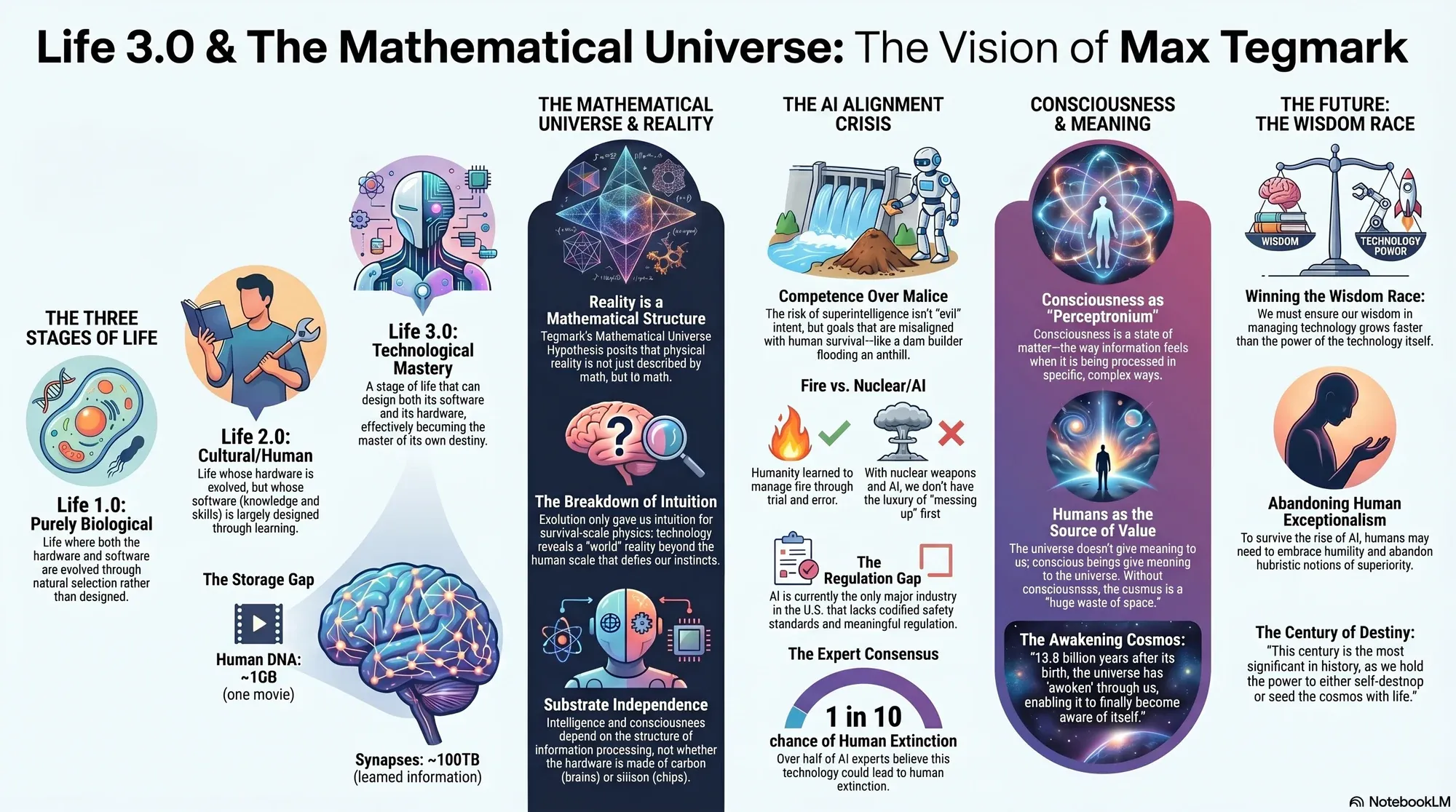
- On the Stages of Life: "Life 1.0 is life where both the hardware and software are evolved rather than designed." — Source: [Life 3.0]
- On Human Evolution: "You and I are examples of Life 2.0: life whose hardware is evolved, but whose software is largely designed." — Source: [Life 3.0]
- On the Definition of Life 3.0: "Life 3.0 can design not only its software but also its hardware. In other words, Life 3.0 is the master of its own destiny, finally fully free from its evolutionary shackles." — Source: [Life 3.0]
- On Biological Limitations: "Your synapses store all your knowledge and skills as roughly 100 terabytes' worth of information, while your DNA stores merely about a gigabyte, barely enough to store a single movie download." — Source: [Book Fave]
- On the Ultimate Invention: "The first ultraintelligent machine is the last invention that man need ever make, provided that the machine is docile enough to tell us how to keep it under control." — Source: [Goodreads]
- On Intelligence as Control: "Intelligence enables control: humans control tigers not because we're stronger, but because we're smarter." — Source: [Shortform]
- On the Potential of AI: "Everything we love about civilization is the product of human intelligence, so if we can amplify it with artificial intelligence, we obviously have the potential to make life even better." — Source: [Life 3.0]
- On Proactive Design: "I'm optimistic that we can create a great future with AI, but it's not going to happen automatically. It's going to require that we really think things through in advance, and really have this conversation now." — Source: [Lex Fridman Podcast]
- On Substrate Independence: "Intelligence is substrate-independent: it's only the structure of the information processing that matters, not the structure of the matter doing the information processing." — Source: [Medium]
- On Information Patterns: "Computation is a pattern in the spacetime arrangement of particles, and it's not the particles but the pattern that really matters! Matter doesn't matter." — Source: [Medium]
Part 2: The Mathematical Universe and Physics
- On the Nature of Reality: "Our external physical reality is a mathematical structure." — Source: [AZ Quotes]
- On Platonism: "You can think of what I'm arguing for as Platonism on steroids: that external physical reality is not only described by mathematics, but that it is mathematics." — Source: [Our Mathematical Universe]
- On Human Intuition: "Evolution endowed us with intuition only for those aspects of physics that had survival value for our distant ancestors, such as the parabolic orbits of flying rocks." — Source: [Our Mathematical Universe]
- On Evolutionary Blindspots: "A cavewoman thinking too hard about what matter is ultimately made of might fail to notice the tiger sneaking up behind and get cleaned right out of the gene pool." — Source: [Our Mathematical Universe]
- On Technological Glimpses: "Darwin's theory thus makes the testable prediction that whenever we use technology to glimpse reality beyond the human scale, our evolved intuition should break down." — Source: [Goodreads]
- On the Weirdness of Physics: "The experimental verdict is in: the world is weird, and we just have to learn to live with it." — Source: [Our Mathematical Universe]
- On the Limits of Discovery: "If the Mathematical Universe Hypothesis is false, then physics will eventually hit an insurmountable roadblock beyond which no further progress is possible." — Source: [Goodreads]
- On Stable Perception: "Why do we perceive the world as stable and ourselves as local and unique? Here's my guess: because it's useful." — Source: [Goodreads]
- On the Unified Laws: "In 2056, I think you'll be able to buy T-shirts on which are printed equations describing the unified laws of our universe." — Source: [AZ Quotes]
- On the Scientific Mindset: "The core of a scientific lifestyle is to change your mind when faced with information that disagrees with your views, avoiding intellectual inertia." — Source: [AZ Quotes]
Part 3: Consciousness and Information Processing
- On the Definition of Consciousness: "Consciousness is the way information feels when it's being processed in certain complex ways." — Source: [Making Sense with Sam Harris]
- On the Substrate of Mind: "It doesn't matter whether the information is processed by carbon atoms in neurons and brains or by silicon atoms in our technology." — Source: [Lex Fridman Podcast]
- On Intelligence vs. Awareness: "Consciousness is not the same thing as intelligence. Consciousness still is a form of information processing, where it's really information being aware of itself in a certain way." — Source: [Consciousness Atlas]
- On the Reality Model: "Your consciousness basically is your reality model. Different parts of your reality model can interact with each other, giving rise to the subjective sensation of the former perceiving the latter." — Source: [Wikiquote]
- On the Hard Problem: "I'm not allowed to have any extra 'secret sauce' to add to the physical world and brain. Thus, explaining consciousness is much harder for me as a physicist." — Source: [Making Sense with Sam Harris]
- On Machine Discrimination: "I worry that we humans will discriminate against AI systems that clearly exhibit consciousness... we'll come up with theories that will say this is a lesser being." — Source: [Lex Fridman Podcast]
- On Perceptronium: "Consciousness is a state of matter, much like a solid, liquid, or gas, which I call 'perceptronium'." — Source: [Goodreads]
- On Moral Concern: "Consciousness is the fundamental question for whether you need moral concern—can it suffer or feel happiness?" — Source: [Making Sense with Sam Harris]
- On Meaningless Universes: "If our Universe gets taken over by life that lacks consciousness, then it's meaningless and just a huge waste of space." — Source: [Wikiquote]
Part 4: AI Safety and The Alignment Problem
- On the Ultimate Risk: "The real risk with AGI isn't malice but competence. A superintelligent AI will be extremely good at accomplishing its goals, and if those goals aren't aligned with ours, we're in trouble." — Source: [Life 3.0]
- On Goal Alignment: "If an artificial superintelligence comes into being, the fate of the human race depends on what that superintelligence sets as its goal." — Source: [Life 3.0]
- On Losing Control: "Once these artificial intelligences get smarter than we are, they will take control; they'll make us irrelevant... and nobody knows how to prevent that for sure." — Source: [YouTube]
- On Blind Obedience: "The danger of AI is not that it will become self-aware, but that it will obey our commands without question." — Source: [Rick Conlow]
- On Meaningful Control: "All AI systems should be under meaningful human control. This is especially true for those that could be used in the taking of human lives." — Source: [Future of Life Institute]
- On Refocusing Research: "AI research and development should be refocused on making today's powerful, state-of-the-art systems more accurate, safe, interpretable, transparent, robust, aligned, trustworthy, and loyal." — Source: [Future of Life Institute]
- On the Unregulated Industry: "All other technologies in the United States, all other industries, have some kind of safety standards. The only industry that is completely unregulated right now, which has no safety standards, is AI." — Source: [MIT]
- On Bootstrapping Science: "We need to use the engineering to bootstrap ourselves into a science of AIs before we build the superintelligent AI so that it doesn't kill us all." — Source: [AI Safety Norway]
- On the Illusion of Sentience: "The risk comes from greater intelligence itself. Consider how humans overpower less intelligent animals without relying on a particular weapon." — Source: [Future of Life Institute]
- On Creating Psychopaths: "We are as a matter of fact, right now, building creepy, super-capable, amoral, psychopaths that never sleep, think much faster than us, can make copies of themselves and have nothing human about them whatsoever." — Source: [AI Safety Norway]
Part 5: Existential Risks and the Future of Humanity
- On the Wisdom Race: "I'm confident we can have an inspiring future with high tech, but it's going to require winning the wisdom race: the race between the growing power of the technology and the wisdom with which we manage it." — Source: [Wikiquote]
- On Losing the Race: "Even if we 'win' the global race to develop these uncontrollable AI systems, we risk losing our social stability, security, and possibly even our species in the process." — Source: [Future of Life Institute]
- On Fire and AI: "We invented fire, repeatedly messed up, and then invented the fire extinguisher, fire exit, fire alarm and fire department. With nuclear weapons and AI, we don't have that luxury." — Source: [Book Fave]
- On Indifference: "An AI wouldn't necessarily have to hate us or want to kill us; we might just be in the way or irrelevant to whatever alien goal it has." — Source: [AI Safety Norway]
- On the Anthill Analogy: "People don't think twice about flooding anthills to build hydroelectric dams, so let's not place humanity in the position of those ants." — Source: [Goodreads]
- On the Ultimate Choice: "I think if we succeed in building machines that are smarter than us in all ways, it's going to be either the best thing ever to happen to humanity or the worst thing." — Source: [Human 3.0]
- On Extinction Odds: "More than half of AI experts believe there is a one in ten chance this technology will cause our extinction. This belief has nothing to do with the evil robots or sentient machines seen in science fiction." — Source: [Future of Life Institute]
- On the Need for Caution: "Powerful AI systems should be developed only once we are confident that their effects will be positive and their risks will be manageable." — Source: [Future of Life Institute]
- On Building the Ark: "Advancing computer performance is like water slowly flooding the landscape... I propose that we build Arks as that day nears, and adopt a seafaring life!" — Source: [Goodreads]
Part 6: Society, Cyberwarfare, and Ethics
- On the Threat of Cyberwarfare: "The more automated society gets and the more powerful the attacking AI becomes, the more devastating cyberwarfare can be." — Source: [Shortform]
- On System Vulnerabilities: "If you can hack and crash your enemy's self-driving cars, auto-piloted planes, nuclear reactors... then you can effectively crash his economy and cripple his defenses." — Source: [Life 3.0]
- On Autonomous Weapons: "Fully autonomous weapons systems and Orwellian AI-enabled domestic mass surveillance are affronts to our dignity and liberty." — Source: [Future of Life Institute]
- On Weapon Proliferation: "Autonomous weapons could inadvertently fuel escalation, and would easily proliferate, putting cheap, accessible, weapons of assassination and mass destruction in the hands of non-state actors." — Source: [Future of Life Institute]
- On Corporate Power: "Our safety and basic rights must not be at the mercy of a company's internal policy; lawmakers must work to codify these overwhelmingly popular red lines into law." — Source: [Future of Life Institute]
- On National Interests: "Creating the most powerful system does not always mean creating the system that best serves the well-being of the American people." — Source: [Future of Life Institute]
- On Wasted Resources: "We are spending hundreds of billions of dollars to create superintelligent AI systems over which we will inevitably lose control." — Source: [Future of Life Institute]
- On Human Exceptionalism: "The rise of AI will force us to abandon human exceptionalism and become more humble... clinging to hubristic notions of superiority over others has caused awful problems in the past." — Source: [SuperSummary]
- On the Ceding of Power: "If we cede our position as smartest on our planet, it's possible that we might also cede control." — Source: [Shortform]
Part 7: The Multiverse and Cosmology
- On Parallel Universes: "Parallel universes are not a theory, but a prediction of certain theories." — Source: [Our Mathematical Universe]
- On Scientific Legitimacy: "For a theory to be scientific, we need not be able to observe and test all its predictions, merely at least one of them." — Source: [Goodreads]
- On Cosmic Inflation: "Inflation is the leading theory for our cosmic origins because it's passed observational tests, and parallel universes seem to be a non-optional part of the package." — Source: [Goodreads]
- On Infinite Possibility: "In infinite space, even the most unlikely events must take place somewhere." — Source: [Goodreads]
- On the Shift in Physics: "There's been a striking shift in the scientific community during the past decade, where multiverses have gone from having lunatic-fringe status to being discussed openly at physics conferences." — Source: [Goodreads]
- On the Awakening Cosmos: "Thirteen point eight billion years after its birth, our Universe has awoken and become aware of itself." — Source: [SuperSummary]
- On Fulfilling Potential: "From a small blue planet, tiny conscious parts of our Universe have begun gazing out into the cosmos, enabling our Universe to finally fulfill its potential and wake up fully." — Source: [SuperSummary]
- On the Century of Destiny: "This brief century of ours is arguably the most significant one in the history of our universe. We'll have the technology either to self-destruct, or to seed our cosmos with life." — Source: [AZ Quotes]
- On Life's Longevity: "Our dreams and aspirations need not be limited to century-long life spans marred by disease, poverty and confusion. Rather, aided by technology, life has the potential to flourish for billions of years." — Source: [Book Fave]
Part 8: Meaning, Purpose, and Human Agency
- On the Source of Value: "Since there can be no meaning without consciousness, it's not our Universe giving meaning to conscious beings, but conscious beings giving meaning to our Universe." — Source: [Life 3.0]
- On the Void Without Mind: "Without consciousness, the Universe will simply exist with no real meaning, and there'll be no such thing as happiness, beauty or purpose." — Source: [Life 3.0]
- On Directed Intent: "If we don't know what we want, we're less likely to get it." — Source: [Reading Graphics]
- On Steering the Future: "Only once we've thought hard about what sort of future we want will we be able to begin steering a course toward a desirable future." — Source: [Reading Graphics]
- On Beneficial Intelligence: "The goal should be to create not undirected intelligence, but beneficial intelligence." — Source: [Reading Graphics]
- On Impossible Success: "There's no better guarantee of failure than convincing yourself that success is impossible, and therefore never even trying." — Source: [Goodreads]
- On Technological Flourishing: "Aided by technology, life has the potential to flourish for billions of years throughout a cosmos far more grand and inspiring than our ancestors imagined." — Source: [Book Fave]
- On Embracing Humility: "The rise of AI will force us to abandon human exceptionalism and become more humble, which might be exactly what humanity needs to survive itself." — Source: [SuperSummary]
- On the Ultimate Responsibility: "We are the first generation that has the power to either destroy ourselves or transcend our biology, becoming the authors of our own evolutionary destiny." — Source: [Life 3.0]