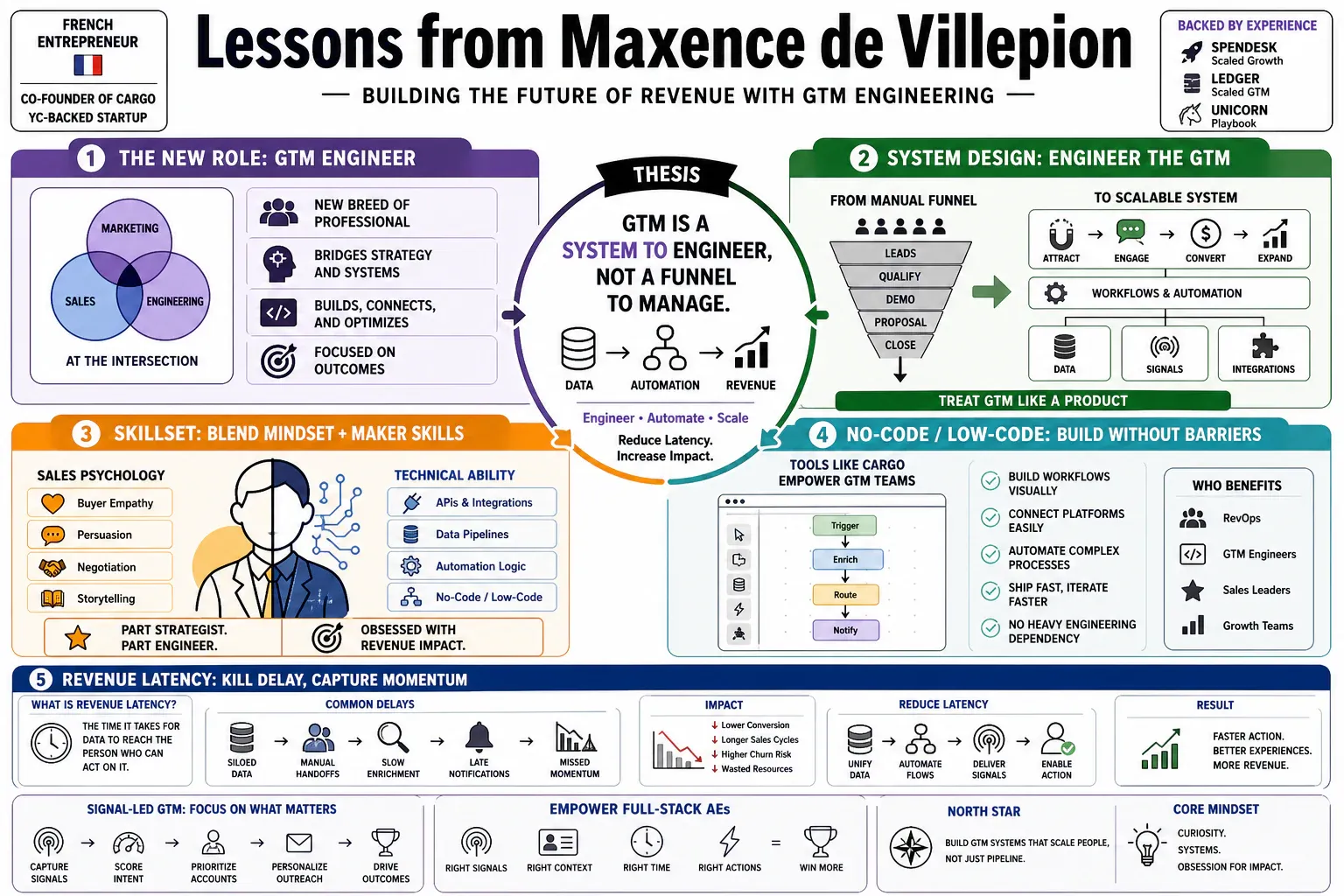
Maxence de Villepion co-founded Cargo, a Y Combinator-backed company that builds tools for go-to-market teams. His work covers sales signals, workflow automation and how to give sales reps useful account context. — Cargo at Y Combinator.
Part 1: The Rise of the GTM Engineer
- Connect growth strategy to the systems that execute it: De Villepion and Matteo Tittarelli describe GTM engineering as combining growth strategy, workflows, data and messaging so teams can put sales and marketing ideas into practice. — The Rise of the GTM Engineer.
- Separate account data, decisions and execution: De Villepion distinguishes collecting account data, adding business context, deciding what should happen next and carrying out the decision. Those jobs can belong to different layers of the sales system. — Revenue Orchestration: The Decision Layer.
- Combine technical skills with an understanding of the buyer: The coauthors describe a role that blends technical execution and data fluency with the ability to shape messages and offers for buyers. — The Rise of the GTM Engineer.
- Give operators a visual environment for automation: Cargo describes its platform as a place for operators to build workflows and use tools and agents to automate go-to-market tasks. — Cargo’s Founding AE Role.
- Measure the delay between information and action: De Villepion uses revenue latency for the time it takes information or a decision to reach the person who can act on it. Delays can build up even when teams already have the relevant data. — Revenue Latency.
- Review changes to sales workflows before deploying them: De Villepion describes keeping workflow definitions in Git so a team can inspect the proposed changes in a pull request before deployment. — How to Version-Control Your GTM Stack.
- Automate account research that reps would otherwise repeat: De Villepion describes an account enrichment step that assembles contact information, technology and recent news before a rep opens the record. — Maxence de Villepion on Signal-Based Selling at Spendesk.
- Move useful warehouse data into tools reps already use: De Villepion gives an example of updating CRM records from warehouse data and sending a rep a Slack alert when an account’s score crosses a threshold. — Reverse ETL for Revenue Operations.
- Give RevOps ownership of decision logic: De Villepion distinguishes syncing records and running predefined workflows from deciding which account to prioritize, who owns it and when a person should intervene. — Revenue Orchestration: The Decision Layer.
Part 2: Unbundling the CRM and The Data Warehouse
- Keep decision rules accessible outside the CRM: De Villepion treats the CRM as one place where a decision is delivered. He recommends keeping the commercial rules that drive those decisions in a shared, auditable form. — Revenue Orchestration: The Decision Layer.
- Sync selected warehouse fields to the CRM: De Villepion shows how to map account scores and tiers from a Snowflake table into Salesforce. A team can run the sync on a schedule or when data changes. — Reverse ETL for Revenue Operations.
- Use product behavior as an input to sales decisions: De Villepion includes product usage, billing and other account activity alongside CRM records in the data that can inform prioritization. — Revenue Orchestration: The Decision Layer.
- Distribute the same account data to several sales tools: De Villepion illustrates how one warehouse table can update account data in the CRM, sales engagement tool and marketing platform. — Reverse ETL for Revenue Operations.
- Automate clear CRM merges and review uncertain ones: De Villepion recommends identifying possible duplicates through stable keys, verifying that the records describe the same entity and sending uncertain matches to a person for review. — CRM Hygiene as Code.
- Put orchestration between account context and outreach: De Villepion describes orchestration as the layer that uses account context to select a sales action and determine where to carry it out. — Revenue Orchestration: The Decision Layer.
Part 3: The Intent Matrix and Signal-Led Sales
- Score readiness using several signals: De Villepion’s framework combines signals over time. A new hire may bring an account into the system, and later hiring, funding or browsing activity can change its priority. — Maxence de Villepion on Signal-Based Selling at Spendesk.
- Use account events to decide when to review a prospect: De Villepion points to funding and leadership changes as events that can bring an account into the pipeline when it already fits the ideal customer profile. — Maxence de Villepion on Signal-Based Selling at Spendesk.
- Read job postings for clues about what a team needs: De Villepion looks at the role, its responsibilities and the tools mentioned in a job posting to identify a timely problem a seller might help with. — Maxence de Villepion’s Guide to Hiring Signals.
- Route accounts according to readiness: In de Villepion’s framework, higher-readiness accounts go to a rep. Medium-readiness accounts can enter an automated prospecting workflow. — Maxence de Villepion on Signal-Based Selling at Spendesk.
- Consider when the actual buyer will be in place: De Villepion suggests that when a vacancy is for the person who would buy your product, it can make sense to wait for the hire and set a follow-up task. — Maxence de Villepion’s Guide to Hiring Signals.
- Treat engagement as one signal among several: De Villepion groups website visits and content activity as signs of possible interest. He separates these from actions that more directly show an account is evaluating a purchase. — Signal-Based Selling.
- Extract relevant responsibilities from job postings: De Villepion says Spendesk used natural language processing to identify job responsibilities connected to problems it could solve, then synced those points into its CRM and outreach drafts. — Maxence de Villepion’s Guide to Hiring Signals.
Part 4: Redefining the SDR and Full-Stack AE Roles
- Combine full-cycle sellers with automated prospecting support: Cargo describes an operating model in which full-cycle account executives use automation for some of the work a separate prospecting team would otherwise handle. — Cargo’s Founding AE Role.
- Give a full-cycle AE ownership of the sales motion: Cargo’s founding AE role combines ownership of the sales cycle with responsibility for refining an automated pipeline and improving how the team sells. — Cargo’s Founding AE Role.
- Use automation to give reps a better starting point: De Villepion describes a workflow in which sellers review a research brief and refine the message before contacting a qualified account. — Full-Cycle AEs vs. SDR Teams.
- Choose the sales model that fits the market: De Villepion argues that full-cycle AEs supported by automation are a fit for complex, signal-rich sales. He identifies high-volume, lower-value sales as a situation where a dedicated SDR team can still work. — Full-Cycle AEs vs. SDR Teams.
- Prepare sales materials before rollout: De Villepion advises training reps on the new signal and giving them dedicated materials so they know how to work the accounts they receive. — Maxence de Villepion’s Guide to Hiring Signals.
Part 5: Automation and Building the Revenue Engine
- Let signals add accounts to the target list: De Villepion describes a system that adds accounts as relevant events occur, provided they fit the target customer profile. Reps can then work from a list that updates as new accounts qualify. — Maxence de Villepion on Signal-Based Selling at Spendesk.
- Set a fallback for each important enrichment field: De Villepion recommends starting with the most accurate provider, moving to another when it cannot supply a reliable value, and tracking where each accepted field came from. — Waterfall Enrichment.
- Test research quality before expanding coverage: De Villepion recommends measuring the accuracy of personalization cues and asking reps whether research briefs are useful before scaling an agent workflow. — Automating Sales Research with AI Agents.
- Send the assigned rep the signal and its context: De Villepion describes a workflow that updates the CRM and alerts the assigned rep with the information needed to act on a qualified account. — Maxence de Villepion on Signal-Based Selling at Spendesk.
- Measure the results of a signal-led sales workflow: De Villepion reports that the meeting-booking rate for a signal-led workflow at Spendesk rose from 5% to 15% across more than 100 reps. The figures are his account of that deployment. — Maxence de Villepion on Signal-Based Selling at Spendesk.
- Recheck account context when it changes: De Villepion describes both scheduled research refreshes for priority accounts and deeper updates triggered by events such as funding announcements. — Automating Sales Research with AI Agents.
- Trace why a workflow took a particular action: De Villepion recommends making routing logic auditable so the team can review rules, test changes and replay failures. — Revenue Orchestration: The Decision Layer.
- Use agents to prepare an account brief: De Villepion illustrates how a funding announcement can trigger research, stakeholder mapping and an outreach draft for the seller to review. — Automating Sales Research with AI Agents.
Part 6: Hyper-Personalization and Strategic Account Tiering
- Set account tiers according to revenue potential: De Villepion recommends matching the sales motion to the value of the account so reps have time for the opportunities that warrant more attention. — Full-Cycle AEs vs. SDR Teams.
- Have reps write to the highest-value accounts: In his account-tiering example, de Villepion proposes that AI prepare research for strategic accounts while a person writes the outreach. — Flowla: Match Engagement to Revenue Potential.
- Use automated sequences for lower-priority accounts: De Villepion describes assigning some lower-tier accounts to automated multi-channel sequences while preserving rep capacity for more involved sales. — Full-Cycle AEs vs. SDR Teams.
- Build outreach around a specific responsibility: De Villepion suggests using a job posting to choose one relevant problem or use case for each message. If the first angle falls flat, a later message can test a different one. — Maxence de Villepion’s Guide to Hiring Signals.
- Engage people who influence the decision: De Villepion recommends identifying stakeholders beyond the person who signs off on a purchase. A job posting can reveal a role that will influence the buyer or use the tool directly. — Maxence de Villepion’s Guide to Hiring Signals.
- Make the follow-up useful to the prospect: De Villepion recalls that Spendesk’s CFO community gave the team a reason to check in about a vacancy. They could also offer to share the job opening with their network. — Maxence de Villepion’s Guide to Hiring Signals.
Part 7: Lessons from Scaling Spendesk and Ledger
- Give a larger sales team a shared place to find account signals: De Villepion recalls that Spendesk put the job title, posting and relevant responsibilities in an Insights object on the CRM account so reps could consult the same material. — Maxence de Villepion’s Guide to Hiring Signals.
- Expand a working pilot in stages: De Villepion recommends starting with a dedicated squad so feedback comes quickly, then expanding account assignment after the team has refined the workflow. — Maxence de Villepion’s Guide to Hiring Signals.
- Track outcomes separately for different account groups: For a hiring-signal campaign, de Villepion recommends distinguishing new accounts, reactivated accounts and accounts already assigned to a rep before estimating conversion and opportunity volume. — Maxence de Villepion’s Guide to Hiring Signals.
Part 8: The Future of AI in Go-To-Market
- Use an agent brief to suggest the next conversation: De Villepion’s research-brief example includes questions for a rep to ask, relevant positioning and a suggested follow-up. — Automating Sales Research with AI Agents.
- Give agents a shared source of business context: De Villepion recommends keeping positioning, qualification logic and sales policy in shared infrastructure so agents can use consistent guidance. — Revenue Orchestration: The Decision Layer.
- Keep research current on priority accounts: De Villepion gives an example of scheduling recurring checks on priority accounts and producing updated briefs or alerts when something important changes. — Automating Sales Research with AI Agents.
- Forecast a range of likely deal outcomes: De Villepion proposes using current activity and historical deals to estimate the likelihood and timing of a close. The guide illustrates how to present a range and flag risk for follow-up. — AI-Driven Pipeline Management and Forecasting.
- Record what the team learns from wins and losses: De Villepion includes patterns from won and lost deals in the shared business context used for sales decisions. — Revenue Orchestration: The Decision Layer.