Melisa Tokmak ran government and enterprise operations at Scale AI before founding Netic, an AI platform for physical service industries. She focuses on fully automating workflows for plumbers, roofers, and mechanics instead of just building basic digital assistants. This collection covers her approach to finding founder-market fit, building technical moats, and selling software to the real economy.
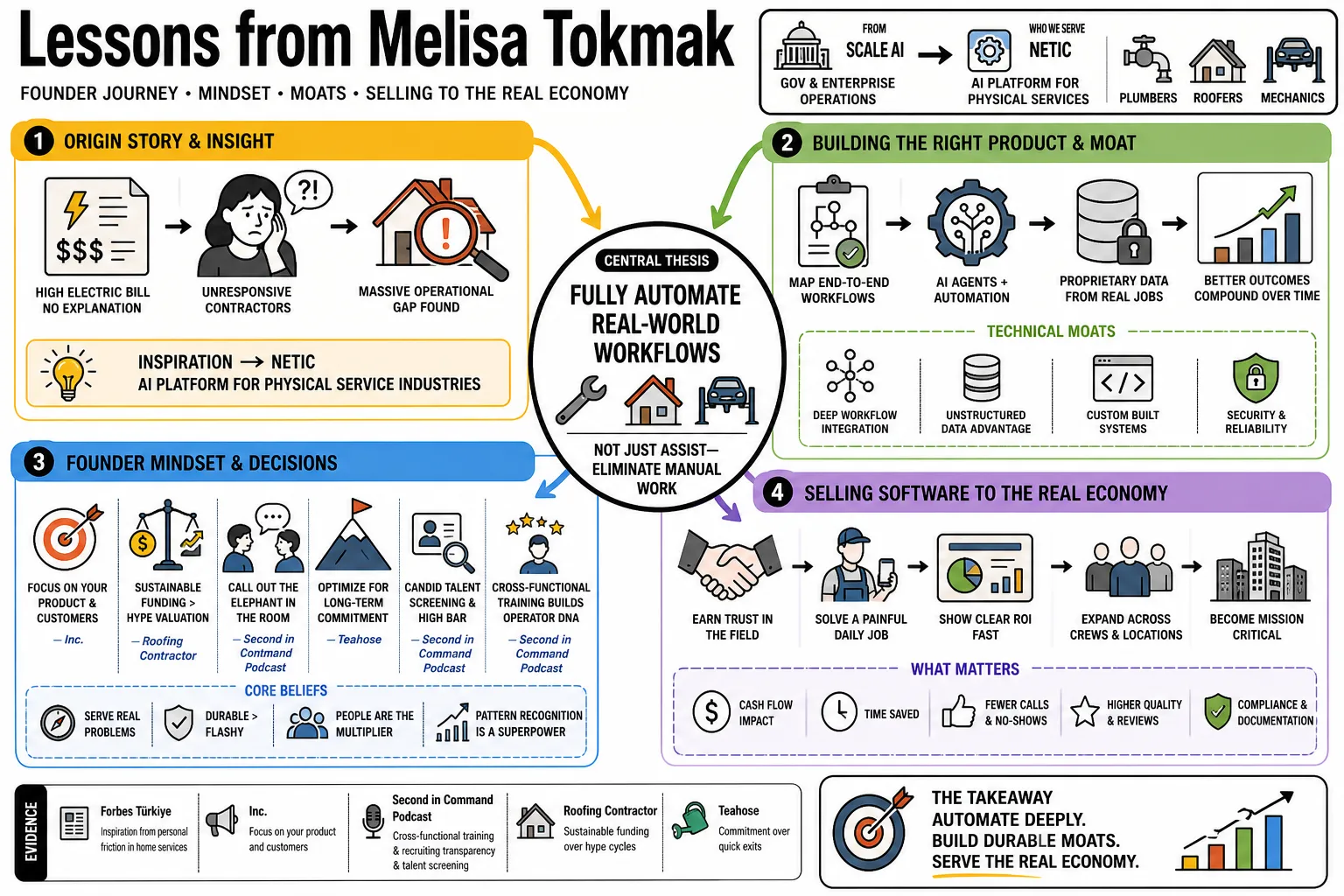
Part 1: The Founder Journey and Mindset
- On finding inspiration: Experiencing the personal friction of an unexplained high electric bill and unresponsive local contractors revealed a massive operational gap in home services, sparking the idea for Netic. — Reference: Forbes Türkiye
- On competition: The best competitive strategy is to direct your energy toward your own product and customers rather than obsessing over what rivals are doing. — Reference: Inc.
- On cross-functional training: Serving as the Chief of Staff and right hand to a hyper-growth CEO provides invaluable exposure to scaling operations and managing diverse units before founding your own company. — Reference: Second in Command Podcast
- On resisting vanity metrics: Consciously keeping funding rounds at a sustainable size, rather than maximizing valuation during a hype cycle, builds a durable business capable of withstanding industry bubbles. — Reference: Roofing Contractor
- On recruiting transparency: When competing for top talent against heavily funded startups, calling out the elephant in the room directly is a more effective strategy than ignoring market realities. — Reference: Second in Command Podcast
- On founder commitment: The cultural shift toward optimizing for quick, short-term exits detracts from the long-term dedication required to build enduring companies. — Reference: Teahose
- On screening talent: Candidates driven by a permanent underclass anxiety—the fear that they will fail if they don't secure an exit within a year—often lack the stamina needed for serious company building. — Reference: Teahose
- On early ambition: Moving from a small town in Turkey to learn English and secure a spot at Stanford requires immense resilience and sets the foundation for tackling difficult, large-scale problems. — Reference: Moving Up Podcast
Part 2: Serving the Real Economy
- On Silicon Valley's blind spot: While the tech industry fixates on digital-first tools and coding copilots, the physical essential services that keep the country running remain trapped in patchwork legacy software. — Reference: Plumbing & Mechanical
- On structural brokenness: Essential physical services suffer from extreme cyclicality and labor shortages, making it impossible to handle massive seasonal demand spikes with human staffing alone. — Reference: Teahose
- On tech readiness: The assumption that trades like plumbing and roofing are technologically backward is false; these business owners are highly focused on value and move quickly when presented with clear ROI. — Reference: Teahose
- On geographic reach: Main Street businesses across the country represent a massive, underserved opportunity simply because they are harder for hub-based tech companies to reach and understand. — Reference: Menlo Times
- On leveling the playing field: Bringing autonomous intelligence to small and mid-sized contractors allows them to deliver the kind of rapid, high-quality customer experience previously reserved for massive corporations. — Reference: Tech Funding News
Part 3: The Autonomous AI Vision
- On execution vs. assistance: Businesses operating on tight margins do not need chat widgets or copilots that merely assist human workers; they need autonomous systems capable of executing complete workflows from start to finish. — Reference: Plumbing & Mechanical
- On revenue creation: "It would be pretty sad if we use AI only for cost cutting." — Source: Teahose
- On predictive targeting: Fusing scattered internal customer data with external signals, such as impending weather events, allows an AI to preemptively book high-value jobs before the customer even calls. — Reference: Plumbing & Mechanical
- On the "Netic First" strategy: The most effective deployment of AI is positioning it as the very first touchpoint in the customer journey, ensuring no lead is dropped during high-volume periods. — Reference: Netic
- On last-mile complexity: Foundation models alone cannot solve real-world business problems; success requires deep orchestration to handle regional accents, routing logic, and specific operational rules. — Reference: Teahose
- On unlocking trapped data: Transitioning from rigid, rule-based programs to flexible machine learning models allows organizations to extract and utilize massive amounts of data previously buried in complex documents. — Reference: Women in Tech Global Conference
- On human-in-the-loop design: Even in highly autonomous systems, strategically keeping humans in the loop remains critical to ensuring accuracy, especially in complex or heavily regulated industries. — Reference: Women in Tech Global Conference
Part 4: Strategy and Competitive Moats
- On frontier labs as competitors: Large AI labs are not an immediate threat in the enterprise space because their lack of focus and habit of quickly killing experimental products makes them unreliable partners for mission-critical operations. — Reference: Teahose
- On software vs. asset roll-ups: Building a scalable software product that serves entire industries is a stronger strategy than buying up individual physical businesses just to implement your own AI tools internally. — Reference: Teahose
- On private equity distribution: Private equity firms transitioning from financial engineering to value creation present a massive distribution channel for AI that can operate across an entire portfolio of related businesses. — Reference: Teahose
- On multi-layered moats: Defensibility in AI comes from combining specialized models with custom software harnesses and highly specific domain data, making the system difficult for generic text models to replicate. — Reference: Plumbing & Mechanical
- On the timeline for robotics: Because physical service environments are highly variable and require extreme dexterity, the replacement of field technicians by robotics is still decades away, making software orchestration the immediate priority. — Reference: Teahose
Part 5: Go-to-Market and Execution
- On product-led growth: A B2B product that delivers clear, immediate financial outcomes can scale to millions in revenue entirely through inbound interest and customer referrals, bypassing the need for a massive traditional sales team. — Reference: Netic
- On speed to ROI: Earning the trust of tight-margin operators requires a system that demonstrates obvious financial return within weeks of deployment, not months. — Reference: Plumbing & Mechanical
- On "free" growth: Instead of pouring shrinking margins into saturated paid marketing channels, companies can unlock substantial revenue simply by using AI to intelligently re-engage their existing lead database. — Reference: Netic
- On mitigating revenue leakage: Deploying an autonomous engine captures the immense value historically lost during sudden demand spikes, when call centers become overwhelmed and expensive leads are dropped. — Reference: Plumbing & Mechanical
- On continuous learning: Every localized interaction, from handling thick regional accents to recommending up-sells, trains the underlying engine to become more effective at matching fluctuating demand with available capacity. — Reference: Plumbing & Mechanical
- On operational flexibility: Rather than forcing service companies to alter their established processes to fit a rigid software platform, an effective AI tool adapts to each company's unique policies and brand voice. — Reference: Plumbing & Mechanical
- On the land-and-expand strategy: Earning adoption in skeptical industries often requires proving value in a single, narrow operational area before customers trust the system enough to deploy it across their entire customer journey. — Reference: Netic