Michael Moritz transitioned from a Time magazine reporter to one of the most successful venture capitalists in history during his nearly four decades at Sequoia Capital. He is best known for funding early internet giants like Google, Yahoo, and PayPal by applying a journalist’s curiosity to the startup ecosystem. This collection organizes his interviews, books, and public statements to explore his views on the mechanics of extreme patience, the psychology of difficult founders, and the permanent advantage of being an outsider.
Part 1: The Foundations of Investing
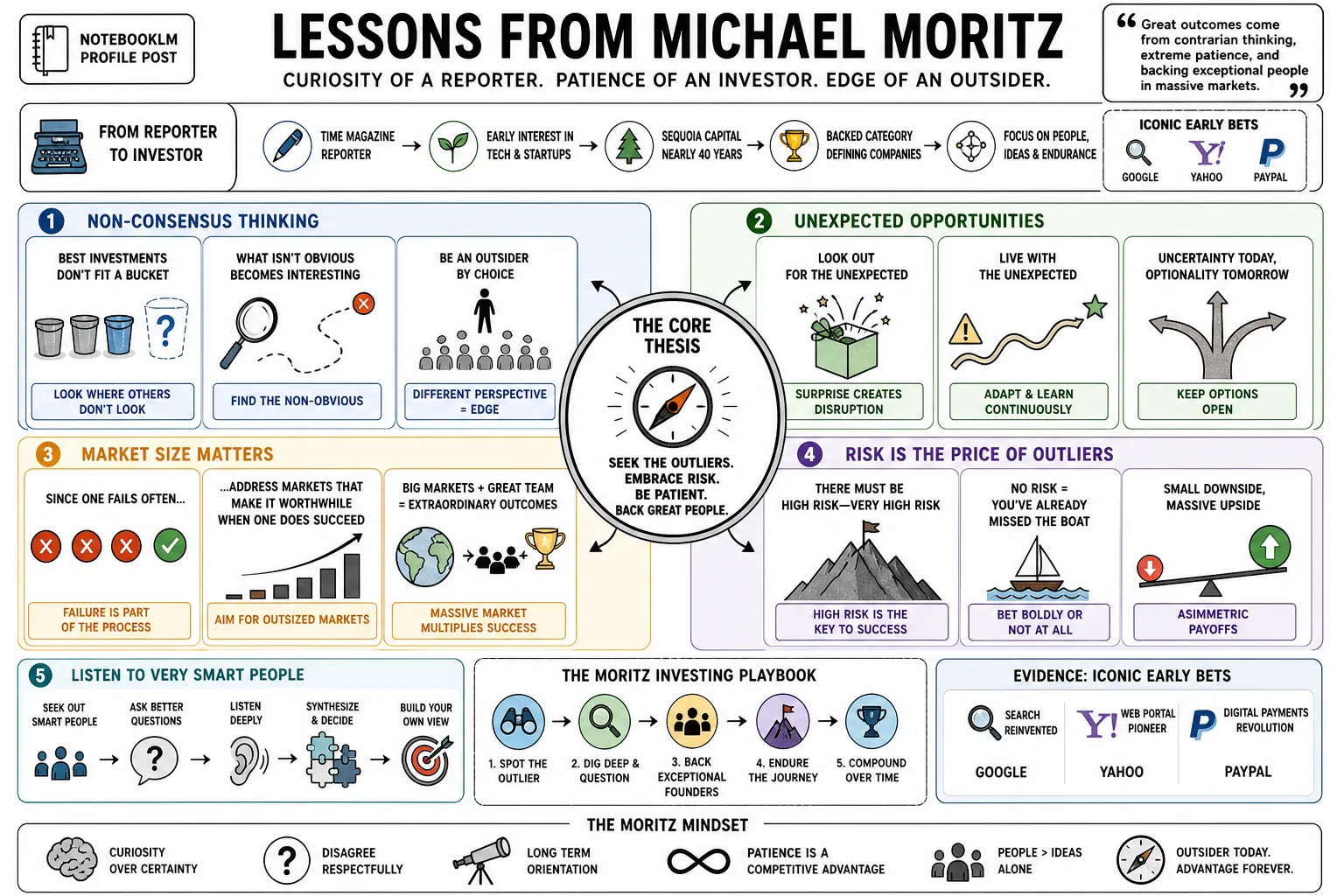
- On Non-Consensus Thinking: "To me, the best investments are always those that don't fit into a convenient bucket. What isn't obvious becomes something really interesting." — Source: [Stanford GSB]
- On Unexpected Opportunities: "Look out for the unexpected. The tech industry must learn to live with the unexpected." — Source: [Financial Times]
- On Market Size: "Since one fails often, address markets that make it worthwhile when one does succeed." — Source: [Forbes]
- On Risk: "There must be high risk—in fact, very high risk. It's the key to success. If there is no risk, you have already missed the boat." — Source: [Startups.com]
- On Listening: "All you need do is listen to very smart people and sift out the ideas that are unworthy or implausible, and I wouldn't pretend for a moment that I hadn't made lots of mistakes." — Source: [Goodreads]
- On Focus: "The older I get, the more I see a straight path where I want to go. If you're going to hunt elephants, don't get off the trail for a rabbit." — Source: [Stanford eCorner]
- On Dealing with Incomplete Data: Engineers often struggle to make judgments without all the facts, but the best investors are trained to form an opinion and act despite ambiguity. — Source: [Stanford GSB]
- On Early Stage Invigoration: "There's nothing more invigorating than being deeply involved with a small company and a young team of founders out to do something incredibly special." — Source: [Medium]
- On Innovation Origins: "The germ of an idea for a breakthrough in technology doesn't come out of a business school curriculum. It comes out of a laboratory or a math lecture or a physics tutorial." — Source: [Goodreads]
- On Extreme Capital Efficiency: Extreme capital efficiency and "counting the nickels" is the true mark of a durable business, far more than marketing flair. — Source: [Financial Times]
Part 2: Identifying the Right Founders
- On Obsession vs. Passion: "Passion is for Valentine's Days. Passion is nowhere near the level you need to do something spectacular. Obsession is a level of devotion required to change the world." — Source: [Medium]
- On Persistence: "For founders — always imagine that everything is possible. And never, ever, ever, give up." — Source: [Forbes]
- On Difficult Characters: The people who do remarkable things tend to be obsessed by what they are working on, often making them extreme or difficult characters. — Source: [Entrepreneur]
- On Finding Fulfillment: "Obsessives, those who cannot imagine doing anything else with their lives, always find their work more fulfilling." — Source: [Evening Standard]
- On the Ideal Founder Profile: He half-joked that he preferred investing in founders who are under 30, lack a history degree, and have a surname he cannot pronounce. — Source: [Digital Riptide]
- On Youth and Drive: Borrowing from Evelyn Waugh, he noted that energy can be sapped by the sight of a baby stroller in the hallway, explaining why venture bets heavily on young, undivided founders. — Source: [CNET]
- On Older Founders: While preferring youth, exceptions are made for older founders who are incredibly smart and have been properly humbled by failure. — Source: [Bloomberg]
- On Outsiders: He gravitates toward founders who feel they have something to prove, recognizing the outsider mentality as a distinct advantage in business. — Source: [Invest Like the Best]
- On Competitiveness: Extreme hunger and competitiveness are the primary traits required when hiring, both for venture firms and portfolio companies. — Source: [Invest Like the Best]
Part 3: Enduring Company Culture
- On Defining Culture: "Culture does not equal baristas and coconut water. Culture equals winning and winning consistently." — Source: [Medium]
- On Value over Aesthetics: "Countless companies had great 'culture' and failed... Remember, value is on the dollar." — Source: [Medium]
- On Consistency: "Be unflagging in your level of consistency." — Source: [Goodreads]
- On Distractions: "The enemy to performance is distractions... Be hyper-alert and hyper-vigilant about the corrosive nature of distraction." — Source: [Medium]
- On Enduring Companies: The ability to fiercely guard against distraction separates one-shot wonder companies from enduring ones. — Source: [Medium]
- On Moral Justification: "Some companies' demise comes not from their inability to turn a profit, but to provide a moral justification for their existence." — Source: [Medium]
- On Private vs. Public Markets: "I think overall it is better for businesses to stay private because you have more latitude, more freedom." — Source: [Goodreads]
- On Furtiveness: "People don't realize how much of an asset furtiveness is." — Source: [Forbes]
- On Simplicity: The best business summary he ever heard was from Cisco's co-founder: "We network networks," which served as the company's north star for 25 years. — Source: [Forbes]
- On Working Environments: "Once you bid farewell to discipline you say goodbye to success." — Source: [Goodreads]
Part 4: Lessons from the Written Word
- On Journalism and Venture: "It's much like being a journalist: to be able to start on an endeavor where you know nothing; where you gather a lot of materials and facts, distill those facts, and then form a cogent opinion." — Source: [Stanford GSB]
- On Time Magazine: He viewed his early work at Time Magazine not much differently than venture capital—both are about being an aggregator, packager, and distributor of information. — Source: [Time]
- On Steve Jobs' Ambition: "Big thinkers often do big things. Small thinkers never do big things." — Source: [Noah Kagan]
- On Refusing Doctrine: "He refused to accept automatically received truths and he wanted to examine everything himself." — Source: [Noah Kagan]
- On Career Planning: "My career path has all been accidental. There's been no grand plan behind my life." — Source: [Stanford GSB]
- On Staying Put as a Risk: "They ALL seemed to feel that the greatest risk was to stay put and do nothing." — Source: [Noah Kagan]
- On True Freedom: "There's always a safe route but exploring life in the way you want is true freedom." — Source: [Noah Kagan]
- On Corporate Efficiency: True organizational efficiency is designing a company that does the most amount of work with the least number of workers, leaving the heavy lifting to subcontractors. — Source: [Noah Kagan]
- On the Nature of the Journey: "The journey is the reward." — Source: [Noah Kagan]
Part 5: Leadership and Organization Building
- On Directional Clarity: "You cannot lead an individual—let alone a team or an organization—without being able to clearly communicate the direction in which you want to go." — Source: [Forbes]
- On the Declining Balance Sheet: "There is nothing like a declining balance sheet to focus the mind." — Source: [CNET]
- On Replenishing the Bench: A successful venture firm must constantly and imperceptibly rotate in new talent to ensure longevity across decades, much like a sports team. — Source: [Stanford GSB]
- On Leading by Example: "You cannot lead by following." — Source: [Goodreads]
- On Managing Defeat: "The experience of defeat, or more particularly the manner in which a leader reacts to it, is an essential part of what makes a winner." — Source: [Goodreads]
- On Listening Twice as Much: "There's a reason that God gave us two ears, two eyes and one mouth. It's so you can listen and watch twice as much as you talk. Best of all, listening costs you nothing." — Source: [Goodreads]
- On Relying on Youth in Companies: If running a company, a leader should always listen to the most talented youngsters, because they are most in touch with the realities of today and the prospects for tomorrow. — Source: [Goodreads]
- On Maintaining Principles: "In the long run principles are just more important than expediency." — Source: [Goodreads]
- On Concentration: "Don't play the occasion, play the game." — Source: [Goodreads]
- On the Habit of Giving In: "If you give in once, you'll give in twice. It's a habit." — Source: [Goodreads]
Part 6: Understanding the Long Game
- On Patience: "These are very, very long journeys that we're on. It takes time and patience and spectacular people and a massive market opportunity to build the real companies that matter." — Source: [Stanford GSB]
- On Holding Periods: It is common for the best investors to hold stock for 15 to 20 years, riding out volatility for ultimate compounding. — Source: [Bloomberg]
- On Doing Nothing: Once you are in a great company with favorable underlying trends, the most valuable and difficult skill is the capacity to simply do nothing. — Source: [Invest Like the Best]
- On the Afternoon Focus: While a 20-year plan is important, survival requires focusing on the immediate little steps and getting through the afternoon. — Source: [Calcalist]
- On Retirement: "I think the notion of retirement is just a dreadful, dreadful idea and I hope I never have to do that." — Source: [Time]
- On Structural Longevity: The structure of a venture capital fund must be deliberately designed to outlast its current leaders. — Source: [Charlie Rose]
- On Stepping Back: Recognizing when to step back from day-to-day management is required when you can no longer maintain the extreme pace of previous decades. — Source: [Forbes]
- On Institutional Memory: The transition from active investing to wealth management allows the principles of long-term compounding to preserve wealth across generations. — Source: [Financial Times]
- On the Prepared Mind: The ability to spot outliers comes from decades of maintaining a prepared mind steeped in continuous narrative analysis. — Source: [Venture Capital Journal]
Part 7: On Silicon Valley & Global Tech
- On Underestimating China: "People underestimate China, especially in Europe. They have very little sense of the size, strength, and scale of ambition of the leading Chinese technology companies." — Source: [Business Insider]
- On Perception Lagging Reality: "It takes a long time for perception to catch up with reality, so most people's perception of China is 20 years behind the times." — Source: [Business Insider]
- On Work Ethic Disparities: The relentless work ethic and speed of Asian tech hubs starkly contrast with a softening culture in Silicon Valley. — Source: [Financial Times]
- On Urban Mismanagement: He has strongly criticized the local governance of San Francisco, arguing it serves as an example of progressive politicians becoming their own worst enemy. — Source: [The New York Times]
- On Political Protection Rackets: Modern urban politics often function as protection rackets that ignore the fundamental issues of homelessness and drug addiction in tech hubs. — Source: [The New York Times]
- On Political Hubris vs. Business: He often distinguishes between actual company builders and political figures who merely act as hustlers. — Source: [Financial Times]
- On Global Markets: Investing globally requires a deep respect for the localized drive and ambition that cannot be easily replicated by Western firms. — Source: [TechCrunch]
- On Staying Ahead: "Many people see Mike as a loner. I think it's because he's ahead of everyone else." — Source: [Time]
- On the Evolution of Tech: The technology ecosystem has shifted from scrappy upstarts to massive geopolitical forces, requiring investors to adjust their scale of thinking. — Source: [Bloomberg]
Part 8: Identity and the Outsider Advantage
- On the Ausländer Concept: The idea of being a stranger or outsider—Ausländer—is a haunting force that ran through his childhood and resurfaced in his adopted home of California. — Source: [The Guardian]
- On Fragility: A refrain inherited from his parents regarding authoritarianism: "If it did happen somewhere, it can happen here." — Source: [The Guardian]
- On Refugee Heritage: A background shaped by refugee escape instills a pragmatic emphasis on education and personal initiative over narratives of enduring victimhood. — Source: [The Rest Is Money]
- On Being Conspicuously Different: Growing up as a German-Jewish refugee descendant in Wales meant constantly feeling conspicuously different. — Source: [The Economic Times]
- On Reclaiming Identity: Applying for German citizenship later in life serves as a symbolic reclamation of the identity his family was forced to abandon. — Source: [The Economic Times]
- On Institutional Reckoning: He contrasts Germany’s thorough institutional reckoning with its past against the increasingly unsettled atmosphere for minority groups in Britain. — Source: [The Economic Times]
- On the Outsider's Edge in Business: "I've always felt an outsider... that's obviously had a huge effect" in maintaining an objective, critical lens in Silicon Valley. — Source: [Stanford GSB]
- On Academic Backgrounds: "My undergraduate degree was in history, and I wish I had been smart enough to really excel at maths, physics, chemistry or biology because... the voyagers and adventurers and real contributors — that's where they come from." — Source: [Medium]
- On Legacy: The dark cloud of a traumatic family history often acts as the unyielding fuel that drives an extreme need to build, secure, and endure. — Source: [Stanford GSB]