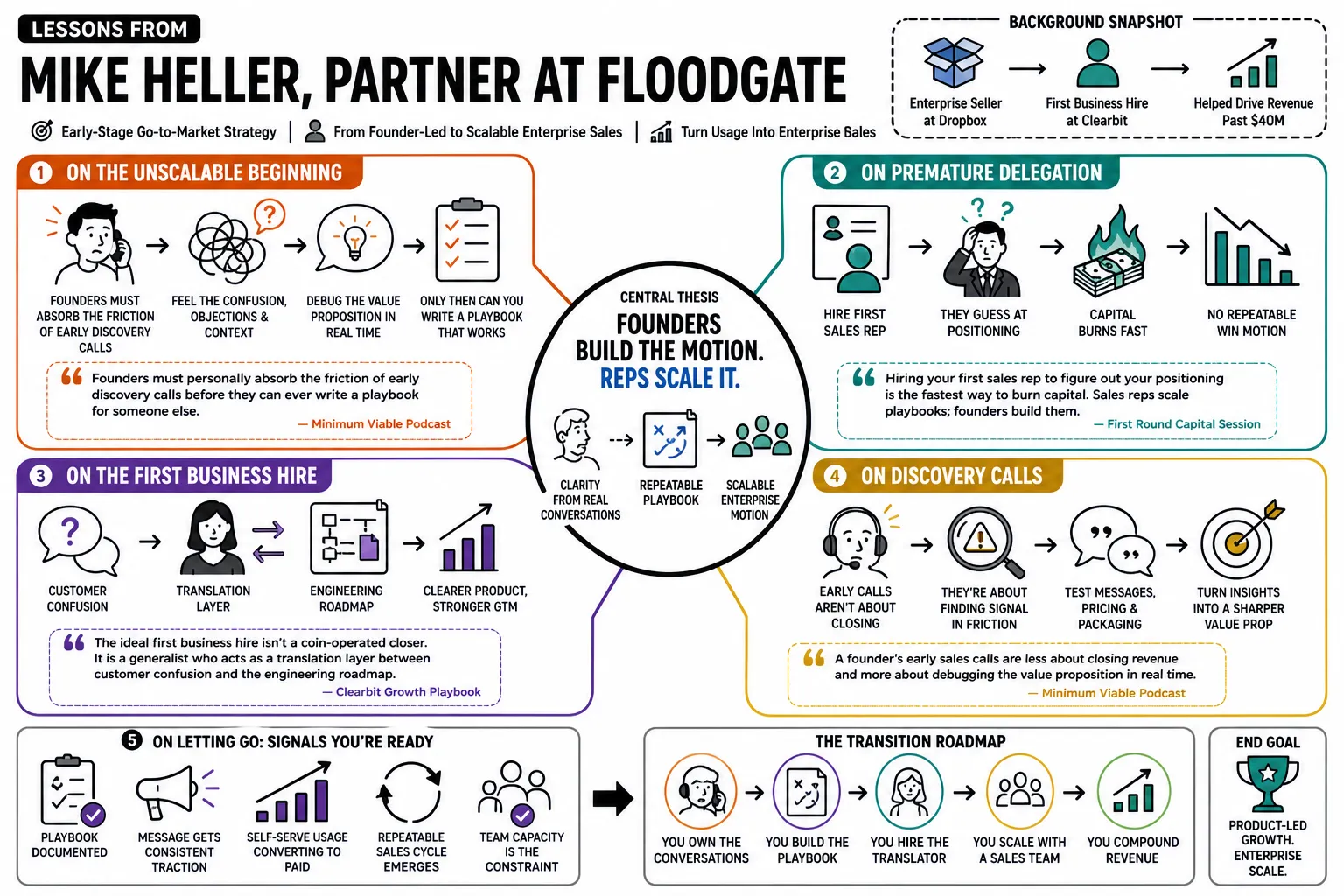
Mike Heller is a partner at Floodgate focused on early-stage go-to-market strategy. He helped build the early product-led sales motion as an enterprise seller at Dropbox and later joined Clearbit as its first business hire, helping drive 40x revenue growth. His experience is a practical guide for founders trying to turn self-serve usage into enterprise deals.
Part 1: The Transition from Founder-Led Sales
- On the unscalable beginning: "Founders must personally absorb the friction of early discovery calls before they can ever write a playbook for someone else." — Minimum Viable Podcast
- On premature delegation: "Hiring your first sales rep to figure out your positioning is the fastest way to burn capital. Sales reps scale playbooks; founders build them." — First Round Capital Session
- On the first business hire: "The ideal first business hire isn't a coin-operated closer. It is a generalist who acts as a translation layer between customer confusion and the engineering roadmap." — Clearbit Growth Playbook
- On discovery calls: "A founder's early sales calls are less about closing revenue and more about debugging the value proposition in real time." — Minimum Viable Podcast
- On letting go of the reins: "You know it is time to hire a dedicated sales leader when the founder becomes the bottleneck to closing obvious, repetitive deals." — Angular Ventures Advisory
- On bad early hires: "The most polished enterprise rep you interview is often the worst possible hire for a seed-stage company trying to find its footing." — The Vibescaling Podcast
- On capturing raw feedback: "Early sales conversations should be treated as product research. The objections you hear are just missing features or unclear copy." — Minimum Viable Podcast
- On founder psychology: "Many technical founders hate sales because they view it as persuasion. It is actually just pattern recognition applied to human pain points." — Angular Ventures Advisory
- On early sales metrics: "At the seed stage, do not measure your sales efforts by quota attainment. Measure them by the velocity of insights returned to the product team." — First Round Capital Session
- On the handoff: "When transitioning deals to your first reps, you have to stay in the room long enough to ensure the customer still feels the founder's urgency." — Minimum Viable Podcast
Part 2: Defining Product-Led Sales
- On the definition of PLS: "Product-led sales is not the absence of sales reps. It is the application of sales effort only when the product data indicates a human can accelerate the deal." — Floodgate Insights
- On Dropbox's early motion: "At Dropbox, we realized that self-serve was generating massive demand inside large corporations, but we needed enterprise reps to consolidate those individual accounts into a master contract." — The Signal Club
- On the seed and the harvest: "Product-led growth is the seed you plant to get users inside an organization. Enterprise sales is how you harvest the actual economic value of that penetration." — The Vibescaling Podcast
- On self-serve limitations: "A self-serve motion can get you thousands of individual users, but it cannot negotiate a procurement review or pass a compliance audit. You need humans for that." — Whimsical GTM Strategy
- On timing the outreach: "Reaching out to a user too early in their product journey feels intrusive. Reaching out right after they hit a usage paywall feels like timely assistance." — Clearbit Growth Playbook
- On user vs. buyer: "The person who falls in love with your free tier is rarely the person who holds the budget for the enterprise license. Your sales motion must bridge that gap." — The Signal Club
- On feature gating: "The most effective product-led sales models gate the features that enterprises care about, like single sign-on and admin controls, not the features that individuals use to get initial value." — Floodgate Insights
- On identifying champions: "Your strongest internal champion is usually the user who logs in the most frequently, not necessarily the executive whose name is on the target list." — First Round Capital Session
- On hybrid motions: "There is no pure PLG company at scale. Eventually, every successful self-serve product bolts on a top-down sales team." — The Vibescaling Podcast
Part 3: The Reality of Enterprise Sales
- On high-touch sales: "Despite all the talk about frictionless software, all roads eventually lead back to steak dinners and high-touch relationship building to close seven-figure deals." — The Vibescaling Podcast
- On procurement friction: "Procurement departments do not care how intuitive your UI is. They care about indemnification, data residency, and SLA penalties. Software cannot negotiate those terms." — Whimsical GTM Strategy
- On executive alignment: "An enterprise deal closes when your executive team aligns with their executive team. The product is just the excuse for the meeting." — Angular Ventures Advisory
- On the limits of self-serve: "No Fortune 500 company has ever swiped a credit card for a million-dollar software license. You have to go shake hands." — The Vibescaling Podcast
- On building trust: "In large enterprises, buyers are risking their careers when they purchase your software. Trust is built through human interaction, not a slick onboarding flow." — Floodgate Insights
- On multi-threading: "Enterprise sales requires mapping an entire organization. You are not selling to a person; you are selling to a buying committee with competing incentives." — Clearbit Growth Playbook
- On the long game: "Enterprise deals take quarters, not days. The rep's job is to maintain momentum when the initial excitement fades and the legal review begins." — First Round Capital Session
- On value engineering: "In high-touch sales, you have to prove the ROI before the contract is signed. This requires deep financial modeling that self-serve products cannot auto-generate." — The Signal Club
- On field marketing: "The steak dinner is not a metaphor. Physical proximity and shared meals remain highly effective ways to uncover the actual political dynamics blocking a deal." — The Vibescaling Podcast
Part 4: Data-Driven Selling and Qualified Leads
- On the PQL: "A Product Qualified Lead is infinitely more valuable than a Marketing Qualified Lead. What a user does in the product is truth; what they fill out on a form is aspiration." — Clearbit Growth Playbook
- On usage thresholds: "Your sales team should only be talking to accounts that have crossed a specific, empirically proven threshold of product usage." — The Signal Club
- On invisible signals: "Often, the best signal for sales outreach is not an action the user took, but an action they failed to take, like inviting a teammate after three days." — Minimum Viable Podcast
- On connecting data: "At Clearbit, the breakthrough was piping real-time product usage data directly into the CRM so reps knew exactly when an account was heating up." — Clearbit Growth Playbook
- On cold outreach: "If you have a self-serve product, cold emailing target accounts is a waste of time. Focus your reps exclusively on accounts that are already warm from product usage." — Floodgate Insights
- On defining activation: "Activation is not when a user logs in. Activation is when the user experiences the core value of the product for the first time." — Whimsical GTM Strategy
- On scoring models: "Keep your PQL scoring simple at first. Complex algorithms break easily. Start with basic parameters like daily active usage and number of seats deployed." — First Round Capital Session
- On telemetry: "If your engineering team is not instrumenting usage telemetry from day one, you are flying your sales team blind." — Angular Ventures Advisory
- On aligning teams: "Product and Sales must agree on the definition of a PQL. If product engineers do not respect the metric, the sales team will starve." — Clearbit Growth Playbook
- On reversing the funnel: "In a data-driven model, the funnel is inverted. You do not sell the product to get usage; you use the usage to sell the contract." — The Signal Club
Part 5: Navigating the Post-Playbook Era
- On the end of old tactics: "The standard SaaS GTM playbook of the 2010s—spamming inboxes and buying ad words—is dead. We are operating in a post-playbook era." — Floodgate Insights
- On channel exhaustion: "Every distribution channel eventually deteriorates as competitors flood it. Founders must constantly invent novel distribution strategies." — Minimum Viable Podcast
- On earning attention: "You can no longer buy your way to a meeting. You have to earn attention through extreme relevance and high-signal, point-of-view-driven content." — The Signal Club
- On AI in GTM: "AI will automate the bottom eighty percent of sales activity. The reps who survive will be the ones who can do the deeply human work of building trust and navigating politics." — Floodgate Insights
- On community as a channel: "Building a community is not a marketing tactic; it is a long-term moat. But it only works if you actually care about the people in it." — Whimsical GTM Strategy
- On content quality: "The bar for outbound messaging is higher than ever. If your cold email reads like a template, it will be ignored by the buyer's spam filter or their AI assistant." — First Round Capital Session
- On capital efficiency: "In a tighter funding environment, you cannot afford to have a six-month ramp time for an enterprise rep who misses quota. Your GTM motion must be highly capital efficient." — Angular Ventures Advisory
- On founder brand: "A founder with a strong public point of view is a massive GTM advantage. It creates an organic slipstream for the sales team to follow." — Minimum Viable Podcast
- On adapting to buyers: "Buyers have less patience for standard discovery questions. They expect you to show up already knowing their business model and their pain points." — The Vibescaling Podcast
Part 6: Scaling Clearbit and Building GTM Engines
- On the Clearbit growth phase: "Growing from $1 million to $40 million requires breaking the company and rebuilding it at every major revenue milestone." — Clearbit Growth Playbook
- On API-first selling: "Selling an API requires a fundamentally different motion than selling an application. You are selling infrastructure, which means the technical evaluation is the entire deal." — Clearbit Growth Playbook
- On post-sales support: "Customer success is not a support function; it is a revenue function. At Clearbit, our biggest growth lever was expanding accounts after the initial implementation." — Whimsical GTM Strategy
- On pricing power: "You only discover your true pricing power when you lose a few deals because the cost is too high. If you win every deal, you are priced too low." — First Round Capital Session
- On hiring criteria: "When hiring for an early GTM team, look for curiosity and resilience over a perfect resume. The product will change, and they need to adapt with it." — Minimum Viable Podcast
- On alignment: "Sales, Marketing, and Success cannot operate in silos. At Clearbit, we managed all three under a single unified revenue umbrella to ensure the customer experience was seamless." — Clearbit Growth Playbook
- On partnerships: "Strategic partnerships are a multiplier, but they take immense effort to set up. Do not rely on them for early traction; build your direct sales motion first." — Angular Ventures Advisory
- On reporting structures: "In the early days, the Head of Sales should report directly to the CEO. There is no room for a middle layer when the company is still finding product-market fit." — First Round Capital Session
- On momentum: "Revenue momentum solves most cultural problems inside a startup. Your primary job as a GTM leader is to maintain that forward velocity." — Clearbit Growth Playbook
Part 7: Advice for Technical Founders on US Market Entry
- On the US buyer: "The American enterprise buyer is fundamentally different. They are more willing to take risks on new technology, but they expect a much higher level of polish and responsiveness." — Angular Ventures Advisory
- On moving headquarters: "If your primary market is the US, your executive team needs to be operating in US time zones. You cannot close complex enterprise deals asynchronously." — Angular Ventures Advisory
- On messaging differences: "European founders often lean heavily into technical specs. US buyers want to hear about the business outcome and the economic impact." — The Signal Club
- On hiring local talent: "When entering the US market, your first local hire should be a senior sales leader who brings their own network and understands the cultural nuances of American procurement." — First Round Capital Session
- On perceived risk: "Foreign startups must work twice as hard to establish trust. Things like local compliance certifications and a US-based entity are table stakes." — Angular Ventures Advisory
- On competitive aggression: "The US market is louder and more aggressive. Technical founders must get comfortable positioning their product sharply against well-funded incumbents." — Minimum Viable Podcast
- On the first US pilot: "Over-invest in making your first three US customers wildly successful. Their logos and references are the only currency you have to win the next ten." — Floodgate Insights
- On translation: "It is not just about translating the language on your website; it is about translating the cultural expectations of the enterprise buying cycle." — Angular Ventures Advisory
- On velocity: "Speed is a feature in the US market. If you take forty-eight hours to reply to a technical question from a prospect, they have already moved on to your competitor." — First Round Capital Session
Part 8: The Role of Venture Capital and AI
- On joining Floodgate: "I joined Floodgate because the next decade of software requires a new approach to distribution. The old playbooks are exhausted." — Floodgate Insights
- On AI native startups: "An AI-native company is not a standard SaaS product with a chatbot bolted on. It requires a fundamental rethink of how software interacts with human workflows." — Floodgate Insights
- On funding GTM: "Venture capital should be used to pour fuel on a fire that is already burning, not to hire a sales team to figure out how to start the fire." — First Round Capital Session
- On evaluating founders: "When assessing early-stage founders, I look for their ability to articulate a clear, differentiated point of view. If they cannot sell me on their vision, they will not be able to sell a customer." — Minimum Viable Podcast
- On the new moat: "In an era where AI can write code, technical execution is no longer the primary moat. The moat is proprietary data and deeply entrenched distribution channels." — The Signal Club
- On AI pricing: "The SaaS seat-based pricing model is breaking down. As AI agents do the work of human users, we have to shift toward consumption or outcome-based pricing." — Floodgate Insights
- On the venture ecosystem: "The role of a seed investor is to help founders navigate the highest-risk phase of their company's lifecycle: the journey from an idea to a repeatable sales motion." — Angular Ventures Advisory
- On early capital: "Raising too much money too early often forces founders to scale a broken GTM engine. Constraint breeds better go-to-market discipline." — The Vibescaling Podcast
- On market shifts: "Every technological platform shift resets the GTM board. AI is resetting the board right now, giving new founders a chance to outmaneuver the incumbents." — Floodgate Insights
- On the ultimate goal: "The purpose of venture capital is to underwrite the risk of doing something entirely novel. If you are building a slightly better version of an existing tool, you do not need VC." — First Round Capital Session