Dannie Herzberg helped build sales organizations at HubSpot and Slack, became a partner at Sequoia Capital, and later joined Baseten as president. Her direct interviews and talks here focus on customer-led selling, product-led growth, hiring, and company building. — Baseten Announcement.
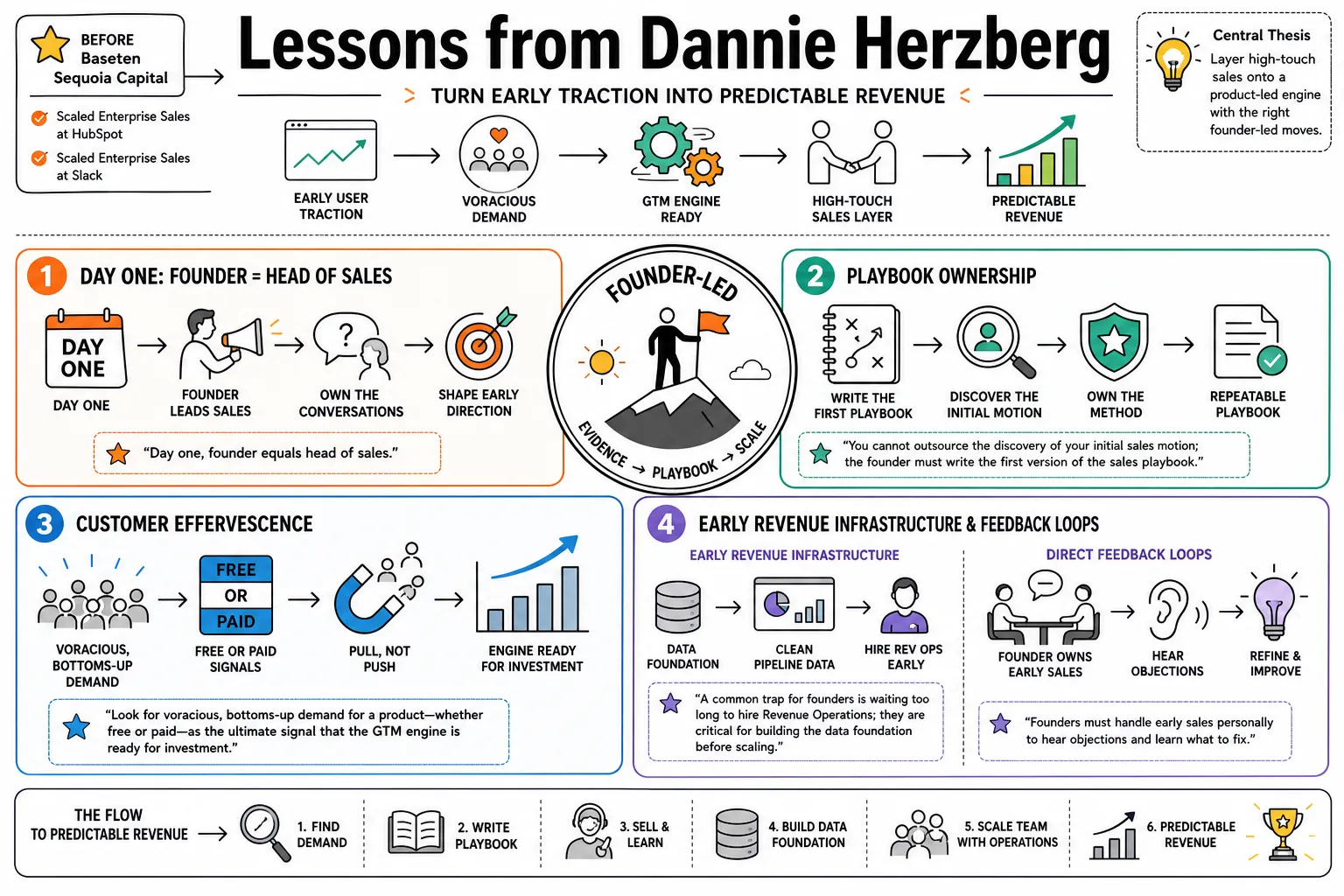
Part 1: Early GTM & Founder-Led Sales
- Day One: Dannie says the founder should be the first person selling the product. — Eniac Ventures Q&A.
- The Founder's Prerequisite: The founder knows the company, technology, and product best, making founder-led sales the starting point. — Eniac Ventures Q&A.
- Customer Effervescence: Dannie looks for customer effervescence: strong demand for a free product or paid seats after product-market fit. — HubSpot Interview.
- Direct Feedback Loops: Early sales hires should gather, synthesize, and relay customer feedback from the front lines to the product team. — Eniac Ventures Q&A.
- The First Sales Hire: For the first sales hire, Dannie favors someone who thrives in ambiguity, is curious about customers, and relays product feedback—not necessarily a star from a mature enterprise sales team. — Eniac Ventures Q&A.
Part 2: Hiring and Assessing Sales Talent
- The Ultimate Hiring Litmus Test: Define the sales role clearly so colleagues can refer people who genuinely fit the opportunity. — Dannie Herzberg Hiring Post.
- Structured Hiring: Dannie favors a repeatable, structured hiring process that tests for the attributes a role actually requires and limits bias. — Gong Dannie Interview.
- Preparedness and Curiosity: Preparedness and genuine curiosity stood out to Dannie in a founding account-executive candidate she interviewed at Slack. — Dannie Herzberg Hiring Post.
- Evaluating Inputs: When coaching sellers, Dannie looks at the number of customer calls, the quantity and quality of emails, and response rates alongside outcomes. — Gong Dannie Interview.
- Early-Hire Curiosity: For an early sales hire, look for comfort with ambiguity and an appetite to learn from customers. — Eniac Ventures Q&A.
- The Roleplay: Practice likely customer questions and objections through roleplay before a sales meeting, then let prepared representatives lead the conversation. — Gong Dannie Interview.
- Coaching Early Signals: When a series of customer meetings creates no pipeline, review what happened in those conversations and coach the representative. — Gong Dannie Interview.
- Cross-Functional Relationships: Dannie urges go-to-market staff to build genuine relationships across product, finance, and operations because those functions shape customer outcomes. — Gong Leadership Panel.
Part 3: The Psychology of Sales & Customer Empathy
- The True Nature of Sales: Dannie likens good selling to coaching: curiosity and well-chosen questions help prospects connect the dots. — HubSpot Interview.
- Preparation: Research the prospect and ask useful questions before trying to win their business. — HubSpot Interview.
- Showing You Care: Meet buyers where they are in their journey and give them the kind of help they actually want; a technical user may prefer to try the product before speaking with sales. — SaaStr Slack Talk.
- Consulting vs. Convincing: For a buyer already using a self-serve product, a salesperson can add value by understanding use and helping with the next stage rather than forcing an early pitch. — SaaStr Slack Talk.
- Guiding the Prospect: Ask questions that help prospects connect their own goals to what the product can do. — HubSpot Interview.
- Building Trust: Dannie links credibility in sales to preparation, curiosity, and understanding whether the product fits the business. — HubSpot Interview.
- Emotional Intelligence: Dannie credits her psychology studies with helping her understand people’s motivations and approach sales with a coaching mindset. — HubSpot Interview.
- Removing Friction: A human salesperson can help a willing buyer work through security, legal, or commercial requirements that a self-serve product cannot answer on its own. — SaaStr Slack Talk.
- Personal Drive: Dannie describes helping people and winning together as the two joys that drew her to enterprise sales. — HubSpot Interview.
Part 4: Product-Led Growth (PLG) Mechanics
- Value Sequencing: At HubSpot and Slack, Dannie saw free tools or a valuable free product build buyer goodwill before the paid conversation. — SaaStr Slack Talk.
- Sales as an Accelerator: In a self-serve business, sales should engage where a buyer needs human help while product answers repeatable questions. — SaaStr Slack Talk.
- Hiring for PLG: For Slack’s product-led motion, Dannie sought sellers who knew and loved the product and could engage sophisticated users in their own language. — SaaStr Slack Talk.
- Product Fluency: Dannie says a seller serving experienced Slack users needs deep product familiarity because some buyers may know integrations the seller has not encountered. — SaaStr Slack Talk.
- Community as a Moat: Dannie seeks products with community-led, bottom-up demand and looks for ways loyalty and mindshare can become market share. — HubSpot Interview.
- Progressive Profiling: Dannie calls product usage and engagement data a guide for deciding when human outreach can be helpful. — Eniac Ventures Q&A.
- Trigger Points: Use point-in-time product signals, such as a new credit-card payment or a team crossing a usage threshold, to identify when human outreach may help. — Eniac Ventures Q&A.
- The Bottom-Up Advantage: Slack used pockets of free-team adoption inside large organizations to learn about use and bring useful themes to an executive buyer. — SaaStr Slack Talk.
- Aligning Sales and Product: Dannie describes sales, product growth, and marketing working together to answer repeatable buyer questions in onboarding. — SaaStr Slack Talk.
Part 5: Scaling the Enterprise Machine
- Wall-to-Wall Adoption: At Slack, sellers identified free teams inside a large organization, interviewed users, and synthesized their needs for the CIO; company-wide expansion was an opportunity, not an automatic outcome. — SaaStr Slack Talk.
- Moving Upstream: As buyers became more varied, Slack segmented sales coverage and shifted its SMB team toward mid-market while moving repeatable answers into product onboarding. — SaaStr Slack Talk.
- Executive Alignment: Dannie recommends synthesizing end-user interviews for an executive buyer to reveal patterns that leadership may not otherwise see. — Eniac Ventures Q&A.
- Navigating Procurement: Security, legal, and commercial questions can justify a human sales conversation even when users first adopt a product on their own. — SaaStr Slack Talk.
- Segmenting the Sales Force: Slack specialized sales coverage by customer segment and function so teams could better match different buyer needs. — SaaStr Slack Talk.
- Adapting the Pitch: Dannie contrasts a technical Slack user who wants hands-on product access with an upmarket buyer who needs more tailored guidance; the sales conversation should fit each buyer. — SaaStr Slack Talk.
- Continuous Reinvention: Dannie urges leaders to step back and ask what the next one or two years require, because what got a high-growth company here may not get it there. — Gong Leadership Panel.
Part 6: Pricing, Product, and Category Strategy
- Strategy as Subtraction: Dannie frames strategy as deciding what not to pursue: HubSpot committed to serving SMBs rather than chasing every enterprise opportunity. — Sequoia Crucible Moments.
- The Importance of Pricing: Dannie calls pricing one of the most overlooked yet critical decisions for a growing company. — Sequoia Crucible Moments.
- The Two-Axis Pricing Model: Dannie uses Salesforce’s two pricing axes—feature access and growth with the customer—as a contrast with HubSpot’s earlier one-dimensional model. — Sequoia Crucible Moments.
- Fixing Churn: HubSpot’s original single-price model fit customers unevenly; adding contacts as a second pricing axis let revenue grow with customer value. — Sequoia Crucible Moments.
- HubSpot’s CRM Bet: Dannie recalls the risk of launching HubSpot CRM against an established incumbent; the episode frames this as a consequential company-wide commitment. — Sequoia Crucible Moments.
- The Free Strategy: HubSpot gave away its new CRM to gain distribution and reach an underserved market before building more sophisticated paid offerings. — Sequoia Crucible Moments.
- The SMB Bet: HubSpot’s early focus on small businesses shaped its path; the episode presents that customer focus as a pivotal strategic choice. — Sequoia Crucible Moments.
- Educating the Buyer: HubSpot combined free education and tools with later sales conversations, helping small-business buyers understand inbound marketing before asking them to buy software. — SaaStr Slack Talk.
Part 7: Sales Leadership & Operating Rhythms
- Attitude, Inputs, and Outputs: Dannie evaluates sales performance through three connected dimensions: attitude, inputs such as outreach quality, and outputs such as revenue. — Gong Dannie Interview.
- Founder Capabilities: Dannie says the best founders stand out in vision, execution, and recruiting. — HubSpot Interview.
- Evaluating Outputs: Dannie treats revenue produced as the output of a sales role, alongside attitude and the quality and quantity of customer-facing work. — Gong Dannie Interview.
- Resilience and Feedback: Dannie values resilience and openness to feedback in a seller’s attitude, especially under adversity. — Gong Dannie Interview.
- Strategic Off-Sites: Dannie recommends periodic leadership off-sites to anticipate the next one or two years, build trust, and set a small number of strategic priorities. — Gong Leadership Panel.
- Sales Culture: Dannie defines culture as shared principles that guide decisions and behavior among colleagues and customers, and urges leaders to articulate those principles. — Gong Leadership Panel.
- Inputs and Outcomes: A sales leader can use call activity, email quality and responses, and revenue output to coach representatives, while keeping attitude in view. — Gong Dannie Interview.
- Strategy Into Practice: Dannie asks leaders to connect strategic priorities to concrete team rituals and to help individual contributors take ownership of specific strengths. — Gong Leadership Panel.
- Aligning Teams: Dannie emphasizes recruiting strong people and defining the principles and mission that guide a go-to-market organization. — Gong Leadership Panel.
Part 8: Investor Perspectives & Board Dynamics
- Baker Scholar Syndrome: Dannie recalls advice not to prove herself at Sequoia by speaking the most; listening and choosing when to contribute helped her find confidence. — Upfront Summit Interview.
- Removing Ego: Dannie describes trust-building outside partner meetings as enabling direct disagreement inside them without making the discussion personal. — Upfront Summit Interview.
- The Unanimous Model: In the Sequoia discussion, Jess Lee describes a unanimous voting model with sponsor conviction and the ability for a partner to block a deal; Dannie adds that trust enables frank debate. — Upfront Summit Interview.
- Constant Reinvention: Dannie says Sequoia pushes itself to innovate and reinvent while things are going well rather than resting on past success. — Upfront Summit Interview.
- The Messy Middle: Dannie describes helping founders raise their ambition in good times and serving as a shock absorber during hard times. — HubSpot Interview.
- Complementary Partner Strengths: Dannie describes Sequoia’s partnership—not a company board—as a team of people with complementary strengths that founders can draw on. — HubSpot Interview.
- Empathy for Operators: Dannie draws on her operator experience to coach founders and revenue leaders, recruit talent, and help absorb pressure during difficult periods. — HubSpot Interview.
- The Privilege of the Role: Dannie describes meeting founders and understanding their motivations as one of the most energizing parts of investing. — Upfront Summit Interview.