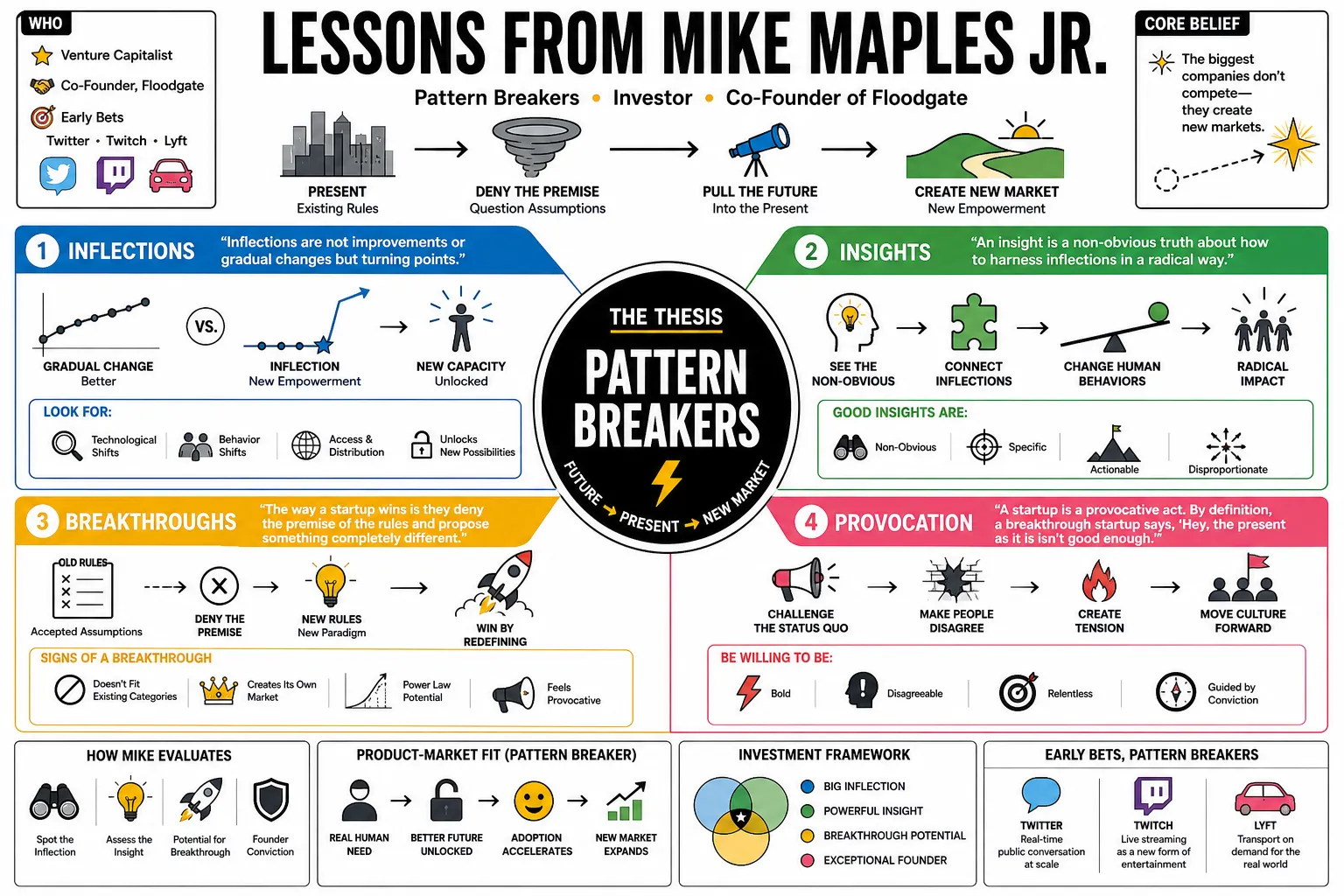
Mike Maples Jr. is a venture capitalist and co-founder of Floodgate who made early investments in companies like Twitter, Twitch, and Lyft. He is known for his concept of "Pattern Breakers," which argues that the most successful startups do not compete in existing markets, but instead create entirely new ones by pulling a future vision into the present. This profile compiles his frameworks on investing, product-market fit, and why founders must be willing to be highly disagreeable to build something meaningful.
Part 1: Pattern Breaking and Inflections
- On Inflections: "Inflections are not improvements or gradual changes but turning points where something new is introduced, creating new empowerment for the first time." — Source: Pattern Breakers
- On Insights: "An insight is a non-obvious truth about how to harness one or more inflections to change human capacities or behaviors in a radical way." — Source: Floodgate
- On Breakthroughs: "The way a startup wins is they deny the premise of the rules and propose something completely different." — Source: Invest Like the Best
- On Provocation: "A startup is a provocative act. By definition, a breakthrough startup says, 'Hey, the present as it is now isn't as good as it could be.'" — Source: Outlander VC
- On Expert Blindness: "Ironically, the experts we respect most are often the least able to see the potential for a break from the past." — Source: Pattern Breakers
- On Incomparability: "They radically break the pattern and can't be compared to anything which came before." — Source: Invest Like the Best
- On Conditioning: "Discovering breakthrough ideas is challenging, not because they're hidden secrets, but because we're conditioned to notice the familiar, while overlooking what might be." — Source: Lenny's Newsletter
- On The Seeds of Greatness: "Profound insights, driven by significant inflections with the potential to shape the future, are the initial seeds of greatness." — Source: Unusual Ventures
- On Types of Secrets: "Some secrets are plausible, some are possible, and some are preposterous." — Source: Invest Like the Best
- On Flawed Initial Ideas: "The initial product idea might be flawed; it is just an attempt at turning the inflection and insight into a product." — Source: Recall.it
Part 2: Backcasting and Time Travel
- On Backcasting: "Legendary builders must stand in the future and pull the present from the current reality to the future of their design." — Source: Category Pirates
- On Opposing Forecasting: "Backcasting is the opposite of forecasting. It works best when you want to create something extraordinarily unique and surprising." — Source: Medium
- On Living in the Future: "Most of the great startups come from a great insight, and a great insight usually occurs when someone is living in the future, and they notice something that's missing." — Source: Podcast Notes
- On Exponential Difference: "Something that's not incrementally better, but exponentially different and unique requires backcasting." — Source: Medium
- On Human Agency and Time: "The future doesn't happen to us; it happens because of us. The future is not like the weather." — Source: Category Pirates
- On Defining the Future: "It's not a destiny or hope; it's a decision." — Source: Lochhead on Marketing
- On Designing Tomorrow: "Great founders design the future. Design is the right word... It's about people with a determined idea of what a better future should be." — Source: Lochhead on Marketing
- On Persuasion in the Present: "Not only building that better future, but convincing people in the present to change the trajectory that they're on." — Source: Lochhead on Marketing
- On Incremental Prediction: "Forecasting uses the past to predict the future; backcasting ignores the past entirely." — Source: Edupreneur
Part 3: Founder Traits and Hiring
- On Owning Solutions: "They own the problem, you own the solution." — Source: Substack
- On Tailoring the Team: "It matters what type of secret it is because the type of team you need, the type of people you need to hire... all of those things vary depending on the type of secret about the future that you're pursuing." — Source: Invest Like the Best
- On Bold Leadership: "Effective movements require bold, decisive, and sometimes idiosyncratic leadership." — Source: Goodreads
- On The Idea Maze: "Founders need a deep understanding of the 'maze' of their industry—knowing what has been tried before, why it failed, and why their specific path leads to the prize." — Source: The Tim Ferriss Show
- On Reckless Optimism: "Early success in Silicon Valley often relies on the reckless optimism of mentors giving a chance to someone with no resume and no grades." — Source: Invest Like the Best
- On First Believers: "Early startup markets are animated by belief, not utility." — Source: Invest Like the Best
- On Buying for Aesthetics: "People buy from startups for aesthetic reasons, not practical reasons. They do it because they co-create the future with the founders." — Source: Invest Like the Best
- On Truth-Seeking vs Consensus: "You are right or wrong based on whether your first principles thinking is right or wrong." — Source: The Tim Ferriss Show
- On Disregarding Practice: "The best founders ignore established best practices to break problems down to their fundamental truths." — Source: The Tim Ferriss Show
- On the Founder's Motivation: "The goal is to find the limited subset of people who are in on the secret with you." — Source: Invest Like the Best
Part 4: Venture Capital and Investing
- On Thunder Lizards: "Thunder Lizards are the rare, wildly disruptive startups that are capitalist mutations." — Source: Stanford University
- On Market Demolition: "I look for 'Thunder Lizards'—startups that are so disruptive that they don't just redefine markets, they demolish them like Godzilla." — Source: Outlander VC
- On The Magnitude of Winning: "My whole business isn't about how often I lose, it's the magnitude of the rightness when I win." — Source: The Tim Ferriss Show
- On Atomic Eggs: "An investor acts as a hunter of atomic eggs that will eventually hatch into massive, market-eating entities." — Source: Starting Greatness
- On The Nature of Venture: "Venture capital has the word 'adventure' in it. And you win some, you lose some." — Source: Huberman Lab
- On Fund Returns: "The only way to make outsized returns as an investor or an entrepreneur is to be right and non-consensus." — Source: The Tim Ferriss Show
- On Adjusting Risk: "Risk profiles must fundamentally shift depending on whether a founder is chasing a plausible, possible, or preposterous secret." — Source: Invest Like the Best
- On Exit Profits: "93% of exit profits come from pivots." — Source: Huberman Lab
- On Recognizing Value: "The most lucrative investments often appear as terrible ideas to the consensus market." — Source: Starting Greatness
- On The Investor's Role: "The VC's job is not to predict the future, but to fund the people who are actively designing it." — Source: Floodgate
Part 5: Product-Market Fit and Strategy
- On Finding Desperation: "Founders should look for desperate customers who have already tried to hack together a solution to the problem themselves." — Source: The Tim Ferriss Show
- On the Golden Rule: "It boils down to this: you aren't allowed to tell them what their problem is, and in return, they aren't allowed to tell you what to build." — Source: Substack
- On Adapting through Failure: "Transformative companies like Twitter only exist because founders were willing to abandon failing ideas like Odeo." — Source: The Tim Ferriss Show
- On Changing the Product: "You have to be completely willing to change the product if the inflection in the market demands it." — Source: Pattern Breakers
- On Forcing Choices: "Force a choice, don't make comparisons." — Source: Lenny's Newsletter
- On Wasting Time: "Find people who value the advantages of your solution and don't waste time on those who don't." — Source: Lenny's Newsletter
- On Eliminating Neutrality: "Create a product that people can't be neutral about, something that people either love or hate." — Source: Lenny's Newsletter
- On Timing Risk: "Of the numerous risks you face, timing is perhaps the biggest, and it is fraught with the most uncertainty." — Source: Book Fave
- On The Goldilocks Moment: "There's a Goldilocks moment, neither too early nor too late but just right, when you can bring about meaningful change." — Source: Lenny's Newsletter
Part 6: Go-To-Market and Movements
- On Movements vs Products: "Successful founders create movements, not just products." — Source: Recall.it
- On Making Change Real: "Ideas make radical change possible. Movements make radical change real." — Source: Unusual Ventures
- On Higher Purpose: "A movement aligns early believers around a higher purpose." — Source: Lenny's Newsletter
- On the Hero's Journey: "Frame your startup's story as a hero's journey." — Source: Lenny's Newsletter
- On Playing the Guide: "Position yourself not as the hero but as the guide (like Obi-Wan Kenobi) who invites customers to embark on a transformative journey." — Source: Lenny's Newsletter
- On the Market Size Fallacy: "While initially targeting sizeable markets may seem logical, it rests upon a flawed assumption... The start-up unintentionally forfeits its primary opportunity to create a true breakthrough." — Source: Goodreads
- On Focusing Advantages: "Focus relentlessly on the people who value your specific advantages rather than trying to convince the broader market." — Source: Lenny's Newsletter
- On Co-creating the Future: "Customers are not buying a utility early on; they are buying the opportunity to co-create the future with the founders." — Source: Invest Like the Best
- On the 'Why Now' Question: "The key question to ask isn't whether an idea has been tried before; it probably has. The important question is: Why is now the time it's going to work?" — Source: Lenny's Newsletter
Part 7: Non-Consensus and Independent Thinking
- On Being Disagreeable: "To go against consensus you have to be comfortable in being disagreeable." — Source: Lenny's Newsletter
- On Outsourcing Thought: "Never outsource your thinking to the crowd. Avoid incremental thinking." — Source: Lenny's Newsletter
- On Enduring Dislike: "Keep in mind, if your idea is non-consensus, it follows that most people will dislike it—even if you are right." — Source: Book Fave
- On Knowing You Are Right: "The problem is, you only know that you're non-consensus when you start, not whether or not you're right." — Source: The Tim Ferriss Show
- On First Principles: "You are right not because people agree with you. You are right or wrong based on whether your first principles thinking is right or wrong." — Source: The Tim Ferriss Show
- On Discarding Best Practices: "Best practices are inherently consensus; breakthrough thinking requires abandoning them." — Source: The Tim Ferriss Show
- On the Cost of Consensus: "Consensus thinking inherently limits outcomes to average, predictable results." — Source: Starting Greatness
- On True Breakthroughs: "True breakthroughs require denying the very premise of existing, accepted rules." — Source: Invest Like the Best
- On Finding the Unseen: "Breakthroughs are hard to find because human nature trains us to only notice the familiar." — Source: Pattern Breakers
Part 8: Life, Mindset, and Philosophy
- On Time and Grudges: "Holding a grudge is a symptom of not knowing how you want to spend the gift of the day." — Source: The Tim Ferriss Show
- On Navigating the Idea Maze: "You must understand why previous attempts failed so you don't repeat the same missteps in life or business." — Source: The Tim Ferriss Show
- On Mentorship: "The kindest thing someone can do is give you a chance when you lack the resume and grades to prove your worth." — Source: Invest Like the Best
- On Book Titles: "Before Tim Ferriss settled on The 4-Hour Workweek, Maples helped brainstorm alternative titles, including Drug Dealing for Fun and Profit." — Source: The Tim Ferriss Show
- On Dealing with Failure: "Failure is mathematically a required step in the process, given that over 90% of returns come from pivots." — Source: Huberman Lab
- On Adventure in Work: "If you aren't winning some and losing some, you aren't experiencing the necessary adventure of the work." — Source: Huberman Lab
- On Avoiding Mediocrity: "It is fundamentally better to be boldly wrong than quietly average." — Source: Starting Greatness
- On Shaping Reality: "The future happens because of our direct actions, not as a passive event we wait for." — Source: Category Pirates
- On The Gift of the Day: "How you choose to spend today is the ultimate reflection of your priorities and understanding of time's value." — Source: The Tim Ferriss Show