Software engineer Nader Khalil built Brev.dev to untangle cloud GPU access and developer environments before selling the company to NVIDIA. His work now focuses on AI agent infrastructure and expanding access to open-source models. This profile covers his history with startup pivots, the process of designing cleaner abstractions, and the practical realities of deploying AI at scale.
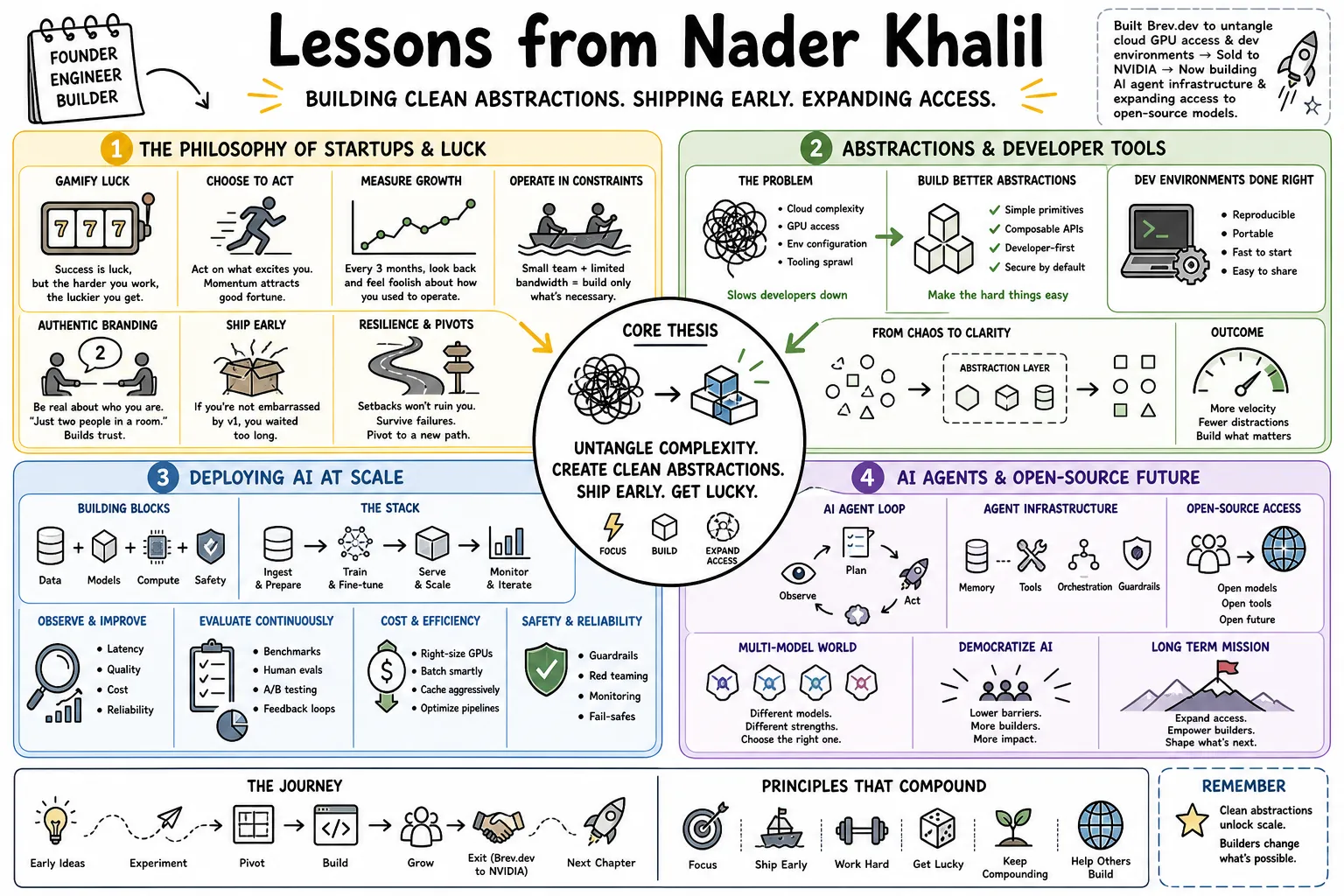
Part 1: The Philosophy of Startups and Luck
- On gamifying luck: "Ultimately, success is luck, but the harder you work, the luckier you get." — Source: Founder to Founder
- On taking action: Choosing to act on what excites you, rather than paralyzing yourself with opportunity costs and optionality, allows you to build momentum and attract good fortune. — Reference: Baxate Podcast
- On measuring growth: A reliable indicator of personal and professional growth as a founder is looking back every three months and feeling foolish about how you used to operate. — Reference: Baxate Podcast
- On constraints: Being forced to operate with a small team and limited bandwidth forces you to focus entirely on building only what is strictly necessary. — Reference: Founder to Founder
- On authentic branding: Startups often pretend to be larger than they are, but embracing your reality—like admitting you are just two people in a room—creates a more genuine and relatable identity. — Reference: Latent Space
- On shipping early: If you are not embarrassed by the first version of your product, you probably waited too long to launch it. — Reference: Founder to Founder
- On resilience: Setbacks and past mistakes won't ruin your future if you continue working hard; you can survive complete failures and successfully pivot to a completely new path. — Reference: Founder to Founder
Part 2: Abstractions and Developer Tools
- On dev environment pain: "When dev environment issues strike, you have no idea how long they’re going to take, and you’re not doing creative work— it feels like blindly throwing things at a wall until something sticks." — Source: DX Tips
- On successful products: "Good startups build good abstractions. Products fail from bad ones. Knowing which abstraction to build is really hard." — Source: DX Tips
- On the limits of abstractions: "there eventually comes a time where you need to do something the makers of an abstraction didn’t intend. And this is where the abstraction fails." — Source: DX Tips
- On evolving needs: Abstractions are powerful when they align with your current problems, but as your problems change, your abstractions must adapt with them. — Reference: DX Tips
- On flexible tooling: Developers should not be forced into a single level of abstraction; instead, tools should let them navigate freely, utilizing only the specific components necessary for their immediate task while hiding what they do not need. — Reference: DX Tips
- On developer preferences: To truly solve the problems of local environments, tools must fully respect and accommodate the individual preferences and existing workflows of developers. — Reference: DX Tips
- On disposable environments: Treating development environments like cattle instead of pets helps engineers avoid the fear of breaking their setups, as they can simply be deleted and replaced. — Reference: Nama Ventures
Part 3: GPU Accessibility and Infrastructure
- On bridging supply gaps: Brev started with the idea of connecting American developers facing daytime supply shortages with idle GPUs in data centers on the other side of the world. — Reference: Washington AI Network Video
- On user experience in cloud computing: Rather than hiding hardware options deep inside complex provisioning forms, tools should make the specific chip developers want the central focus of the interface. — Reference: Latent Space
- On infrastructure costs: Optimizing how hardware is provisioned and utilized can reduce a developer's GPU spending by as much as 90%. — Reference: Viaka Newsletter
- On eliminating configuration: Development tools should abstract away databases, hosting, and scaling so engineers can focus solely on writing the code required for their specific project. — Reference: Founder to Founder
- On democratization: Lowering the barrier to acquiring and managing top-tier GPUs enables startups and individual developers to compete without needing massive, dedicated infrastructure teams. — Reference: Things Have Changed Podcast
Part 4: AI Agents and Open Source
- On the nature of agents: If you conceptualize a large language model as a brain, an agent is simply that brain equipped with a memory, web browsing, and tools to act upon the world. — Reference: Washington AI Network Video
- On integrating AI into workflows: Since most work relies on human-to-human collaboration within shared spaces, plugging agents directly into those same codebases and workflows makes intuitive sense. — Reference: Washington AI Network Video
- On AI harnesses: The infrastructure surrounding models has improved so significantly that developers can leverage off-the-shelf harnesses rather than building agent systems entirely from scratch. — Reference: Washington AI Network Video
- On agent security: To maintain safe bounds, you should limit agents to only two of three key capabilities: file system access, custom code execution, and internet access. — Reference: Latent Space
- On avoiding lock-in with open source: The advantage of open source projects is that if maintainers make decisions you disagree with, you have the option to propose a change or clone the repository entirely, rather than being stuck with a closed system. — Reference: Washington AI Network
- On US leadership in AI: Maintaining America's edge in artificial intelligence is geopolitically critical because it dictates where and how global standards are established. — Reference: Washington AI Network
- On the normalization of AI: AI capabilities will become so fundamental to software that calling something an AI application will eventually sound as redundant as advertising a database application. — Reference: Baxate Podcast
Part 5: Career Trajectory and Execution
- On capturing early opportunities: Making YouTube videos to teach Arabic as a child led to an unexpected in-person tutoring opportunity that permanently changed his career trajectory. — Reference: Baxate Podcast
- On the magic of software: The realization that writing a line of code on a screen could cause a physical object to move in the real world served as the catalyst for pursuing engineering. — Reference: Baxate Podcast
- On pivoting from pain: The struggle of deploying an advertising platform that repeatedly broke in production inspired the pivot away from advertising toward solving the developer environment issue itself. — Reference: Nama Ventures
- On swift adaptation: When a global crisis destroyed demand for ride-share advertising, the team immediately hacked together a platform to help local businesses sell vouchers for future use. — Reference: Nama Ventures
- On contrarian decisions: Moving forward without remote work policies and staying in San Francisco when the broader tech community was migrating elsewhere demonstrated an independent approach to building a company. — Reference: Nama Ventures
- On following user behavior: Even after building a tool for solving general development issues, noticing that users were primarily flocking to the platform for GPU access dictated the company's ultimate focus on AI. — Reference: Nama Ventures