Olivia Moore is a partner on the investing team at Andreessen Horowitz (a16z), where she focuses on consumer applications and the rapidly evolving AI landscape. Through her research, podcasts, and the Accelerated newsletter, she tracks how early-stage startups are applying generative models to reshape human behavior, marketplace economics, and enterprise workflows. The following synthesis explores her perspectives on how AI is transitioning from a novelty to an invisible utility that fundamentally alters how we work and interact.
Part 1: Spotting Consumer App Trends
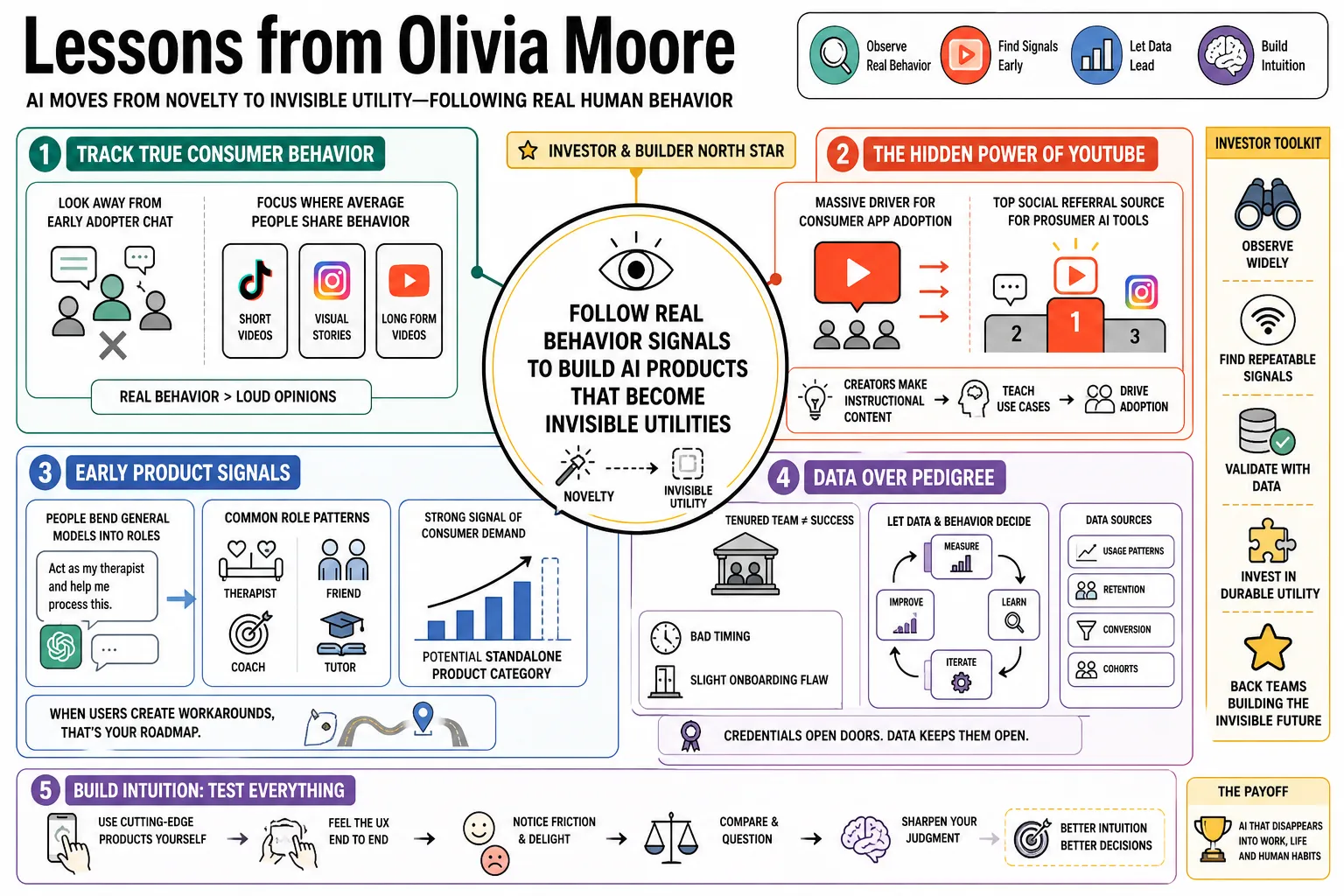
- On tracking true consumer behavior: To find real consumer trends, look away from where AI early adopters talk and instead focus on platforms where average people share their behaviors, such as TikTok, Instagram, and YouTube. — Reference: The Cognitive Revolution
- On the hidden power of YouTube: YouTube acts as a massive driver for consumer application adoption, serving as the top social referral source for many prosumer AI tools thanks to creators making instructional content. — Reference: The Cognitive Revolution
- On early product signals: When users go out of their way to manipulate a general model like ChatGPT into filling a specific role, such as a therapist, friend, or coach, it signals enough consumer demand to support standalone products in that category. — Reference: The Cognitive Revolution
- On data over pedigree: In consumer apps, a highly tenured team can still fail due to bad timing or a slight onboarding flaw; product insights must be driven by data and actual user behavior rather than pure intuition or credentials. — Reference: The Cognitive Revolution
- On building intuition: Actually testing cutting-edge products is one of the simplest yet most overlooked ways for investors and builders to develop market intuition. — Reference: The Cognitive Revolution
- On the scale of virality: Reaching the top of the iOS App Store requires a massive spike in attention, often around 100,000 downloads in a single day, which startups typically achieve by riding or orchestrating viral moments on TikTok. — Reference: LinkedIn
- On invisible AI: The most successful AI applications will eventually operate invisibly, where the core value and stickiness come from underlying algorithms rather than explicit AI interfaces. — Reference: LinkedIn
- On the importance of memory: Personalized memory is currently one of the most underrated features in the consumer AI landscape, even as it becomes critical for long-term utility. — Reference: a16z Podcast
- On the importance of design: When building AI products, subtle choices in product design and user experience frequently matter more in winning users than possessing the highest raw model quality. — Reference: Apple Podcasts
- On cross-app identity: The future utility of consumer applications will heavily depend on their ability to manage cross-application identity and maintain personalized context across workflows. — Reference: Newsfilter
Part 2: The Evolution of Marketplaces
- On second chances for marketplaces: AI is turning historical marketplace graveyards into greenfields by solving the fundamental economic issues that caused previous generation platforms to fail. — Reference: a16z
- On the historical bottleneck: Before AI, complex service marketplaces failed due to high customer acquisition costs caused by matching friction, or low lifetime value caused by infrequent transactions. — Reference: a16z
- On AI as the middleman: By taking over the roles of vetting supply and demand, matching users, and managing relationships, AI removes the human labor bottleneck that historically constrained marketplace growth. — Reference: a16z
- On automated intake: AI voice agents can replace human interviewers in talent marketplaces, screening candidates deeply and cheaply to increase the odds of a successful match without high labor costs. — Reference: a16z
- On proactive candidate engagement: In talent matching, AI can persistently re-engage past candidates the moment a relevant new role appears, driving higher transaction throughput. — Reference: a16z
- On automated coordination: Back-office tasks like inquiry responses, document generation, and scheduling can now be handled by AI, allowing real estate platforms to scale to more properties with leaner teams. — Reference: a16z
- On passing savings to users: As AI reduces the human labor required to facilitate transactions, marketplaces can offer significantly lower commissions to suppliers, shifting the value proposition to win more business. — Reference: a16z
- On driving repeat usage: AI can act as an always-on engagement manager for services needed infrequently, making highly personalized follow-ups exactly when a customer is likely to need maintenance or repairs. — Reference: a16z
- On transitioning to subscriptions: With AI coordinating logistics in the background, marketplaces in traditionally isolated service categories can lock in long-term relationships by charging flat annual subscription rates. — Reference: a16z
- On offering fixed pricing: AI can analyze discovery details effectively enough that complex projects, like roofing or legal services, can be offered to consumers at a guaranteed, transparent fixed price. — Reference: a16z
Part 3: AI in the Enterprise and Startup Budgets
- On AI-native structure: While massive corporations use AI for incremental improvements to existing teams, early-stage startups are building entirely AI-native organizations around new software models. — Reference: a16z
- On tracking real adoption: Analyzing what startups spend on application layer tools offers a much more accurate signal of where AI is creating practical workflow value than looking at infrastructure usage alone. — Reference: a16z
- On the horizontal application lead: Startup budgets lean slightly toward horizontal productivity tools, suggesting broad adoption of capabilities that anyone across a company can use, rather than strict role-specific automation. — Reference: a16z
- On contextual workspaces: Users are increasingly interacting with LLMs directly inside workspaces, signaling that AI usage may split depending on where a user's files and context live rather than consolidating into a single chat interface. — Reference: a16z
- On real-time meeting support: The meeting software category is evolving beyond post-call notetakers to applications that provide real-time, in-meeting feedback to participants. — Reference: a16z
- On the democratization of creative tools: AI has transformed creative tools from niche applications for marketing and design departments into horizontal capabilities usable by any employee. — Reference: a16z
- On the expansion of vibe coding: Vibe coding platforms have expanded beyond engineering teams to enable rapid application building for employees regardless of their technical background. — Reference: a16z
- On augmentors versus substitutes: Currently, most vertical AI software focuses on augmenting human workers by removing mundane tasks, but the market is preparing for end-to-end applications designed to fully substitute specific roles. — Reference: a16z
- On hiring AI: Startups unencumbered by long-term service contracts are leading the trend of hiring autonomous agentic products instead of traditional human professional service firms. — Reference: a16z
- On enterprise controls in vibe coding: While some low-code tools win consumer traffic via rapid UI generation, platforms that offer enterprise controls, autonomous agent runs, and integrated cloud services capture vastly more startup revenue. — Reference: a16z
Part 4: LLM Market Dynamics and Big Tech Strategy
- On the winner-take-most dynamic: Despite intense competition and specialized models entering the space, the broad LLM application market appears to be trending toward a winner-take-most structure. — Reference: Apple Podcasts
- On big tech bottlenecks: Major AI labs are experiencing friction in their consumer product efforts due to internal conflicts over compute allocation and highly risk-averse product execution. — Reference: Newsfilter
- On the startup advantage: In the consumer space, highly opinionated and standalone applications built by agile startups have a stronger chance of breaking out than the incremental feature improvements released by tech incumbents. — Reference: Apple Podcasts
- On model bifurcation: A distinct divergence is emerging in how users apply different top-tier models, with certain foundations becoming the default for enterprise coding while others dominate creative applications. — Reference: Newsfilter
- On local workflows: The market is beginning to shift back toward desktop-local workflows, enabled by powerful local models and platforms designed to run deep integrations directly on the user's machine. — Reference: Newsfilter
- On the role of aggregators: Aggregator platforms are proving critical for global distribution, particularly helping non-Western foundational models gain international market traction among users who might not seek them out directly. — Reference: Newsfilter
- On business model shifts: The introduction of autonomous agents and unified multimodal models is pushing the application market away from standard software subscriptions and toward usage-based pricing models. — Reference: Apple Podcasts
- On workflow integration: The consumer AI tools that maintain persistent recurring usage are those that successfully embed themselves directly into the user's daily workflow rather than requiring the user to visit a distinct destination. — Reference: Newsfilter
Part 5: Agents, Voice, and the Future of Automation
- On agentic operations: Rather than simply digitizing data storage for small businesses, the next wave of platforms is creating autonomous agents capable of executing complex administrative workflows end-to-end. — Reference: Newsfilter
- On selling labor savings: AI applications targeting labor-constrained industries build stronger moats when they frame their product as a direct replacement for manual work hours rather than just another software license. — Reference: Newsfilter
- On workflow ontologies: Startups can create defensible moats against incumbents by building proprietary workflow ontologies that deeply understand the specific operational friction within a niche industry. — Reference: Newsfilter
- On voice AI for SMBs: Voice technology is unlocking new operational capabilities for small businesses, such as deploying conversational AI to handle complex after-hours customer support inquiries affordably. — Reference: The Cognitive Revolution
- On bottom-up educational adoption: The integration of AI into education is being driven strongly from the bottom up, as teachers and parents recognize the potential for massive productivity gains and self-paced learning improvements. — Reference: Newsfilter
- On shifting metrics in education: As schools deploy AI-first models, the definition of success is moving away from traditional standardized testing and toward metrics like weekly engagement and content mastery in self-paced environments. — Reference: Newsfilter
- On high-retention web tools: Some application categories, specifically vibe coding platforms, are proving capable of exceptional revenue retention despite operating entirely on the web and lacking a mobile presence. — Reference: Newsfilter
- On autonomous video generation: Advanced foundation models are accelerating narrative media creation, allowing users to rapidly generate consistent multi-character scenes and dialogue from simple text inputs. — Reference: Newsfilter