Patrick Dovigi is the founder and CEO of GFL Environmental, a waste management company he built from a single operation into a multibillion-dollar business. Before entering the industry, he spent 15 years as a professional hockey goalie, an experience that still shapes how he manages people. This profile covers his views on corporate growth, sustainable energy, and running decentralized teams.
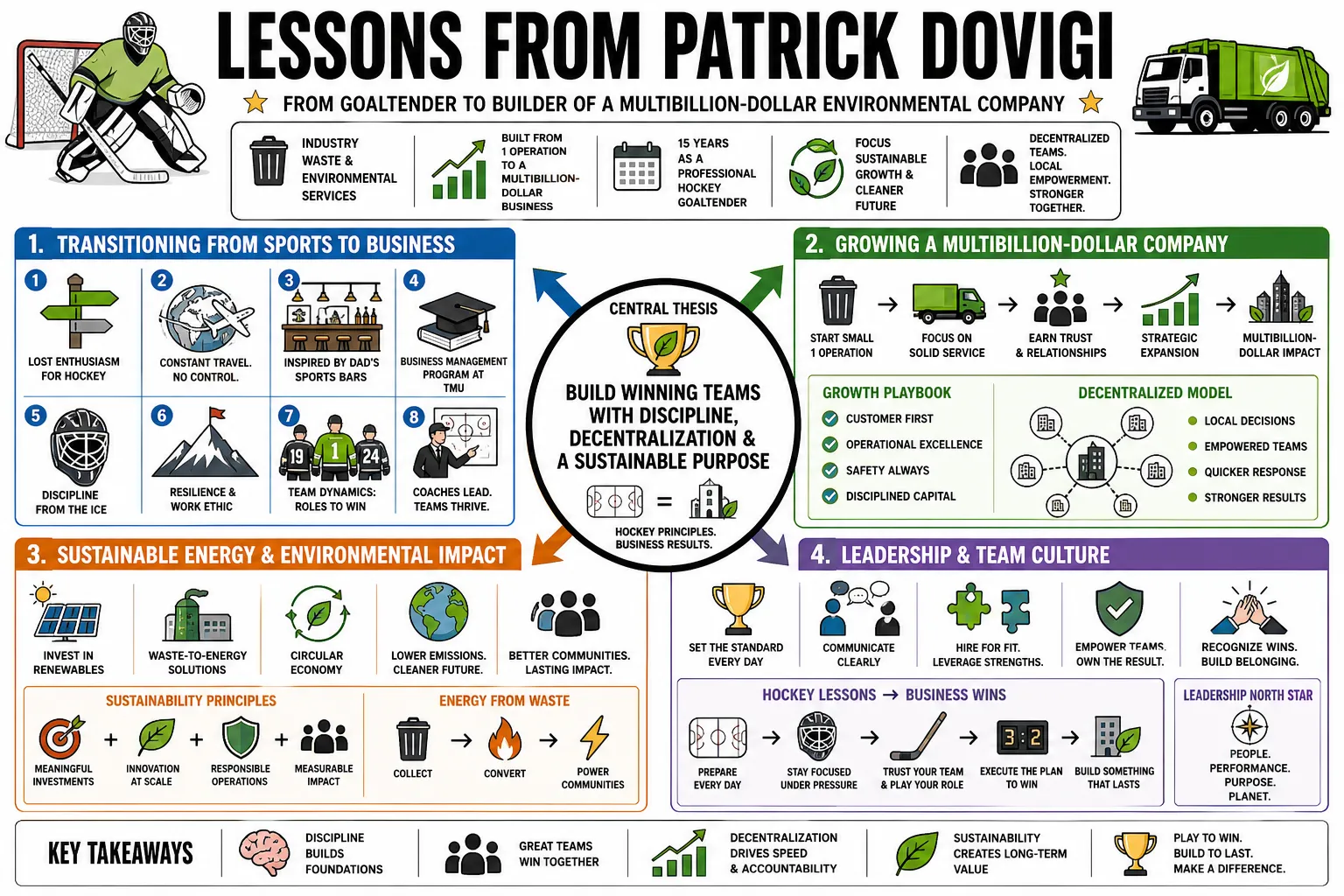
Part 1: Transitioning from Sports to Business
- On changing careers: After 15 years as a goaltender, he lost his enthusiasm for hockey and sought a new path where he could control his own destiny. — Reference: canadianbusiness.com
- On the reality of pro sports: The constant travel and lack of agency over where he lived made him feel like an asset at the mercy of others' draft decisions. — Reference: canadianbusiness.com
- On early inspiration: Watching his father operate sports bars in Northern Ontario sparked his entrepreneurial drive to eventually become his own boss. — Reference: canadianbusiness.com
- On educational steps: To facilitate his transition out of sports, he enrolled in a business management program at Toronto Metropolitan University. — Reference: canadianbusiness.com
- On corporate discipline: He directly attributes his ability to build a major environmental services company to the strict discipline he learned on the ice. — Reference: gflenv.com
- On handling adversity: The resilience and work ethic required to succeed in sports translate seamlessly into the skills needed to be an effective executive. — Reference: canadianbusiness.com
- On team dynamics: He observes that a successful business operates much like a hockey team, requiring distinct roles to cooperate in order to win. — Reference: canadianbusiness.com
- On leadership style: A successful team thrives under a coach who lets players execute the game rather than a dictator who controls every move. — Reference: waste360.com
Part 2: Seizing Unconventional Opportunities
- On entering the industry: His exposure to waste management was accidental, beginning when a small investment bank assigned him to fix an operational disaster. — Reference: canadianbusiness.com
- On learning by doing: Spending over two years cleaning up a site with 100,000 tons of illegally dumped garbage served as an intensive crash course in the industry. — Reference: canadianbusiness.com
- On market fragmentation: After navigating the clean-up, he realized the waste sector was full of small, mom-and-pop operations that could be consolidated. — Reference: canadianbusiness.com
- On defining the service: He built his company to serve as a comprehensive provider for customers, managing everything from municipal trash to underground stormwater. — Reference: canadianbusiness.com
- On initial funding: He secured his first $10 million in seed capital through a relationship formed years earlier while playing hockey with an investor's son. — Reference: canadianbusiness.com
- On expanding during downturns: Rather than retreating during the 2008 financial crisis, he used the economic environment to acquire companies and expand into Western Canada. — Reference: canadianbusiness.com
- On managing growth expectations: He initially set out to build a business generating $50 million in revenue, a goal he ultimately surpassed by reaching $7 billion. — Reference: canadianbusiness.com
- On going public: He viewed his company's 2020 IPO as a necessary step to access the capital required for continued expansion. — Reference: canadianbusiness.com
Part 3: Operational Strategy and Growth
- On empowering regional leaders: He treats local market managers as entrepreneurs, relying on their frontline knowledge to guide collaborative corporate decisions. — Reference: waste360.com
- On employee engagement: Giving people a voice in operational decisions makes them feel more attached to the business and invested in its outcomes. — Reference: waste360.com
- On market valuation: He remains confident that temporary gaps in stock multiples relative to industry peers will correct themselves as the business shows its value. — Reference: wastedive.com
- On long-term scaling: Combining organic growth with up to $2 billion in annual acquisition spending allows him to project doubling the company's size within seven years. — Reference: wastedive.com
- On absorbing acquisitions: Once major deals receive final approval, his immediate focus shifts to integrating the assets and extracting their maximum value. — Reference: waste360.com
- On defending the brand: He is quick to publicly condemn short-sellers, framing their reports as unfounded attacks intended to distract the leadership team. — Reference: corpgov.com
Part 4: Technology and Artificial Intelligence
- On selective technology adoption: Instead of chasing every new trend, he advocates for selecting three to five technical initiatives and executing them thoroughly. — Reference: wastedive.com
- On practical AI: He uses a bottom-up approach to artificial intelligence, relying on his workforce to identify solutions that generate meaningful change rather than tinkering on the margins. — Reference: wastedive.com
- On route optimization: By applying AI to a major hauling yard, he successfully improved the management and efficiency of approximately 200 routes. — Reference: wastedive.com
- On scaling innovation: He drives broader technological adoption by sharing the specific successes of localized AI deployments during quarterly operating reviews. — Reference: wastedive.com
- On tech investment cycles: While capital frequently flows toward high-growth technology, he notes that investors reliably return to steady, compounding businesses when markets crack. — Reference: wastedive.com
Part 5: Environmental Stewardship and Sustainability
- On embedding sustainability: He integrated green practices directly into the corporate strategy, positioning the business to help communities reduce their own carbon footprints. — Reference: usatoday.com
- On the circular economy: He focuses operations on minimizing waste and maximizing resource recovery by steering reusable goods away from landfills. — Reference: usatoday.com
- On clear metrics: He established an action plan that specifically commits to increasing the recovery of recyclables at material recovery facilities by 40% by 2030. — Reference: usatoday.com
- On soil remediation: He expanded the company's capabilities to include treating contaminated soil through techniques like bioremediation, solidification, and thermal absorption. — Reference: usatoday.com
- On regulatory trust: He advises conducting regular audits and engaging with environmental authorities to build credibility and proactively address compliance gaps. — Reference: usatoday.com
- On cultural shifts: Building a sustainable business model requires an organizational transformation that genuinely values social responsibility and environmental stewardship. — Reference: usatoday.com
Part 6: Energy Infrastructure and Renewable Gas
- On energy acquisitions: He targets energy waste disposal companies to improve corporate margins while accelerating growth beyond traditional waste collection. — Reference: wastedive.com
- On political neutrality: He prefers to bet on stable, underlying business returns rather than making investments based on shifting political policies. — Reference: wastedive.com
- On renewable natural gas: He set a corporate goal to double the beneficial use of biogas by 2030 by converting landfill emissions into usable energy. — Reference: usatoday.com
- On scaling infrastructure: To capture more landfill gas, he initiated plans to bring eight new renewable natural gas facilities online by 2028. — Reference: wastedive.com
- On evaluating energy trends: While competitors pivot to generating electricity for data centers, he maintains that renewable natural gas is a safer, more stable play. — Reference: wastedive.com
- On fueling operations: He plans to sell generated natural gas to voluntary markets while also using it directly to fuel his company's compressed natural gas vehicles. — Reference: usatoday.com
Part 7: Extended Producer Responsibility (EPR)
- On program efficiency: He supports extended producer responsibility frameworks that consolidate processing capacity and maintain tight regulatory control over material volumes. — Reference: wastedive.com
- On capital requirements: Executing a successful EPR rollout is complex and requires significant financial investment in new facilities and equipment. — Reference: wastedive.com
- On return stability: Despite the high initial costs, he expects extended producer responsibility programs to generate the same steady returns as traditional collections. — Reference: wastedive.com
- On flawed policies: He is critical of state-level EPR schemes that fail to force systemic change and merely shift the financial burden to other parties. — Reference: wastedive.com
- On legislative opportunities: As governments introduce new material recovery demands, he positions his operations to capture the resulting processing and collection contracts. — Reference: usatoday.com
Part 8: Culture, Safety, and Philanthropy
- On safety culture: He mandates a zero-tolerance policy for distracted driving, arguing it must be reinforced constantly through both legislation and internal rules. — Reference: waste360.com
- On behavioral change: He believes eliminating texting and driving requires the same level of essential retraining as wearing a seatbelt. — Reference: waste360.com
- On internal promotion: He views grooming talent from within as the best use of resources, noting that top drivers often become the company's best managers and executives. — Reference: waste360.com
- On corporate philanthropy: He applies his business success to support host communities, consistently funding local charities focused on family and health initiatives. — Reference: gflenv.com
- On targeted giving: In 2019, he contributed $5 million to create a specialized sports medicine clinic to help individuals recovering from sports-related injuries. — Reference: gflenv.com
- On employee retention: He acknowledges that employees in environmentally conscious organizations report higher well-being, increased productivity, and a stronger commitment to the company. — Reference: usatoday.com