Patrick Lencioni, one of the founders and the president of The Table Group, is an author, consultant, and speaker whose work focuses on organizational health, teamwork, meetings, leadership motive, and individual contribution. Through practical fables and operating models, he argues that healthy organizations depend on vulnerability-based trust, productive conflict, clarity, accountability, collective results, and work aligned with people's natural gifts.
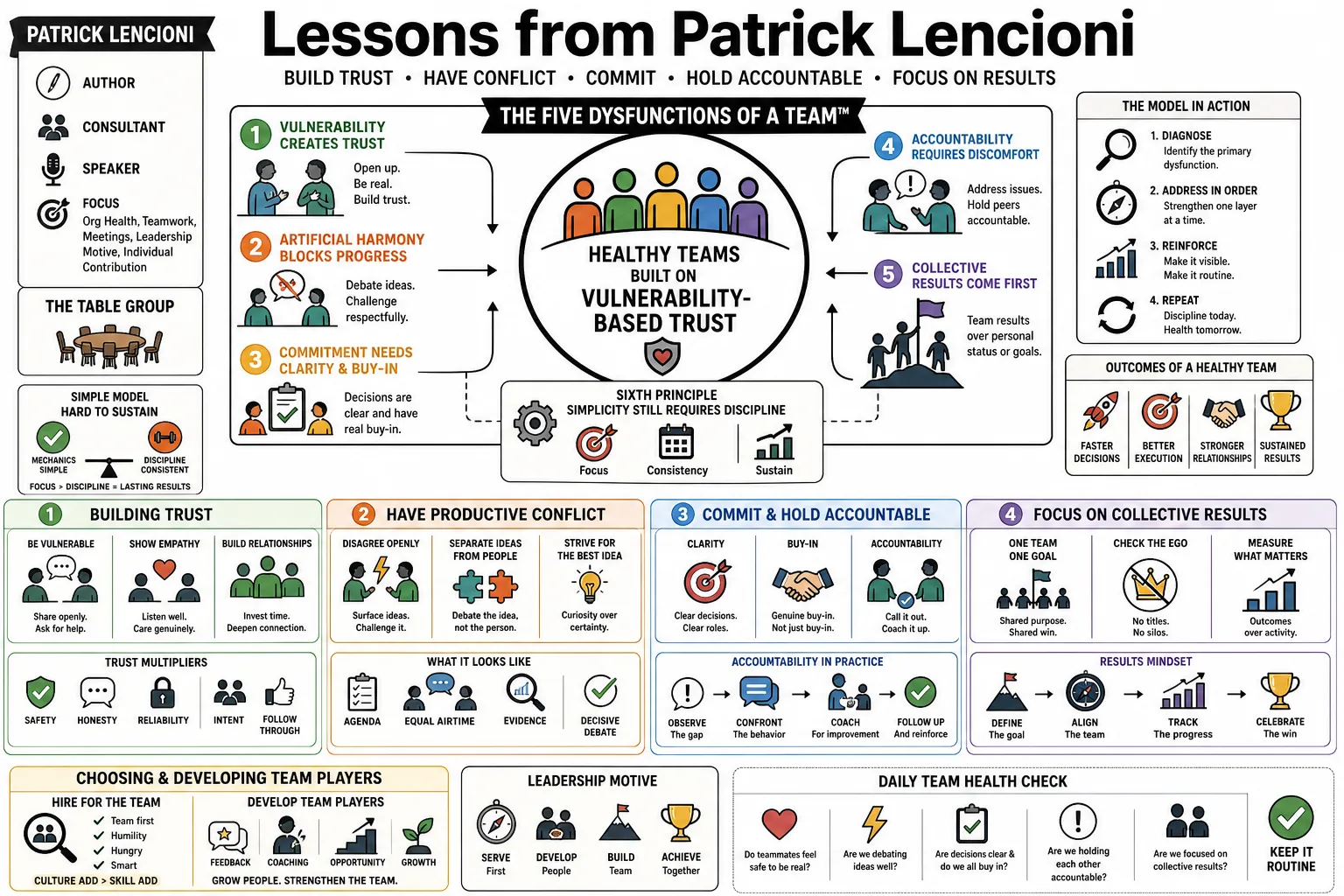
Building Cohesive Teams
- On Vulnerability Creates Trust: Trust begins when teammates can be vulnerable with one another instead of protecting an image of invulnerability. — Reference: The Table Group — Five Dysfunctions of a Team model
- On Artificial Harmony Blocks Progress: A team that protects artificial harmony suppresses the productive disagreement needed to make strong decisions. — Reference: The Table Group — Five Dysfunctions of a Team model
- On Commitment Needs Clarity and Buy-In: People struggle to commit when a decision is unclear or they have not genuinely bought into it. — Reference: The Table Group — Five Dysfunctions of a Team model
- On Accountability Requires Discomfort: Peer accountability fails when people prioritize interpersonal comfort over addressing weak behavior or performance. — Reference: The Table Group — Five Dysfunctions of a Team model
- On Collective Results Come First: Personal status and individual goals weaken a team when they displace attention from shared outcomes. — Reference: The Table Group — Five Dysfunctions of a Team model
- On Simplicity Still Requires Discipline: The mechanics of teamwork are straightforward, but applying them consistently requires focus and discipline. — Reference: The Table Group — Five Dysfunctions of a Team model
Choosing and Developing Team Players
- On Hire for the Combination: The strongest team players combine humility, hunger, and interpersonal intelligence rather than relying on only one or two of those virtues. — Reference: The Table Group — Ideal Team Player model and summary
- On Put Team Success Ahead of Credit: Humility means caring more about the team's success than receiving personal recognition. — Reference: The Table Group — Ideal Team Player model and summary
- On Humility Is Not Self-Erasure: Humble people can acknowledge their skills honestly without turning that acknowledgment into boasting or status seeking. — Reference: The Table Group — Ideal Team Player model and summary
- On Look for Self-Motivated Effort: Hungry team members seek responsibility, fill gaps, and look for the next useful contribution without repeated managerial pushing. — Reference: The Table Group — Ideal Team Player model and summary
- On People Smarts Are Practical: Interpersonal intelligence is the judgment to understand group dynamics and anticipate how words and actions will affect others. — Reference: The Table Group — Ideal Team Player model and summary
- On One Missing Virtue Can Damage the Team: A serious deficit in any one of the three virtues creates predictable team problems even when the other two are strong. — Reference: The Table Group — Ideal Team Player model and summary
- On Hunger Without People Smarts Leaves Damage: A humble, driven contributor can still create interpersonal destruction when they lack awareness of how they affect others. — Reference: The Table Group — Ideal Team Player model and summary
- On Ability Without Hunger Creates Drag: A humble and socially skilled employee who lacks drive frustrates colleagues by contributing only when pushed. — Reference: The Table Group — Ideal Team Player model and summary
- On Teach the Model Before Giving Up: Introducing the three-virtue model and inviting self-assessment can help existing employees recognize where they need to improve. — Reference: The Table Group — Ideal Team Player model and summary
Making Meetings Matter
- On Judge Meetings by Clarity and Commitment: A meeting succeeds when participants leave clear and committed, not merely when it ends quickly or on schedule. — Reference: The Table Group — Death by Meeting model
- On Give Every Meeting a Purpose: Meetings become more useful when each format has a distinct purpose rather than mixing every kind of discussion together. — Reference: The Table Group — Death by Meeting model
- On Use Conflict Productively: Good meetings include enough disagreement to surface real issues and improve the decision. — Reference: The Table Group — Death by Meeting model
- On Keep Daily Coordination Brief: A daily check-in should focus on schedules and immediate activities rather than expanding into tactical or strategic debate. — Reference: The Table Group — Death by Meeting model
- On Resolve Tactical Obstacles Weekly: Weekly tactical meetings should review near-term work and metrics while removing operational obstacles. — Reference: The Table Group — Death by Meeting model
- On Protect Strategic Thinking Time: Longer strategic meetings are for analyzing, brainstorming, and deciding the few issues that affect long-term success. — Reference: The Table Group — Death by Meeting model
- On Use Off-Sites for the Wider System: Quarterly reviews create room to examine strategy, competition, industry shifts, key people, and team development together. — Reference: The Table Group — Death by Meeting model
Leading from Responsibility
- On Know Why You Want to Lead: Leadership motive matters: the role can be treated as a reward to enjoy or as a responsibility to serve. — Reference: The Table Group — Why Matters: A Leader's Motivation
- On Do the Uncomfortable Work: Responsibility-centered leaders accept difficult, mundane, and uncomfortable duties as part of the job. — Reference: The Table Group — Why Matters: A Leader's Motivation
- On Develop the Team: A leader cannot hide behind personal competence while refusing to develop or trust the people around them. — Reference: The Table Group — Why Matters: A Leader's Motivation
- On Have the Hard Conversation: Avoiding a difficult conversation does not remove the leadership obligation; it merely leaves the problem for others. — Reference: The Table Group — Why Matters: A Leader's Motivation
- On Run the Team's Meetings: Leaders abdicate responsibility when they allow important team meetings to be repeatedly displaced by individual priorities. — Reference: The Table Group — Why Matters: A Leader's Motivation
- On Repeat the Message: Clarity usually requires leaders to communicate consistently and repetitively rather than cycling through each new management idea. — Reference: The Table Group — Why Matters: A Leader's Motivation
Aligning Work with Working Genius
- On Name Your Geniuses and Frustrations: People work better when they can describe the activities that energize them, the competencies they can perform, and the work that chronically frustrates them. — Reference: Carey Nieuwhof Leadership Podcast — Patrick Lencioni on Working Genius
- On Drop Guilt About Natural Limits: Stop treating every missing natural gift as a personal failure; use self-awareness to design better contribution and support. — Reference: Carey Nieuwhof Leadership Podcast — Patrick Lencioni on Working Genius
- On Ask for Complementary Help: Naming the work that causes frustration makes it easier to ask teammates with complementary gifts to take the lead. — Reference: Carey Nieuwhof Leadership Podcast — Patrick Lencioni on Working Genius
- On Staff Around Gifts: Aligning roles with natural gifts benefits both the person doing the work and the organization relying on it. — Reference: Carey Nieuwhof Leadership Podcast — Patrick Lencioni on Working Genius
- On Use Gifts to Increase Team Joy: Teams become more energizing when people understand one another and can contribute through their strongest modes of work. — Reference: Carey Nieuwhof Leadership Podcast — Patrick Lencioni on Working Genius
- On Change a Misaligned Role: When a job consistently opposes someone's natural contribution, first seek a role pivot; if no viable pivot exists, consider a better-fitting position. — Reference: Carey Nieuwhof Leadership Podcast — Patrick Lencioni on Working Genius
- On Helping Is a Distinct Contribution: Setting aside your own preferred task to support someone else is a real form of contribution, not an ability everyone naturally shares. — Reference: Carey Nieuwhof Leadership Podcast — Patrick Lencioni on Working Genius
- On Reframe Challenges as Opportunities: Stepping back from a challenge can reveal an opportunity that is invisible while reacting from inside the problem. — Reference: Carey Nieuwhof Leadership Podcast — Patrick Lencioni on Working Genius