Paul Copplestone is the co-founder and CEO of Supabase, an open-source database platform that emerged as the primary alternative to Firebase. He is known for building a highly autonomous, asynchronous company culture composed largely of former founders, and for his strict adherence to building on top of standard Postgres rather than proprietary systems. This profile collects his direct operating principles, offering a practical look at how he approaches product-led growth, remote team building, and the shifting landscape of AI-assisted coding.
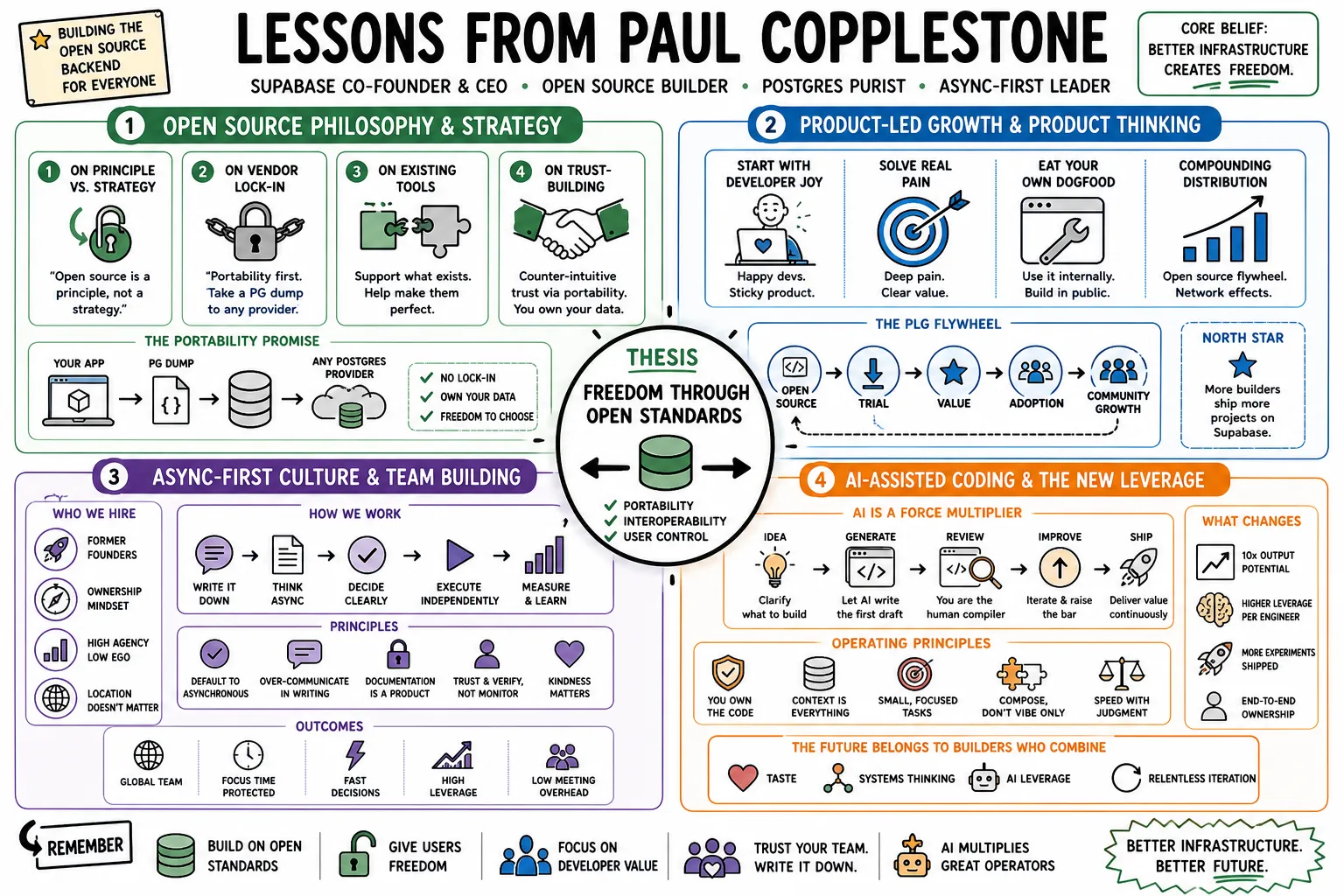
Part 1: Open Source Philosophy & Strategy
- On principle vs. strategy: "Open source is a principle, not a strategy. I wouldn't want to work on tools if they were closed source." — Source: [Syntax.fm]
- On vendor lock-in: "One of our core principles is portability. You should be able to take anything you build, basically a PG dump, and take it to your favorite Postgres provider." — Source: [The Changelog]
- On existing tools: "We like the model where you try to support the tools that exist. They might not be perfect, but we can help to try and make them perfect." — Source: [The Commit Podcast]
- On trust-building: Counter-intuitive trust is built through portability; guaranteeing users the right to leave ensures they feel safe to stay. — Source: [StackSync]
- On configuration over customization: "Go for configuration over customization. Expose the knobs and levers so that people can customize themselves. Otherwise, you end up building many different products." — Source: [Copplest.one]
- On enterprise deals: Avoid deals with enterprises that require massive amounts of bespoke work, as it fragments the core open-source product. — Source: [Scaling DevTools]
- On default architectures: Open source should be the default way to build infrastructure, rather than a marketing growth hack to acquire initial users. — Source: [Reddit]
- On open standards: By relying on open standards like SQL and Postgres, developers gain a level of flexibility and extensibility that proprietary NoSQL ecosystems cannot offer. — Source: [Medium]
- On competing via experience: Open-source companies should win by providing a vastly superior developer experience and hosting service rather than through restrictive licensing. — Source: [Open Source Startup Podcast]
- On long-term focus: "Building for 30 years, not quick wins," is the only viable timeline for foundational open-source infrastructure. — Source: [TechCrunch]
Part 2: Building Developer Tools
- On developer love: "There’s only one way to build a great database company: it’s to become the database that developers love on day one." — Source: [Wandb.ai]
- On the weekend goal: A developer tool must allow users to "build in a weekend, scale to millions." — Source: [Supabase Blog]
- On simplicity: "We’re very proud that we don’t have to teach you anything. If you can’t use it without us intervening, then we haven’t done our job." — Source: [Syntax.fm]
- On the danger of handholding: "We see a lot of that handholding exercise should just be product. As much as we can, we’re trying to build around the limitations." — Source: [Coatue Interview]
- On community retention: "You have to keep your community. I’ve seen so many great developer tools that I’ve loved slowly wane because they lose the pulse of their own community." — Source: [Evil Martians]
- On early choices: Developers choose their underlying stack before they even conceptualize the side project they are going to build, making early adoption critical. — Source: [TechCrunch]
- On avoiding fragmentation: Turning down million-dollar enterprise contracts is necessary if it prevents you from bifurcating your product into twenty different versions. — Source: [The Changelog]
- On technical debt: Proprietary lock-in is a form of technical debt that developers inevitably regret as their applications scale. — Source: [Linux Foundation]
- On product-led growth: The product itself must be the primary driver of education; if sales teams must explain the basics, the user experience has failed. — Source: [Accel Spotlight]
Part 3: The Primacy of Postgres
- On replacing legacy systems: "The death of Oracle won't take a generation." — Source: [TechCrunch]
- On generational defaults: "If you can become a generation's default database, you earn the right to take on the giants." — Source: [Wandb.ai]
- On ubiquitous query engines: "I'd love to see better support for pluggable storage. I think Postgres can become a more ubiquitous query engine for more specialized use-cases." — Source: [The Changelog]
- On built-in extensibility: "Luckily with Postgres, it's got extensibility built in," which allows it to adapt to new paradigms without breaking the core engine. — Source: [Syntax.fm]
- On standardizing data: Postgres is the foundation of everything; mastering it eliminates the need to reinvent basic data storage paradigms. — Source: [Thinking Elixir]
- On avoiding lock-in: Because Supabase is standard Postgres under the hood, users are protected from the exact vendor trap that traditional Backend-as-a-Service platforms create. — Source: [The Commit Podcast]
- On the 100-day challenge: During Y Combinator, he challenged an engineer to "build an interface that looks exactly like a table on top of Postgres and you've got 100 days to do it." — Source: [Y Combinator Blog]
- On the limits of NoSQL: Relational data structures in Postgres eventually outlast the early convenience of schema-less NoSQL databases as applications mature. — Source: [Copplest.one]
- On AI vector storage: The extensibility of Postgres through tools like pgvector allows it to effortlessly transition into the AI era without needing a separate database. — Source: [Hashnode]
Part 4: Remote Work & Async Culture
- On async-first design: An organization should be built like an open-source project that is highly autonomous, capable of self-management, and running with very few meetings. — Source: [JobsByCulture]
- On written updates: Teams post weekly written updates and metrics instead of holding synchronous stand-ups to force deep engagement with the numbers. — Source: [Evil Martians]
- On the three solutions rule: To decouple a proposal from a creator's ego in an async environment, designers must present three different ways to solve a problem. — Source: [Dev Propulsion Labs]
- On intellectual honesty: "Writing is a way of rethinking about problems" and helps maintain the intellectual honesty required when you cannot debate in real-time. — Source: [Coatue Interview]
- On meeting minimalism: "Teams have by requirement one meeting a week and then outside of that they can attend any meeting but they don’t have to." — Source: [Accel Spotlight]
- On global reach: Operating across dozens of time zones demands that almost everything is documented; decisions are made in writing so everyone participates equally. — Source: [Syntax.fm]
- On culture as a filter: "Supabase is very remote and async and loud about that. So culture begins before someone even applies. You either fit our culture or you don't." — Source: [Copplest.one]
- On extreme autonomy: Remote work only functions when you hire individuals who do not require daily check-ins to maintain momentum. — Source: [Open Source Startup Podcast]
- On the relentless pace: A high-autonomy async environment often leads to a relentless shipping pace, requiring individuals to self-enforce their own boundaries. — Source: [Glassdoor]
- On social bonding: Synchronous video calls should be strictly reserved for moments when async communication breaks down or for deliberate social connection. — Source: [The Changelog]
Part 5: Hiring & Team Composition
- On hiring ex-founders: "Former founders fit really well into Supabase because they kind of fit into this distributed culture where we can give them a lot of autonomy." — Source: [Dev Propulsion Labs]
- On beaten-down egos: He actively seeks out ex-founders with beaten-down egos because they care more about solving the problem correctly than maintaining their status. — Source: [Evil Martians]
- On the reality of PMF: Founders who have spent years grinding for product-market fit truly appreciate positive growth charts, unlike those accustomed to large corporate stability. — Source: [TechCrunch]
- On self-selection: A former founder willing to take an individual contributor role has likely already made peace with stepping out of the spotlight. — Source: [Coatue Interview]
- On high agency: Ex-founders are used to owning entire domains end-to-end, making them perfect independent operators in a flat remote structure. — Source: [Syntax.fm]
- On the prestige of interviewing: "Make interviewing a badge of honor. We treat hiring like an honor. That means we have a small list of people approved by the CEO to interview." — Source: [Accel Spotlight]
- On polarizing vs. toxic: "There’s a big difference between hiring someone who’s an asshole and hiring someone who’s polarizing. No one follows an asshole from their last job." — Source: [Copplest.one]
- On cultural onboarding: "The best cultural onboarding happens before people join. People join Supabase because they know this is how we operate." — Source: [Wandb.ai]
- On the glamour of startups: The allure of being a founder is vastly overstated compared to the quiet satisfaction of solving hard technical problems for forty hours a week. — Source: [Dev Propulsion Labs]
Part 6: Launch Weeks & Marketing
- On the origin of Launch Week: Without the looming deadline of a Demo Day, they needed a new forcing function to maintain shipping momentum. — Source: [Evil Martians]
- On sustained momentum: Launching one major feature every day for five days creates a sustained slope of growth, keeping the product at the top of community feeds longer than a single launch. — Source: [Supabase Blog]
- On fixed timelines: The rule is fixed timeline, variable scope; if a feature is not ready, it gets pulled, but the Launch Week happens regardless. — Source: [The Changelog]
- On engineers writing copy: The person who writes the code writes the marketing content, ensuring technical depth and zero marketing fluff. — Source: [Supabase Blog]
- On building holistic engineers: Forcing engineers to write their own release posts trains them to clearly communicate the value of their work to the community. — Source: [Syntax.fm]
- On approachability: Marketing must remain intentionally fun and human, relying on inside jokes, puns, and internal meme workshops. — Source: [Twitter]
- On community spotlights: Starting a launch cycle by highlighting open-source contributors reinforces the company's positioning as a collaborative alternative to proprietary giants. — Source: [Coatue Interview]
- On immediate adoption: Running a hackathon immediately after a week of feature releases incentivizes developers to turn from passive readers into active builders. — Source: [The Commit Podcast]
- On avoiding playing startup: Sticking to strict launch deadlines prevents teams from endlessly polishing features and forces them to ship and learn. — Source: [Open Source Startup Podcast]
Part 7: AI and the "Vibe Coding" Era
- On vibe coding: Developers are increasingly shifting toward vibe coding, where they use AI agents to prompt an application into existence rather than writing it line-by-line. — Source: [Medium]
- On demos not memos: Product managers should stop writing long specification memos; instead, they should use AI to generate a functional demo to show developers exactly what they want. — Source: [AWS re:Invent]
- On the 100x engineer: "With AI and agents now, you literally can be a 100x engineer. A back-end engineer can do front-end, and front-end can do back-end." — Source: [Syntax.fm]
- On the democratization of building: AI lowers the barrier to entry so drastically that product managers are seamlessly transitioning into hands-on builders. — Source: [TechCrunch]
- On machine-readable APIs: Infrastructure companies must ensure their documentation and APIs are easily legible to language models, effectively making themselves the default choice for AI agents. — Source: [Evil Martians]
- On reducing boilerplate friction: AI removes the friction of setting up early infrastructure, allowing human developers to focus entirely on hardening, securing, and scaling. — Source: [Hashnode]
- On capturing AI traffic: By building standard, predictable, and robust Postgres tools, Supabase positions itself to passively capture the massive influx of AI-generated code. — Source: [Twitter]
- On the irrelevance of syntax: The exact syntax of code matters less when an AI writes it; the focus shifts entirely to architectural intent and user experience. — Source: [Copplest.one]
- On the permanence of the shift: The pivot toward prompt-based application generation is a permanent, structural change in software engineering. — Source: [Wandb.ai]
Part 8: Startup Strategy & Y Combinator
- On extreme iteration: "Everything in Supabase is an iteration. I can’t remember any time we’ve done like a big bang change. If you try to do too much too soon you’ll just have a failure to launch." — Source: [Accel Spotlight]
- On the reality of PMF: "Product-market fit happens in stages." He actively pushes back on the myth that product-market fit is a single lightning-strike moment. — Source: [Copplest.one]
- On the early pivot: Supabase repositioned from real-time Postgres to an open-source Firebase alternative three months in, proving the necessity of early flexibility. — Source: [Medium]
- On YC pressure: "What happens during YC is that you get all this pressure leading up to demo day," which serves as the ultimate catalyst for early velocity. — Source: [Y Combinator Blog]
- On building remotely in YC: Being part of the first fully remote batch meant operating from Singapore and taking critical meetings at 2 a.m., shaping their future async culture. — Source: [TechCrunch]
- On community as a moat: Building an open-source community around your startup provides a defensive moat that raw capital cannot easily replicate. — Source: [Syntax.fm]
- On avoiding the handholding trap: If your product requires extensive customer success intervention to function, you are building a consultancy, not a scalable startup. — Source: [The Changelog]
- On the community of communities: Rather than building every feature from scratch, startups should sponsor and integrate existing open-source projects to compound their growth. — Source: [Open Source Startup Podcast]
- On refusing bad revenue: Taking enterprise money to build bespoke features is the fastest way to lose focus and ruin a startup's trajectory. — Source: [Scaling DevTools]
- On the role of luck: You cannot guarantee startup success, but by shipping constantly and openly, you effectively widen the luck funnel so good things are more likely to happen. — Source: [Evil Martians]