Philipp Herzig is the Chief Technology Officer and Chief AI Officer at SAP, where he leads the integration of business AI and autonomous agents across the company's software portfolio. He is recognized for advocating that enterprise AI adoption requires deep domain context and embedded workflows rather than standalone tools or isolated platforms. This profile distills his approach to building enterprise-ready AI, migrating to the cloud, and managing the organizational shifts required to operate an autonomous enterprise.
Part 1: Context and the Autonomous Enterprise
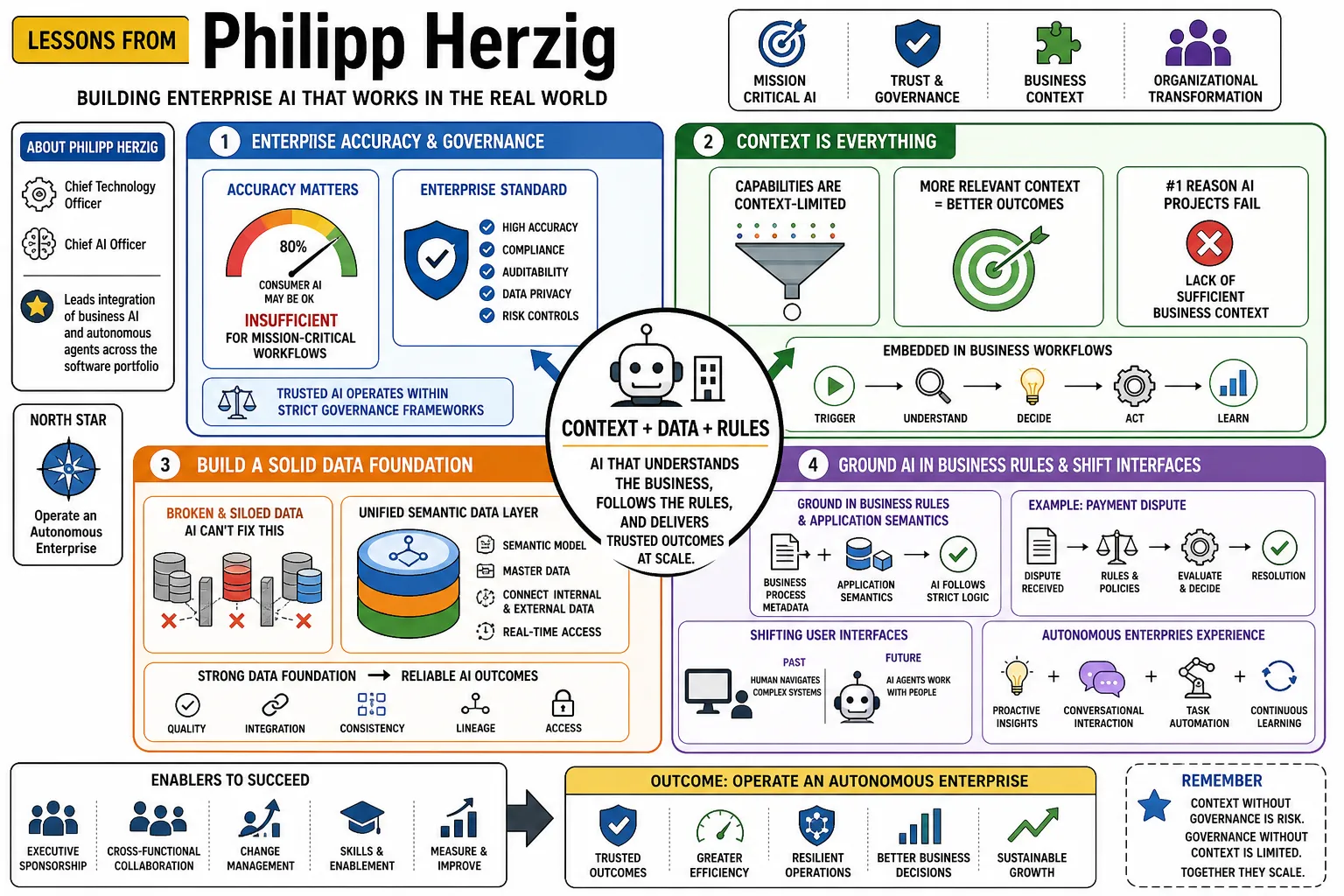
- On Enterprise Accuracy: An 80% accuracy rate may work for consumer AI applications, but it is entirely insufficient for mission-critical business workflows, which require AI that operates within strict compliance and governance frameworks. — Reference: SAP Sapphire Keynote
- On the Importance of Context: An AI agent's capabilities are fundamentally limited by the depth and quality of the context it can access. — Reference: SAP Sapphire Keynote
- On AI Project Failures: The primary cause of failure for enterprise AI initiatives is a lack of sufficient business context. — Reference: SAP Sapphire Keynote
- On Data Foundation: An AI agent cannot compensate for a broken or siloed data model; organizations must build a unified semantic data layer that connects internal and external data before deploying agents. — Reference: SAP Sapphire Keynote
- On Grounding AI in Business Rules: To ensure AI systems follow strict logic during complex operations like payment disputes, models must be tied directly to business process metadata and application semantics rather than raw text alone. — Reference: FutureCIO
- On Shifting User Interfaces: The era of building software that relies entirely on human intelligence to navigate complex interfaces has ended. — Reference: No Priors YouTube
- On the Innovation-to-Outcome Gap: While AI experimentation is nearly universal, many companies struggle to translate that activity into tangible financial returns, resulting in an expanding gap between technological innovation and actual business outcomes. — Reference: No Priors Podcast
- On Cohesive Architecture: A consistent, layered AI framework spanning user experience, autonomous assistants, and process orchestration is significantly more valuable than a disjointed collection of isolated product announcements. — Reference: Cloud Wars
Part 2: Product Strategy and Embedded AI
- On Embedded Workflows: AI features deliver the highest value when they are embedded directly into existing applications, allowing users to query HR, finance, and supply chain data simultaneously without switching interfaces. — Reference: TechTarget
- On the Cost of On-Premises AI: Attempting to build AI capabilities on top of legacy on-premises systems frequently devolves into massive data cleansing projects that cost more than the AI is projected to save. — Reference: TechTarget
- On Cloud Exclusivity: Because scaling AI requires out-of-the-box functionality, true enterprise AI delivery is effectively a cloud-only proposition. — Reference: Computer Weekly
- On Vendor Responsibility: Software providers should handle the heavy lifting of security, data pipelines, and identity management so customers are not forced to hire large teams of data scientists simply to deploy standard AI features. — Reference: Computer Weekly
- On Extensibility and Security: While core AI features should run natively, enterprises still need dedicated platforms with restricted extension points to safely build custom capabilities without opening new security vulnerabilities. — Reference: TechTarget
- On Evaluating AI Features: Every AI feature must be measured by its return on investment; if a tool is too expensive to run or provides marginal business value, customers will simply ignore it. — Reference: Computer Weekly
- On KPI-Driven Agents: Specialized AI assistants should be designed with specific outcomes in mind, mapped to core business roles, and measured against defined performance metrics. — Reference: SAP Sapphire Keynote
Part 3: Organizational Change and AI Leadership
- On the Role of the CAIO: A Chief AI Officer must maintain a 360-degree view that aligns engineering, legal, marketing, and commercial teams to navigate rapid technological shifts safely. — Reference: DataCamp
- On End-to-End Alignment: To accelerate how fast customers see benefits from AI, internal teams working on product research must be directly linked to the teams managing customer implementations. — Reference: ERP Today
- On Immutable Values: While underlying models and technologies change constantly, an organization's core values regarding how AI should fit into workflows and applications must remain steady. — Reference: DataCamp
- On Change Management: Deploying AI is a fundamental organizational transformation challenge, requiring leadership to guide employees through deep changes in how they execute their daily work. — Reference: FutureCIO
- On Human-Agent Collaboration: Software providers can automate tasks, but customers must still actively rethink their operating models and job roles to effectively collaborate with autonomous agents. — Reference: Cloud Wars
- On Leadership Resilience: Navigating the current pace of AI development requires leaders to cultivate intense personal and organizational resilience to endure stressful periods of rapid change. — Reference: DataCamp
- On the Cost of Inaction: Taking a wait-and-see approach to AI is a strategic error; organizations need to begin experimenting immediately to discover where the technology adds real value. — Reference: TechTarget
- On Standardization: The transition to AI mirrors the origin of enterprise software: realizing that building custom implementations from scratch for every customer is economically unscalable. — Reference: No Priors Podcast
- On Migration as Strategy: System modernization is no longer just a technical back-office upgrade; it is the foundational infrastructure required to enable an enterprise-wide AI transformation. — Reference: Cloud Wars
Part 4: Ethics, Governance, and Safety
- On Human Oversight: Maintaining a human in the loop is a non-negotiable design principle for enterprise AI to ensure safety, compliance, and trust in the system's outputs. — Reference: FutureCIO
- On Ethical Guidelines: An effective AI ethics policy must explicitly mandate the avoidance of discriminatory language and require the system to cite sources for its generated recommendations. — Reference: TechTarget
- On the AI Act: Companies that have proactively baked AI governance and human oversight into their systems since the design phase have little to fear from emerging regulations like the EU AI Act. — Reference: TechTarget
- On Final Decisions: Even as autonomous AI agents gain the ability to reason, plan, and execute across multiple applications, a human must retain ultimate decision-making authority. — Reference: FutureCIO
- On Lifecycle Risk: Managing AI ethics requires assessing risks differently at the early design phase versus the runtime deployment phase. — Reference: TechTarget
- On Market Hype vs. Reality: True enterprise AI adoption depends on strict governance, security, and scalability—elements that are often entirely ignored in broad market discussions about AI capabilities. — Reference: Financial Express
- On Managing Multiple Agents: As companies deploy a mix of internal and third-party AI agents, they require a centralized command center to discover, govern, and monitor them effectively. — Reference: SAP Sapphire Keynote
Part 5: The Future of Work and Global Talent
- On Job Security: AI will not eliminate the role of the software developer, but developers who refuse to learn AI coding tools will inevitably lose their jobs to those who do. — Reference: Financial Express
- On Productivity and Demand: The software development industry acts as an early indicator for the broader workforce: massive gains in productivity through AI typically generate higher overall demand rather than eliminating jobs. — Reference: Financial Express
- On Developer Efficiency: Agentic coding tools represent a clear, immediate killer use case for enterprise AI, delivering documented efficiency gains of 30% to 50% for engineering teams. — Reference: Financial Express
- On the Verifiability Gap: Because current AI agents lack guaranteed accuracy, there is a massive emerging need for trained human consultants whose sole job is to verify that domain-specific agents are executing their tasks correctly. — Reference: Financial Express
- On Regional Talent Hubs: Aggressive government promotion and intense local ambition have positioned India as a vital testbed and primary talent hub for deploying enterprise AI. — Reference: Financial Express
- On Internal AI Literacy: Distributing generative AI tools directly to internal developers is a necessary step to increase overall AI literacy and operational efficiency across a global company. — Reference: FutureCIO
- On Addressing Anxiety: Technology leaders have a direct responsibility to address employee anxieties regarding AI job displacement through transparent communication and active reskilling support. — Reference: FutureCIO
Part 6: Evaluations, Scale, and Organizational Learning
- On the Demo-to-Scale Gap: A system that works across ten documents or a handful of APIs has not yet proved it can operate across thousands of documents and tens of thousands of enterprise interfaces, where scale becomes the defining engineering problem. — Reference: No Priors YouTube
- On Personalized Context: Useful enterprise context must reflect master data such as an employee's location, role, permissions, payroll, and tax rules rather than relying on a generic document repository alone. — Reference: No Priors YouTube
- On Evaluation-First Development: Agent builders should define testable outcomes and boundary conditions before implementation, because generated work is valuable only when the desired business result can be verified. — Reference: No Priors YouTube
- On Test-Driven AI Coding: As agents automate more implementation work, people need to specify expected behavior before code is generated, making test-driven development more important rather than less. — Reference: No Priors YouTube
- On Systems of Record as Ground Truth: Existing transactional systems provide an initial evaluation baseline because they show what valid process inputs and outcomes should look like. — Reference: No Priors YouTube
- On Agent Mining: Human clarifications and agent decision traces should be captured as organizational learning data instead of disappearing into calls, chats, and individual memory. — Reference: No Priors YouTube
- On Improving Standard Procedures: Agent traces can expose both harmful local deviations and genuinely better ways of working; organizations should suppress the former and promote the latter into improved standard operating procedures. — Reference: No Priors YouTube
- On APIs and Computer Use: Structured tools and APIs should carry most durable automation, while computer-use agents are best reserved for legacy systems or workflows without reliable interfaces. — Reference: No Priors YouTube
Part 7: Structured Intelligence and AI Economics
- On Unstructured and Structured Work: Large language models deliver the fastest early gains in document-heavy work, while finance, sales, and supply-chain processes require added semantic and orchestration layers to work reliably with structured data. — Reference: No Priors YouTube
- On Knowledge Graphs: Knowledge graphs connect natural-language requests to structured enterprise data by resolving business terms that can refer to several different objects or processes. — Reference: SAP TechEd
- On Predictive Workloads: Language models are not the right default for forecasting demand, cash flow, payment delays, churn, and other tabular outcomes that depend on classification, regression, or time-series reasoning. — Reference: No Priors YouTube
- On Relational Foundation Models: A pretrained model for relational and tabular data can replace hundreds of narrow models and produce useful predictions from limited context without retraining a new system for every task. — Reference: SAP Prior Labs Announcement
- On Long-Term Agent Memory: Enterprise agents should preserve prior inputs, decisions, and corrections so they improve over time instead of restarting each interaction without organizational memory. — Reference: SAP TechEd
- On AI Pricing Models: Enterprise AI economics will move from seats toward consumption and eventually outcomes, but hybrid pricing remains necessary while customers still need cost predictability and independently verifiable results. — Reference: No Priors YouTube
- On the New Product Bottleneck: As generating code becomes cheaper, the constraint shifts toward product ideas, precise specifications, security, and product-market fit; faster implementation should enable more disciplined experimentation. — Reference: CNBC YouTube