Raquel Urtasun is the founder and CEO of Waabi and a computer science professor at the University of Toronto who shifted autonomous vehicle development away from brute-force road testing. Through high-fidelity generative AI simulation, she developed an approach that trains autonomous trucks to handle rare edge cases before they ever touch public highways. This profile collects her perspectives on the limitations of traditional robotics, the economics of freight, and the realities of leading a deep-tech company.
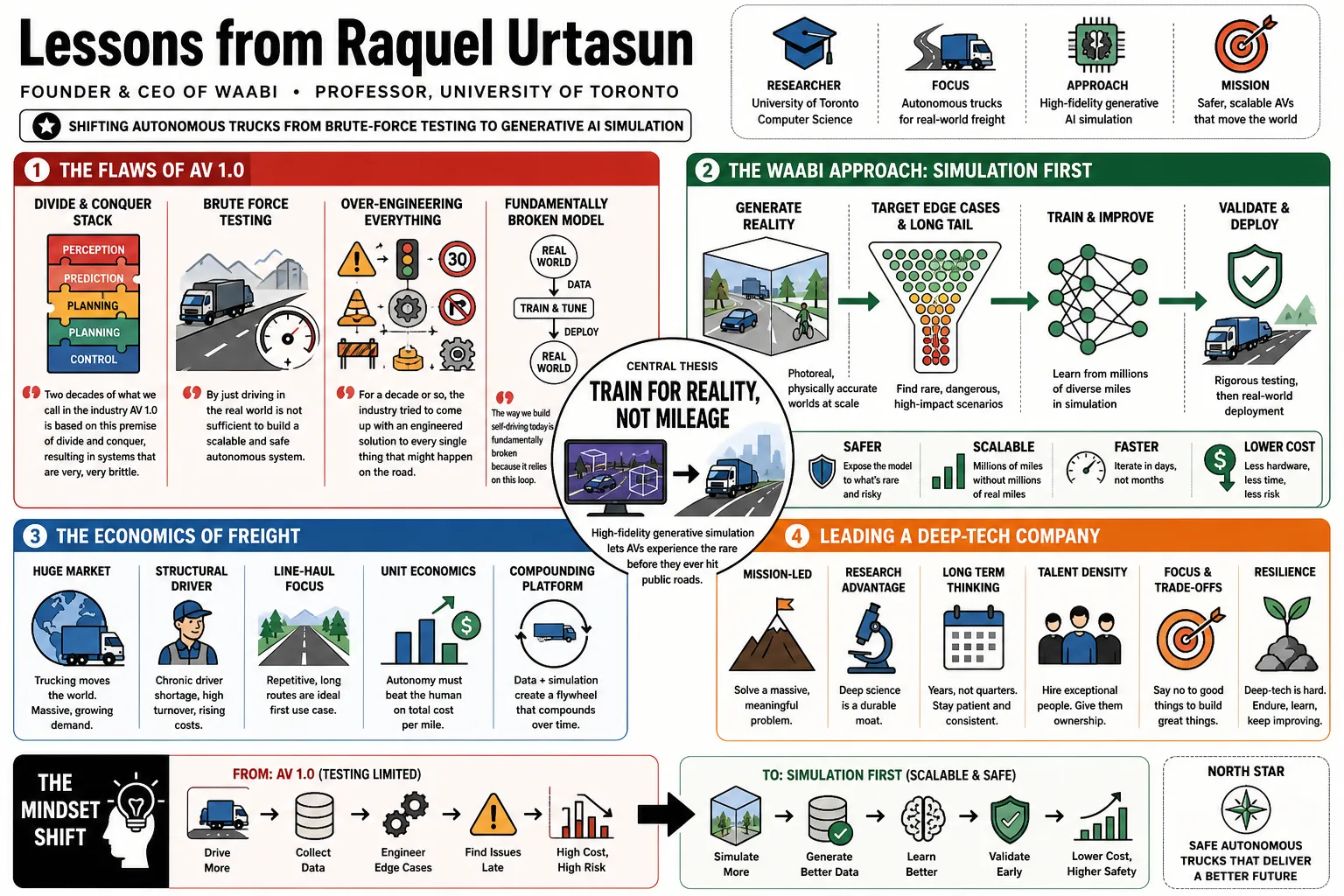
Part 1: The Flaws of AV 1.0
- On the traditional robotics stack: "Two decades of what we call in the industry AV 1.0 is based on this premise of divide and conquer, resulting in systems that are very, very brittle." — Source: [TechCrunch Found Interview]
- On brute force testing: "By just driving in the real world is not sufficient to build a scalable and safe autonomous system." — Source: [U of T News]
- On over-engineering: "For a decade or so, the industry tried to come up with an engineered solution to every single thing that might happen on the road. That has been very non-scalable and cumbersome." — Source: [TechCrunch]
- On the broken development model: "The way we build self-driving today is fundamentally broken because it relies on manual rules and endless real-world trial and error." — Source: [Lex Fridman Podcast]
- On capital intensity: "I didn’t think the industry’s capital-intensive approach of physically driving millions of miles would generate scalable technology that could be deployed in the real world." — Source: [Business Insider]
- On human coders vs. reality: "You simply cannot have a human engineer write a rule for every possible scenario a vehicle might encounter in the physical world." — Source: [TechCrunch]
- On the illusion of progress: "The world was trying to solve this very complex task in the exact same way, creating a massive echo chamber where brute-force mileage was mistaken for actual intelligence." — Source: [Business Insider]
- On the limits of the modular approach: "When you break driving down into isolated modules—perception, prediction, planning—errors cascade and compound throughout the system." — Source: [The AI Podcast]
- On being a second mover: "There is a huge advantage to being a second mover in this space. We get to learn from the massive limitations of the AV 1.0 era without inheriting its technical debt." — Source: [U of T Entrepreneurship]
- On old software architectures: "AI needs to be at the center of the solution in order for the technology to scale. It can’t be peripheral or plugged into an old software stack." — Source: [Business Insider]
Part 2: The AI-First Paradigm & AV 2.0
- On learning like a human: "Our approach for training the systems is the other way around. The system can actually learn like humans do, which is by learning from data and experience." — Source: [TechCrunch]
- On the single brain concept: "The brain of the self-driving car should be a single AI system that can learn and generalize, rather than thousands of lines of hand-coded rules." — Source: [Lex Fridman Podcast]
- On the definition of AV 2.0: "AV 2.0 is an AI-first approach where a single foundation model is responsible for the entire driving task, learning end-to-end from vast amounts of data." — Source: [TechCrunch Found Interview]
- On generalization: "Because we use deep learning for the entire driving task, the system can generalize its understanding to new environments without needing bespoke engineering for every new city." — Source: [The Robot Brains Podcast]
- On learning vs. programming: "We are no longer programming the car to drive; we are building an AI that learns how to drive by observing the world." — Source: [The AI Podcast]
- On data-driven decision making: "When you replace handwritten logic with a learned model, the vehicle becomes infinitely more adaptable to the complex realities of the physical world." — Source: [U of T News]
- On continuous improvement: "An AI-first system gets better every single day just by ingesting more data, whereas an engineered system becomes harder to update as the code base grows." — Source: [TechCrunch]
- On physical AI: "We are entering the era of physical AI, where generative models and large-scale machine learning are finally interacting safely with the real, physical environment." — Source: [BetaKit]
- On breaking the mold: "We needed to be different, think different, and be creative to escape the paradigm that trapped the rest of the autonomous driving industry." — Source: [Forbes]
Part 3: Generative Simulation & Waabi World
- On the purpose of simulation: "We build a simulator which is a concept that is very different than anything else that exists. It uses the power of generative AI to create a virtual universe." — Source: [TechCrunch Found Interview]
- On high-fidelity environments: "We have built a simulator that is so high-fidelity that the AI doesn't know it's in a simulator. This allows us to train the system in a way that was previously impossible." — Source: [Lex Fridman Podcast]
- On training vs. testing: "Simulation is not just for testing; it's for training. It is the only way to expose the AI to the 'long tail' of rare events safely." — Source: [Lex Fridman Podcast]
- On the competitive advantage of simulation: "Because we can do everything on the simulator, we are already ready with a generation that is much more advanced without needing massive physical fleets." — Source: [Forbes]
- On sensor simulation: "Waabi World generates the actual sensor data—the LiDAR, the camera feeds, the radar—so the AI brain experiences the virtual world exactly as it would the real one." — Source: [The AI Podcast]
- On interactive environments: "It’s not just a static video game. The simulation acts as a reactive world where the virtual traffic agents respond dynamically to what our autonomous truck is doing." — Source: [TechCrunch]
- On speed of development: "A high-fidelity simulator allows us to iterate and test new software versions in minutes rather than waiting weeks for a physical fleet to gather miles." — Source: [U of T News]
- On capital efficiency: "By shifting the bulk of our training to the virtual world, you end up with a system that you can develop much faster and that requires vastly less capital." — Source: [U of T Entrepreneurship]
- On generative AI's physical application: "Waabi World is the ultimate application of generative AI. It hallucinates a physically accurate reality to teach a robot how to survive." — Source: [The Robot Brains Podcast]
- On infinite data: "Through procedural generation and generative AI, our simulator gives us an infinite data engine to train the vehicle on scenarios that almost never happen in reality." — Source: [TechCrunch Found Interview]
Part 4: Safety, Edge Cases, and The Long Tail
- On the core motivator: "When this technology is at scale, it will save so many lives. Improving safety on the road is one of the most important motivators for me." — Source: [TechCrunch Found Interview]
- On learning on public roads: "If you learn on the road, that’s dangerous. You cannot put untrained, experimental software on highways with human drivers around." — Source: [TechCrunch Found Interview]
- On solving the long tail: "The hardest part of autonomous driving is the long tail—the one-in-a-million events. You cannot physically drive enough miles to encounter them all." — Source: [Lex Fridman Podcast]
- On Safety 2.0: "By training entirely in simulation, this is a way to really push safety—what we call safety 2.0—to the absolute next level before the tires ever touch the pavement." — Source: [U of T News]
- On proving safety first: "Safety is the first thing that we need to prove before deployment. It cannot be an afterthought patched in during physical testing." — Source: [TechCrunch]
- On handling chaos: "We can train the system to handle chaotic edge cases in simulation, deliberately throwing complex accidents and weather at the AI so it knows exactly how to react." — Source: [U of T Entrepreneurship]
- On zero real-world harm: "The beauty of the virtual world is that our trucks can crash millions of times during training without a single person ever getting hurt." — Source: [The AI Podcast]
- On public trust: "Building public trust requires demonstrating mathematically and empirically that your system can handle the unexpected, not just the everyday routine." — Source: [The Logic]
- On deterministic validation: "Simulation provides a deterministic environment where we can test the exact same dangerous scenario thousands of times to guarantee the AI's safety response." — Source: [TechCrunch Found Interview]
Part 5: The Autonomous Trucking Opportunity
- On choosing trucking first: "Highways are still very difficult, but they’re less complex compared to a city like Toronto, with all the pedestrians, bikes, and people who don't follow the rules." — Source: [U of T Entrepreneurship]
- On commercial reality: "We are not building demos; we are building a real commercial product from day one." — Source: [TechCrunch Found Interview]
- On market necessity: "The supply chain is incredibly strained. Autonomous trucking isn't just a cool science project; it is a critical necessity to keep the global economy moving." — Source: [TechCrunch]
- On the Uber partnership: "Uber is the largest network globally, so partnering with Uber Freight enables an incredible market for us to enter and scale." — Source: [Forbes]
- On unit economics: "Trucking offers a clear path to profitability. The unit economics of moving freight autonomously on highways make sense much faster than the robotaxi market." — Source: [Business Insider]
- On B2B deployment: "Working directly with major carriers allows us to deploy the technology in structured, predictable hub-to-hub routes, minimizing operational chaos." — Source: [The Logic]
- On hardware integration: "We design our AI to be platform-agnostic, meaning our autonomous brain can be integrated seamlessly into the manufacturing lines of major trucking OEMs." — Source: [TechCrunch]
- On scaling logistics: "Autonomy will unlock a level of efficiency in logistics that is currently impossible due to hours-of-service regulations and human fatigue." — Source: [The Robot Brains Podcast]
- On the first commercial miles: "Our focus is purely on launching a driverless commercial service that delivers real freight for real customers safely and reliably." — Source: [U of T News]
Part 6: The Human Element & Workforce Impact
- On the grueling nature of trucking: "I don’t think that humans should actually be doing long-haul trucking. It keeps them away from their families for weeks and takes a massive toll on their health." — Source: [TechCrunch Found Interview]
- On shifting the workforce: "Instead of spending weeks on the highway, this workforce is going to be working at terminals, managing the logistics, which will actually provide better, safer jobs." — Source: [TechCrunch]
- On upskilling drivers: "The future of the trucking workforce is in local, last-mile delivery and terminal operations—roles that allow drivers to sleep in their own beds at night." — Source: [The AI Podcast]
- On the driver shortage: "We are building technology that addresses a massive, structural shortage of drivers. We are not replacing a thriving workforce; we are filling a critical gap." — Source: [Forbes]
- On the human toll of accidents: "When a human driver makes a split-second error in a massive semi-truck, the consequences are devastating. We are building this to prevent those tragedies." — Source: [TechCrunch Found Interview]
- On humanizing work: "Technology should serve to humanize our lives. Removing people from the most dangerous, monotonous jobs is exactly what AI should be used for." — Source: [TechCrunch]
- On economic empowerment: "By lowering the cost of transport, autonomous trucking will decrease the price of goods for everyday consumers, creating broad economic empowerment." — Source: [The Logic]
- On collaborative transitions: "We work closely with our freight partners to ensure that the transition to autonomous fleets is done in a way that respects and supports their human drivers." — Source: [Business Insider]
- On physical labor and AI: "The true promise of AI is not replacing creative thought, but liberating humans from perilous physical labor." — Source: [BetaKit]
Part 7: Academia, Industry, and The Toronto Ecosystem
- On the Canadian AI advantage: "Canada, wake up. The physical AI revolution is happening right now, and we have the talent to lead it globally." — Source: [BetaKit]
- On remaining in Toronto: "I want this company to remain, as much as possible, Canadian. I love Toronto, I love Canada. It’s an amazing place to do innovation." — Source: [U of T News]
- On the Toronto tech ecosystem: "We see a lot of foreign talents that do not necessarily have any ties to Canada that want to come here because this is the place to be for AI." — Source: [U of T News]
- On academic limitations: "As an academic, I cannot pay to have massive datasets manually labeled. Just the aerial images alone would cost between twenty to thirty million dollars." — Source: [LDV Capital]
- On the industry stepping stone: "Had I started Waabi strictly as an academic without my experience in industry, I don’t think I would be as successful today." — Source: [Business Insider]
- On bridging two worlds: "I am still an academic at heart, but leading a company is definitely the next level of bringing theoretical research into physical reality." — Source: [U of T Entrepreneurship]
- On the role of universities: "Universities like U of T are the engines of fundamental research. My goal is to keep a tight loop between academic breakthroughs and industrial deployment." — Source: [U of T News]
- On global competition: "Toronto has a unique collaborative culture that you don't always see in Silicon Valley, which gives us an incredible edge in building complex systems." — Source: [Global News]
- On building homegrown champions: "We don't just want to export our best AI researchers; we want to build generation-defining, globally successful companies right here in Canada." — Source: [The Logic]
Part 8: Leadership, Grit, and Fundraising
- On self-belief: "Be bold, aim high and never give up. Don't let anyone tell you that you can't do it, because YOU can." — Source: [Radical Ventures]
- On pitching investors: "In front of the venture capitalists, you cannot be humble. They will never fund you. You need to confidently explain why you, why this team, and why this technology." — Source: [U of T Entrepreneurship]
- On absolute grit: "What has made me very successful is I have infinite grit. Regardless of what people say, that just fires me up to say, 'I'm going to show you.'" — Source: [Radical Ventures]
- On the role of the CEO: "I'm CEO of the company, but I also do a lot of the technology, business, HR, legal, PR, whatever—make coffee, you name it. It's very important that you embrace that." — Source: [Business Insider]
- On founder commitment: "Building a company is such a hard, but an exciting, thing. You should put all of your soul into it or you shouldn't do it." — Source: [Forbes]
- On choosing the right VC: "I knew from the beginning I wanted to work with investors from the deep tech and AI sector, because they would fundamentally understand Waabi's long-term mission." — Source: [Khosla Ventures]
- On emotional regulation: "Understanding that your behavior is going to affect the team is important. You need to be calm. No matter which fires are out there, handle them in the background to keep the team stable." — Source: [Radical Ventures]
- On strategic discipline: "My philosophy is to write a strategy and focus relentlessly on that. I just tuned out the noise and focused on doing my thing." — Source: [Forbes]
- On building the right team: "There is nothing that can really substitute building the technology you believe in with the people you genuinely love to work with." — Source: [Khosla Ventures]
- On ultimate motivation: "I’m not building Waabi just for an exit. I am building it to completely transform the physical world." — Source: [Business Insider]