Lessons from Rebecca Lynn
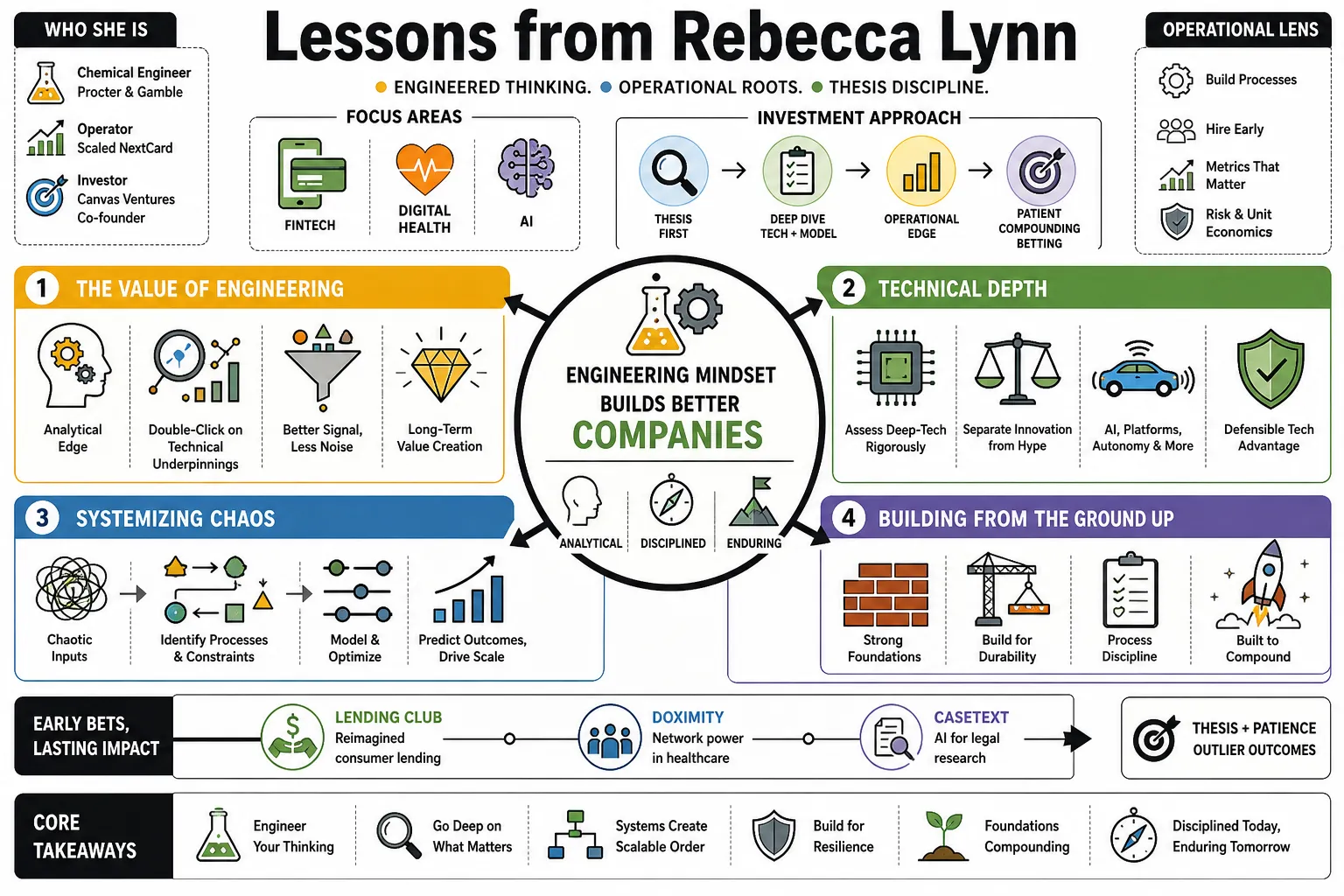
Canvas Ventures co-founder Rebecca Lynn focuses on early-stage investments in fintech, digital health, and AI. Before entering venture capital, she worked as a chemical engineer at Procter & Gamble and helped scale NextCard. That operational background grounds her strict, thesis-driven approach, which led to early bets on Lending Club, Doximity, and Casetext.
Part 1: The Chemical Engineering Foundation
- On The Value of Engineering: "Her chemical engineering background provides an analytical edge, allowing her to double-click on the technical underpinnings of companies she evaluates." — Source: [Stanford eCorner]
- On Technical Depth: "Having an engineering foundation is useful when assessing deep-tech companies like AI platforms or autonomous vehicle startups, as it helps separate real innovation from marketing claims." — Source: [Stanford eCorner]
- On Systemizing Chaos: "Chemical engineering trains the brain to look at chaotic systems and identify the underlying processes and constraints, an ability that applies directly to scaling early-stage startups." — Source: [Forbes]
- On Building From the Ground Up: "The rigorous nature of engineering translates into her preference for companies that build fundamentally sound technological infrastructure before adding commercial applications." — Source: [Canvas Ventures]
- On First Principles Thinking: "Engineering teaches first-principles problem solving, which she uses to deconstruct market assumptions rather than accepting the consensus view in Silicon Valley." — Source: [Invest Like the Best]
- On Bridging Tech and Business: "Her transition from engineering to holding a JD/MBA allowed her to translate complex technical capabilities into clear legal and business frameworks." — Source: [Stanford eCorner]
- On The Law and Tech Convergence: "Understanding patent law provides a distinct advantage when evaluating defensible intellectual property in highly competitive sectors." — Source: [Stanford eCorner]
- On Midwestern Pragmatism: "Raised in a farming family in Missouri, she approaches venture capital with an expectation of hard work and tangible results, avoiding the echo chamber of the coasts." — Source: [Fortune]
- On Recognizing Mainstream Needs: "The Midwest perspective is vital because Silicon Valley VCs often build products for themselves, ignoring the practical problems faced by mainstream America." — Source: [Fortune]
Part 2: Lessons from Procter & Gamble
- On The Gold Standard: "Procter & Gamble serves as the gold standard for consumer marketing, teaching foundational lessons about how to identify and speak directly to a target audience." — Source: [The Full Ratchet]
- On The Umbrella Concept: "A brand must establish an umbrella concept—an emotional, high-level promise—that sits above and unifies all individual product features and technical details." — Source: [Invest Like the Best]
- On Emotional Resonance: "In the P&G framework, marketing a paper towel isn't about absorbency; it's about positioning the parent as the hero who quickly restores order to the household." — Source: [The Full Ratchet]
- On Ignoring Personal Bias: "I learned early in my tenure at Procter & Gamble that my personal opinion does not matter. It's far more important what the customer says." — Source: [SaaStr]
- On Feature Obsession: "Tech founders frequently make the mistake of marketing the spokes instead of the umbrella, diluting their message by focusing entirely on features." — Source: [Invest Like the Best]
- On The Why vs. The What: "Buyers look for the reason a product exists; if a company cannot articulate this beyond technical specifications, its marketing fails." — Source: [Invest Like the Best]
- On Institutional Discipline: "Large consumer goods companies instill a discipline around market research and consumer testing that venture-backed startups often lack." — Source: [The Full Ratchet]
- On Brand Architecture: "Applying P&G's brand architecture to B2B SaaS helps companies organize multiple product lines into a cohesive, easily understandable story for enterprise buyers." — Source: [SaaStr]
- On International Expansion: "Launching products internationally for P&G taught her how to adapt core messaging to entirely different cultural contexts and consumer behaviors." — Source: [Canvas Ventures]
Part 3: The NextCard Era & Surviving the Crash
- On Taking Money Off the Table: "When you can take some money off the table, you should do it... It’s like when you play poker; when you’re up, you take some money off the table and play with your winnings." — Source: [Stanford eCorner]
- On Managing Greed: "Founders and investors must actively manage the temptation of greed, securing enough capital to change their lives before returning to focus on the long-term mission." — Source: [Stanford eCorner]
- On Rapid Scaling: "As employee #30 at NextCard, she witnessed firsthand the operational friction involved in scaling a company to over 1,300 employees and navigating a massive IPO." — Source: [The Twenty Minute VC]
- On The Dot-Com Collapse: "Experiencing a company lose 98% of its public market value in a single day instilled a profound respect for fundamental business economics over speculative growth." — Source: [Stanford eCorner]
- On Building Digital Distribution: "NextCard's success in becoming the first real-time online credit card approval platform required building an unprecedented digital advertising engine from scratch." — Source: [The Twenty Minute VC]
- On Data-Driven Marketing: "Before it was standard practice, running massive online ad campaigns required treating marketing as an engineering discipline centered on conversion data." — Source: [The Full Ratchet]
- On Risk Awareness: "Surviving the early 2000s tech crash taught her to recognize frothy market conditions and differentiate between durable businesses and temporary phenomenons." — Source: [Bloomberg Technology]
- On Early Fintech Pioneers: "The first generation of online financial services proved that consumers were willing to trust digital platforms with their money if the friction was removed." — Source: [Fintech Leaders]
- On Playing with House Money: "Once founders secure their financial downside, they often make bolder, more rational strategic decisions because the fear of personal ruin is removed." — Source: [Stanford eCorner]
Part 4: Thesis-Driven Sourcing
- On Outbound Investing: "Rather than waiting for inbound pitch decks, her firm proactively maps out sectors, identifies the necessary solution, and then searches for the founder building it." — Source: [The Health Care Blog]
- On Defining a Thesis: "A proper thesis involves drawing a detailed picture of where an industry is headed over the next five to ten years and using that as an absolute filter for all investments." — Source: [Invest Like the Best]
- On Exhaustive Mapping: "Before investing in Doximity, she evaluated over 300 healthcare IT companies to gain absolute conviction on the market dynamics and the winning model." — Source: [The Health Care Blog]
- On Missing Pinterest: "A conversation with cousins in Missouri about Pinterest taught her that ignoring regional trends outside of California leads to missing massive cultural shifts." — Source: [Fortune]
- On Concierge Tech: "She actively avoids funding concierge services for wealthy coastal elites, preferring to target companies that solve unglamorous, structural problems for mainstream consumers." — Source: [Fortune]
- On Sector Focus: "In today's market, nothing is more important than focus... This intentional approach is how we find, support, and grow transformational companies." — Source: [Canvas Ventures]
- On The Matchmaker Model: "She specializes in marketplace dynamics, identifying platforms that successfully act as matchmakers between fragmented supply and diffuse demand." — Source: [Smart Venture Podcast]
- On Recognizing Patterns: "Thesis-driven investors don't just look for good teams; they look for specific structural market failures that a new technology can inevitably correct." — Source: [The Health Care Blog]
- On Early Identification: "Deep research allows an investor to have conviction at the Series A or B stage, precisely when the cost of customer acquisition might look temporarily terrible to outsiders." — Source: [The Full Ratchet]
- On Validation Through Diligence: "The process of reviewing hundreds of competitors ensures that when the final investment is made, the VC understands the competitive moat better than anyone else." — Source: [The Health Care Blog]
Part 5: Evaluating Founders & Teams
- On The Red Flag of Distraction: "And that's a big red flag for me... if you're spending so much energy on non-core issues, that you're not thinking about how to scale your business." — Source: [Stanford eCorner]
- On Tenacity vs. Stubbornness: "Tenacity is an ally. Stubbornness is not. They can feel similar. Learn the difference internally and it will serve you well." — Source: [Smart Venture Podcast]
- On Customer Isolation: "A major warning sign is a founder who refuses to speak directly with their end consumers, relying instead on internal assumptions or secondhand data." — Source: [Smart Venture Podcast]
- On Coachability: "The best founders possess a paradoxical mix of extreme, stubborn confidence in their vision, combined with an open willingness to be coached on operational tactics." — Source: [Invest Like the Best]
- On Cultural Foundation: "A company built on shaky operational ground or distracted leadership will never be able to foster a thriving internal culture as it scales." — Source: [Stanford eCorner]
- On Fixing Companies: "Venture capital is 25% picking the right company and 75% building and fixing, requiring a hands-on partnership with the founding team." — Source: [Canvas Ventures]
- On Recognizing Blind Spots: "Successful founders are acutely aware of their own operational blind spots and actively hire executives who compensate for those specific weaknesses." — Source: [The Twenty Minute VC]
- On Market Feedback: "When a founder is overly stubborn about how they view the market, they fail to iterate when early adoption metrics point them in a slightly different direction." — Source: [Smart Venture Podcast]
- On Diversity of Thought: "Promoting diverse hiring prevents the intellectual groupthink that routinely causes startups to miss obvious market opportunities." — Source: [All Raise]
- On The Right Motivation: "She looks for founders driven by a stubborn desire to solve a specific problem, rather than those primarily motivated by the status of running a startup." — Source: [Stanford eCorner]
Part 6: Board Leadership & Fiduciary Duty
- On The Core Responsibility: "I just don't know how you could possibly give a venture capitalist money and have them not sit on a board... what you're paying that person to do is be a fiduciary." — Source: [Smart Venture Podcast]
- On Long-Term Board Impact: "The next one to 10 years is all about the work the board does to help hire the right team, focus the strategy, and take advantage of new technology opportunities." — Source: [Smart Venture Podcast]
- On Crypto Skepticism: "She has heavily criticized the trend of VCs investing in blockchain without clear use cases, questioning how such speculative bets align with strict fiduciary duties." — Source: [The New York Times]
- On Avoiding the Scattershot Trap: "A VC cannot effectively serve on boards and protect their LPs' capital if they make dozens of shallow investments; deep involvement is required." — Source: [Stanford eCorner]
- On Independent Directors: "Bringing on independent board members early helps professionalize a startup and prevents the board from becoming an echo chamber between founders and investors." — Source: [Smart Venture Podcast]
- On Guarding Against Froth: "A key role of the board is to serve as the voice of financial reason during market manias, protecting the company's long-term health over short-term hype." — Source: [Bloomberg Technology]
- On Navigating Transitions: "The board plays a critical role in managing the transition periods, such as evolving the executive team as the company shifts from Series B to pre-IPO maturity." — Source: [The Twenty Minute VC]
- On Humility in Governance: "Effective board members maintain the humility to admit when their initial assumptions were wrong, adjusting strategy rather than forcing a failed thesis." — Source: [Stanford eCorner]
- On Operational Value Add: "Startups should expect their lead investors to actively recruit talent, negotiate partnerships, and troubleshoot marketing bottlenecks, rather than merely attending quarterly meetings." — Source: [Canvas Ventures]
Part 7: Go-To-Market & Distribution
- On The Definition of Fintech: "Fintech is all about distribution and acquisition." — Source: [The Twenty Minute VC]
- On Fixing Acquisition Costs: "She invested in Lending Club despite its high early Customer Acquisition Cost because she knew her operational experience could fix the marketing engine." — Source: [The Full Ratchet]
- On Good Marketing vs. Product: "She frequently argues that in crowded, commoditized markets, superior marketing and distribution will almost always defeat a marginally better product." — Source: [The Full Ratchet]
- On Removing Friction: "Financial tools succeed when they remove cognitive load. Products like Check succeeded because they were making the stress of your finances go away." — Source: [The Full Ratchet]
- On Target Audiences: "You're not the target audience as a venture capitalist. So many people forget that." — Source: [Fortune]
- On Validating Product-Market Fit: "True product-market fit only exists when the company has engineered a repeatable, scalable distribution channel that functions efficiently outside of early adopters." — Source: [Invest Like the Best]
- On Aligning Sales and Marketing: "In B2B environments, disjointed messaging between the marketing umbrella and the direct sales team will fatally undermine the customer acquisition engine." — Source: [SaaStr]
- On Building the Engine: "Startups must transition from opportunistic hacks to a systematic marketing engine driven by data, testing, and predictable conversion metrics." — Source: [Fintech Leaders]
- On Nailing the Customer: "It is entirely possible to fix a broken acquisition model if the startup has completely nailed the core product experience and deeply understands the target user." — Source: [The Full Ratchet]
- On The Consumer Feedback Loop: "Establishing direct, high-frequency channels for consumer feedback is a non-negotiable requirement for sustaining long-term distribution advantages." — Source: [SaaStr]
Part 8: AI, Market Cycles, & The Future
- On The Generative AI Shift: "The current wave of generative artificial intelligence represents a true Vanguard moment that will redefine the tech landscape similarly to the invention of the iPhone." — Source: [Fortune]
- On Transformative AI: "She has zero interest in companies that simply tag AI onto an existing platform; she requires AI that is deeply integrated and transformative to the core business model." — Source: [Bloomberg Technology]
- On Rebuilding the Stack: "Companies like Luminar succeed because they pair massive software AI teams with hardware, fundamentally reinventing the technological stack of their industry." — Source: [The Full Ratchet]
- On Supercharging Industries: "The most lucrative applications for AI will be in legacy sectors like legal research and wealth management, where workflows can be massively accelerated." — Source: [Canvas Ventures]
- On The Advantage of Scarcity: "Your limitations in resources can actually be helpful. So many of our best decisions were pivots in response to obstacles that seemed devastating at first glance." — Source: [Forbes]
- On Thriving in Downturns: "Great companies are created in downturns... the best companies are grown in an environment of scarcity and economic uncertainty." — Source: [SaaStr]
- On Cutting Burn Rates: "When the market shifts, founders must immediately cut your burn, cut your burn, and cut your burn, ensuring they can survive on their own oxygen without external funding." — Source: [Bloomberg Technology]
- On Pivot Readiness: "An economic downturn is the ultimate test of a team's agility; those unwilling to pivot away from a cash-intensive strategy will not survive the winter." — Source: [Bloomberg Technology]
- On The Venture Cycle: "Enduring the 2008 financial crisis proved that while capital dries up, the fundamental need for innovation remains, leading to the creation of generationally defining companies." — Source: [Stanford eCorner]