Reynold Xin co-created Apache Spark and co-founded Databricks. He went from writing distributed systems code at UC Berkeley to designing databases for a world where AI agents write most queries. This collection covers his views on open-source infrastructure, data engineering, and scaling an enterprise software company.
Part 1: The Origins of Spark and Open Source Data
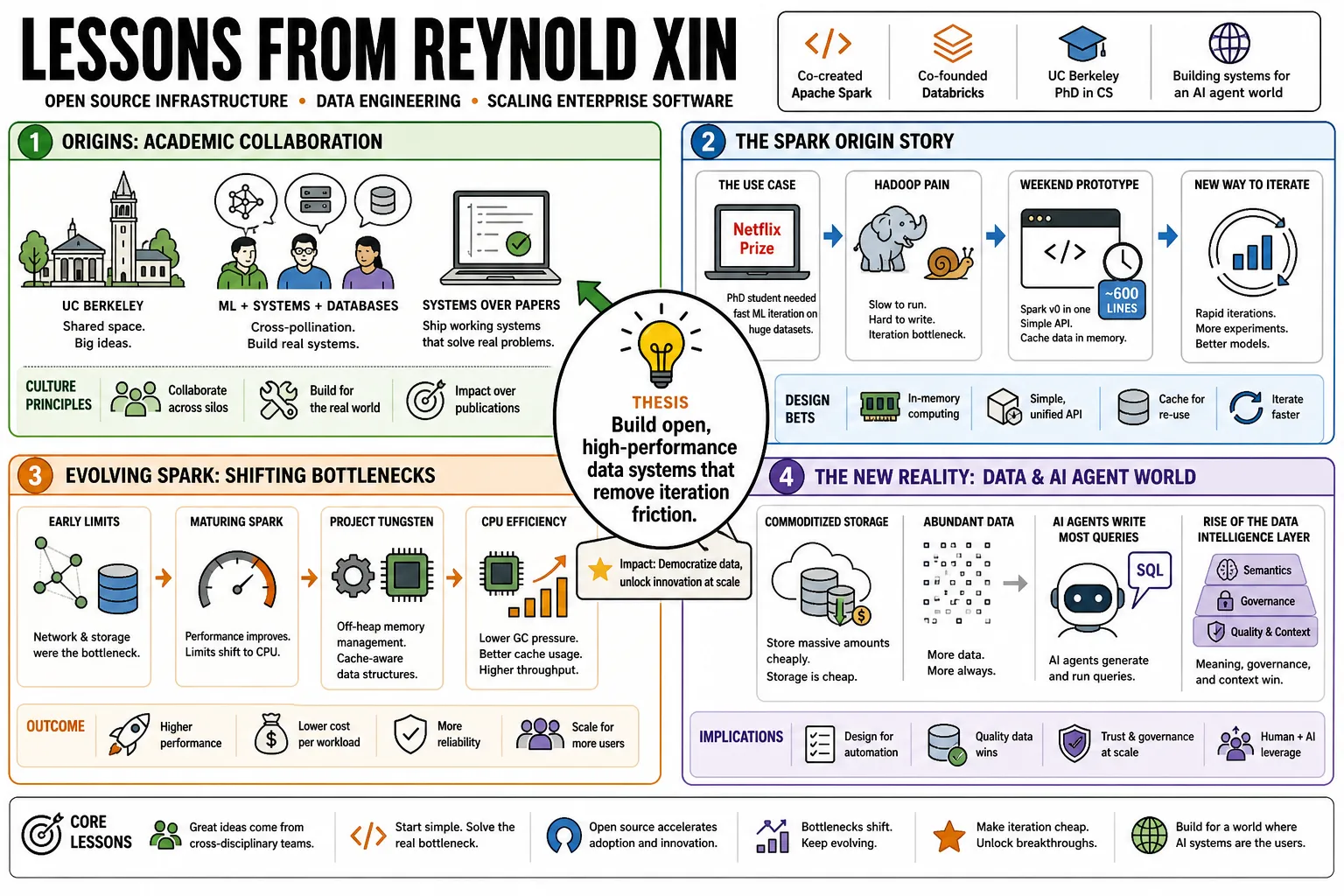
- On academic collaboration: The environment at UC Berkeley stood out by mixing researchers from machine learning, systems, and databases in a shared space, prioritizing the construction of real-world systems over publishing isolated papers. — Reference: Engineers of Scale
- On the initial Spark use case: Spark was conceived because a fellow PhD student needed a way to rapidly iterate on machine learning models for the Netflix Prize, which required a system capable of repeatedly processing datasets too large for a single laptop. — Reference: Engineers of Scale
- On early Hadoop inefficiencies: Early distributed data processing using Hadoop was both slow to execute and cumbersome to write, creating a severe bottleneck for the fast iterations demanded by machine learning workloads. — Reference: Engineers of Scale
- On Spark's first prototype: The initial version of Spark was written over a single weekend in roughly 600 lines of code, aiming to provide a simple API that could cache data in memory for repeated computations. — Reference: Engineers of Scale
- On shifting bottlenecks: As Spark matured, performance limits shifted from network and storage constraints to the CPU, prompting architectural changes like off-heap memory management and cache-aware data structures through Project Tungsten. — Reference: AMPLab News
- On commoditized storage: The ability to store large amounts of data has become a cheap commodity, shifting the primary technical challenge toward effectively analyzing that massive data footprint. — Reference: Data Science & Strategy Lecture
- On multi-cloud necessity: To avoid vendor lock-in and ensure resilience against individual cloud provider failures, enterprise companies are best served by adopting a deliberate multi-cloud strategy. — Reference: Data Science & Strategy Lecture
- On open foundations: Starting with open data formats gives a platform room to expand across workloads without turning the customer's data layer into a proprietary lock-in mechanism. — Reference: Latent Space — Why the Frontier Ecosystem Must Be Open
- On batteries-included platforms: Infrastructure should be immediately useful for common tasks while remaining open enough for users to extend it with their own interfaces and capabilities. — Reference: Latent Space — Why the Frontier Ecosystem Must Be Open
Part 2: Re-architecting the Database (Lakebase and LTAP)
- On monolithic databases: Traditional databases bundle compute and storage into a rigid structure, forcing engineering teams to pay for idle peak capacity and risking total failure during basic maintenance tasks. — Reference: Databricks Blog
- On local storage risks: In legacy databases, a transaction's durability relies on local write-ahead logs and data files; if that single machine's disk fails or flushes are misconfigured, data is lost permanently. — Reference: Databricks Blog
- On the Lakebase architecture: By separating compute from storage, the Lakebase model externalizes logs and data files into independent cloud services, unlocking serverless scaling and eliminating the need for expensive idle machines. — Reference: Databricks Blog
- On database branching: Modern databases should offer the same agility as software development, allowing petabyte-scale databases to be cloned and branched in seconds for safe experimentation and fast rollbacks. — Reference: Databricks Blog
- On data pipelines: Traditional change data capture pipelines used to move data between transactional and analytical systems are notoriously brittle and prone to constant failure. — Reference: Latent Space Podcast
- On LTAP over HTAP: Instead of trying to force transactional and analytical workloads into a single query engine, LTAP unifies them at the storage layer, allowing specialized engines to run on a single copy of fresh data. — Reference: Databricks Blog
- On vector databases: The industry mistakenly treated vector databases as a separate software category, when unstructured data architecture for AI should actually be built directly on top of object stores using a Lakebase approach. — Reference: LinkedIn
- On row-to-column transcoding: Spare CPU in the storage tier can convert transactional row data into compressed columnar files, improving analytical access and reducing object-store write volume without slowing transactions. — Reference: Latent Space — Why the Frontier Ecosystem Must Be Open
- On workload-trained database design: A database-engine factory should learn from years of production traces to predict which algorithms and data structures fit each workload instead of relying on elegant papers alone. — Reference: Latent Space — Why the Frontier Ecosystem Must Be Open
- On avoiding second-system syndrome: Even an ambitious engine rewrite should reach users through incremental endpoints and capabilities rather than disappearing into a five-year attempt to launch a perfect replacement. — Reference: Latent Space — Why the Frontier Ecosystem Must Be Open
Part 3: The Agentic Era and Data Intelligence
- On agents as primary users: Artificial intelligence agents, rather than human engineers, are rapidly becoming the primary personas writing queries and interacting with transactional databases. — Reference: DataCamp Podcast
- On data ontology: AI agents cannot generate accurate business intelligence without a foundational ontology layer that explicitly defines internal company concepts, such as how revenue is calculated. — Reference: DataCamp Podcast
- On computing vs. memorizing: While many consumer AI tools attempt to memorize existing information, effective enterprise agents must be built to perform quantitative computations grounded in actual business data. — Reference: DataCamp Podcast
- On reasoning vs. math: Generative AI models excel at reasoning and orchestration but struggle with math, meaning they should be used to select and run classic machine learning methods rather than trying to calculate numerical forecasts directly. — Reference: DataCamp Podcast
- On repointing the data team: As AI automates query writing, human data teams will shift their highest-value work toward data modeling, building ontologies, and maintaining clean data pipelines. — Reference: DataCamp Podcast
- On unified semantics: Business intelligence systems often fragment a company's semantic layer across proprietary tools, but agentic AI requires a single, open semantic foundation governed uniformly across all assets. — Reference: Databricks Blog
- On the Omnigent meta-harness: Because enterprise and coding agents face similar challenges regarding session history, security, and cost controls, Databricks open-sourced Omnigent to serve as a common API layer above them. — Reference: Latent Space Podcast
- On contextual security for agents: As agents gain the ability to act on data, the industry must prioritize strict, stateful governance to prevent scenarios where an agent might read confidential documents or leak sensitive information. — Reference: Latent Space Podcast
- On live context for incident agents: Agents investigating operational failures become far more useful when they can reason over fresh transactional records alongside service logs instead of seeing telemetry alone. — Reference: Latent Space — Why the Frontier Ecosystem Must Be Open
- On query-language plurality: Once agents write the queries, supporting multiple specialized query engines is less burdensome; making the same governed data accessible matters more than forcing one universal language. — Reference: Latent Space — Why the Frontier Ecosystem Must Be Open
- On agent-driven database volume: Cheap branching and autonomous experimentation turn databases into disposable working contexts, creating millions of short-lived instances rather than a small number of long-lived systems. — Reference: Latent Space — Why the Frontier Ecosystem Must Be Open
Part 4: Business Strategy and Growth Mechanics
- On go-to-market investments: Pausing go-to-market hiring during economic pullbacks creates a temporary illusion of profitability while masking a long-term growth collapse, rewarding companies that maintain strategic investment. — Reference: Han Lee Blog
- On acquiring startup DNA: Acquisitions should be evaluated primarily on the basis of acquiring startup DNA and founders who have survived the long-term grind, treating existing revenue merely as a validation metric. — Reference: Han Lee Blog
- On software vs. model serving: Competing in foundation model training and serving yields poor profit margins, making it strategically wiser to focus on building high-margin software infrastructure around AI. — Reference: Han Lee Blog
- On the limits of Product-Led Growth: PLG motions fail if they do not match the product's underlying complexity; infrastructure requiring sensitive operations like VPC peering cannot simply be adopted via a credit card swipe. — Reference: Han Lee Blog
- On consolidation in data infrastructure: The market for data infrastructure is rapidly consolidating into a handful of major cloud service providers and leading independent platforms, rendering smaller players largely irrelevant. — Reference: Han Lee Blog
- On named target customers: Product teams should build in weeks around a specific customer they know well enough to text, using that tight feedback loop to settle product debates quickly. — Reference: Latent Space — Why the Frontier Ecosystem Must Be Open
- On extreme-customer wedges: Solving a workload far larger or stricter than the current product supports can create a capability that later works for the rest of the market. — Reference: Latent Space — Why the Frontier Ecosystem Must Be Open
- On enterprise buying reality: Enterprise products must account for governance, procurement, legacy systems, and many stakeholders rather than assuming every customer behaves like a self-serve engineering team. — Reference: Latent Space — Why the Frontier Ecosystem Must Be Open
Part 5: Leadership and the Future of Engineering
- On the reluctant manager: The transition from a hands-on technical contributor to an executive often happens out of sheer necessity when no one else is available to manage a growing company. — Reference: Han Lee Blog
- On over-delegation: One of the biggest leadership mistakes technical founders make is deferring too much authority to experienced external hires due to imposter syndrome. — Reference: Han Lee Blog
- On context beating credentials: Prestigious external executive hires often struggle because they lack the deeply ingrained, multi-year contextual knowledge possessed by founders who have grinded through the company's early stages. — Reference: Han Lee Blog
- On the end of static applications: AI will fundamentally disrupt the enterprise software model by dynamically generating and maintaining bespoke applications at marginal cost, reducing the need to buy generic SaaS products. — Reference: Han Lee Blog
- On AI-native databases: The future of the database market involves systems that are provisioned, optimized, and maintained primarily by AI, featuring autonomous scaling and self-adjusting schemas based on real-time query patterns. — Reference: Han Lee Blog
- On decoupling clients and servers: Transitioning to a thin client architecture allows systems like Spark to run on low-compute devices, decoupling updates while offering better isolation and memory management for multi-tenant environments. — Reference: Coder Stan
- On learned executive capability: A founder's effectiveness as CEO is not fixed at the beginning; high performance can require years of deliberate study across finance, sales, communication, and organizational leadership. — Reference: Latent Space — Why the Frontier Ecosystem Must Be Open