Richard Dickson has built a career returning legacy consumer brands to the cultural mainstream. As CEO of Gap Inc. and former President and COO of Mattel, he updates core products by tying them directly to pop culture. The lessons below detail his methods for leading companies and turning brands around.
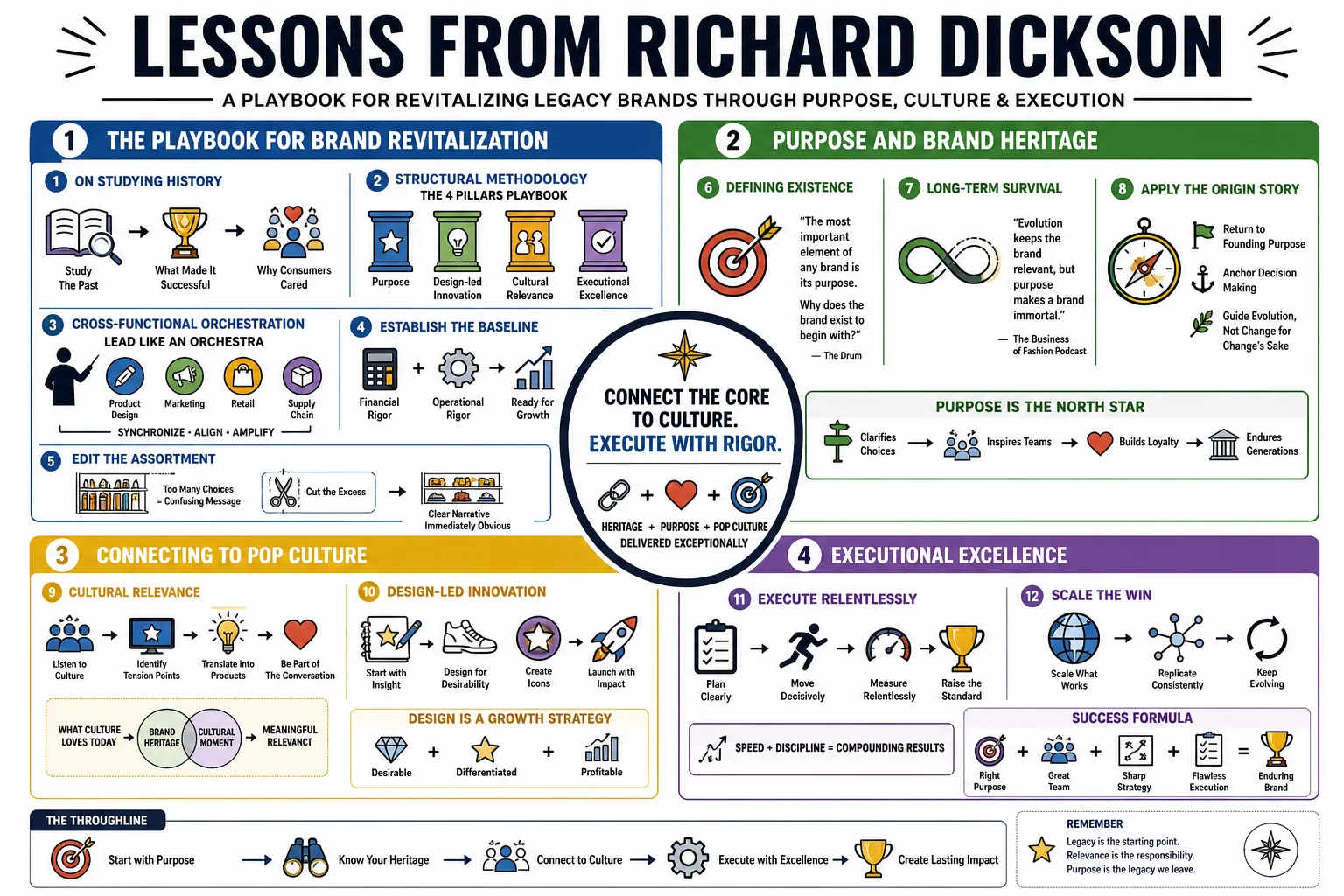
Part 1: The Playbook for Brand Revitalization
- On studying history: Revitalizing a legacy brand requires analyzing its history to determine what originally made it successful and why consumers were initially interested. — Reference: Masters of Scale
- On structural methodology: At Mattel, the turnaround approach was formalized into a playbook built on four pillars: Purpose, Design-led Innovation, Cultural Relevance, and Executional Excellence. — Reference: Outside In
- On cross-functional orchestration: A brand turnaround functions like an orchestra, requiring leadership to synchronize distinct teams across product design, marketing, retail, and supply chain. — Reference: Masters of Scale
- On baseline operations: Before a company can successfully execute creative marketing and storytelling, it must establish basic financial and operational rigor. — Reference: Masters of Scale
- On editing the assortment: When a brand's message becomes disjointed in its retail stores, leadership must cut excess product lines so the core narrative is immediately obvious to shoppers. — Reference: Masters of Scale
Part 2: Purpose and Brand Heritage
- On defining existence: "The most important element of any brand is its purpose. Why does the brand exist to begin with?" — Source: The Drum
- On long-term survival: "Evolution keeps the brand relevant, but purpose makes a brand immortal" — Source: The Business of Fashion Podcast
- On applying the origin story: Returning to a brand's founding purpose—such as Barbie's initial mandate to inspire limitless possibilities for girls—provides a blueprint for its modern commercial strategy. — Reference: The Business of Fashion Podcast
- On updating heritage: Gap's origin story, initially named "The Generation Gap" to bridge generational divides, serves as a foundation for the company's modern efforts to bridge social and environmental gaps. — Reference: Masters of Scale
- On maintaining trust: A brand is fundamentally a relationship with the consumer, and prioritizing short-term financial decisions over the narrative breaks that trust. — Reference: Masters of Scale
- On value alignment: Purpose has become increasingly important for modern consumers, who expect their purchasing decisions to reflect their personal values. — Reference: Outside In
Part 3: Cultural Relevance and Pop Culture
- On attracting attention: "To get people interested, you have to be interesting." — Source: Masters of Scale
- On pacing with society: Remaining relevant requires moving at the speed of culture; legacy brands built on print and television must adapt to where consumers spend their time today. — Reference: Masters of Scale
- On commercial outcomes: Cultural relevance is not an abstract concept; when executed correctly, it directly drives revenue. — Reference: Masters of Scale
- On driving inclusion: Updating a brand to be culturally relevant often involves modernization efforts, such as Barbie introducing multiple body types and skin tones to shed a dated reputation. — Reference: Outside In
- On elastic appeal: Embedding a toy brand in broader pop culture can create an elastic effect where nostalgia drives adults and multiple generations to engage with the product. — Reference: The Drum
Part 4: Entertainment as a Strategic Pillar
- On entertainment integration: "As we reinvigorate Gap Inc.’s house of iconic American brands to drive relevance and revenue, we recognize entertainment is a critical link to the consumer" — Source: Retail Dive
- On fashion as entertainment: Apparel brands must view fashion as a form of entertainment, utilizing music, art, and film to authenticate their narrative. — Reference: Masters of Scale
- On structural commitment: Creating a dedicated Chief Entertainment Officer role helps brands build a formal platform for music, film, sports, and gaming partnerships, proving that cultural alignment requires dedicated executive leadership. — Reference: PR Newswire
- On quality over commercials: Brand-driven films should be designed to create cultural conversations and stand on their own as quality content, rather than functioning simply as feature-length toy commercials. — Reference: The Drum
- On brand independence: While a successful movie serves as a massive cultural tentpole, a legacy brand must be strong enough to survive and thrive outside of theatrical releases. — Reference: Toy World Magazine
- On unexpected partnerships: Reaching new demographics involves cross-sector collaborations, such as a toy brand partnering with fashion labels, beauty companies, and homeware designers. — Reference: The Drum
Part 5: Design-led Innovation and Execution
- On execution versus ideas: "If you can’t execute them and bring them to the market in a meaningful way, however, they’re really nothing but ideas." — Source: The Drum
- On consumer obsession: Design-led innovation requires studying consumer behavior, tracking current trends, and running those observations through the filter of the brand's purpose. — Reference: Outside In
- On the necessity of good product: Marketing and storytelling will fail if the underlying product does not meet consumer expectations regarding fit, fabrication, and value. — Reference: Masters of Scale
- On blending physical and digital: Physical play and digital gaming are not competitors; product teams should design experiences that allow consumers to transition seamlessly between the two. — Reference: Outside In
- On direct-to-consumer communities: Establishing dedicated e-commerce portals for adult collectors serves as a direct bridge to pop culture enthusiasts and highly engaged fandoms. — Reference: Outside In
Part 6: Tracking Metrics and Listening to Consumers
- On alternative metrics: Rather than looking strictly at sales, executives should monitor daily dashboards that measure brand love and consumer receptivity to ongoing media campaigns. — Reference: Masters of Scale
- On constant curiosity: Retail is driven by hourly details, requiring a leadership team that is persistently curious about exactly why a product is succeeding or failing in real time. — Reference: Masters of Scale
- On immediate feedback loops: Because digital platforms move instantly, companies can determine if a campaign has captured cultural attention within 24 hours of its launch. — Reference: Masters of Scale
- On cutting losses: When retail data shows a product is stagnant on the shelf, the business must accept the markdown and clear it out rather than waiting for an improvement that will not come. — Reference: Masters of Scale
Part 7: Leadership, Risk, and Navigating Failure
- On taking shots: "If we're not swinging, we're never going to hit." — Source: Masters of Scale
- On the danger of safety: Organizations that become spooked by past failures stop trying new things, resulting in safe execution that ultimately bores the consumer. — Reference: Masters of Scale
- On learning from misses: Failure should trigger a dialogue about what went wrong—whether it was an issue of timing, execution, or strategy—rather than serve as a reason to avoid future risks. — Reference: Masters of Scale
- On retrying ideas: A good idea that failed due to poor timing or flawed execution in the past should not be permanently discarded; teams must be encouraged to try again under different circumstances. — Reference: Masters of Scale
- On embracing discomfort: Effective modern leadership requires the capacity to feel comfortably uncomfortable during periods of transformation and experimentation. — Reference: Masters of Scale
- On delegating expertise: A CEO cannot operate alone; success requires acting as an architect who hires and supports talent that is significantly better at specific functions than the executive themselves. — Reference: Masters of Scale
- On industry competition: Observing a competitor release great, sometimes controversial creative work should inspire a company to elevate its own standards rather than breed resentment. — Reference: Masters of Scale
Part 8: The Future of Retail (Sustainability and Technology)
- On environmental imperatives: Sustainability initiatives are not optional corporate gestures; because apparel production relies heavily on resources like water, ecological stewardship is a core strategic objective. — Reference: Masters of Scale
- On artificial intelligence: AI is evolving from a supplementary tool into the fundamental operating platform that retail businesses will be built upon. — Reference: Masters of Scale
- On AI in operations: Generative technology is already proving beneficial in accelerating the speed of product design, development, and gathering consumer insights. — Reference: Masters of Scale
- On physical store evolution: The function of brick-and-mortar retail is shifting toward human connection, acting as community spaces where shoppers can physically engage with products and sensory elements like music. — Reference: Masters of Scale
- On younger consumers: Younger demographics are showing a desire for analog experiences away from their phones, making physical retail environments increasingly important. — Reference: Masters of Scale
- On continuous store updates: Retail spaces will never reach a state of permanent perfection; they require continuous remodeling and iteration to adapt to changing expectations. — Reference: Masters of Scale
- On cross-channel trust: Creating a seamless transition between online and in-store experiences depends entirely on maintaining consumer trust regarding how their data and personal style preferences are utilized. — Reference: Masters of Scale