Roger L. Martin, a world-renowned business strategist and former Dean of the Rotman School of Management, has profoundly influenced modern management with his work on integrative thinking, design thinking, and what it truly means to create a winning strategy. His writing cuts through corporate jargon to provide clear, actionable frameworks for leaders.
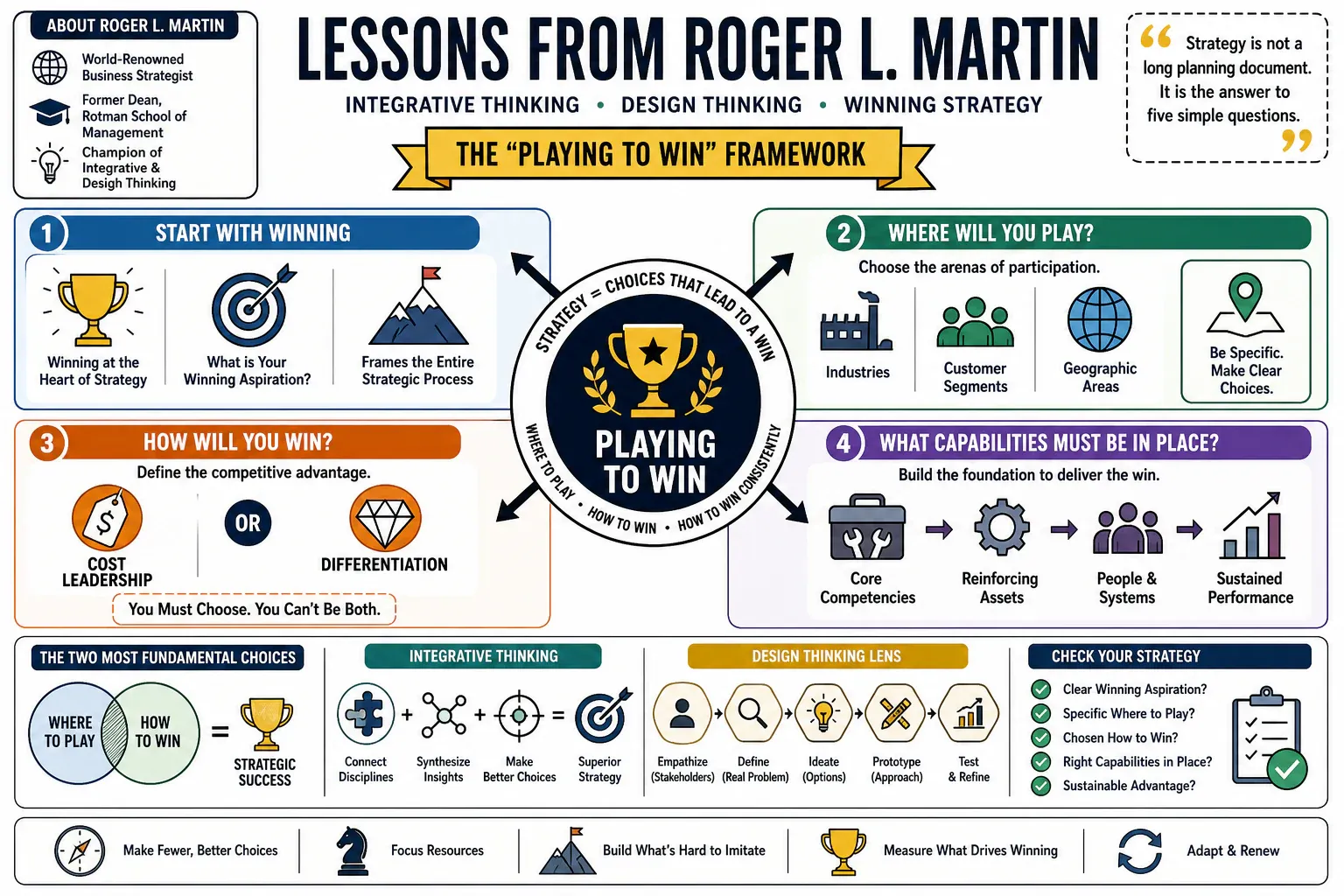
On Strategy: The 'Playing to Win' Framework
- "Strategy is not a long planning document. It is the answer to five simple questions." — Playing to Win: How Strategy Really Works.
- "The two most fundamental strategic choices are deciding where to play and how to win." — Playing to Win: How Strategy Really Works.
- "Winning should be at the heart of every strategy." — Playing to Win: How Strategy Really Works.
- "What is your winning aspiration? The first question frames the entire strategic process around the goal of winning." — Playing to Win: How Strategy Really Works.
- "Where will you play? A company must choose the specific industries, customer segments, and geographic areas in which it will compete." — Playing to Win: How Strategy Really Works.
- "How will you win? This choice defines the competitive advantage that will lead to victory in the chosen 'where to play' arena." — Playing to Win: How Strategy Really Works.
- "The two generic ways to win are cost leadership and differentiation. You must choose. You can't be both." — Playing to Win: How Strategy Really Works.
- "What capabilities must be in place? These are the core competencies and reinforcing activities required to support the 'how to win' choice." — Playing to Win: How Strategy Really Works.
- "What management systems are required? These are the systems and structures that support the choices and build the necessary capabilities." — Playing to Win: How Strategy Really Works.
- "Strategy is not complex. But it is hard. It is hard because it forces people and organizations to make specific choices and trade-offs." — Playing to Win: How Strategy Really Works.
- "True strategy is about placing bets and making hard choices. The objective is not to eliminate risk but to increase the odds of success." — Playing to Win: How Strategy Really Works.
- "Strategy is a cascade of choices. The choices at the top of the organization constrain and guide the choices below." — Playing to Win: How Strategy Really Works.
On Possibility vs. Proof: The Strategist's Core Task
- "In strategy, what counts is what would have to be true—not what is true." — Harvard Business Review: The Big Lie of Strategic Planning.
- "The most powerful question in strategy is: What would have to be true for this choice to be a brilliant one?" — Harvard Business Review: The Big Lie of Strategic Planning.
- "Data is about the past. Strategy is about the future. You can't prove a new idea in advance." — Harvard Business Review: The Big Lie of Strategic Planning.
- "Analysis should be used to build your confidence in a possibility, not to 'prove' it. If you can prove it with data, your competitors already know it." — Harvard Business Review: The Big Lie of Strategic Planning.
- "Strategy requires imagination and design, not just analysis and forecasting." — The Design of Business: Why Design Thinking is the Next Competitive Advantage.
- "Strategy is not about being right. It is about being thoughtfully wrong in a way that you can learn and adapt." — Harvard Business Review: The Big Lie of Strategic Planning.
On Integrative Thinking: The Core Philosophy
- "Integrative thinking is the ability to face constructively the tension of opposing ideas...[and] generate a creative resolution of the tension in the form of a new idea that contains elements of the opposing ideas but is superior to each." — The Opposable Mind: How Successful Leaders Win Through Integrative Thinking.
- "The conventional thinker prefers to accept the world as it is. The integrative thinker welcomes the challenge of shaping the world for the better." — The Opposable Mind: How Successful Leaders Win Through Integrative Thinking.
- "Don't just choose between option A and option B. Ask yourself, 'How can I create a better option C that combines the best parts of both?'" — Creating Great Choices: A Replacement for Integrative Thinking 2.0.
- "In order to have a hope of creating better answers, we need to deeply understand the logic of the opposing answers." — Creating Great Choices: A Replacement for Integrative Thinking 2.0.
- "The status quo is more tenacious than anyone would ever imagine. The human mind prefers continuity rather than change." — The Opposable Mind: How Successful Leaders Win Through Integrative Thinking.
- "Instead of merely asking 'What should I do?' leaders should consider 'What should I think?'" — A New Way to Think: Your Guide to Superior Management Effectiveness.
On Design Thinking & Innovation
- "Business people don't need to understand designers better. They need to be designers." — The Design of Business: Why Design Thinking is the Next Competitive Advantage.
- "The Knowledge Funnel: Innovation is the process of moving an idea from a mystery (something we can't explain) to a heuristic (a rule of thumb) to an algorithm (a repeatable formula)." The job of the innovator is to live in the world of mystery. — The Design of Business: Why Design Thinking is the Next Competitive Advantage.
- "Strategy and design thinking shouldn't be thought of as separate... Rather, there are just more and less designerly ways of doing strategy." — The Design of Business: Why Design Thinking is the Next Competitive Advantage.
Critiques of Conventional Business Wisdom
- "Shareholder value is the dumbest idea in the world." Martin argues that focusing on shareholder value leads to short-term actions that often destroy long-term value. — Fixing the Game: Bubbles, Crashes, and What Capitalism Can Learn from the NFL.
- "Peter Drucker had it right when he said that the primary purpose of a business is to acquire and keep customers." — Harvard Business Review: The Age of Customer Capitalism.
- "95% of what is called strategy... is actually a thing called planning. And planning involves making up a list of all laudable and doable initiatives that are in the areas under our control." — Harvard Business Review: A Plan Is Not a Strategy.
- "The problem with best practices is that they are past practices." Following them ensures you will never be better than the competition. — A New Way to Think: Your Guide to Superior Management Effectiveness.
- "Being 'strategic' is not a synonym for 'long-term' or 'important'. It means making a choice." — Playing to Win: How Strategy Really Works.
- "We have optimized the efficiency of our system at the expense of its resilience." A core argument from When More Is Not Better, critiquing the obsession with efficiency above all else. — When More Is Not Better: Overcoming America's Obsession with Economic Efficiency.
- "The problem with OKRs is that they are a tool for communicating a desired future, not for causing it to happen." — Roger Martin on Medium.
- "Will AI eliminate the need for strategists? No. But it will eliminate the need for analysts who masquerade as strategists." — Roger Martin on Medium.
Key Learnings from Medium
- On personal strategy: "Being 'Too Busy' Means Your Personal Strategy Sucks." Constant busyness is a sign of a lack of clear choices about what truly matters. — Roger Martin on Medium.
- On your current strategy: "Your actions reveal your real strategy, not your presentations." Reverse-engineer what your strategy is today based on what you do, not what you say. — Roger Martin on Medium.
- On making choices: "Not making a choice is a choice." Indecision is a passive form of strategic choice that often has negative consequences. — Roger Martin on Medium.
- On meetings: "If the purpose of a meeting isn't to make a decision, it shouldn't be a meeting." It should be a memo, a call, or a workshop. — Roger Martin on Medium.
- On making your case: "In the part of the world where things can be other than they are... may the best argument win not may the most powerful data win." — A New Way to Think: Your Guide to Superior Management Effectiveness.
- On functional strategy: "A functional strategy should be a set of choices that explains how the function will help the company win." — Harvard Business Review: The One Thing You Need to Know About Managing Functions.
- On starting strategy work: "The best starting point for strategy is a problem." — Playing to Win: How Strategy Really Works.
- On the language of strategy: "The single biggest barrier to the creation of a good strategy is the use of the word 'and'." It signals a refusal to make a trade-off. — Roger Martin on Medium.
- On transformation: "A superior possibility may be one for which one or more key elements are currently not true, but we develop a transformation plan that is both plausible and compelling for making them true." — Harvard Business Review: The Big Lie of Strategic Planning.
- On mission statements: "Your Mission Statement is Not Your Strategy. It is your statement of purpose. It doesn't tell you how you will achieve that purpose." — Roger Martin on Medium.
- On the fear of choice: "The fear of being wrong is the single most powerful obstacle to the development of a great strategy." — Playing to Win: How Strategy Really Works.
On Leadership and Culture
- "The job of the leader in the modern model changes from hero to community builder." — A New Way to Think: Your Guide to Superior Management Effectiveness.
- "You can't make a renaissance person anymore... But you could actually assemble a renaissance team." — The Opposable Mind: How Successful Leaders Win Through Integrative Thinking.
- "A culture of 'no' is a culture of fear. A culture of 'yes' is a culture of irresponsibility. A culture of 'maybe, if' is a culture of strategy and innovation." — Roger Martin on Medium.
- "The job of the leader is to create a context within which others can make great choices." — A New Way to Think: Your Guide to Superior Management Effectiveness.
- "You have to be humble enough to say, 'I'm not sure if this is going to work,' but bold enough to make a choice." — Playing to Win: How Strategy Really Works.
- "Stop trying to motivate people. Instead, stop demotivating them." Remove the obstacles that prevent people from doing great work. — A New Way to Think: Your Guide to Superior Management Effectiveness.
- "The art of leadership is the art of giving people a reason to do things they wouldn't otherwise do." — The Responsibility Virus: How Control Freaks, Shrinking Violets-and the Rest of Us-Can Harness the Power of True Partnership.
- "The opposite of love isn't hate; it's indifference. The opposite of a good strategy isn't a bad strategy; it's indifference to choice." — Playing to Win: How Strategy Really Works.
- "The only thing a leader can control is his or her own behavior. But that behavior has a disproportionate impact on the behavior of others." — The Responsibility Virus: How Control Freaks, Shrinking Violets-and the Rest of Us-Can Harness the Power of True Partnership.
- "The ultimate test of a strategy is whether it creates a sustainable competitive advantage." — Playing to Win: How Strategy Really Works.
Sources and Further Reading:
- Books: Playing to Win, The Opposable Mind, The Design of Business, When More is Not Better, and A New Way to Think.
- Medium Profile: Roger Martin's "Playing to Win/Practitioner Insights" series can be found at rogermartin.medium.com.
- Harvard Business Review: Numerous articles, including "The Big Lie of Strategic Planning" and "The Age of Customer Capitalism."
- Interviews and Talks: Widely available on YouTube and podcast platforms. A search for "Roger Martin talk" will yield many valuable results.