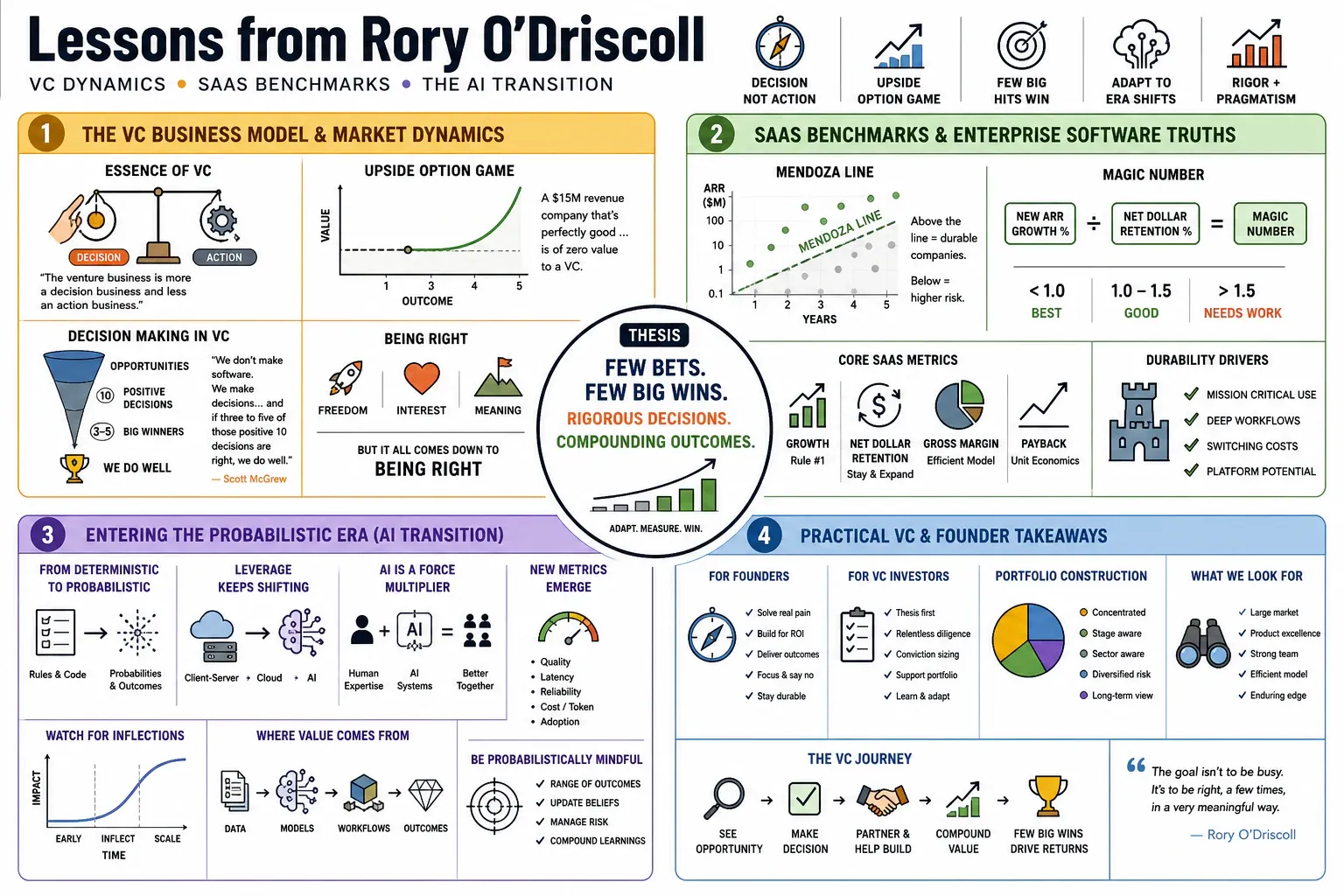
Rory O’Driscoll, a seasoned General Partner at Scale Venture Partners, has spent decades navigating the shifts from client-server architectures to the cloud, and now to the age of applied artificial intelligence. Known for establishing industry-standard SaaS benchmarks like the "Mendoza Line" and the "Magic Number," his insights blend rigorous, data-driven analysis with a pragmatic, founder-honest philosophy. The following lessons capture his perspectives on venture capital dynamics, enterprise software metrics, and the profound transition into the probabilistic era of AI.
## Part 1: The Venture Capital Business Model & Market Dynamics
- On the Essence of VC: "The venture business is more a decision business and less an action business." — Scale Venture Partners
- On VC Being an Upside Game: "A $15 million revenue company that's perfectly good and has reasonable growth is actually of zero value to a VC cuz we're in the upside option game." — SaaStr
- On Decision Making in VC: "We don't make software. We make decisions... and if three to five of those positive 10 decisions are right, we do well." — Scott McGrew
- On Being Right: "Everything about this job is awesome—freedom, the interest, money... there’s only one thing: you got to be right. And you got to be right more often than you’re wrong." — YouTube
- On the Humbling Nature of Venture: "Venture is a humbling business... the days when you feel like you’re about two inches high are some of the best days in retrospect." — YouTube
- On Market Psychology: "You’re never as good as you seem to be at the height of a bull market, but conversely, you’re never as dumb as you feel you are when you’ve just lost money." — YouTube
- On Pricing Deals: "There's only two ways of pricing a deal. You price a deal on hope or you price a deal on the multiples. When you price a deal on hope and growth, you can lean in on anything." — SaaStr
- On Timing and IRR: "IRR is the hardest of the three things to control... because it’s the timing of the exits." — Fabrice Grinda
- On Market Correction: "Economics is about seeking equilibrium... things push things back into balance." — Fabrice Grinda
- On Exit Discipline: "Price discipline is even more important the closer you get to an exit." — YouTube
## Part 2: The Mendoza Line & Growth Metrics
- On the Mendoza Line Concept: "The Mendoza Line is the minimum growth rate a venture-backed SaaS company needs to maintain at various revenue stages to remain on a path toward a successful IPO." — Kellblog
- On the IPO Target: "To go public, a SaaS company typically needs to reach $100M in Annual Recurring Revenue (ARR) while still maintaining a forward growth rate of at least 25%." — Relayto
- On Growth Persistence: "Growth rates naturally decline as a company gets larger... the growth rate in any given year is roughly 80% to 85% of the previous year's growth rate." — Kellblog
- On Early-Stage Growth: "At $10M ARR, you should be growing at ~100% YoY to stay above the Mendoza Line." — Medium
- On Mid-Stage Growth: "At $30M ARR, you should be growing at ~60% YoY to remain on track for public markets." — Medium
- On Late-Stage Growth: "At $100M ARR, you should be growing at ~25-30% YoY to demonstrate sustainable scale." — Medium
- On the Danger of Stalling: "If you’re below that line for two years in a row, it’s getting hard, and by the time you hit three, it’s just not going to happen." — YouTube
- On Fundraising Friction: "If a company falls below the line, it becomes significantly harder to raise venture capital at high valuations because the path to IPO is no longer clear." — YouTube
- On Market Premiums: "High-growth software companies get valued highly and raise money quickly... people pay up for growth." — YouTube
- On Pivoting When Growth Slows: "Falling below the line isn't a death sentence, but it is a signal to management that they cannot simply do more of the same. It requires a fundamental change." — YouTube
## Part 3: SaaS Vital Signs & The Magic Number
- On Defining the Magic Number: "The SaaS Magic Number is a measure of sales efficiency—specifically, how much new revenue a company generates for every dollar spent on sales and marketing." — MetricHQ
- On the Origin of the Magic Number: "In the mid-2000s, analyzing Omniture, I noticed that for every $1 they spent on S&M, they were generating roughly $2 in new annualized revenue. I thought, 'It's magic!'" — Scale Venture Partners
- On High Sales Efficiency: "If your Magic Number is greater than 1.0, it indicates high efficiency; the company should consider increasing its sales and marketing spend to accelerate growth." — MetaMindz
- On Low Sales Efficiency: "A Magic Number below 0.5 indicates low efficiency. The company likely has a 'leaky bucket' or an inefficient sales process and should fix the model before spending more." — MetaMindz
- On the Four Vital Signs: "The Four Vital Signs of SaaS—Growth, Efficiency, Churn, and Burn—provide a quick, universally understood snapshot of a company's performance, much like medical vital signs." — Scale Venture Partners
- On the Rule of 40: "A healthy SaaS company's combined growth rate and profit margin should be at least 40%. It balances growth against profitability." — Crunchbase
- On Benchmarking: "Metrics don't fix a company, but they allow management teams to pinpoint issues and benchmark their performance against top-quartile peers." — Scale Venture Partners
- On Revenue Churn: "High churn indicates a leaky bucket that can undermine even the strongest growth, destroying the sustainability of the revenue base." — Scale Venture Partners
- On Cash Burn: "Cash burn tracks the company's capital intensity and runway, helping management understand how much capital is required to achieve the current growth." — Scale Venture Partners
- On Cloud Market Saturation: "Goodbye Gold Rush, hello Hunger Games. The era of easily taking market share from legacy on-premise vendors is largely over." — Business Insider
## Part 4: The Transition to the "Third Wave" of AI
- On the Third Wave of AI: "We are currently in the third wave of AI, shifting from infrastructure—LLMs and chips—to Applied AI that solves specific business problems." — Scale Venture Partners
- On the Purpose of AI: "The purpose of AI is to make better, more cost-effective decisions." — Apple Podcasts
- On Human Replacement: "It’s extraordinarily hard to replace people with AI. Hard things are easy and easy things are hard." — YouTube
- On the Jason Test for AI: "For an AI feature to be valuable, it must be good enough to charge for independently." — BigGo
- On the AI Valuation Death Spiral: "Many legacy SaaS companies are in a valuation death spiral because their AI features are too weak to monetize, forcing them to give them away for free." — BigGo
- On Enterprise Dominance in AI: "Enterprise AI will capture two-thirds of the total market value, flipping the consumer-first dynamic of the internet era." — BigGo
- On the AI Productivity Bet: "Either you are going to see pretty profound productivity changes, or AI is still going to be wonderful, but you're going to have a readjustment period that's going to make your head hurt." — Scale Venture Partners
- On the End of Staying Private Forever: "The massive capital requirements for AI are forcing a rehabilitation of the IPO market." — SaaStr
- On Public Market Benchmarks: "Public SaaS stocks will continue to struggle until pure-play AI-native companies go public and establish new valuation benchmarks." — BigGo
## Part 5: Applied AI & Probabilistic Software
- On the Shift from Deterministic to Probabilistic: "SaaS was deterministic—you type X, you get Y report. AI is probabilistic—it gives an answer that might be wrong. This is a fundamental shift in how software works." — Crunchbase
- On Monetizing Probabilistic AI: "The real money will be made in identifying which enterprise tasks can tolerate the probabilistic nature of AI." — Crunchbase
- On AI Risk Assessment: "Success in AI depends on how catastrophic failure is for a specific use case. AI for marketing copy is safer than AI for accounting audits." — Crunchbase
- On Product Fluidity in AI: "In prior days, you'd nail product-market fit, then sell the hell out of it. Now, you have to stay on offense on product and underlying technology from seed to IPO and beyond." — Scale Venture Partners
- On AI Replacing BPOs: "AI applications allow companies to reduce reliance on outsourced Business Process Outsourcing (BPO) by automating complex, document-heavy tasks internally." — Scale Venture Partners
- On Legacy SaaS Vulnerability: "There is a slow death spiral for public SaaS companies that ship mediocre AI solutions, facing a shift toward replacing human roles with AI agents." — SaaStr
- On AI Workflow Automation: "The application of generative AI to specific functions represents the next massive unlock in enterprise value." — Regie.ai
- On Regulating AI: "It’s hard to regulate what you don’t understand." — YouTube
- On AI Video Generation: "Technologies using hyper-realistic digital replicas show how generative AI can transform standard enterprise communications." — Scale Venture Partners
## Part 6: Robotics & AI in the Physical World
- On Physical AI: "Beyond pure software, there is massive potential at AI's intersection with the physical world, particularly in robotics and automation." — Scale Venture Partners
- On Warehouse Automation: "Companies building autonomous warehouse robots show how AI can automate labor-intensive workflows in physical environments." — Scale Venture Partners
- On Vision Systems in Logistics: "Vision systems are bringing the intelligence of software to the unpredictable nature of physical supply chains." — Scale Venture Partners
- On the Drone Economy: "Aerial data and drone software platforms represent the deployment of applied AI to manage and inspect physical assets." — Scale Venture Partners
- On Human-Robot Collaboration: "The goal of warehouse robotics isn't simply replacing workers, but optimizing the workflow so humans and machines operate at peak efficiency." — Scale Venture Partners
- On the Data Advantage in Robotics: "Robotics companies with the largest deployed fleets accumulate a data advantage that improves their AI models faster than new entrants." — Scale Venture Partners
- On Scaling Hardware: "Scaling a robotics company is fundamentally different from scaling pure SaaS; it requires a deep understanding of physical supply chains and deployment logistics." — Scale Venture Partners
- On Computer Vision Leaps: "The second wave of AI—predictive analytics and computer vision—was the unlock that made modern autonomous warehouse robots possible." — Scale Venture Partners
- On the Physical World's ROI: "When AI is deployed in physical logistics, the ROI is often measured in hard metrics like units picked per hour, making the value proposition undeniably clear." — Scale Venture Partners
## Part 7: Leadership, Founders, & Team Building
- On Evaluating Founders: "For CEOs, you're selecting on the basis of strengths, not lack of weaknesses." — True Platform
- On the Necessity of Extreme Strengths: "I'll take a founder with some profound weaknesses if they're awesome at something, and that's something that's important to the business." — True Platform
- On the Burden of Leadership: "Part of being a leader is... literally internalizing the uncertainty, absorbing the uncertainty and keeping some of it away from the team." — True Platform
- On the Core of a Startup: "Every investment should have at its core a founder with a vision for something exciting that should exist in the world that does not exist today and is now possible." — True Platform
- On Founder Honesty: "Board members must be 'founder-honest' rather than just 'founder-friendly,' meaning they must deeply understand the product and competition to keep companies accountable." — SaaStr
- On the Role of a VC: "I don't want to get to know you. I want to understand your business... I'm not looking for a friend. I'm looking for an investment opportunity." — Venture Geopolitics
- On Doing the Hard Work: "Entrepreneurship is 10x harder than venture capital due to the sheer effort, resilience, and drive required to build something from nothing." — YouTube
- On Dealing with Failure: "The definition of insanity is doing the same thing over and over again and expecting a different result. When growth stalls, you must pivot." — YouTube
- On Building Important Companies: "Distinguish between a successful business and an 'important' one. A company can build a good app and be worth billions, but still not be transcendent or 'important.'" — YouTube
## Part 8: Philosophy, Decision Making & Advice
- On the Limits of Advice: "The right advice is situational, conditional, and should recognize the risk of bias from the advice giver." — True Platform
- On Concentration vs. Diversification: "Diversification reduces your downside but also reduces your upside... You need to start off with a significant element of diversification and then concentrate down." — Operator Blog
- On the Power Law in Venture: "The power law in venture capital means that a few massive outcomes can dwarf the rest of the market combined." — SaaStr
- On Short vs. Long Term Value: "The longer-term markets are weighing machines, and the short-term markets are voting machines." — Substack
- On Contrarian Investing: "Investing in venture right now is contrarian... I think it’s the best time to invest." — Fabrice Grinda
- On Direct Competition: "New startups must now compete directly against established cloud giants rather than just disrupting old technology. The environment is qualitatively harder." — Business Insider
- On Evaluating New Markets: "When evaluating a new market, look for areas where a technological shift has suddenly made the previously impossible, possible." — Scale Venture Partners
- On Learning the VC Business: "Venture capital is an apprenticeship business; it takes years of living through cycles to develop the intuition necessary for success." — Forbes
- On Intellectual Honesty: "You have to be intellectually honest about why a company is winning or losing. If you lie to yourself about the metrics, the market will eventually correct you." — Scale Venture Partners