Tyler Hogge is a prominent venture capitalist at Pelion Venture Partners and a former product executive who helped lead Divvy through its $2.5 billion acquisition by BILL. Known for his intense, outcome-oriented approach, his philosophies bridge the gap between product strategy, go-to-market execution, and the mental models required to build exceptional startups. The following lessons distill his most impactful insights on leadership, venture capital, and the rigorous habits that separate generation-defining companies from the rest.
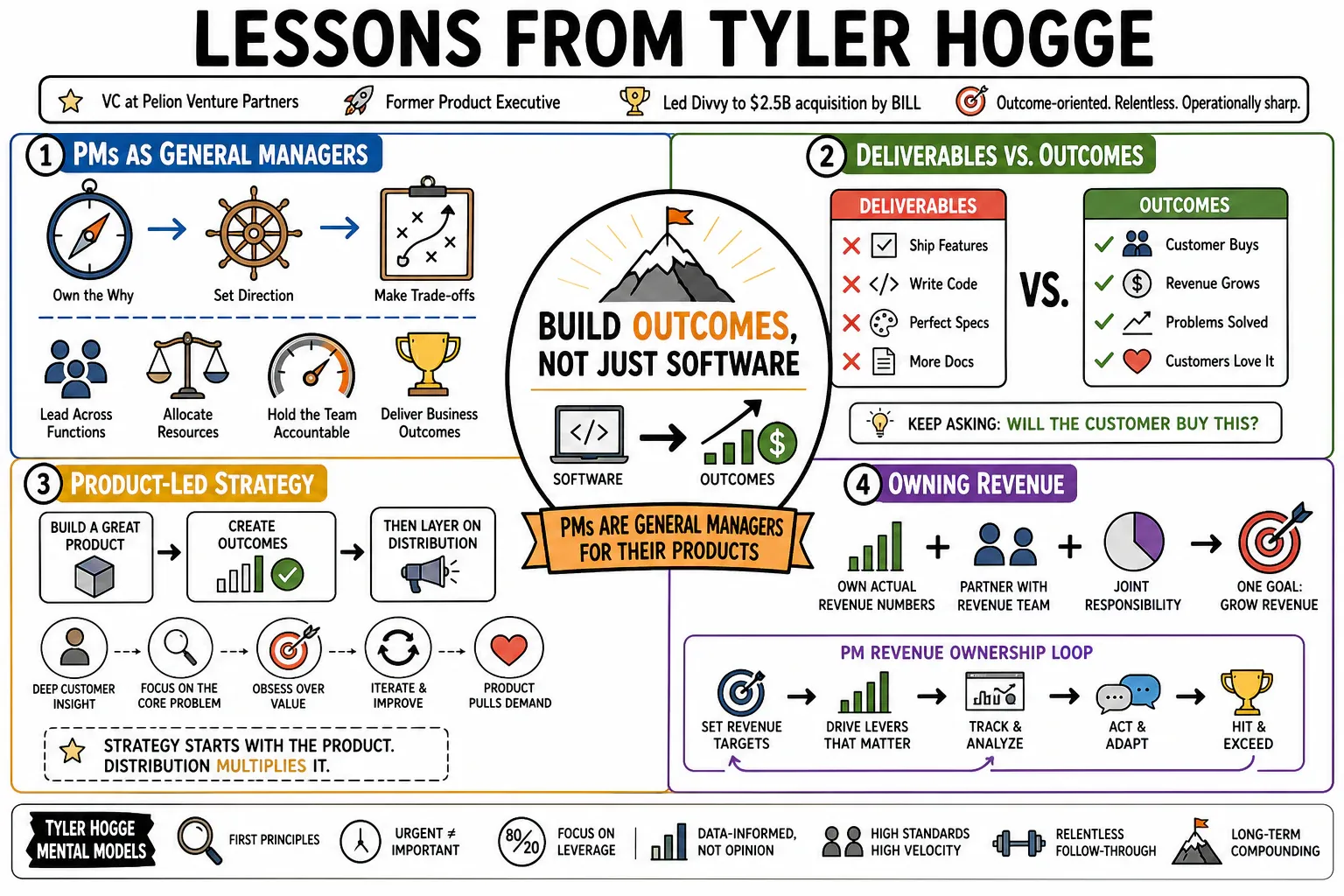
Part 1: The Role and Mindset of a Product Manager
- On PMs as General Managers: "The main goal for a product manager is not simply to ship software — it's to deliver business outcomes." — Source: [Tyler Hogge on Medium]
- On Deliverables vs. Outcomes: "Product folks over-intellectualize product sometimes when really it boils down to: will the customer buy this?" — Source: [The IO Podcast]
- On Product-Led Strategy: "Every tech company should be product-led... the strategy should be around building a great product and then layering on distribution." — Source: [The IO Podcast YouTube]
- On Owning Revenue: PMs should own actual revenue numbers for their products, often sharing this responsibility jointly with the revenue team. — Source: [First Round Review]
- On Variable Compensation: Aligning PM incentives with business metrics like sales, revenue, and Customer Acquisition Cost (CAC) ensures they are building for the market, not just for the roadmap. — Source: [First Round Review]
- On PMs as Sellers: PMs should be required to join sales calls, give demos, and travel for onsite client visits to stay intimately grounded in market realities. — Source: [First Round Review]
- On Working Backwards: "You’ve got to start with the customer experience and work backwards to the technology," rather than building a feature and searching for a problem to solve. — Source: [Tyler Hogge's Website]
- On Avoiding "Product Owners": Eliminate the "Product Owner" title; PMs should focus on high-level strategy and business problem-solving rather than merely managing Jira tasks. — Source: [First Round Review]
- On Aligning with Sales: "You want the go-to-market functions to be fulfilling demand that your product generates because it's just so damn good." — Source: [The IO Podcast]
Part 2: Quality, Speed, and Building Products
- On the True North Star: "Quality is our northstar. Nothing trades off against it. Speed is our second star." — Source: [The IO Podcast]
- On the Quality-Speed Loop: Quality and speed are not in conflict; they create a feedback loop where higher quality enables faster movement, and faster iteration drives higher quality. — Source: [The IO Podcast]
- On the "Embarrassment" Adage: The idea that "if you're not embarrassed by your first version, you shipped too late" is outdated; today's users demand a much higher baseline of quality. — Source: [The IO Podcast YouTube]
- On the Sequence of Building: Adopt a "Sell → Design → Build" framework to validate a product's value proposition before committing engineering resources to it. — Source: [First Round Review]
- On Customer Limitations: You cannot rely on customers to innovate; they can only imagine incremental improvements to what already exists. — Source: [Tyler Hogge on Medium]
- On Customer Development: Customer development is a tool to test your unique insights and hypotheses, not a mechanism to generate the insights themselves. — Source: [Tyler Hogge on Medium]
- On Differentiation: Building something fundamentally different in its business model or approach is far more effective than building something that is just marginally better. — Source: [Tyler Hogge's Website]
- On Switching Costs: A new product often needs to be 10 times better than the existing alternative just to overcome user inertia and switching costs. — Source: [Tyler Hogge's Website]
- On Product Reviews: Treat internal product reviews like "mini board meetings" that focus strictly on business impact and outcomes rather than simple status updates. — Source: [First Round Review]
- On Owning Onboarding: The product team should exclusively own the signup and onboarding process for smaller customers, allowing sales to focus on complex, high-value deals. — Source: [First Round Review]
Part 3: Mental Models for Decision Making
- On Adverse Selection: Always ask why a specific deal or candidate is available to you; if a system unintentionally attracts "lemons," you are suffering from adverse selection. — Source: [Tyler Hogge on Medium]
- On the "Free Wedge" Strategy: Disrupt incumbents by offering a core service for free that the incumbent relies on for profit, making it economically unviable for them to compete. — Source: [Tyler Hogge's Website]
- On Negativity Bias: Humans naturally give more weight to negative news; overcoming this bias is essential for maintaining the long-term optimism required to build and invest. — Source: [Tyler Hogge on Medium]
- On Conviction vs. Opinion: An opinion is a casual preference, while conviction is a deeply held belief backed by evidence and a willingness to act decisively. — Source: [Tyler Hogge's Website]
- On the Cost of Conviction: True conviction is incredibly rare because it requires the grueling work of deep thinking and carries the terrifying risk of public failure. — Source: [Tyler Hogge's Website]
- On World-Class Standards: "World-class" is a moving target; it simply represents the highest level reached so far, not an absolute ceiling on what is possible. — Source: [Tyler Hogge's Website]
- On the "Next Play" Mentality: In the volatile environment of startups, you must immediately move to the next task or opportunity regardless of the success or failure of the last one. — Source: [Tyler Hogge's Website]
- On Types of Risk: "You can methodically kill technical risk by hiring talented engineers... but you cannot kill market risk unless you build what people desperately want." — Source: [Tyler Hogge's Website]
- On the Due Diligence Analogy: Due diligence in investing is like dating; it doesn't create conviction, but rather stress-tests your initial hypothesis to either deepen or destroy it. — Source: [Tyler Hogge's Website]
- On Positive Selection: The holy grail for any company or fund is creating a magnetic system of positive selection that proactively attracts the exact top-tier talent you want. — Source: [Tyler Hogge on Medium]
Part 4: The Habits of Exceptional Startups (Operations)
- On Managing Expectations: Exceptional startups consistently beat and raise expectations; they make promises and over-deliver on them every time. — Source: [Tyler Hogge's Website]
- On the Talent Bar: Recruiting top-tier talent is treated as an obsessive core competency by leadership, not just an administrative HR function. — Source: [Tyler Hogge's Website]
- On Velocity: Great startups ship product incredibly fast, prioritizing relentless momentum and iteration over perfect, slow-moving plans. — Source: [Tyler Hogge's Website]
- On Product Obsession: Operating quickly never equates to sloppiness; exceptional teams care deeply about the minute details and polish of their products. — Source: [Tyler Hogge's Website]
- On Bureaucracy: They are fundamentally allergic to bureaucracy, aggressively stripping away any processes that slow down decision-making. — Source: [Tyler Hogge's Website]
- On Work Ethic: Exceptional outcomes require exceptional effort; the best startups acknowledge that working long hours is part of the equation. — Source: [Tyler Hogge's Website]
- On Focus: They do not waste time at useless networking events; their entire focus is dedicated to building the business, not "playing startup." — Source: [Tyler Hogge's Website]
- On Capital Efficiency: They never burn money inefficiently; capital discipline and a drive toward profitability are treated as operational virtues. — Source: [Tyler Hogge's Website]
- On Long-Term Horizons: The ultimate goal is creating enduring enterprise value—building a "castle" with immense terminal value rather than a quick flip. — Source: [Tyler Hogge's Website]
Part 5: The Habits of Exceptional Startups (Culture & Leadership)
- On Internal Debate: Cultivate healthy conflict; teams must debate ideas vigorously but align immediately once a strategic decision is made. — Source: [Tyler Hogge's Website]
- On Aesthetics as Signal: Exceptional startups have beautiful websites and pitch decks because they understand that design is a loud proxy for overall quality. — Source: [Tyler Hogge's Website]
- On Communication: They write incredibly clear, concise copy that communicates their value proposition without relying on jargon. — Source: [Tyler Hogge's Website]
- On Protecting Culture: Fire fast; great companies protect their culture fiercely by quickly removing individuals who are not a fit. — Source: [Tyler Hogge's Website]
- On Belief: The best startups exhibit cult-like employee enthusiasm, where the team acts as true believers in the overarching mission. — Source: [Tyler Hogge's Website]
- On Executive Speed: The CEO replies instantly; high responsiveness from leadership sets a relentless pace for the entire organization. — Source: [Tyler Hogge's Website]
- On Market Reality: The CEO stays grounded in reality by personally talking to numerous customers every single week. — Source: [Tyler Hogge's Website]
- On Practitioner Leaders: Leaders aren't "empty suit" executives; they are practitioners who still have the ability to get into the weeds and do the work. — Source: [Tyler Hogge's Website]
- On Engineering Culture: The engineering team is competitive, aggressive, and deeply driven by a desire to out-build rivals and win the market. — Source: [Tyler Hogge's Website]
- On Setbacks: Exceptional companies use crises as catalysts, turning setbacks into the momentum needed to forge a stronger path forward. — Source: [Tyler Hogge's Website]
Part 6: Venture Capital, Investing & Markets
- On the Ultimate Differentiator: "Without intensity, great startups—and I would argue great lives—cannot be built." — Source: [The IO Podcast YouTube]
- On Career Timing: "Joining a company as early as possible, right after achieving product-market fit, offers the greatest career advantage." — Source: [The IO Podcast]
- On Generational Companies: The very best early-stage startups eventually reach a point where their success simply feels "inevitable." — Source: [Tyler Hogge's Website]
- On Venture Arrogance: It is arrogant for VCs to try and calculate exactly what percentage of a founder's created value they must capture to make their fund model work. — Source: [Tyler Hogge's Substack]
- On VC Mimicry: The venture industry is full of "sheep" waiting to see if top-tier firms lead a round; outsized returns are only earned by having independent conviction. — Source: [Tyler Hogge's Website]
- On Evaluating Founders: "Some people just blow you away from the first meeting. When that happens, I do one thing: I dig deeper and figure out if I get more excited or less." — Source: [Tyler Hogge's Website]
- On ROAC: AI agents are a new form of enterprise capital; the metric of the future is Return on Agent Capital (ROAC). — Source: [GlobeNewswire]
- On AI in the Enterprise: For AI to succeed in regulated industries, strict governance, observability, and auditability must be built in by design from day one. — Source: [GlobeNewswire]
- On the Evolution of SaaS: The industry is shifting away from high-priced SaaS toward offering free software that monetizes efficiently through embedded payments. — Source: [Tyler Hogge on X]
- On Winning the Market: "Counterintuitively, most companies actually don't win because of their product in the long term; I think it actually ends up being because of distribution." — Source: [The IO Podcast]
Part 7: Life Lessons & Core Principles
- On Integrity: Integrity means always telling the truth and keeping your commitments, regardless of the circumstances. — Source: [Tyler Hogge's Website]
- On Agency: Don't wait for permission or to be told what to do; you possess the agency to proactively "bend the world" around you. — Source: [Tyler Hogge's Website]
- On Accountability: You are never a victim of your circumstances; you, and you alone, own the ultimate outcome of your life. — Source: [Tyler Hogge's Website]
- On True Leadership: A leader's fundamental purpose is to serve others and help them evolve into the best versions of themselves. — Source: [Tyler Hogge's Website]
- On Resilience: Hard times are not punishments; they are vital opportunities to grow stronger and signals that something great is on the horizon. — Source: [Tyler Hogge's Website]
- On Communication Style: Embrace the habit of "speaking plainly" in professional settings, stripping away corporate speak to reveal the truth. — Source: [Tyler Hogge's Website]
- On Optimism: Optimism isn't naivety; it is a strategic prerequisite for navigating the immense difficulty of building something new. — Source: [Tyler Hogge on Medium]
- On Weathering Storms: Conviction is the structural integrity that allows a founder or investor to "bend but not break" during the brutally hard storms of company building. — Source: [Tyler Hogge's Website]
Part 8: Go-to-Market & Execution Tactics
- On Validating Fit: Product-market fit is proven when you address a market that desperately wants your solution—"if the dogs are eating the dog food," you can win. — Source: [Tyler Hogge on Medium]
- On Product Vision: Don't just build a tool; aim to build platforms that act as the complete "financial nervous system" of a business. — Source: [Tyler Hogge on Medium]
- On Org Structure: Structure product organizations into Mutually Exclusive and Collectively Exhaustive (MECE) areas to prevent overlap and ensure total coverage. — Source: [The IO Podcast YouTube]
- On Accountability Design: Utilize the Directly Responsible Individual (DRI) model so there is always one specific person who owns the success or failure of an initiative. — Source: [The IO Podcast YouTube]
- On Competitive Moats: "I'm always thinking: how can I move the company forward in a way that my competitors cannot afford to do?" — Source: [The IO Podcast YouTube]
- On Marketing: "You are advertising to a moving parade, not a standing army," meaning your messaging must be continuous and dynamic. — Source: [Tyler Hogge's Substack]
- On Closing Candidates: "Don't give a job offer to a great candidate on a Friday... you never want them going into the weekend not knowing exactly where they stand." — Source: [Tyler Hogge's Substack]
- On Niche Dominance: Products succeed more often when they are deeply loved by a passionate, small segment first, rather than being tolerated by a massive audience. — Source: [Tyler Hogge's Website]
- On Execution Pace: The rhythm of execution should be set to outpace the market; speed of learning and iterating is the ultimate sustainable advantage. — Source: [The IO Podcast YouTube]