Lessons from Roy Baumeister
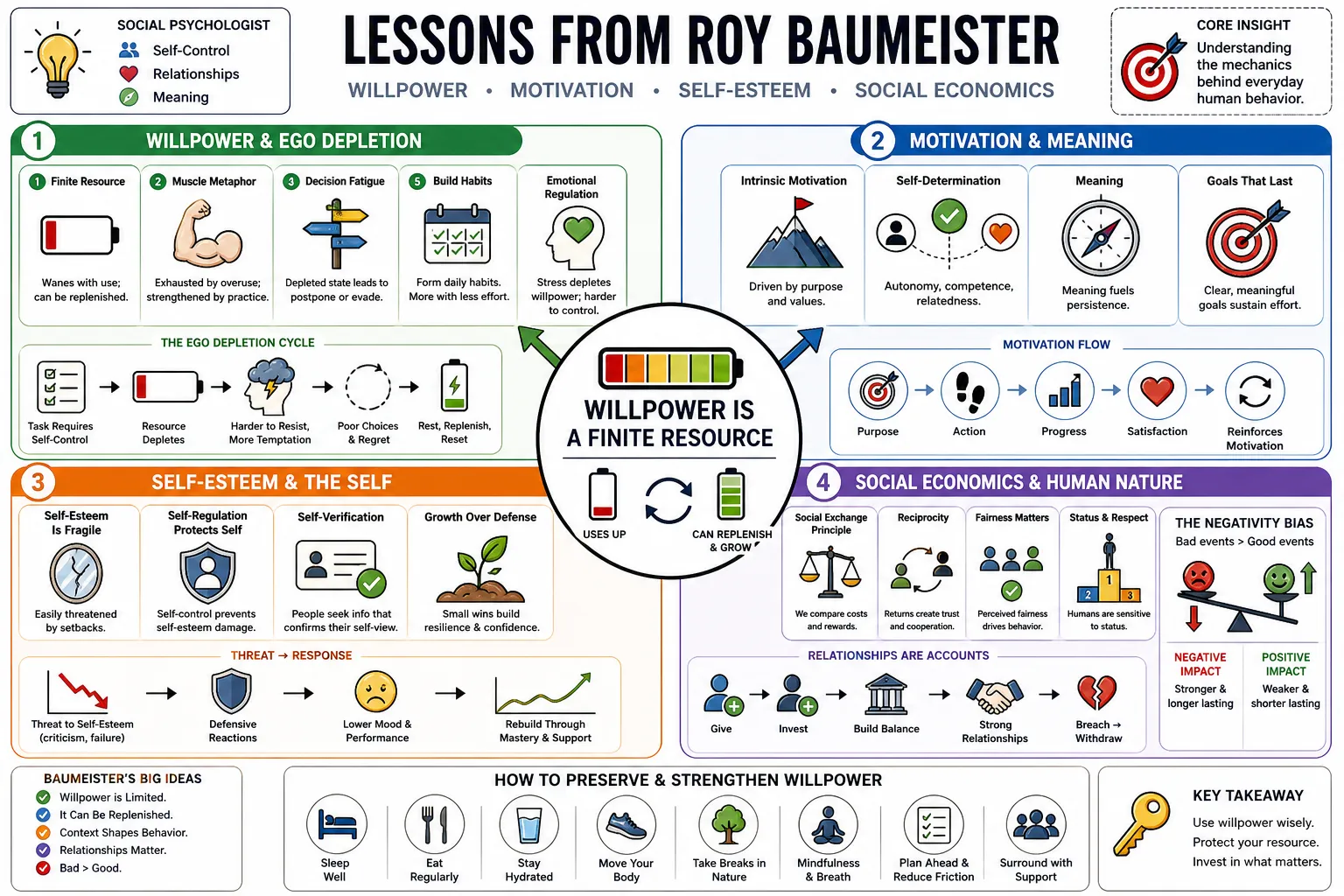
Social psychologist Roy Baumeister studies how people exercise self-control, form relationships, and find meaning. He is best known for framing willpower as a finite resource and demonstrating that bad events impact us far more than good ones. This profile organizes his research on motivation, self-esteem, and social economics to explain the mechanics behind everyday human behavior.
Part 1: Willpower and Ego Depletion
- On the nature of self-control: "Self-control is not a limitless resource; it wanes as it is used, but it can also be replenished." — Source: [Still Mind Florida]
- On the muscle metaphor: Willpower functions similarly to a physical muscle, meaning it can become exhausted from overuse but can also be strengthened over time through consistent practice. — Source: [TeuxDeux]
- On decision fatigue: "It takes willpower to make decisions, and so the depleted state makes people look for ways to postpone or evade decisions." — Source: [Medium]
- On building habits: "Use your self-control to form a daily habit, and you'll produce more with less effort in the long run." — Source: [Goodreads]
- On emotional regulation: "What stress really does, though, is deplete willpower, which diminishes your ability to control those emotions." — Source: [Goodreads]
- On human uniqueness: "Willpower is what separates us from the animals." — Source: [AZ Quotes]
- On setting yourself up for success: "The best way to reduce stress in your life is to stop screwing up," meaning you should use self-control to avoid creating stressful situations in the first place. — Source: [Goodreads]
- On the double whammy of depletion: "Ego depletion thus creates a double whammy: Your willpower is diminished and your cravings feel stronger than ever." — Source: [Medium]
- On long-term versus short-term thinking: "The results showed that a narrow, concrete, here-and-now focus works against self-control, whereas a broad, abstract, long-term focus supports it." — Source: [Heroic]
- On self-awareness: Changing personal behavior requires willpower, but without self-awareness, willpower is as useless as a cannon commanded by a blind man. — Source: [Heroic]
Part 2: The Negativity Bias
- On the fundamental asymmetry of life: "Bad is stronger than good." — Source: [Psychology Today]
- On evolutionary survival: The negativity bias is an evolutionary feature rather than a bug, because to survive, life has to win every day, whereas to die, life has to lose only once. — Source: [TTISI]
- On keeping relationships stable: "The best way to keep things positive is to avoid negatives." — Source: [DailyGood]
- On the Low-Negativity Golden Rule: Do not do unto others what you do not want done unto you, because avoiding causing harm matters far more to relationships than actively doing good. — Source: [DailyGood]
- On the Rule of Four: "It takes four good things to overcome one bad thing," meaning a single negative event carries so much emotional weight that you need a positivity ratio of at least four-to-one to feel secure. — Source: [Bookey]
- On perspective and doom: "If one thing goes wrong, don't interpret it as a harbinger of inevitable doom, whether you're dealing with a personal setback or contemplating the state of the world." — Source: [Blinkist]
- On relationship impact: "Relationships are far more strongly affected by negative things than positive things." — Source: [Blinkist]
- On receiving criticism: People respond so strongly to criticism that they often forget whatever praise was given first, making it generally better to deliver bad news early so the good news can eventually sink in. — Source: [DailyGood]
- On rational override: "The more we can get our rational brain involved in overriding these gut reactions, the more things will keep getting better." — Source: [DailyGood]
- On using the negative: "Properly understood, bad can end up being a force for good," as recognizing our bias allows us to use negative feedback as a signal for growth rather than a source of despair. — Source: [Penguin Books]
Part 3: The Need to Belong
- On our primary social motivation: "Human beings are fundamentally motivated by a need to belong, that is, by a strong desire to form and maintain enduring interpersonal attachments." — Source: [NIH]
- On the two requirements for belonging: People need frequent personal interaction with another person, and they need to perceive that there is an interpersonal bond marked by stability and affective concern. — Source: [OsloMet]
- On the pain of loneliness: A lack of belongingness constitutes severe deprivation and causes a variety of serious mental and physical ill effects. — Source: [Wabash College]
- On quality over quantity: The human need to belong is best met by a few stable, close relationships rather than a large number of superficial acquaintances. — Source: [New Public]
- On the group dynamic: "Rejecting others may strengthen one's ties to one's ingroup. Belonging to all humankind is not the point... There's 'no us without them'." — Source: [BYU-Hawaii]
- On the consequences of exclusion: "Social exclusion impairs self-regulation," making it significantly harder for rejected individuals to control their impulses and behavior. — Source: [OsloMet]
- On the evolutionary root of rejection: Loneliness is designed by evolution to be painful to motivate us to seek out others, functioning exactly like physical pain warns us of bodily injury. — Source: [OsloMet]
- On satiation of the social drive: Once people establish a few stable, close relationships, the internal drive to find more connections naturally decreases. — Source: [ResearchGate]
- On substituting relationships: If one social bond is lost, humans can sometimes substitute it with another, though deeply established bonds like a long-term marriage are much harder to replace. — Source: [ResearchGate]
- On rejection and aggression: When people feel excluded by a group, they often experience a temporary emotional numbness that leads to decreased prosocial behavior and increased chances of lashing out. — Source: [OsloMet]
Part 4: The Self-Esteem Illusion
- On the self-esteem movement: "Boosting people's sense of self-worth has become a national preoccupation. Yet surprisingly, research shows that such efforts are of little value in fostering academic progress or preventing undesirable behavior." — Source: [Reviewing]
- On what actually creates success: "Self-esteem does not lead to success in life. Self-discipline and self-control do." — Source: [AZ Quotes]
- On the correlation confusion: High self-esteem is strongly correlated with success, but it is almost always the result of achievement and good behavior, rather than the cause of it. — Source: [Gracious Quotes]
- On the danger of unconditional praise: "The societal pursuit of high self-esteem for everyone may literally end up doing considerable harm." — Source: [QuoteFancy]
- On threatened egotism: "Violence appears to be most commonly a result of threatened egotism—that is, highly favorable views of self that are disputed by some person or circumstance." — Source: [AZ Quotes]
- On the worst combination of traits: "People with high but unstable self-esteem exhibit the greatest hostility." — Source: [QuoteFancy]
- On positive illusions: "Illusions, distortions, and self-deception appear to be integral to the way normal, well-adjusted people perceive the world." — Source: [QuoteFancy]
- On depressive realism: The person with low self-esteem is often more accurate in their self-appraisals than the person with high self-esteem, who tends to be heavily biased in a self-serving direction. — Source: [QuoteFancy]
- On the cost of strict realism: "Seeing things as they really are is associated with depression and low self-esteem." — Source: [Goodreads]
- On actionable advice for parents: "Forget about self-esteem. Work on self-control." — Source: [Heroic]
Part 5: Meaning versus Happiness
- On the difference between humans and animals: "What sets human beings apart from animals is not the pursuit of happiness, which occurs all across the natural world, but the pursuit of meaning, which is unique to humans." — Source: [Heroic]
- On the simplicity of happiness: "Happiness is in many ways simpler, and presumably linked to earlier steps in evolution, than meaningfulness. Creatures feel good when they satisfy their needs and feel bad when denied satisfaction." — Source: [UNSW]
- On givers and takers: "Happiness was linked to being a taker rather than a giver, whereas meaningfulness went with being a giver rather than a taker." — Source: [UC Berkeley]
- On time orientation: "Happiness is about the present. Meaning is about linking the past, present, and future." — Source: [RePEc]
- On optimizing for the moment: "If you want to maximize your happiness, the advice would be to remain focused on the here and now. But if you want a meaningful life, you have to look at the big picture." — Source: [The Beautiful Truth]
- On the cost of helping others: Helping others consistently increases our sense of meaning, but it can decrease our day-to-day happiness because it requires sacrifice, stress, and work. — Source: [Stanford University]
- On the parenthood paradox: "Parents often report that they are very happy they had children, but parents who are living with children usually score very low on measures of day-to-day happiness." — Source: [The Beautiful Truth]
- On fulfilling desires: Happiness is largely about getting what you want and need, whereas meaning is often irrelevant to comfort and is instead about doing things that are culturally valued. — Source: [UC Berkeley]
- On stress and significance: A highly meaningful life often involves high levels of worry, stress, and anxiety because it requires taking on challenging long-term goals and responsibilities. — Source: [Journal of Positive Psychology]
- On self-expression: While a happy life is fundamentally about feeling good and securing self-gratification, a meaningful life is about expressing the self and developing a permanent personal identity. — Source: [The Beautiful Truth]
Part 6: Human Evil and Cruelty
- On the myth of pure evil: "The myth of pure evil depicts innocent victims fighting against gratuitously wicked, sadistic enemies. The myth encourages people to believe that they are good and will remain good no matter what." — Source: [Goodreads]
- On how evil masquerades as good: "Belief in the myth is itself one recipe for evil, because it allows people to justify violent and oppressive actions. It allows evil to masquerade as good." — Source: [Goodreads]
- On the elasticity of victimhood: "The myth of pure evil, then, is surprisingly durable and elastic. Even when each side provokes and antagonizes the other, the myth can be invoked." — Source: [QuoteFancy]
- On the magnitude gap: "A central fact about evil is the discrepancy between the importance of the act to the perpetrator and to the victim. This can be called the magnitude gap." — Source: [Goodreads]
- On memory and trauma: "Oppression, violence, and cruelty fade much faster into the distant past for the perpetrator than for the victim." — Source: [Goodreads]
- On the eye of the beholder: "Most people who perpetrate evil do not see what they are doing as evil. Evil exists primarily in the eye of the beholder, especially in the eye of the victim." — Source: [QuoteFancy]
- On our own capacity for harm: "The hardest part of understanding the nature of evil is to first recognize that you or I could, under certain circumstances, commit many of the acts that the world has come to regard as evil." — Source: [Rob K. Henderson]
- On the role of idealism: "Idealism can make the methods seem right and good, or at least acceptable... Evil is not likely to result when people firmly believe that ends do not justify means." — Source: [Goodreads]
- On removing restraint: "You do not have to give people reasons to be violent, because they already have plenty of reasons. All you have to do is take away their reasons to restrain themselves." — Source: [The Power Moves]
Part 7: Gender and Sexual Economics
- On the disparity of desire: "Women, perhaps especially thoughtful women, simply cannot fathom the strength of the male sex drive—and the ache of sexual frustration that pervades so many hours of a man's life." — Source: [Jake Seliger]
- On the sexual marketplace: "Sexual marketplaces take the shape they do because nature has biologically built a disadvantage into men: a huge desire for sex that makes men dependent on women." — Source: [Jake Seliger]
- On negotiating power: "Men's greater desire puts them at a disadvantage, just as when two parties are negotiating a possible sale or deal, the one who is more eager to make the deal is in a weaker [position]." — Source: [Scribd]
- On the terms of exchange: In the traditional framework of sexual economics, the woman contributes sex, whereas the man must contribute other things, such as money, commitment, or status to complete the exchange. — Source: [Jake Seliger]
- On our uneven ancestry: "Today's human population is descended from twice as many women as men... maybe 80% of women but only 40% of men reproduced." — Source: [Dhushara]
- On the pyramid of success: "The pyramid of success is steep and cruel. Nature dooms most of the males to fail but impels each of them to try to be the one." — Source: [Jake Seliger]
- On free-floating interest: "A man in love may feel sexual desire for a specific, particular woman, but most men also have plenty of free-floating sexual interest in other women, all women, any woman, at least in the broad set of 'reasonably attractive' ones." — Source: [Scribd]
- On culture exploiting men: "Young men spend much of their time wishing and trying to have more sex than they can get. One reason they buy into the system of work and achievement... is the implicit promise that if they do become successful, they will finally be able to have the women and the sex they want." — Source: [Jake Seliger]
Part 8: Free Will and Agency
- On the practical reality of free will: "Free will is most likely a set of inner capabilities for controlling action. It is the inner faculty that makes choices." — Source: [In-Mind]
- On resisting influence: "Freedom means the ability to resist various particular influences, such as external pressure or strong inner impulses." — Source: [In-Mind]
- On cognitive flexibility: "Self-regulation frees [humans] from [acting on the first or strongest impulse], thereby producing the great flexibility and diversity of human behavior." — Source: [In-Mind]
- On adaptation to culture: "Human evolution seems to have created a relatively new, more complex form of action control that corresponds to popular notions of free will. It is marked by self-control and rational choice, both of which are highly adaptive, especially for functioning within culture." — Source: [ResearchGate]
- On the rarity of true freedom: "People have a capacity for free action but only use it sometimes... free will is at best an occasional phenomenon." — Source: [ResearchGate]
- On the breakdown of agency: "Most of the problems that plague our society—addiction, overeating, crime, domestic violence, prejudice, debt... are in some degree a failure of self-control." — Source: [AZ Quotes]
- On willpower as a protective mechanism: Changing personal behavior requires discipline, and overcoming automatic responses is the primary mechanism that allows humans to overwrite destructive biological defaults. — Source: [Heroic]
- On improving life outcomes: "Improving willpower is the surest way to a better life." — Source: [Heroic]