The items below are statements from research papers Sergey Edunov co-authored and things Edunov said in an interview about machine learning for drug discovery. — Ching, Edunov, Kabiljo, Logothetis and Muthukrishnan, “One Trillion Edges: Graph Processing at Facebook-Scale” (VLDB 2015).
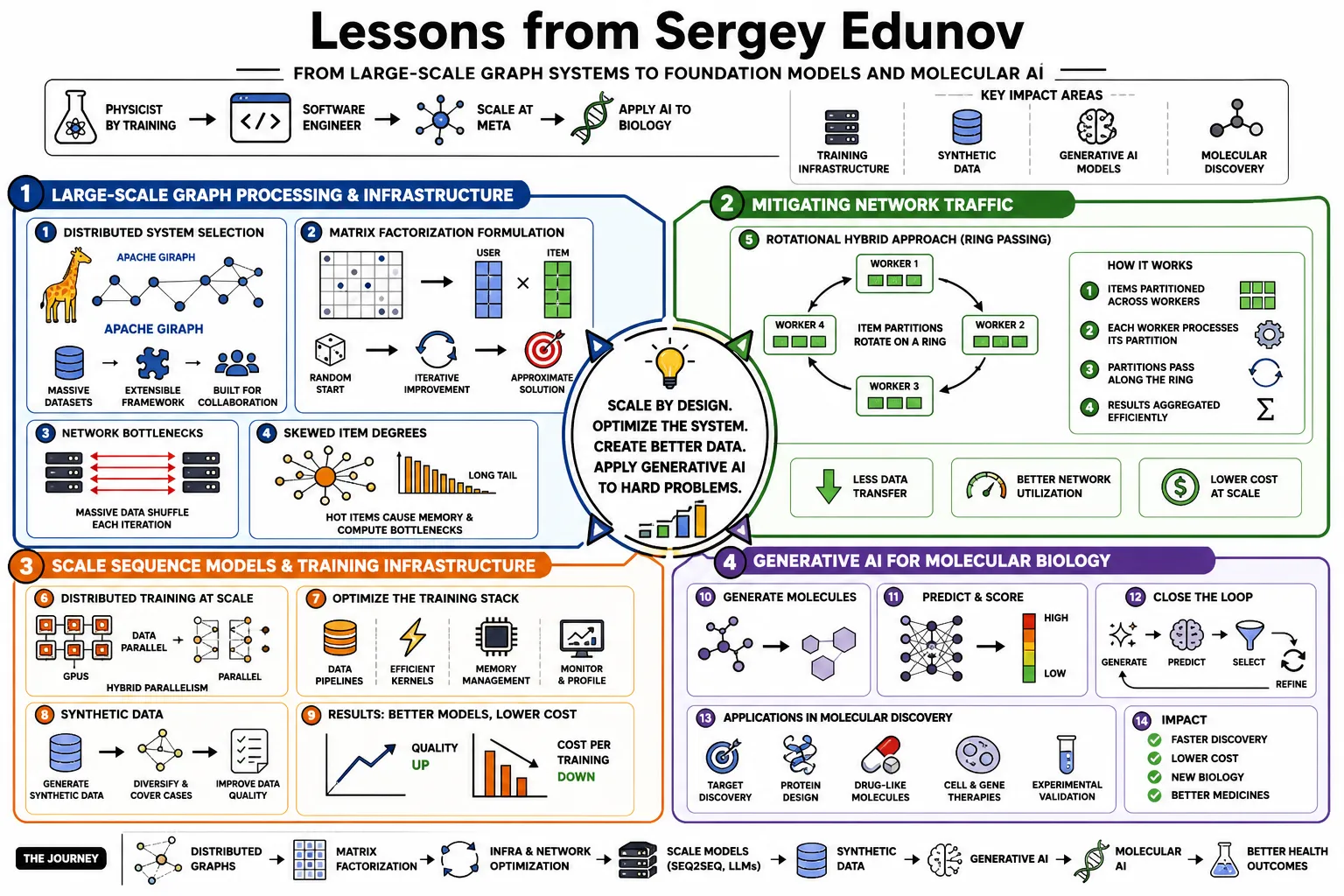
Part 1: Large-Scale Graph Processing and Infrastructure
- On Industry-Scale Graphs: In the paper on graph processing, Edunov and co-authors wrote: "Industry graphs can be two orders of magnitude larger - hundreds of billions or up to one trillion edges". — Ching, Edunov, Kabiljo, Logothetis and Muthukrishnan, “One Trillion Edges: Graph Processing at Facebook-Scale” (VLDB 2015).
Part 2: Scaling Neural Machine Translation
- On Reduced Precision: In the paper on scaling translation, Edunov and co-authors wrote: "reduced precision and large batch training can speedup training by nearly 5x on a single 8- GPU machine with careful tuning and implementation". — Ott, Edunov, Grangier and Auli, “Scaling Neural Machine Translation” (2018).
Part 3: Data Augmentation and Model Training Techniques
- On Sampling: In the paper on back-translation, Edunov and co-authors wrote: "sampling or noisy synthetic data gives a much stronger training signal than data generated by beam or greedy search". — Edunov, Ott, Auli and Grangier, “Understanding Back-Translation at Scale” (2018).
- On Effective Back-Translations: In the paper on back-translation, Edunov and co-authors wrote: "back-translations obtained via sampling or noised beam outputs are most effective". — Edunov, Ott, Auli and Grangier, “Understanding Back-Translation at Scale” (2018).
Part 4: Open Source Foundation Models
- On Architectures: In a podcast interview about AI for drug discovery, Edunov said: "I wouldn't be that surprised by the model architecture". — Sergey Edunov interview on The Cognitive Revolution, auto-generated captions.
- On No Consensus: In a podcast interview about AI for drug discovery, Edunov said: "there is no consensus whatsoever". — Sergey Edunov on The Cognitive Revolution podcast about AI for drug discovery, auto-generated captions
- On Opportunity for Innovation: In a podcast interview about AI for drug discovery, Edunov said: "the opportunity for innovation here is much much bigger". — Sergey Edunov on The Cognitive Revolution podcast about AI for drug discovery, auto-generated captions
Part 5: Physics, Machine Learning, and Molecular Biology
- On Data: In a podcast interview about AI for drug discovery, Edunov said: "AI for drug discovery is not fundamentally different from LMS". — Sergey Edunov interview on The Cognitive Revolution, auto-generated captions.
- On Selectivity: In a podcast interview about AI for drug discovery, Edunov said: "we don't only need to find the molecule that binds". — Sergey Edunov interview on The Cognitive Revolution, auto-generated captions.
- On Useful Models: In a podcast interview about AI for drug discovery, Edunov said: "it makes those models actually useful in real drug programs". — Sergey Edunov interview on The Cognitive Revolution, auto-generated captions.
- On Binders: In a podcast interview about AI for drug discovery, Edunov said: "protein binders themselves is not a therapeutic modality". — Sergey Edunov interview on The Cognitive Revolution, auto-generated captions.
- On a Long Pipeline: In a podcast interview about AI for drug discovery, Edunov said: "the whole drug discovery pipeline is very long and very complex". — Sergey Edunov interview on The Cognitive Revolution, auto-generated captions.
- On Agents: In a podcast interview about AI for drug discovery, Edunov said: "having all of this abstracted away and driven by agent is potentially a super powerful innovation". — Sergey Edunov interview on The Cognitive Revolution, auto-generated captions.
- On Not Just Binding: In a podcast interview about AI for drug discovery, Edunov said: "just finding something that binds to a target is clearly not enough". — Sergey Edunov on The Cognitive Revolution podcast about AI for drug discovery, auto-generated captions
- On Qualitative Shifts: In a podcast interview about AI for drug discovery, Edunov said: "more of a qualitative shift than quantitative shift". — Sergey Edunov on The Cognitive Revolution podcast about AI for drug discovery, auto-generated captions
- On Scaling Differently: In a podcast interview about AI for drug discovery, Edunov said: "we can't just scale the way LLMs were able to scale". — Sergey Edunov on The Cognitive Revolution podcast about AI for drug discovery, auto-generated captions
- On Inductive Biases: In a podcast interview about AI for drug discovery, Edunov said: "we need to build inductive biases into the models themselves". — Sergey Edunov on The Cognitive Revolution podcast about AI for drug discovery, auto-generated captions
- On Learning Every Tool: In a podcast interview about AI for drug discovery, Edunov said: "learning every single model and tool that is available on the market is very hard". — Sergey Edunov on The Cognitive Revolution podcast about AI for drug discovery, auto-generated captions
- On Changing Tools: In a podcast interview about AI for drug discovery, Edunov said: "those tools change all the time". — Sergey Edunov on The Cognitive Revolution podcast about AI for drug discovery, auto-generated captions
- On Starting From the Ground Up: In a podcast interview about AI for drug discovery, Edunov said: "rather than trying to rethink things from the ground up". — Sergey Edunov on The Cognitive Revolution podcast about AI for drug discovery, auto-generated captions
- On Human Taste: In a podcast interview about AI for drug discovery, Edunov said: "human taste is still very very important in this field". — Sergey Edunov on The Cognitive Revolution podcast about AI for drug discovery, auto-generated captions